What Are the Best Blinds for a Bathroom Window — Privacy and Moisture Guide

Authored By Michael Turner -30 Years Home Improvement Expertise | Updated 2026 | BlindShades.pro
Updated on July 14, 2026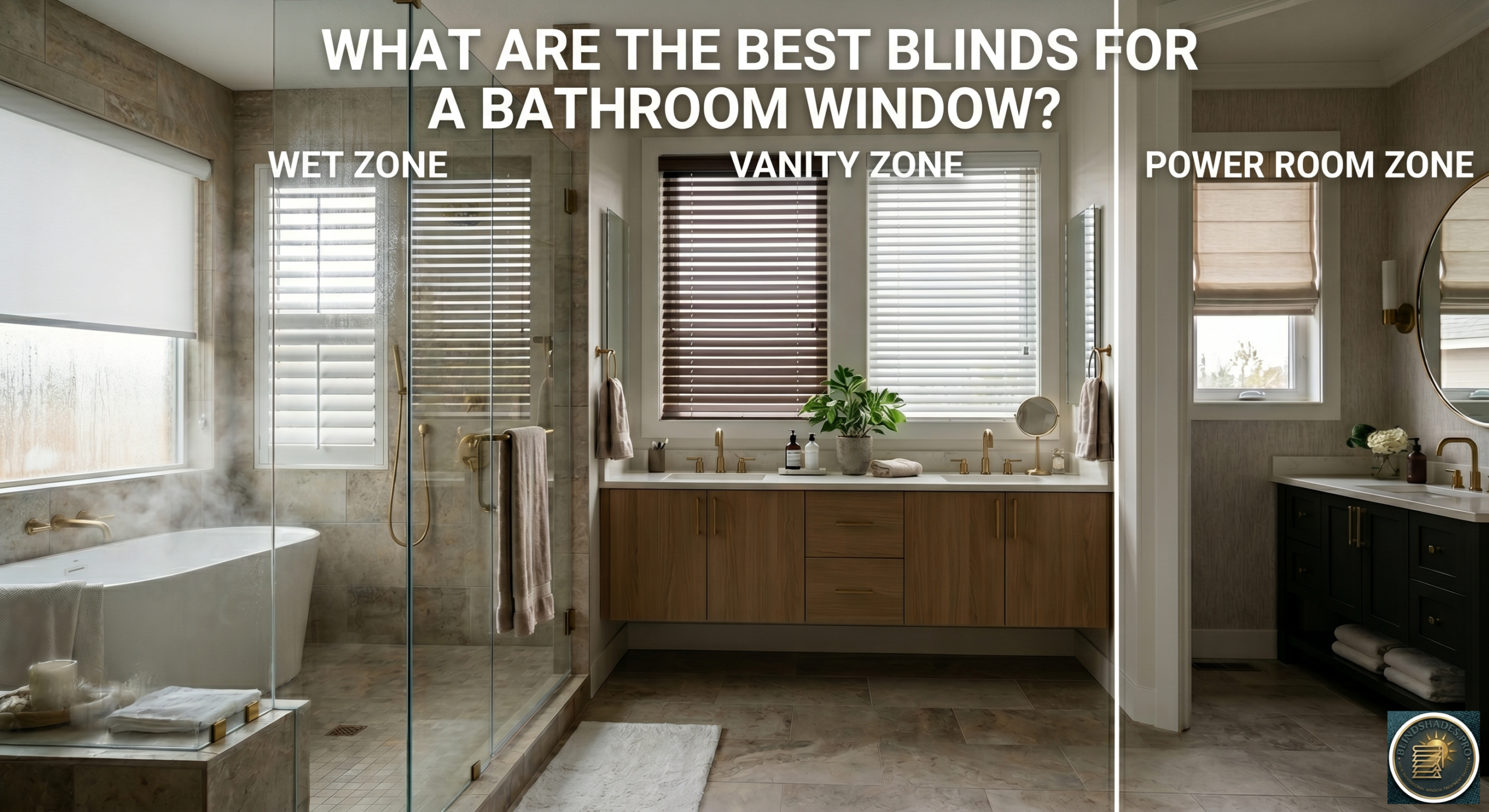
⭐ Quick Answer — What Are the Best Blinds for a Bathroom Window?
- The 3-Zone Framework: The best blinds for a bathroom window depend on location — not preference. Zone 1 (within 36 inches of shower/bath, 90–100% RH): PVC vinyl roller shade or polymer composite shutter — the only materials that tolerate direct splash. Zone 2 (vanity/sink, 70–80% RH): faux wood or aluminium Venetian. Zone 3 (powder room, 55–70% RH): moisture-treated cellular TDBU shade
- The Solar Shade Night Privacy Failure: Solar shades fail completely in any bathroom at night. During daylight, exterior light (10,000–100,000 lux) exceeds interior (300–500 lux) — solar shades appear opaque from outside. At night, bathroom interior lighting (600–1,000 lux) far exceeds street lighting (5–20 lux) — the shade becomes fully transparent and occupants are visible from outside
- Material RH Tolerance — The Decision Table: PVC/vinyl = 100% RH indefinitely ✅ · Aluminium (powder-coated) = 90%+ ✅ · Faux wood (PVC composite) = 90%+ ✅ · Moisture-treated polyester = 70–80% · Real wood = warps at 65%+ RH ❌ — unsuitable for any full bathroom
- The Slat Angle Technique for Ground-Floor Privacy: Tilt faux wood slats upward (angled toward ceiling) rather than the conventional downward. Light enters from ceiling reflection; an observer at ground level outside needs to be above the window level to see in — significantly better privacy for ground-floor and basement bathroom windows
- The Mould Species You’re Preventing: Cladosporium (most common) grows on fabric at 55%+ RH · Stachybotrys (black mould) grows on real wood after 72 hours at 90%+ RH · Aspergillus grows on treated polyester at 75%+ RH if not fully dried. PVC and aluminium provide no biological substrate — zero mould risk regardless of humidity
- Best Sources: Zone 1 PVC vinyl → Blindsgalore Vinyl Roller Shade · Zone 2 faux wood → SelectBlinds Faux Wood Blinds · Zone 3 TDBU cellular → Blindsgalore Cordless TDBU Cellular
⚠️ The Cellular Shade Condensation Trap — and the Powder Room vs Full Bathroom Specification: Cellular (honeycomb) shades are often recommended for bathrooms as insulation. In a cold climate bathroom, this can backfire: the honeycomb cells trap air between the shade fabric and the cold window glass. This trapped air cools rapidly in winter, concentrating condensation on the glass surface behind the shade where it cannot evaporate — creating a sustained wet microclimate that accelerates mould growth on the window frame and shade bottom rail. For cold-climate full bathrooms: specify PVC roller or faux wood Venetian (both allow air movement) and reserve cellular shades for Zone 3 powder rooms only. And the powder room specification is genuinely different: a toilet-and-sink-only room reaches only 55–70% peak RH (vs 90–100% in a full bathroom) — almost any moisture-resistant material works here, including treated fabric roller shades. The specification rigour of Zone 1 is not needed for a powder room. See the full 3-zone framework below.
💡 The Best Blinds for a Bathroom Window in Zone 1 — Why PVC Beats Faux Wood for Shower-Adjacent Windows: Faux wood blinds are the most commonly recommended bathroom blind — but they are not Zone 1 safe. Faux wood is PVC composite — a mixture of PVC and wood fibre or chalk filler that achieves the textured wood-grain appearance. The wood fibre content means faux wood is not 100% waterproof: it is highly moisture-resistant (tolerates 90%+ RH) but not recommended for direct splash contact. A solid PVC vinyl roller shade has zero wood or organic filler — it is entirely non-porous and can withstand direct water spray without any degradation. For a window directly beside a bathtub or inside a shower enclosure, always specify solid PVC vinyl rather than faux wood composite. For the specific best blinds for a bathroom window that is bathtub-adjacent or inside a shower, see What Are the Best Blinds for a Window Inside a Shower and Window Treatments for a Bathroom Next to a Bathtub.
📖 Read the complete guide below for: the 3-zone bathroom window location framework with radius thresholds, the full material RH tolerance table, why solar shades fail at night (lux reversal physics), the slat angle UP technique for ground-floor bathroom privacy, the three mould species (Cladosporium, Stachybotrys, Aspergillus) with specific RH triggers, the cellular shade condensation trap in cold climates, why PVC beats faux wood for Zone 1, and the complete specification table by zone.
Related guides: for the full room decision — steam zones, privacy geometry, and mounting — see the complete bathroom window blinds & shades guide.
The Three Bathroom Window Zones — The Framework Every Guide Misses
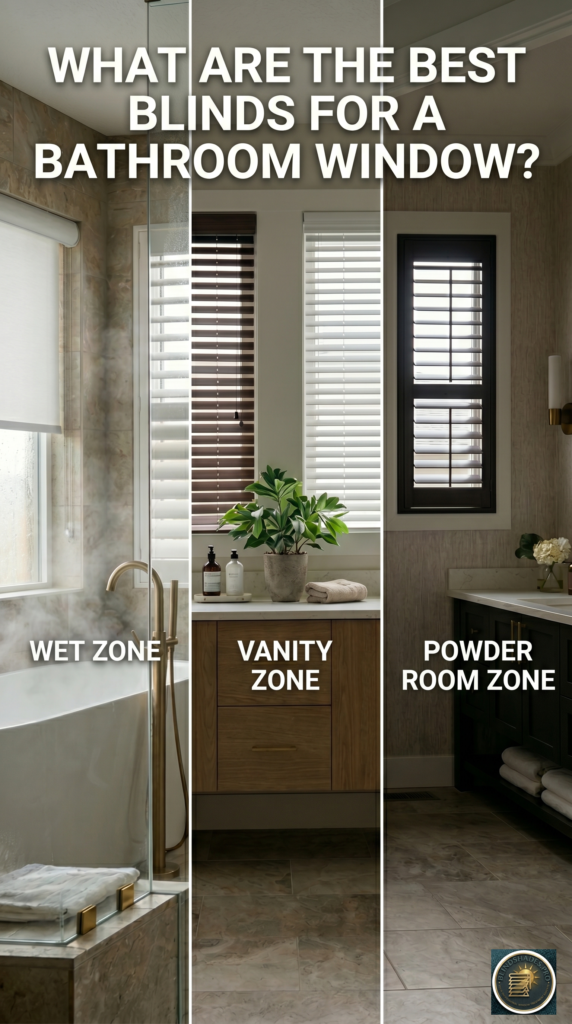
The best blinds for a bathroom window are not a single answer — they are three different answers depending on where in the bathroom the window sits. Installing the wrong specification for the zone is the most common and costly bathroom blind mistake.
Zone 1 — Shower or Bath-Adjacent (Window within 36 inches of the shower or bath): This zone experiences direct water splash, condensation dripping from the glass surface, and daily humidity spikes reaching 90–100% relative humidity (RH) during shower use. The NCBI (National Center for Biotechnology Information) research on indoor dampness and respiratory health documents that sustained humidity above 80% RH is associated with mould growth and respiratory risk. Only fully waterproof materials belong in Zone 1: PVC vinyl roller shades, polymer composite shutters, or aluminium Venetian blinds with baked-on powder coating.
Zone 2 — Vanity and Sink-Adjacent (Window above or beside the sink, 36–72 inches from water sources): This zone experiences daily steam but rarely direct water contact. Peak RH typically reaches 70–80% during shower use, dropping back to 50–60% within 20–30 minutes with adequate exhaust ventilation. The correct materials for Zone 2 are moisture-resistant faux wood blinds, aluminium mini blinds, or moisture-treated roller shades. Real wood is still not appropriate.
Zone 3 — Non-Wet Zone (Powder room, or bathroom window more than 72 inches from any water source): This zone has moderate peak RH of 55–70% and no direct moisture risk. Nearly any moisture-resistant material is appropriate here: faux wood, aluminium, moisture-treated cellular shades, or even carefully specified fabric-backed roller shades. This is also the one zone where real wood may be acceptable if the bathroom has excellent exhaust ventilation and the window is well away from the shower.
The Specific Humidity Tolerance Thresholds by Material
No competitor guide gives this data. The specification decision for the best blinds for a bathroom window should be made against these specific material thresholds.
| Material | Maximum Tolerated RH | Zone Suitability |
|---|---|---|
| PVC / solid vinyl | Indefinite at 100% | Zone 1, 2, 3 ✅ |
| Aluminium (powder-coated baked finish) | 90%+ RH | Zone 1, 2, 3 ✅ |
| Faux wood (PVC composite) | 90%+ RH | Zone 1 (limited), 2, 3 ✅ |
| OEKO-TEX moisture-treated polyester | 70–80% RH | Zone 2, 3 only |
| Cellular shade (synthetic fabric) | 65–75% RH | Zone 3 preferred |
| Real wood | 65% RH maximum | Zone 3 only (with ventilation) |
| Cotton / untreated natural fabric | Begins mildewing at 55–65% RH | Not recommended |
The practical decision rule: Zone 1 windows need 100% waterproof materials. Zone 2 needs 90%+ RH tolerance. Zone 3 can use 70%+ RH tolerance materials provided the bathroom has good exhaust ventilation.
The Best Blinds for a Bathroom Window — By Location Zone
Zone 1 Best Specification — PVC Vinyl Roller Shade
A PVC vinyl roller shade is the best blinds for a bathroom window in Zone 1 (shower or bath-adjacent). PVC stands for polyvinyl chloride — a non-porous, non-absorbent synthetic material that repels water entirely. Unlike fabric roller shades that absorb moisture, PVC roller shades can be wiped dry in seconds and are biologically inert (no organic substrate for mould to colonise).
The specific advantages over competitors in Zone 1:
- PVC roller shades have no slats, folds, or fabric crevices where moisture accumulates
- The flat smooth surface dries completely after each shower exposure
- Available in blackout PVC (100% privacy, zero light transmission when closed) or light-filtering PVC
- No mechanism corrosion risk — the rolling tube is housed above the Zone 1 moisture reach
Where to order: Blindsgalore Vinyl Roller Shade and SelectBlinds waterproof PVC roller shade both offer Zone 1-appropriate PVC construction. See the Blindsgalore bathroom window range for compatible Zone 1 specifications.
The ceramic tile interaction: PVC roller shades work with inside-mount installation in tiled bathroom windows without adhesive damage. The headrail mounts to the tile-adjacent frame (typically non-tiled surface) rather than the tile itself.
Zone 1 Alternative — Polymer Composite Shutters
Polymer composite shutters (also called PVC shutters or solid vinyl plantation shutters) are the premium Zone 1 specification. They are solid-injection-moulded PVC throughout — no wood core, no fabric lining, no organic component. The louvres (slats) tilt for precise light and privacy control; the solid frame is watertight and mould-proof.
The specific Zone 1 advantage of shutters over roller shades: Shutters do not contact the window glass when opened — the louvres remain in the frame. This means the shutter surface never traps condensation against the glass (a problem with close-fitting roller shades in cold climates, discussed further below). The open louvre allows air circulation between the shutter and the glass, drying both surfaces faster after shower steam.
Limitation: Polymer shutters require at least 3.5–4 inches of window recess depth for inside-mount installation. For shallow bathroom windows — outside-mount polymer shutters are the alternative.
Zone 2 Best Specification — Faux Wood Blinds
Faux wood blinds are the best-value Zone 2 specification. Faux wood is manufactured from PVC composite or recycled polymer materials formed and textured to resemble natural timber grain. They tolerate 90%+ RH sustained exposure without warping, cracking, or swelling — the key failure modes of real wood in bathrooms.
The slat angle technique no guide explains: Faux wood blinds in a bathroom have adjustable slats. Most homeowners tilt slats downward (angled toward the floor from the inside). This allows light in from above but creates a direct sightline for anyone at street level looking slightly upward.
For ground-floor bathrooms or basement-level windows — tilt slats upward (angled toward the ceiling from the inside). Light enters by reflecting off the ceiling rather than directly through the open slat angle. An observer outside at ground level would need to be above the window (looking down) to see in — which is rarely possible from a standard standing position on a pavement or path. This upward tilt provides meaningfully better privacy on ground-floor bathroom windows without blocking any additional natural light.
For the full comparison of moisture materials including cellular shades, see What Is the Best Window Treatment for a Bathroom Next to a Bathtub, which covers the Zone 1 proximity-to-water specification in detail.
Faux wood cleaning: Wipe with a damp cloth. Never submerge or soak — even faux wood slat mechanisms can collect moisture in pivot points over time. See Do Bathroom Blinds Get Moldy — How to Prevent Mold on Bathroom Blinds for the complete bathroom blind maintenance schedule.
Zone 2 Alternative — Aluminium Venetian Blinds
Aluminium Venetian blinds are the budget-first Zone 2 alternative. They are made from lightweight aluminium with a baked-on powder coating that resists rust, corrosion, and humidity damage.
The specific aluminium advantage: The baked enamel coating on quality aluminium slats does not rust or corrode even with daily 90%+ RH exposure. Budget aluminium blinds with spray-painted (not baked) finishes can develop rust spots after 12–18 months in a bathroom.
How to verify: When ordering aluminium blinds for a bathroom, confirm the finish is “powder-coated” or “baked enamel” — not “spray-painted” or “painted.” The coating method is the durability differentiator.
Zone 3 Best Specification — Moisture-Treated Cellular Shade (TDBU)
For a powder room or low-moisture Zone 3 bathroom window, a moisture-treated cellular shade with top-down bottom-up (TDBU) configuration provides the best combination of privacy, natural light, and thermal insulation.
The TDBU configuration is particularly valuable in a bathroom context — lowering the top of the shade lets natural light in from above while keeping the bottom portion closed for sightline-level privacy. For a full explanation of TDBU mechanics and configuration, see What Are Top-Down Bottom-Up Shades — Are They Good for a Bathroom.
The condensation trap warning: Cellular shades should NOT be specified for Zone 1 or cold-climate Zone 2 bathroom windows where the shade would be installed close to cold glass. The honeycomb cells trap air between the shade fabric and the cold window glass — in cold weather this trapped pocket cools rapidly, concentrating condensation on the window glass behind the cellular shade where it cannot evaporate. This creates a sustained wet microclimate between the shade and glass that accelerates mould growth on both the window frame and the shade bottom rail. For cold climates — specify a roller shade or Venetian blind in Zone 2 and reserve cellular shades for Zone 3 only.
The Solar Shade Mistake — Why the Physics Fails at Night
Solar shades are one of the most commonly installed bathroom window treatments — and one of the most commonly regretted. Understanding why requires understanding the physics of one-way vision.
How solar shade one-way vision works: Solar shade privacy relies on the luminance differential between interior and exterior environments. When exterior light levels significantly exceed interior levels (as during daylight hours), an observer outside looking through the solar shade sees a bright exterior behind the shade fabric — the interior occupant is not visible. The interior occupant looking out sees through the semi-transparent fabric to the brighter exterior.
Why it fails at night: A standard bathroom interior with ceiling lights on generates approximately 600–1,000 lux. A street lamp outside generates approximately 5–20 lux. At night, the interior is 30–200 times brighter than the exterior. The luminance differential reverses completely — the interior occupant is fully visible from outside, and the observer sees only the bright interior against a dark exterior background. A solar shade that provided adequate privacy at 10am provides zero privacy at 9pm with bathroom lights on.
If you are considering solar shades for your bathroom, see Can Solar Shades Be Used in a Bathroom — The Night Privacy Problem for the complete specification guide including the layering solutions that address the night privacy failure.
The Mould Species Your Bathroom Blinds Face
The NCBI documents indoor dampness and mould as a respiratory health risk. Three specific mould species are the primary bathroom blind threats:
Cladosporium: The most common bathroom blind mould. Grows on fabric, paper, and organic materials at sustained RH above 55%. Appears as dark olive-green to black spots on blind fabric. Prevented entirely by PVC, vinyl, and aluminium surfaces. If your current fabric bathroom blind has dark spots — this is almost certainly Cladosporium.
Stachybotrys (black mould): Grows on cellulose-containing materials (real wood, cotton, untreated natural fabric) after 72 hours of sustained moisture above 90% RH. Produces mycotoxins associated with respiratory symptoms. The primary reason real wood blinds are completely unsuitable for full bathrooms.
Aspergillus: Grows on synthetic fabrics with moisture treatment coatings at sustained RH above 75% when not fully dried between exposures. Appears as white, yellow, or greenish colonies. Prevented by PVC (no coating to colonise) and by adequate exhaust ventilation that allows treated polyester to dry fully between shower uses.
The prevention specification: For Zone 1 and Zone 2 windows — specify PVC vinyl or aluminium (both biologically inert surfaces that provide no substrate for any of these species). For Zone 3 treated polyester cellular shades — run the exhaust fan for 20–30 minutes after every shower to allow the fabric to return to below 65% RH before the next exposure.
The Real Wood Question — When Is It Acceptable?
Real wood blinds are not suitable for any bathroom window that is regularly exposed to shower or bath steam. Real wood (timber) is a hygroscopic material — it absorbs water molecules from the air, swelling along the grain and causing the slats to warp, crack, or seize in their pivot mechanisms. This begins at sustained RH above 65%.
The one acceptable scenario: Real wood blinds may be specified for a Zone 3 powder room window (toilet and sink only, no shower) if the following conditions are all met:
- The window is more than 72 inches from any water fixture
- The powder room has an exhaust fan operated after every use
- The blinds are treated with a protective sealant at installation
- The powder room is in a temperate climate (not extreme cold or heat)
For every other bathroom scenario — specify faux wood, aluminium, or PVC instead. See Can You Use Real Wood Blinds in a Bathroom — What Happens and What to Use Instead for the full real wood damage timeline and repair costs.
The Complete Bathroom Window Blind Specification Guide
| Window Zone | Best Material | Second Choice | Avoid |
|---|---|---|---|
| Zone 1 (shower/bath-adjacent) | PVC vinyl roller shade | Polymer composite shutters | All fabric, real wood, faux wood |
| Zone 2 (vanity, moderate steam) | Faux wood Venetian | Aluminium Venetian | Real wood, untreated fabric |
| Zone 3 (powder room / dry zone) | TDBU cellular (moisture-treated) | Faux wood or aluminium | Real wood (with exceptions) |
| Any zone | Never: Solar shades | Never: Real wood in Zone 1/2 | Never: Untreated cotton/linen |
Where to Order — Bathroom Window Blind Specifications
For Zone 1 PVC vinyl roller shades: Blindsgalore Vinyl Roller Shade — fully waterproof PVC fabric, inside or outside mount, blackout or light-filtering. Available in custom widths for non-standard bathroom windows. See the full Blindsgalore bathroom window range and the Blinds.com shower and tub window guide for compatible Zone 1 products.
For Zone 2 faux wood Venetian blinds: Blindsgalore Faux Wood Blinds — PVC composite, baked finish, multiple slat widths (1-inch, 2-inch, 2.5-inch). SelectBlinds Premium Faux Wood Blind — routeless option for enhanced privacy (no cord holes in slats).
For Zone 3 TDBU cellular shades: Blindsgalore Cordless TDBU Cellular Shade — moisture-treated polyester, available in over a dozen colours. SelectBlinds Cordless Cellular TDBU — single and double-cell options for Zone 3 bathroom thermal insulation.
Frequently Asked Questions
What are the best blinds for a bathroom window? The best blinds for a bathroom window depend on the window’s location within the bathroom. For windows directly beside or above a shower or bath, PVC vinyl roller shades or polymer composite shutters are the correct specification — both are fully waterproof and tolerate 100% relative humidity without warping, corroding, or growing mould. For vanity windows with moderate steam exposure, faux wood PVC composite blinds or aluminium Venetian blinds are the correct specification. For powder rooms with no shower or bath, moisture-treated cellular shades with top-down bottom-up configuration provide the best privacy, light, and thermal performance.
Can you use fabric blinds in a bathroom? Only in dry zones (powder rooms and low-moisture areas) using fabrics specifically treated for moisture resistance. Standard fabric blinds in a full bathroom with a shower begin growing Cladosporium mould at sustained relative humidity above 55%, which a shower bathroom reaches daily. PVC vinyl roller shades or faux wood blinds are the correct specification for any bathroom with a shower. If fabric aesthetics are important — specify a moisture-treated polyester roller shade in Zone 3 only, run the exhaust fan for 20 minutes after every shower, and replace every 3–5 years.
Are solar shades appropriate for bathroom windows? Solar shades provide adequate privacy during daylight hours but fail completely at night. The one-way vision of solar shades depends on exterior light being brighter than interior light. At night, bathroom interior lighting of 600 to 1,000 lux far exceeds exterior street lighting of 5 to 20 lux — the luminance differential reverses and the interior occupant is fully visible from outside. Solar shades are not recommended for bathroom windows unless layered with a secondary opaque blind for nighttime use.
What is the difference between Zone 1 and Zone 2 bathroom windows? Zone 1 bathroom windows are within 36 inches of a shower or bath and are exposed to direct water splash, condensation dripping from glass, and daily humidity spikes of 90 to 100% relative humidity. Zone 2 windows are 36 to 72 inches from water sources and experience steam but rarely direct contact. Zone 1 requires fully waterproof PVC or polymer composite materials. Zone 2 can use faux wood or aluminium that tolerates 90% relative humidity but is not fully waterproof. Zone 3 includes powder rooms and dry-zone bathroom windows at 55 to 70% peak relative humidity where almost any moisture-resistant material is appropriate.
How do I stop bathroom blinds from getting mouldy? Specify non-organic materials: PVC vinyl and aluminium provide no biological substrate for Cladosporium, Stachybotrys, or Aspergillus to colonise. For Zone 2 faux wood blinds — wipe dry with a cloth after steamy showers and run the exhaust fan for 20 to 30 minutes after every shower to allow ambient humidity to drop below 65% before the blind surface fully cools. Never install cellular shades or fabric shades in Zone 1 or Zone 2 without adequate ventilation. See the full mould prevention guide at Do Bathroom Blinds Get Moldy — How to Prevent Mold on Bathroom Blinds.
Contextual Internal Links — Used in Article Body
| Anchor Text | Links To | Location in Article |
|---|---|---|
| What Is the Best Window Treatment for a Bathroom Next to a Bathtub | /guide/window-treatments-bathroom-bathtub/ | Zone 1 faux wood section |
| Do Bathroom Blinds Get Moldy — How to Prevent Mold | /guide/bathroom-blinds-mold-prevention/ | Faux wood cleaning section + FAQ |
| What Are Top-Down Bottom-Up Shades — Are They Good for a Bathroom | /guide/top-down-bottom-up-shades-bathroom/ | Zone 3 TDBU section |
| Can Solar Shades Be Used in a Bathroom — The Night Privacy Problem | /guide/solar-shades-bathroom-privacy/ | Solar shade section |
| Can You Use Real Wood Blinds in a Bathroom | /guide/real-wood-blinds-bathroom/ | Real wood section |
Related Guides on BlindShades.pro
- The Best Bathroom Window Blinds & Shades Buying Guide — the complete bathroom specification guide
- How Do I Get Privacy in a Bathroom Without Losing Natural Light — TDBU, slat angle, and layering for privacy + daylight
- Can Solar Shades Be Used in a Bathroom — The Night Privacy Problem — the full night privacy physics guide
- What Are the Best Blinds for a Window Inside a Shower — Zone 1 deep specification including IP ratings
- Do Bathroom Blinds Get Moldy — How to Prevent Mold on Bathroom Blinds — mould species, material thresholds, and prevention protocol
By Michael Turner | 30 Years Home Improvement Expertise | Updated 2026 | BlindShades.pro
