Can You Use Roman Shades in a Kitchen?

Authored By Michael Turner -30 Years Home Improvement Expertise | Updated 2026 | BlindShades.pro
Updated on July 16, 2026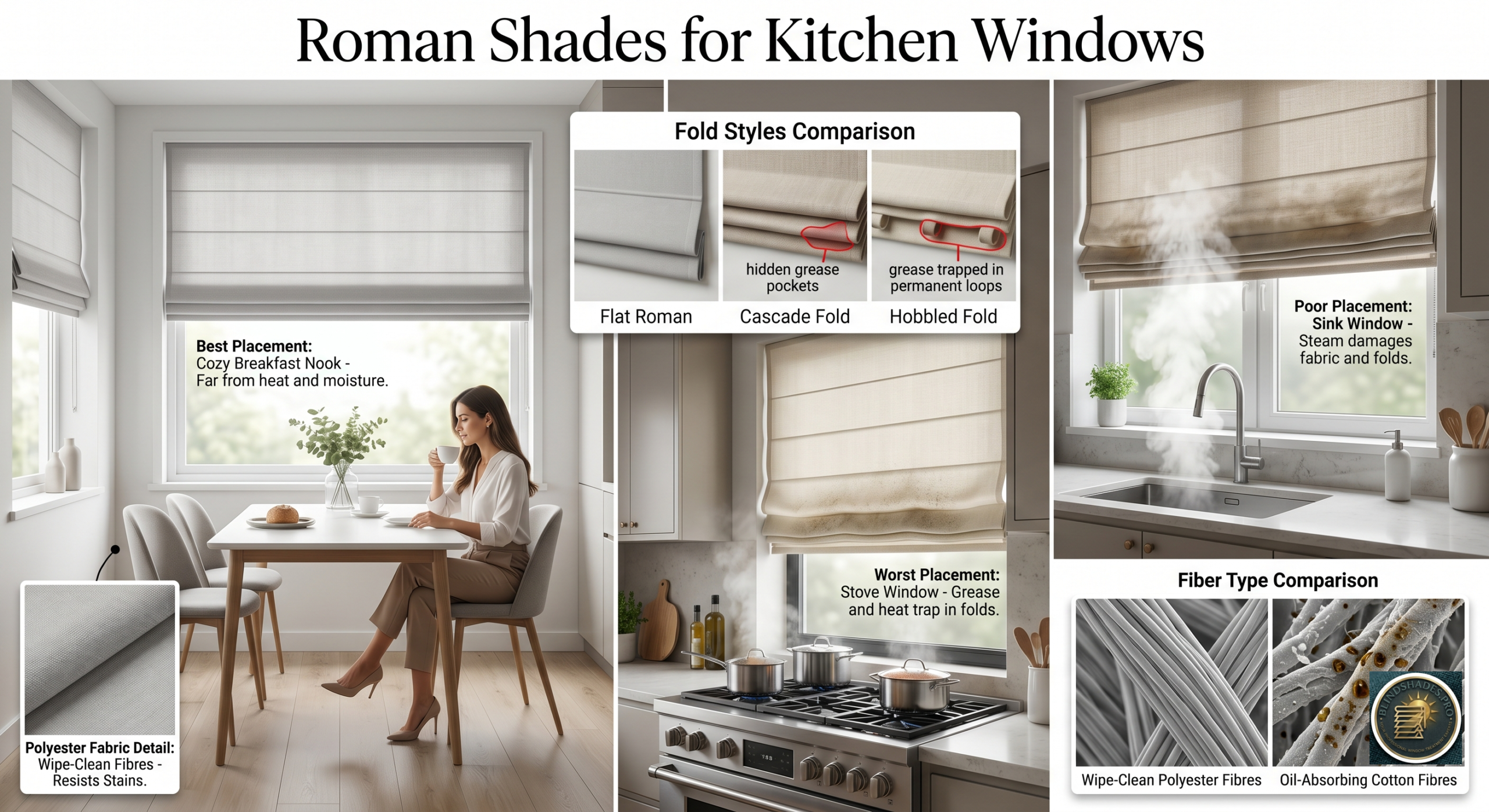
⭐ Quick Answer — Can You Use Roman Shades in a Kitchen?
- Zone K3 Only — 90cm From Both Sink and Stove: Roman shades for kitchen windows are appropriate in one specific zone: a breakfast nook, eating area, or any window more than 90cm from both the sink and the stove. Not appropriate for sink windows (steam concentrates into the hanging bottom fold during hot water use) or stove windows (the raised fold-stack piles horizontal fabric layers directly into the thermal zone above the hob)
- The Fold Style Is the Most Important Decision: Flat Roman shade: fabric hangs as a single panel when lowered — grease deposits on the front surface only, accessible for wiping. Cascade/soft fold: grease deposits on the visible front ridge AND collects in the hidden fold valley behind each ridge — the shade looks clean while grease accumulates invisibly. Hobbled/teardrop: permanent visible loops trap grease in multiple collection points inside every loop — the worst possible kitchen specification. For any kitchen zone: flat fold only
- The Odour Timeline Nobody Tells You: Months 1–4: minimal odour, fabric not yet greasy. Months 3–6: grease film forms; cooking odour molecules begin bonding to the film — faint residual smell after cooking. Months 6–12: persistent cooking smell even when kitchen has been aired for hours; occupants habituate, visitors notice. Year 1–2 for cotton: absorbed oil cannot be removed by any surface cleaning — replacement required. For polyester: surface deposits remain removable with dish soap throughout
- Cotton Absorbs Odour Permanently — Polyester Does Not: Cotton fibres are hollow porous tubes — cooking oils enter the fibre interior and cannot be extracted by surface cleaning. Polyester fibres are solid non-porous extruded filaments — oils deposit on the outer surface only and remain removable with dish soap. For any roman shades for kitchen use: specify 100% polyester or high-percentage polyester blend. Avoid cotton, linen, silk, or velvet regardless of treatment or lining
- The Practical Wipe-Test Before Buying: Apply a small amount of vegetable oil to a fabric swatch. Apply dish soap with warm water and gently work. After rinsing and drying: if fabric appears clean — appropriate for kitchen use. If grease mark remains or fabric changed colour — not appropriate regardless of the product description. This single test predicts long-term kitchen performance better than any specification claim
- Best Sources: Motorized flat polyester Roman → SmartWings kitchen Roman shade guide · Flat polyester cordless → Blindsgalore kitchen Roman shades · General kitchen Roman guidance → The Shade Home kitchen Roman shades
⚠️ The Lining Specification and the Ring-and-Cord Grease Problem: For roman shades for kitchen Zone K3 windows, two specification details no guide covers. First: specify lined Roman shades — not unlined. An unlined Roman shade exposes both the face fabric AND the back of the fabric to kitchen air, doubling the grease deposition surface area and exposing the back face to condensation from cold window glass in winter. A lined shade (interlining or blackout backing) protects the back face and concentrates grease deposits to the front face only. Second: the ring-and-cord operating system on the back of the shade accumulates cooking grease over time. The plastic or brass rings and lift cords become progressively sticky after 12–18 months in an active cooking kitchen, making the shade increasingly stiff and difficult to raise or lower. Motorized Roman shades eliminate manual cord handling and significantly extend the period before cord stickiness becomes a functional problem. For a kitchen eating area where the aesthetic of Roman shades is the priority: specify motorized + flat fold + polyester + lined. See What Are the Best Blinds for Kitchen Windows for the full zone comparison. See the full fold style guide below.
💡 When to Raise Your Roman Shade During Cooking — and the Steam Bottom-Fold Problem: For roman shades for kitchen Zone K3 windows, always raise the shade fully before cooking begins — not after. Steam, grease particles, and cooking vapour are generated from the moment the hob is lit or the oven is preheated. A Roman shade lowered during cooking accumulates a full cooking session of grease and steam exposure on the fabric face. Raising the shade before cooking begins eliminates this accumulation entirely. And if a Zone K3 Roman shade is positioned near enough to the sink that the bottom rail hangs above the sink basin — specify the bottom rail to hang at least 30cm above the sink rim when the shade is fully lowered. Steam rising from hot water in the basin concentrates at the hanging bottom fold and is the highest moisture exposure point on a flat Roman shade in a kitchen. Specifying 30cm clearance keeps the bottom fabric out of the direct upwelling steam zone. For the complete zone-by-zone kitchen blind specification including Zone K1 sink and Zone K2 stove guidance, see What Are the Best Blinds for Kitchen Windows. See the full cleaning protocol below.
📖 Read the complete guide below for: the kitchen zone assessment for Roman shades (Zone K1 and K2 not appropriate, Zone K3 appropriate), the full fold style guide (flat vs cascade vs hobbled with grease collection mechanism for each), the 12-month odour absorption timeline for cotton vs polyester, the cotton hollow porous fibre vs polyester solid non-porous filament mechanism, why lined specification protects the back face from double-sided grease exposure, the ring-and-cord grease buildup and 12–18 month cord stickiness timeline, the practical wipe-test for evaluating fabric suitability, and the full cleaning protocol (daily raise during cooking, weekly vacuum, monthly spot-clean, 6–12 monthly professional).
Roman Shades for Kitchen Windows – Where They Work and Where They Fail
Definition: A Roman shade is a fabric window covering that folds into horizontal pleats when raised and lowers as a flat or softly folded fabric panel. Unlike roller shades, the fabric does not roll onto a tube – it folds up in stacked horizontal sections controlled by a ring-and-cord mechanism.
Roman shades are among the most aesthetically appealing window treatments available. They are also among the most specification-sensitive window treatments for kitchen use. The same properties that make them beautiful – soft fabric folds, natural weave textures, layered visual depth – are the same properties that create challenges in a cooking environment.
The honest assessment: Yes in certain locations. No near sink or stove. The location is the primary decision – the fabric choice is secondary.
Related guides: where fabric is safe (and where it is banned) is settled zone by zone in the kitchen blinds & shades buying guide.
The Kitchen Zone Assessment for Roman Shades
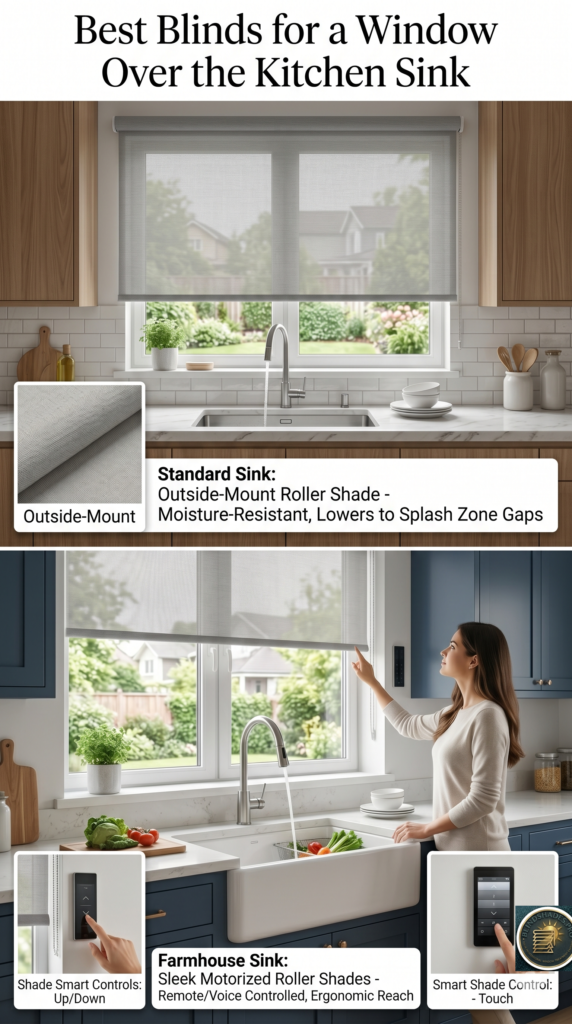
Zone K1 (above sink) – NOT appropriate: The window above a kitchen sink receives direct steam upwelling from hot water use. A Roman shade lowered to counter height with its bottom fabric fold hanging above the sink creates a fabric surface directly in the path of steam rising from the basin. The bottom fold of the shade becomes the condensation collection point – repeatedly wetted and dried as hot water is used throughout the day. Combined with cooking grease from the kitchen air, this creates a concentrated wet-grease environment at the bottom of the shade. For sink windows: specify PVC vinyl roller or aluminium Venetian as covered in What Are the Best Blinds for a Window Over the Kitchen Sink.
Zone K2 (near stove) – NOT appropriate: Two specific stove-related risks make Roman shades inappropriate within 90 cm of a cooking hob.
First, the fabric proximity fire risk common to all fabric window treatments near a heat source.
Second, and specific to Roman shades: the fold-stack fire risk. When a Roman shade is raised at a stove window, the fabric does not roll onto a tube (as a roller shade does) – it folds and stacks in horizontal layers at the top of the window. This folded fabric stack is directly below the stove hood or above-range cabinetry, in the hottest thermal zone of the cooking area. The accumulated fold layers of raised Roman shade fabric above a stove represent a greater fire risk geometry than any other blind style.
Zone K3 (breakfast nook, eating area, window away from cooking zone) – APPROPRIATE: A window positioned more than 90 cm from both the sink and stove receives ambient cooking steam and some airborne grease particles but no direct water contact or concentrated heat. This is the appropriate zone for Roman shades for kitchen windows. The aesthetic warmth of fabric folds is most relevant in an eating area rather than a functional cooking zone.
Zone K4 (large picture window, window above island) – CONDITIONAL: A kitchen picture window away from the cooking zone is appropriate for Roman shades if the window does not receive concentrated cooking steam. Kitchen islands produce cooking steam that rises to the ceiling and disperses horizontally – a window above an island with overhead cooking receives concentrated steam from below. For a kitchen island without a gas hob or wok burner, a Roman shade above the island is acceptable.
The Fold Style Guide – The Most Important Kitchen Roman Shade Decision
This is the specific technical insight that determines whether a Roman shade is manageable in a kitchen long-term – and it is absent from all competitor guides.
Definition: Roman shade fold style refers to the specific geometry of how the shade fabric hangs when the shade is in the lowered position.
Flat Roman Shade (Best for Kitchen Zone K3)
Mechanism: When lowered, the fabric hangs as a single flat panel. When raised, the fabric folds in neat horizontal pleats stacked above the mounting rail.
Grease collection geometry: Grease deposits on the flat front surface of the fabric. There are no fold pockets or valleys – the grease is exposed on a single accessible surface. Wipe cleaning with a damp cloth reaches the entire deposit.
Why flat is the best kitchen fold style:
- Grease visible on inspection – no hidden accumulation
- Single-surface cleaning – one wipe covers the deposit
- When raised, folds stack tidily with minimum surface area exposed to kitchen air
- Easiest to spot-clean and maintain appearance over time
Cascade or Soft Fold Roman (Acceptable for Zone K3 With Caveat)
Mechanism: The shade fabric forms soft horizontal curves when lowered – each fold creates a visible ridge at the front with a valley fold behind it.
Grease collection geometry: Grease deposits on the front ridge (visible and cleanable) AND in the valley behind the ridge (hidden, accessible only by opening the fold). The valley accumulation is invisible from the front face of the shade – a cascade Roman shade can appear clean on inspection while having significant grease buildup in the hidden fold valleys.
The specific problem: After 3-6 months in an active kitchen Zone K3, the fold valleys accumulate a grease layer that cannot be reached by wiping the visible front surface. The shade looks clean but the hidden valleys have developed a grease-dust matrix that promotes mould and odour retention. Professional cleaning is required more frequently than for a flat Roman shade.
Hobbled or Teardrop Roman (Not Appropriate for Any Kitchen Zone)
Mechanism: The shade fabric has permanent cascading loops visible even when fully lowered. The loops are the defining aesthetic of this style.
Grease collection geometry: Each permanent loop creates multiple grease collection surfaces: the outer face of the loop, the inner concave surface of the loop, and the fold points at the top and bottom of each loop. In a kitchen environment, every loop becomes a grease-accumulation structure within weeks of installation. The surface area available for grease deposition in a hobbled Roman shade is many times greater than a flat Roman shade of the same window width.
The verdict: Hobbled and teardrop Roman shades are not appropriate for any kitchen zone, including Zone K3 eating areas. The permanent loop geometry collects grease faster than any other fabric window treatment style.
The Odour Absorption Timeline – What to Expect Over 12-24 Months
This timeline is completely absent from all competitor guides, yet it is the single most important factor for long-term kitchen Roman shade satisfaction.
Month 1-4: New polyester or poly-blend Roman shade in Zone K3. Cooking odours are minimal – the fabric has not yet developed a grease film significant enough to bond odour molecules. Regular vacuuming with a brush attachment keeps the surface dust-free.
Month 3-6: A light grease film begins to develop on the front face of the fabric from airborne cooking particles. Cooking odours (aldehydes, ketones, and volatile fatty acids from heating oils and proteins) begin to bond to this grease film. The shade may have a faint residual cooking smell hours after cooking.
Month 6-12: The established grease film on polyester fabric bonds odour molecules persistently. The shade smells of cooking even when the kitchen has been aired for several hours. The occupants of the home begin to habituate to the smell. Visitors are more likely to notice the cooking odour from the shade.
Year 1-2 for cotton Roman shades: Cotton fibres absorb oils into the hollow fibre interior. Surface cleaning removes the outer grease layer but not the oil absorbed into the fibre structure. The shade develops a persistent cooking smell that cannot be fully removed by any surface cleaning method. Professional cleaning reduces the smell temporarily but the absorbed oil in the cotton fibre cannot be extracted without fibre damage. At year 2, a cotton Roman shade in an active kitchen cooking zone typically requires replacement.
Year 1-2 for polyester Roman shades: Polyester fibres are solid extruded filaments – oil deposits on the smooth outer surface but cannot penetrate the non-porous fibre interior. Surface grease deposits are removable with dish soap and warm water. A well-maintained polyester Roman shade in Zone K3 retains its appearance and minimises odour retention for significantly longer than cotton.
Cotton vs Polyester – The Fibre Mechanism That Determines Kitchen Performance
Definition: Fibre porosity is the degree to which a fabric fibre absorbs liquids and gases into the fibre interior rather than retaining them on the surface only.
All guides say “polyester is better than cotton for kitchens.” None explain why. This explanation determines whether a buyer understands how serious the material choice is.
Cotton fibre structure: Cotton fibres are natural cellulosic tubes – hollow, porous, and hygroscopic. The hollow core of a cotton fibre means that liquid oil and volatile odour molecules can enter the fibre interior through the porous cell wall. Once inside the fibre, oil and odour are bound in the fibre structure and cannot be removed by surface cleaning. Dish soap applied to a cotton Roman shade removes the oil on the fibre surface but not the oil inside the fibre. This is why a cotton Roman shade in an active kitchen gradually develops a persistent cooking smell that surface cleaning cannot eliminate.
Polyester fibre structure: Polyester fibres are extruded from molten PET polymer and are solid, non-porous filaments. The outer surface of a polyester fibre is smooth and non-porous – oil and odour molecules cannot enter the fibre interior. Cooking grease deposits on the fibre surface and remains removable by surface cleaning. This is why polyester Roman shades remain cleanable in kitchen conditions where cotton would have absorbed permanent odour.
The practical wipe-test before purchasing: For any Roman shade being considered for a kitchen Zone K3 window – apply a small amount of vegetable oil (simulating cooking grease) to a fabric swatch or test area. Apply dish soap with warm water and gently work the fabric. After rinsing and drying: if the fabric appears clean with no oil residue – the material is appropriate. If the fabric still shows a grease mark or has changed colour – the material is not appropriate for kitchen use regardless of what the product description states.
The Lining Specification for Kitchen Roman Shades
Unlined Roman shade: The face fabric is exposed on both sides – the front face (toward the room) and the back face (toward the window). In a kitchen, the back face of an unlined Roman shade is exposed to condensation forming on cold window glass in winter and to ambient cooking air circulation behind the shade. Grease deposits accumulate on both faces of an unlined shade, doubling the cleaning surface area.
Lined Roman shade: An interlining or blackout backing is sewn behind the face fabric. The lining layer protects the back face of the face fabric from direct condensation contact and reduces the double-sided grease exposure. The lining also adds thermal mass to the shade, slightly improving insulation, and adds weight to the bottom rail, which can improve the drape of the flat Roman fold.
Recommendation for kitchen Zone K3: Specify lined Roman shades – at minimum a light interlining, preferably a blackout lining. The back protection is worth the additional cost in a kitchen environment.
The Ring-and-Cord Mechanism – The Cleaning Challenge Nobody Mentions
Roman shades operate via a system of plastic or brass rings sewn to the back face of the fabric at horizontal intervals, with lift cords threaded through the rings from the bottom rail to the headrail. This mechanism is entirely on the back face of the shade and is not visible from the front.
The kitchen-specific problem: In a kitchen environment, cooking grease deposits on every surface including the back of the shade and the ring-and-cord system. The lift cords become progressively sticky as grease accumulates. After 12-18 months in an active kitchen, the cords on a manually operated Roman shade in Zone K3 become difficult to slide through the rings – the shade operation becomes stiff and requires more force to raise or lower.
The solution: Motorized Roman shades have lift cords that are not manually handled – the motor pulls the cords automatically without the operator touching them. This significantly extends the period before cord stickiness becomes a functional issue. For kitchen Zone K3 Roman shades: motorized specification is strongly preferred over manual cord operation, particularly in active cooking households.
The Kitchen Roman Shade Cleaning Protocol
Daily: Raise the shade fully when cooking to keep it out of the direct steam and grease zone during meal preparation.
Weekly: Vacuum the front face gently with a brush attachment on low suction to remove loose dust before it combines with grease particles to form the sticky grease-dust matrix.
Monthly: Spot-clean any visible grease deposits with warm water and dish soap on a microfibre cloth – blot, do not rub. Rubbing spreads the grease deposit and damages the weave structure.
Every 6-12 months: Professional cleaning for cotton or linen Roman shades. Self-washing (if the manufacturer allows) for polyester shades – confirm the shade can be removed from its mounting rings and washed without damaging the cord mechanism before attempting.
Where to Order – Kitchen Roman Shade Specification
For Zone K3 kitchen Roman shades (flat fold, polyester, lined, motorized): SmartWings motorized flat Roman shade in polyester fabric – see smartwingshome.com/blogs/smart-home/best-roman-shades-for-kitchen-windows for the kitchen-appropriate range with Alexa and Google Home integration.
For Zone K3 kitchen Roman shades (flat fold, polyester, lined, cordless): Blindsgalore flat Roman shade – see the Blindsgalore kitchen Roman shade guide for the flat fold polyester range with cordless options. Specify lined construction.
For a general Zone K3 kitchen Roman shade reference: The Shade Home kitchen Roman shade guide at theshadehome.com provides additional style guidance for eating area applications.
Related guides: For complete buying advice, see our kitchen window blinds buying guide, Roman shades buying guide, and Roman and roll-up curtains guide.
Related guides: if the kitchen look you want is natural weave over the sink, choose the material with the complete guide to woven wood and bamboo shades.
Frequently Asked Questions
Can you use Roman shades in a kitchen? Roman shades for kitchen windows can be used in a breakfast nook, eating area, or any window more than 90 centimetres from both the sink and stove. They are not appropriate for sink windows because steam from hot water concentrates into the bottom fabric fold, and not appropriate for stove-adjacent windows because the fold stack when raised creates horizontal fabric layers in the thermal zone above the heat source. For appropriate kitchen zones, specify flat fold style in 100 percent polyester or polyester-blend fabric, with lining and cordless or motorized operation.
Which Roman shade fold style is best for a kitchen? Flat Roman shades are the best fold style for kitchen use because the fabric hangs as a single flat panel when lowered, with grease depositing on one accessible front surface only. Cascade or soft fold Roman shades create hidden grease accumulation points in the fold valleys behind each ridge – the shade can appear clean while significant grease buildup is invisible in the valleys. Hobbled and teardrop Roman shades have permanent visible loops that trap grease in multiple collection points and are not appropriate for any kitchen zone.
How long before a kitchen Roman shade starts to smell of cooking? A polyester Roman shade in a kitchen eating area Zone K3 away from the cooking zone begins to retain cooking odours in a noticeable way after approximately 6 to 12 months of daily use in an active cooking household. A cotton or linen Roman shade in the same position develops more persistent absorbed odour from 6 months onward because the hollow cotton fibre structure absorbs oils into the fibre interior where surface cleaning cannot reach. By year 1 to 2, a cotton kitchen Roman shade typically has a persistent cooking smell that cannot be fully removed by any cleaning method and requires replacement.
Does the cotton or polyester fabric matter for kitchen Roman shades? Fabric fibre type is the most important specification for kitchen Roman shades. Cotton fibres are hollow porous tubes that absorb cooking oils and odour molecules into the fibre interior – these absorbed deposits cannot be removed by surface cleaning and cause the shade to develop a permanent cooking smell over 6 to 24 months. Polyester fibres are solid non-porous extruded filaments – cooking grease deposits on the smooth outer surface only and remains removable with dish soap and warm water. For any kitchen Roman shade regardless of zone: specify 100 percent polyester or a high-percentage polyester blend. Avoid cotton, linen, silk, or velvet.
Should kitchen Roman shades be lined? Yes – specify lined Roman shades for kitchen use. An unlined Roman shade exposes both the front face and the back face of the fabric to kitchen air, doubling the grease deposition surface area. A lined shade protects the back face of the face fabric from condensation forming on cold window glass and reduces double-sided grease exposure. The lining also adds weight to the bottom rail, improving the drape of the flat fold, and adds slight thermal insulation value.
Related Guides on BlindShades.pro
- The Best Kitchen Window Blinds and Shades Buying Guide
- What Are the Best Blinds for Kitchen Windows
- What Are the Best Blinds for a Window Over the Kitchen Sink
- Can You Use Real Wood Blinds in a Kitchen
- How Do You Clean Greasy Kitchen Blinds
By Michael Turner | 30 Years Home Improvement Expertise | Updated 2026 | BlindShades.pro
