Can You Use Real Wood Blinds in a Kitchen?

Authored By Michael Turner -30 Years Home Improvement Expertise | Updated 2026 | BlindShades.pro
Updated on May 25, 2026
⭐ Quick Answer — Can You Use Real Wood Blinds in a Kitchen?
- Two Failure Mechanisms — Not One: Real wood blinds in a kitchen fail for two reasons simultaneously. Mechanism 1 (shared with bathrooms): moisture from cooking steam warps slats at uncoated pivot holes. Mechanism 2 (kitchen-specific): cooking grease penetrates the lacquer finish through micro-cracks created by heat cycling — the slat surface heats and cools repeatedly during cooking, expanding and contracting the lacquer at a different rate than the wood beneath. Once grease enters the wood grain, it oxidises and permanently darkens the slat colour
- The Grease-Darkening Timeline: Months 1–3: lacquer intact, micro-cracks forming invisibly from heat cycling. Months 3–6: visible darkening at grain lines, yellowing at pivot holes. Months 6–12: overall slat colour shifted from original; grain lines dark; staining visible at any lacquer chip or abrasion. Years 1–2: permanent, irreversible darkening across all slats — the wood looks aged and greasy, not warm and natural
- The One Acceptable Scenario: Real wood blinds in a kitchen are acceptable in a Zone K3 dining or breakfast nook window positioned more than 1.5 metres from both the sink and stove, with a functioning exhaust fan. In this position: expected lifespan 5–8 years before grease darkening becomes aesthetically unacceptable. In Zone K1 (sink) or Zone K2 (stove): visible grease darkening within 6–12 months, mechanism failure within 24 months
- The Annual Cost Reality: Zone K1/K2: real wood $40–$200/year (12–24 month kitchen lifespan) vs faux wood $3.50–$15/year (10–15 year lifespan) — 15–80× more expensive per year. Zone K3: real wood $10–$40/year vs faux wood $3.50–$10/year — still 3–4× the annual cost for a material that will look worse after year one
- After Year One, Real Wood Looks Worse Than Faux Wood: New real wood blinds are genuinely more visually appealing than faux wood. After 12–18 months in an active cooking kitchen: kitchen-aged real wood has greasy darkened grain lines, shifted colour tone, and staining at pivot holes — aesthetically worse than a regularly cleaned faux wood blind that maintains its original appearance throughout its 10–15 year kitchen life
- Best Sources: Real wood vs faux wood comparison → SelectBlinds real wood range · Kitchen cleaning guide → Blindsgalore wood blind cleaning guide · Kitchen zone framework → Bloominblinds 2026 kitchen guide
⚠️ The Wood Species Factor and the Cleaning Dilemma Unique to Kitchens: For real wood blinds in a kitchen, the wood species affects how quickly grease penetration and darkening occur. Most commercial real wood blinds are basswood — the lightest and cheapest species and the one with the most open porous grain structure, making it the most susceptible to grease penetration of any common blind wood. Oak has a denser grain but its pronounced pattern makes darkening extremely visible. Teak has the highest natural oil content and is the most resistant real wood to grease penetration, but is rarely used in window blinds at standard price points. And the cleaning dilemma: kitchen grease requires dish soap (a degreaser) to remove, but dish soap with too much water risks swelling the wood grain at lacquer micro-cracks. The correct protocol: barely-damp microfibre cloth with 2–3 drops of dish soap, wipe, immediately dry with a completely dry cloth. Never allow the slat to air-dry wet. This nearly-dry protocol is the only way to remove kitchen grease from real wood slats without accelerating moisture damage. For the full zone specification for kitchen windows, see What Are the Best Blinds for Kitchen Windows. See the full two-mechanism failure guide below.
💡 How Kitchen Lacquer Failure Differs From Bathroom Lacquer Failure: Both kitchens and bathrooms destroy lacquer-sealed real wood blinds — but the mechanisms differ. In a bathroom, lacquer fails at pivot holes where steam penetrates uncoated end-grain directly. In a kitchen, lacquer fails across the entire slat face from three compounding mechanisms: (1) heat cycling from nearby cooking creates differential thermal expansion between lacquer and wood, forming micro-cracks; (2) cleaning agents applied to remove grease gradually emulsify the lacquer plasticiser, softening and cracking the finish; (3) any petroleum solvent used to remove stubborn grease (white spirit, mineral spirits, acetone) strips the lacquer entirely from the treated area. The kitchen failure is more progressive and harder to arrest than the bathroom pivot-hole failure because it affects the entire slat surface rather than just the uncoated holes. For the bathroom real wood blind comparison, see Can You Use Real Wood Blinds in a Bathroom. See the full lacquer cleaning dilemma below.
📖 Read the complete guide below for: the two kitchen real wood failure mechanisms (moisture warping + grease penetration through lacquer micro-cracks), the grease-darkening month-by-month timeline, the wood species kitchen performance table (basswood most susceptible, teak most resistant), the one acceptable kitchen scenario (Zone K3, 1.5 metres from sink and stove, exhaust fan, 5–8 year lifespan), the annualised cost comparison (Zone K1/K2: 15–80× more per year; Zone K3: 3–4× more per year), the nearly-dry microfibre cleaning protocol for kitchen real wood, and why kitchen-aged real wood looks aesthetically worse than maintained faux wood after 12–18 months.
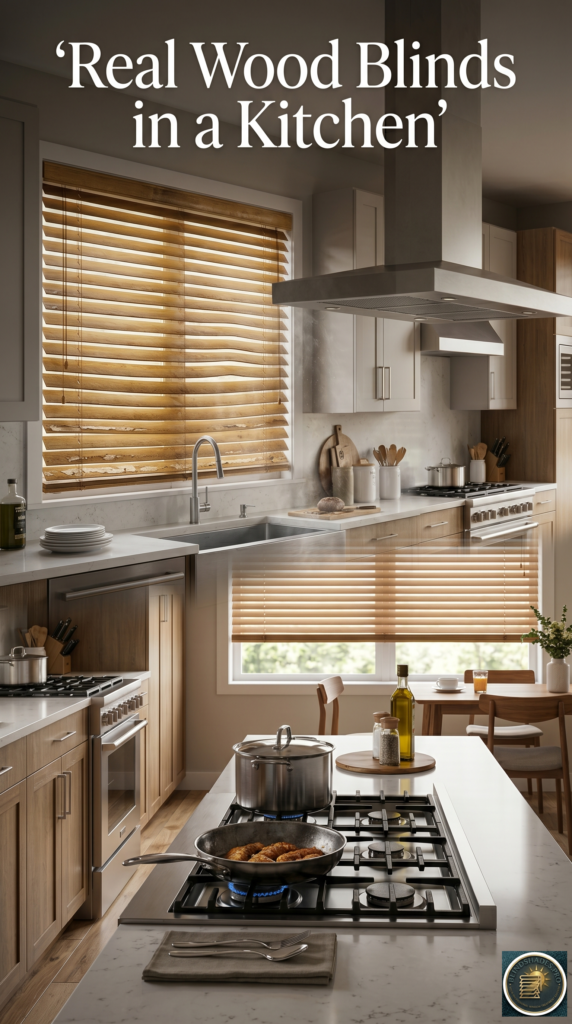
Real Wood Blinds in a Kitchen – The Two Failure Mechanisms
Definition: Real wood blinds are window blinds manufactured from solid timber slats, most commonly basswood, that have been kiln-dried to reduce moisture content and finished with lacquer or urethane sealant.
Every guide says real wood blinds fail in kitchens. None explain that the kitchen presents two completely distinct failure mechanisms that a bathroom does not.
Failure Mechanism 1 – Moisture warping (shared with bathrooms): Kitchen steam from boiling water, the dishwasher, and the kettle introduces moisture into the kitchen air. This moisture is absorbed by unprotected wood end-grain at pivot holes (the uncoated holes through which the ladder cord passes – covered in Can You Use Real Wood Blinds in a Bathroom). The wet-dry moisture cycling causes the characteristic bow-shaped warp familiar to anyone who has installed real wood blinds in a humid room.
Failure Mechanism 2 – Grease penetration (kitchen-specific): This mechanism is unique to kitchens and is absent from all competitor guides.
When food is cooked at high heat, aerosolised cooking grease particles – polymerised lipids from frying, roasting, and sauteing – are deposited on the lacquer surface of real wood slats daily. The lacquer finish on new real wood slats repels this grease initially. But over weeks and months:
- Heat cycling from cooking (the slat surface heats and cools repeatedly as cooking occurs nearby) creates micro-cracks in the lacquer finish – the coefficient of thermal expansion of lacquer differs from that of the wood underneath
- Cleaning agents applied to remove grease accumulation (dish soap, general purpose cleaner) gradually emulsify the plasticiser in the lacquer, accelerating finish deterioration
- Any homeowner who attempts to remove stubborn grease with white spirit, turpentine, or acetone-based cleaner strips the lacquer entirely from the slat surface
Once micro-cracks develop in the lacquer, cooking grease penetrates directly into the wood grain. Wood grain – particularly basswood’s open porous structure – absorbs the polymerised lipids permanently. This grease cannot be removed from the wood grain by surface cleaning because:
- Water-based cleaners cannot penetrate into the wood to reach the embedded grease
- Solvent-based cleaners that could reach the embedded grease also strip the remaining lacquer
- The grease in the wood grain oxidises over time, creating the characteristic darkening and yellowing visible on kitchen-aged real wood blinds
The Grease-Darkening Timeline – What Happens to Real Wood in a Kitchen
This month-by-month timeline is absent from all competitor articles but is the most practical information for anyone considering real wood in a kitchen.
Weeks 1-4: The lacquer finish repels most cooking grease deposition. The slats look clean and as-purchased. The lacquer is intact.
Months 1-3: Heat cycling from cooking begins to create micro-cracks in the lacquer at grain lines and any mechanical stress points (pivot holes, tilt rod contact points). These cracks are invisible to the naked eye but allow cooking grease to begin penetrating. Slight yellowing may appear at grain lines in the highest-exposure zones.
Months 3-6: Visible darkening begins at the grain lines where grease has penetrated. The wood takes on a slightly darker, warmer tone. Pivot holes show the first visible staining. In Zone K1 sink windows, the slats nearest the sink may show water staining from splash contact.
Months 6-12: The overall slat colour has shifted noticeably from the original tone. The natural pale gold of basswood has become deeper amber or brown. Grain lines are dark. Any lacquer chips or abrasion points from cleaning are visibly stained. The slats no longer look like new wood – they look like aged, greasy wood.
Years 1-2: The staining is permanent and visible across all slats. The tilt mechanism is stiffer due to grease accumulation on the ladder cord and pivot holes. In Zone K1 or K2 positions, warping is also visible. The blind is aesthetically poor and mechanically deteriorating.
The Wood Species Factor in Kitchen Performance
All guides treat real wood blinds as a single category. The wood species used in the blind significantly affects how quickly grease penetration and darkening occur.
| Wood Species | Grain Density | Grease Penetration Speed | Staining Visibility | Kitchen Suitability |
|---|---|---|---|---|
| Basswood | Very low density, open porous grain | Fast – most susceptible | Moderate (pale baseline shows darkening) | Poor |
| Poplar | Low-medium density | Fast-moderate | Low (naturally pale with little grain variation) | Poor |
| Oak | Medium-high density | Moderate | High (pronounced grain shows darkening very clearly) | Poor-Fair in Zone K3 |
| Cherry | Medium density | Moderate | High (dark baseline masks some staining) | Fair in Zone K3 only |
| Teak | High density, natural oils | Slow (natural oils resist penetration) | Low-moderate | Best real wood for kitchen, still not ideal |
The practical implication: Most commercial real wood blinds are basswood – the cheapest, lightest species and the one with the most open porous grain. Basswood is the worst wood species for kitchen grease resistance. If real wood is specified for a Zone K3 kitchen window, request teak or a denser species – though these will cost significantly more than standard basswood.
The Lacquer Cleaning Dilemma Unique to Kitchens
In a bathroom (covered in Can You Use Real Wood Blinds in a Bathroom), the cleaning challenge is avoiding water. In a kitchen, the challenge is more acute: the grease deposits require a degreasing agent, but the agents that remove grease risk damaging the lacquer.
The dilemma:
- Grease on real wood requires a surfactant-based degreaser (dish soap) to remove
- Dish soap with water, applied generously, can introduce enough moisture to swell the wood grain in the area of lacquer micro-cracks
- Petroleum solvent cleaners (white spirit, mineral spirits) remove grease effectively but also strip the lacquer finish
- Abrasive cleaning pads remove grease mechanically but scratch the lacquer, creating more surface area for grease to penetrate
The correct protocol for kitchen real wood slats:
- Apply two to three drops of dish soap to a microfibre cloth
- Dampen the cloth with warm water – the cloth should be barely damp, not wet (wring completely before use)
- Wipe the slat surface gently in one direction
- Immediately follow with a completely dry microfibre cloth
- Never allow the slat surface to air-dry wet – always dry immediately
The frequency: In a Zone K3 kitchen position, this protocol every 2-3 weeks is required to prevent grease accumulation from reaching the micro-crack penetration stage. This is significantly more maintenance than faux wood, which can be wiped with a damp cloth without the immediate-dry requirement.
The One Acceptable Kitchen Scenario for Real Wood Blinds
Every guide says never use real wood in a kitchen. The specific exception:
A Zone K3 window in a breakfast nook, dining area, or any kitchen window meeting ALL of the following conditions:
- More than 1.5 metres from the nearest cooking hob or stove
- More than 1.5 metres from the nearest sink
- Not in the direct path of cooking steam (not directly above or aligned with the cooktop extraction path)
- Well-ventilated kitchen with a functioning cooker hood exhaust that captures cooking steam before it disperses
- Temperate climate – high ambient humidity climates (tropical, coastal) accelerate moisture failure even in remote kitchen positions
Expected lifespan under these conditions: A quality kiln-dried lacquer-sealed real wood blind in this position: 5-8 years before grease darkening becomes aesthetically unacceptable. This is less than faux wood in the same position (10-15 years) but may be acceptable when the natural wood aesthetic is genuinely important for the dining area design.
The Annualised Cost Reality for Kitchen Real Wood Blinds
Every guide notes faux wood is cheaper upfront. No guide calculates the kitchen-specific annual cost.
Zone K1 (sink window) and Zone K2 (stove-adjacent):
| Specification | Upfront Cost | Kitchen Lifespan | Annual Cost |
|---|---|---|---|
| Real wood blind | $80-$200 | 12-24 months | $40-$200/year |
| Faux wood blind | $50-$150 | 10-15 years | $3.50-$15/year |
| PVC vinyl roller | $40-$120 | 12-18 years | $2.50-$10/year |
Real wood in Zone K1 or K2: 15-80 times more expensive per year than faux wood.
Zone K3 (breakfast nook, 1.5m+ from cooking zone):
| Specification | Upfront Cost | Kitchen Lifespan | Annual Cost |
|---|---|---|---|
| Real wood blind | $80-$200 | 5-8 years | $10-$40/year |
| Faux wood blind | $50-$150 | 10-15 years | $3.50-$10/year |
Real wood in Zone K3: 3-4 times more expensive per year than faux wood. The smaller premium may be acceptable to buyers who strongly prefer the natural wood aesthetic for a dining area.
The Kitchen Aging Comparison – Real Wood Looks Worse Than Faux Wood After Year 1
This is the counterintuitive finding that is absent from all competitor guides:
New real wood blinds: Natural grain variation, warm tones, genuine material quality – unquestionably more visually appealing than new faux wood of equivalent price.
Kitchen-aged real wood blinds (after 12-18 months): Greasy grain lines, darkened overall tone, possible lacquer chips or staining at pivot holes, stiff tilt operation. Aesthetically poorer than new faux wood.
Kitchen-aged faux wood blinds (after 12-18 months): With regular cleaning, the faux wood slat maintains its original appearance. No grease penetration into the material (PVC composite is non-porous). No colour change.
The argument for choosing real wood over faux wood in a kitchen for aesthetic reasons is valid at the time of purchase. After 12-18 months in an active cooking kitchen, the real wood looks worse than quality faux wood maintained with regular cleaning. The aesthetic premium of real wood is temporary in a kitchen environment.
Where to Order – The Correct Alternative to Real Wood in a Kitchen
For Zone K1 and K2 windows where real wood is not appropriate: SelectBlinds faux wood Venetian blind – see selectblinds.com/real-wood-blinds for the comparison between real wood and faux wood product ranges. Blindsgalore faux wood routeless Venetian – the routeless option eliminates pivot holes, removing the primary grease and moisture entry point.
For understanding real wood maintenance in kitchen environments: Blindsgalore complete wood blind cleaning guide at blindsgalore.com provides the kitchen-specific cleaning cautions including the pivot hole issue and the nearly-dry microfibre protocol.
For the general kitchen window treatment zone framework: Bloominblinds 2026 kitchen guide at bloominblinds.com provides the zone-by-zone material guidance including real wood avoidance.
Frequently Asked Questions
Can you use real wood blinds in a kitchen? Real wood blinds in a kitchen fail from two mechanisms simultaneously: moisture warping from cooking steam, and cooking grease penetrating through micro-cracks in the lacquer finish to permanently darken the wood grain. In Zone K1 sink windows and Zone K2 stove-adjacent windows, real wood blinds show visible grease darkening within 6 to 12 months and warping within 12 to 24 months. The one acceptable scenario is a Zone K3 window in a breakfast nook or dining area more than 1.5 metres from both the sink and stove, with a functioning exhaust fan, where real wood blinds can last 5 to 8 years before grease darkening becomes aesthetically unacceptable.
Why do real wood blinds turn dark and yellow in a kitchen? Real wood blinds darken and yellow in a kitchen because cooking grease penetrates the wood grain through micro-cracks in the lacquer finish. Heat cycling from nearby cooking creates micro-cracks in the lacquer by differential thermal expansion between the lacquer and the wood. Cleaning agents applied to remove surface grease gradually degrade the lacquer plasticiser, accelerating crack formation. Once cooking grease enters the wood grain through these cracks, it oxidises at room temperature and creates a permanent golden-to-brown darkening of the wood. This grease cannot be removed by surface cleaning because the agents strong enough to dissolve it would also strip the remaining lacquer.
How is kitchen real wood blind failure different from bathroom failure? Kitchen real wood blind failure involves two mechanisms while bathroom failure involves primarily one. In a bathroom, real wood blinds fail primarily from moisture warping – steam penetrates the uncoated end-grain at pivot holes and causes differential swelling that creates the characteristic bow-shaped warp. In a kitchen, real wood blinds fail from moisture warping AND from cooking grease penetration into the wood grain through lacquer micro-cracks created by heat cycling and cleaning. The grease penetration mechanism is unique to kitchens and causes visible darkening and permanent staining that does not occur in bathroom failure.
What is the annual cost of real wood blinds in a kitchen compared to faux wood? In Zone K1 sink windows and Zone K2 stove-adjacent windows, real wood blinds cost $80 to $200 and have a practical lifespan of 12 to 24 months before grease darkening and warping make them aesthetically and mechanically unacceptable – an annual cost of $40 to $200. Faux wood blinds for the same windows cost $50 to $150 and last 10 to 15 years in a kitchen – an annual cost of $3.50 to $15. Real wood in Zone K1 or K2 kitchen windows costs 15 to 80 times more per year of useful life than faux wood. In Zone K3 dining area windows away from cooking, the premium narrows to approximately 3 to 4 times more per year.
Do kitchen-aged real wood blinds look better than faux wood? No – kitchen-aged real wood blinds after 12 to 18 months in an active cooking kitchen look worse than quality faux wood maintained with regular cleaning. New real wood blinds are genuinely more visually appealing than faux wood, with natural grain variation and warm material quality. After 12 to 18 months, kitchen real wood blinds develop greasy darkened grain lines, an overall colour shift from original tone, and staining at pivot holes – aesthetically poorer than a regularly cleaned faux wood blind that maintains its original appearance throughout its 10 to 15 year life.
Related Guides on BlindShades.pro
- The Best Kitchen Window Blinds and Shades Buying Guide
- What Are the Best Blinds for Kitchen Windows
- Can You Use Real Wood Blinds in a Bathroom
- How Do You Clean Greasy Kitchen Blinds
- Are Faux Wood Blinds Better Than Aluminum Blinds for a Bathroom
By Michael Turner | 30 Years Home Improvement Expertise | Updated 2026 | BlindShades.pro
