Are Cellular Shades Good for Kitchen Windows

Authored By Michael Turner -30 Years Home Improvement Expertise | Updated 2026 | BlindShades.pro
Updated on May 26, 2026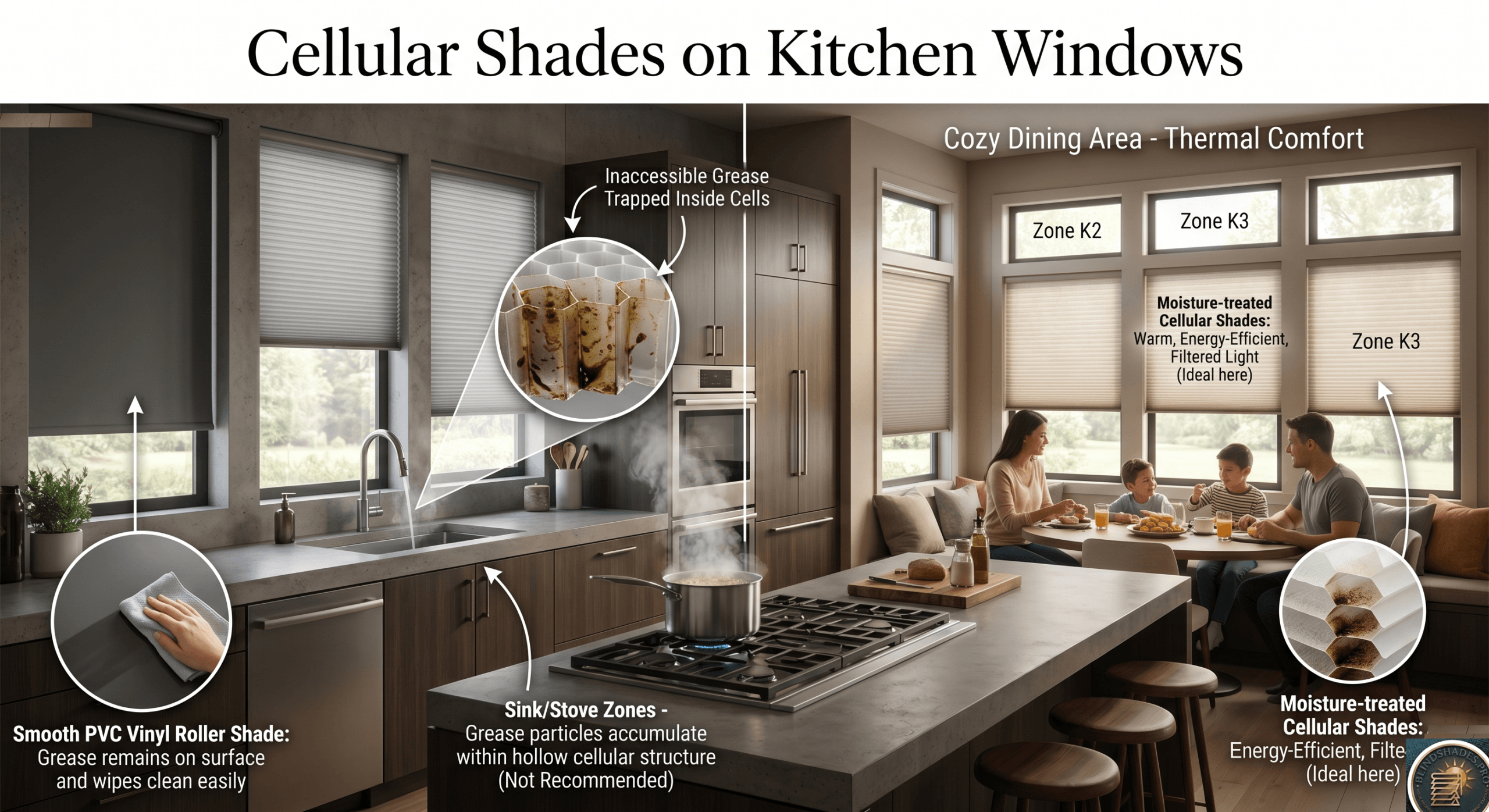
⭐ Quick Answer — Are Cellular Shades Good for Kitchen Windows?
- Zone K3 Only — 90cm From Both Sink and Stove: Cellular shades on kitchen windows are appropriate only in Zone K3 positions more than 90cm from both the sink and the stove. The reason: hollow honeycomb cells create enclosed grease accumulation chambers. When cooking grease particles enter the cell openings, they adhere to the inner cell walls — impossible to reach for cleaning without crushing the cell structure. This is fundamentally different from a flat PVC vinyl roller shade where grease deposits on an accessible surface and wipes off. This 90cm radius is more conservative than for roller shades or Venetian blinds because even lighter ambient grease deposition permanently accumulates in the cells
- The Cell Interior Grease Diagnostic — When to Replace: Hold the shade up to a bright light source. Clean cells appear lighter than the cell walls as light diffuses evenly through the air-filled honeycomb. Grease-contaminated cells appear darker than the cell walls — grease coating on the inner surfaces absorbs light. A shade with dark cell interiors has permanently degraded insulation (grease conducts heat through the cell walls, bypassing the dead-air insulation benefit) and requires replacement, not cleaning
- Specify 3/8-Inch Small Pleat + Moisture-Treated Fabric: For Zone K3 kitchen window cellular shades: specify the 3/8-inch (9mm) small pleat — smaller cell openings minimise cooking grease particle entry compared to 3/4-inch large-pleat cells. And specify moisture-treated fabric: standard cellular polyester absorbs ambient kitchen steam, creating a moisture film that increases grease particle adhesion to the fabric surface. Hydrophobic-coated moisture-treated cellular keeps the fabric drier and reduces grease capture — the same specification as bathroom Zone 2 cellular shades
- The Kitchen-Specific Energy Case — Worth the Premium on Large Windows: Cellular shades manage two kitchen thermal challenges simultaneously: (1) external solar heat gain through the window in summer (reducing the already-hot cooking kitchen further); (2) heat loss through the window in winter, retaining warmth generated by cooking. US Department of Energy data indicates cellular shades can reduce heat loss through windows by up to 40% in heating season. This double benefit makes cellular cost-effective for kitchen windows 48 inches wide or larger. For windows under 24 inches wide in mild climates: a PVC vinyl roller shade is the better cost-to-performance choice
- Kitchen TDBU Configuration — Seated vs Standing: For a Zone K3 dining area: raise the bottom rail to 36–40 inches from the floor — covers seated diner privacy (eye height 44–48 inches) while leaving the full upper window open for daylight. For a Zone K3 standing kitchen position: raise the bottom rail to 54–60 inches from the floor — covers standing-person privacy (60–66 inches). Different from the living room TDBU configuration: the kitchen occupant is primarily standing, not seated
- Best Sources: Duette Honeycomb kitchen spec → Hunter Douglas kitchen guide · Cordless and motorized cellular → Blindsgalore kitchen range · Zone K3 dining area cellular → Graber Blinds kitchen guide
⚠️ The Grease Trap Physics — Why Cellular Fails Where Roller Shades Do Not: The fundamental difference between cellular shades and flat window treatments on kitchen windows is not about fabric quality or moisture resistance — it is about geometry. A honeycomb cell is a three-dimensional enclosed chamber formed by two bonded layers of pleated polyester. When cooking grease aerosol particles enter the cell from the top opening or through the fabric face edges, they travel into the interior and adhere to the inner cell walls. Unlike a flat surface where grease sits accessibly on the top, inner-cell grease is enclosed by the cell geometry on three sides. Any tool inserted to clean it would crush the pleated structure that creates the insulating air pocket. The result: a Zone K1 or Zone K2 cellular shade accumulates grease permanently in its cells and has no cleaning solution — it must be replaced. In a Zone K3 position with moisture-treated 3/8-inch pleat specification, the grease entry rate is low enough that this accumulation is slow — but the diagnostic (hold to light) should be performed annually to assess cell interior condition. For the full zone framework for kitchen blinds, see What Are the Best Blinds for Kitchen Windows. See the full grease trap physics below.
💡 Is Cellular Worth the Premium Over a Roller Shade for a Kitchen Window? For cellular shades on Zone K3 kitchen windows, the cost premium over a PVC vinyl roller shade is justified when three conditions are met: (1) the window is 48 inches wide or larger — the energy savings per square foot are the same regardless of size, but the upfront premium is more proportionate on a large window; (2) the climate has significant temperature extremes — cold winters or hot summers where the DOE 40% heat loss reduction or 80% solar gain reduction translate to meaningful energy cost savings; (3) the kitchen window is single-pane or old glazing — modern double-pane glazing already provides significant insulation and the cellular shade marginal improvement is smaller. For Zone K3 windows under 24 inches wide in mild climates or with modern glazing: a PVC vinyl roller shade at lower cost performs adequately. For Zone K1 and Zone K2 positions: cellular is not appropriate regardless of window size — use the PVC vinyl roller shade as specified in What Are the Best Blinds for a Window Over the Kitchen Sink. See the full cost and energy comparison below.
📖 Read the complete guide below for: the grease trap physics of honeycomb cells (enclosed chamber geometry vs flat wipeable surface), the Zone K1/K2/K3/K4 kitchen assessment for cellular shades, the moisture-treated fabric specification and why standard cellular absorbs steam that increases grease adhesion, the 3/8-inch small-pleat vs 3/4-inch large-pleat kitchen comparison, the cell interior grease diagnostic (hold to bright light — dark cells mean replacement needed), the DOE 40% heat loss reduction energy case for kitchen windows specifically, the kitchen TDBU configuration (seated dining 36–40 inches vs standing kitchen 54–60 inches), and the cost-justification window size analysis (48 inches and above vs under 24 inches).
Cellular Shades Kitchen Windows – The Zone and Grease Trap Assessment
Definition: A cellular shade, also called a honeycomb shade, is a soft fabric window treatment manufactured from two or more layers of pleated polyester fabric bonded together to create a honeycomb cross-section of enclosed air pockets. These pockets trap still air, creating a thermal insulating barrier between the window glass and the room interior.
The assessment of cellular shades for kitchen windows requires understanding one physical characteristic that is unique to cellular construction and differs from all other blind types.
The grease trap problem – specific to cellular shades:
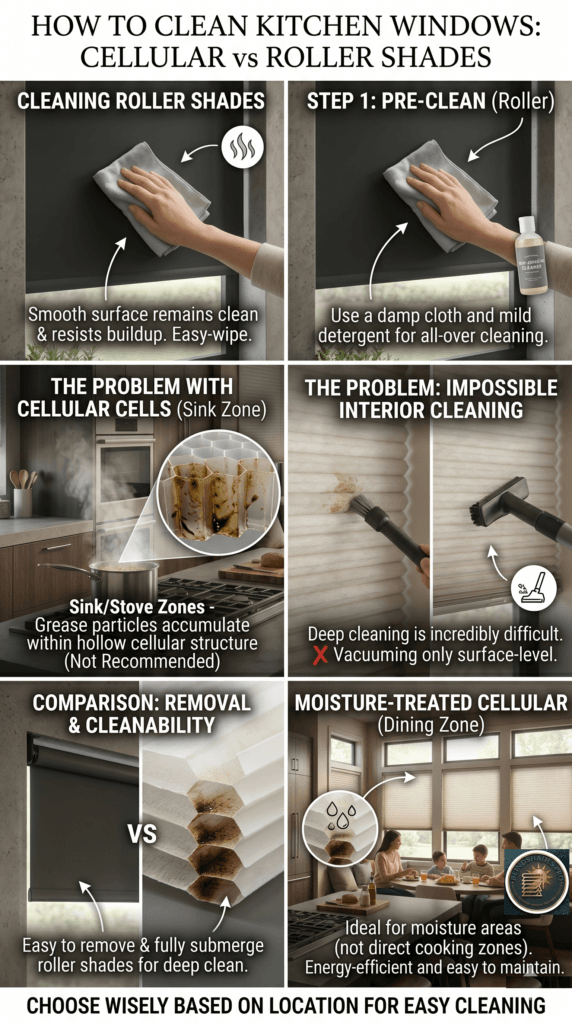
Standard window blinds and roller shades have accessible flat surfaces. Cooking grease that deposits on a faux wood slat or PVC vinyl roller fabric sits on the surface. It can be wiped off with a damp cloth and dish soap.
A cellular shade has hollow enclosed cells. When cooking grease particles enter the cell from the top opening or the fabric face edges, they travel into the cell interior and adhere to the inner cell walls. The cell geometry partially encloses the grease deposit – it cannot be reached by any cleaning tool without inserting something into the cell opening, which would crush and damage the cell structure.
This means that a cellular shade in a grease-producing kitchen environment accumulates grease in its cells in a way that is effectively permanent – the shade cannot be cleaned and must eventually be replaced when cell grease accumulation becomes visible or when insulation performance degrades.
The correct zone specification for cellular shades in kitchens is therefore more conservative than for roller shades or Venetian blinds. Even lighter grease deposition that a roller shade could handle with weekly wiping will permanently accumulate in cellular shade cells.
The Kitchen Zone Assessment for Cellular Shades
Zone K1 (window above or adjacent to sink) – NOT appropriate: The zone receives direct water splash and the highest concentration of cooking grease vapour from steam rising above the dishwasher, kettle, and hot tap use. The cellular shade cells trap all moisture and grease particles that enter from this environment. Not appropriate at any distance closer than 90 cm from the sink.
Zone K2 (window near stove or hob, within 90 cm) – NOT appropriate: The zone receives the highest concentration of cooking grease aerosols from frying, roasting, and sauteing. The cellular cells trap grease immediately and permanently. Additionally, the heat from Zone K2 cooking exceeds the comfort zone for cellular fabric – sustained heat exposure above 60-70 degrees Celsius can affect the bonding adhesive that holds cellular layers together. Not appropriate within 90 cm of any cooking appliance.
Zone K3 (breakfast nook, dining area, window 90cm+ from both sink and stove) – APPROPRIATE with correct specification: A Zone K3 window receives only ambient kitchen cooking vapour – the background aerosol level of a kitchen rather than the concentrated grease deposition of Zone K1 and K2. Cellular shades are appropriate here with two conditions:
- Moisture-treated fabric (see below)
- Small pleat specification (see below)
Zone K4 (large picture window, far end of open-plan kitchen-diner) – APPROPRIATE: The furthest position from the cooking zone, often facing a garden or outdoor area. Full cellular shade specification appropriate. The large window size also maximises the return on the energy efficiency premium of cellular construction.
For the complete kitchen window zone framework, see What Are the Best Blinds for Kitchen Windows.
The Moisture-Treated Specification – Why Standard Cellular Is Not Enough for a Kitchen
Definition: Moisture-treated cellular fabric has a hydrophobic chemical coating applied to the polyester fibres that reduces moisture absorption by the fabric surface.
Why moisture treatment matters in a kitchen:
Standard cellular fabric has untreated polyester fibres that absorb ambient kitchen steam during cooking. When cooking steam contacts the cellular fabric surface and cools, it deposits as a thin film of moisture on the fabric fibres. This moisture film has two effects:
- Increased grease adhesion: cooking grease aerosol particles that land on a wet fabric surface have higher adhesion than on a dry surface – the water film acts as a temporary adhesive for grease particles
- Mould risk in the cell interior: moisture that enters the cell interior cannot easily evaporate because the cell is partially enclosed – sustained moisture inside the cells creates a mould microclimate
The moisture-treated solution: A hydrophobic-coated cellular fabric reduces steam absorption significantly. The fabric surface remains drier during cooking, reducing both grease adhesion and internal cell moisture. For Zone K3 kitchen cellular shades: always specify moisture-treated fabric rather than standard cellular.
Note that moisture-treated cellular is the same specification as for bathroom Zone 2 cellular shades (covered in What Are Top-Down Bottom-Up Shades – Are They Good for a Bathroom). The kitchen kitchen Zone K3 specification is identical.
The Pleat Size Selection for Kitchen Cellular Shades
Definition: Pleat size in cellular shades refers to the height of each individual honeycomb cell – commonly available in 3/8 inch (9mm), 9/16 inch (14mm), and 3/4 inch (19mm).
How pleat size affects kitchen suitability:
Each honeycomb cell has an opening at the top and bottom (on single-cell shades) or at the outer edges of the cell row (on double-cell shades). The larger the pleat size, the larger this opening and the greater the volume of air – and cooking grease aerosol – that can enter the cell per unit of surface area.
| Pleat Size | Cell Opening | Grease Entry Risk | Insulation per Inch | Kitchen Suitability |
|---|---|---|---|---|
| 3/8 inch (9mm) | Smallest | Lowest | Lower (thinner cells) | Best for kitchen |
| 9/16 inch (14mm) | Medium | Medium | Medium | Acceptable for Zone K3 |
| 3/4 inch (19mm) | Largest | Highest | Highest | Not preferred for kitchen |
The kitchen recommendation: Specify 3/8 inch small-pleat cellular for Zone K3 kitchen windows. The smaller cell opening minimises grease particle entry while still providing meaningful insulation. The 3/4 inch large-pleat configuration provides the best insulation R-value but has the largest cells with the greatest grease accumulation potential – appropriate for bedrooms and living rooms but the wrong choice for kitchens.
The Cell Interior Grease Diagnostic
This is the practical test that tells you when a kitchen cellular shade needs replacement:
When a cellular shade in a Zone K3 kitchen has been in place for several years, grease from ambient kitchen cooking accumulates inside the cell interiors. This grease degrades the shade’s appearance and – importantly – its insulation performance.
The diagnostic test:
- Remove the cellular shade from its mounting
- Hold it up to a bright light source (a sunny window or bright lamp)
- Look through the shade at the light
What you see:
- Clean cells: the cell interiors appear lighter than the cell walls, and you can see the light diffusing through the honeycomb structure evenly
- Grease-contaminated cells: the cell interiors appear darker than the cell walls – the grease coating on the inner cell surfaces absorbs light rather than reflecting it
Why grease inside cells degrades insulation: The insulation performance of cellular shades depends on still air trapped inside the cells. When grease coats the inner cell walls, two things happen:
- The grease coating slightly seals the cells, partially preventing natural air circulation – but more importantly
- The grease absorbs and transfers heat through conduction rather than the still air providing resistive insulation – a greasy cell wall conducts heat more readily than the air-only cell
A cellular shade with visibly dark cell interiors has permanently degraded insulation performance and should be replaced rather than cleaned.
The Kitchen-Specific Energy Savings Case
Every guide mentions cellular insulation. None make the kitchen-specific case.
Why kitchens benefit specifically from cellular shade energy management:
A kitchen window faces two thermal challenges simultaneously that other rooms do not:
External solar heat gain: In summer, a south or west-facing kitchen window receives direct solar radiation. The kitchen is typically the hottest room in the home in summer because of cooking heat. Adding solar heat gain through an uncovered window compounds this problem significantly. A cellular shade reduces solar heat gain through the window while still diffusing natural light for food preparation.
Internal cooking heat retention: In winter, cooking generates significant internal heat. A cellular shade acts as an insulating barrier that reduces heat loss through the window during and after cooking – this keeps the kitchen warmer without additional heating running as long after cooking ends.
The energy savings data: US Department of Energy (energy.gov) data on cellular shades indicates:
- Heat loss reduction through windows in heating season: up to 40%
- Solar heat gain reduction in cooling season: up to 80% (with room-darkening specification)
For a typical 36×48 inch kitchen window, the energy saving over a standard uncovered window or roller shade is:
- Heating season: meaningful reduction in heat loss at the window
- Cooling season: meaningful reduction in solar heat gain contributing to kitchen overheating
The energy premium of cellular over roller shade is most justified for large kitchen windows (48 inches wide and above) in climates with significant temperature extremes. For small kitchen windows under 24 inches wide in mild climates, the energy saving is modest and a standard roller shade provides a better cost-to-performance ratio.
The TDBU Configuration for Kitchen Cellular Shades
As covered in the bathroom TDBU guide, the correct TDBU configuration differs by the room and the occupant position. For kitchen cellular shades:
For a Zone K3 dining area window (seated primary occupant): The typical seated diner is at 44-48 inches eye height. Raise the bottom rail of the TDBU shade to approximately 36-40 inches from the floor – this covers the zone below seated eye height, providing seated privacy at the dining table while leaving the full upper window open for daylight above head height.
For a Zone K3 window where standing is the primary activity: A standing kitchen occupant at 60-66 inches requires the bottom rail to be raised higher – to approximately 54-60 inches from the floor – to provide standing privacy. This leaves only the very top of the window open for sky light.
The kitchen TDBU advantage: A TDBU cellular shade in a Zone K3 kitchen position provides the same triple function as described in Article 47-3 for bathroom TDBU: privacy adjustment for different activities (seated dining vs standing preparation), natural light from above without sightline exposure, and if the window opens, ventilation through the upper zone.
Is a Cellular Shade Worth the Premium Over a Roller Shade for a Kitchen Window?
The cost comparison: A standard PVC vinyl roller shade for a 36×48 inch kitchen window: $40-120 A moisture-treated single-cell cellular shade for the same window: $80-200 A moisture-treated double-cell cellular shade: $120-280
When cellular is worth the premium:
- Zone K3 window 48 inches wide or larger in a cold climate where heating bills are significant
- A kitchen window that receives strong direct afternoon sun (west-facing) where solar heat gain is a comfort problem during cooking
- A kitchen in an old house with poor window insulation where single-pane glass causes significant heat loss in winter
When a roller shade is the better choice:
- Zone K1 or K2 positions (cellular not appropriate – roller shade is the correct specification)
- Zone K3 window under 24 inches wide (modest energy saving; roller shade cost-effective)
- Mild climate with minimal heating/cooling requirement
- Zone K3 window with modern double-pane glazing (already provides significant insulation – cellular shade marginal improvement)
Where to Order
For moisture-treated small-pleat cellular (Zone K3 kitchen specification): Hunter Douglas Duette Honeycomb Shades – the original cellular shade – see Hunter Douglas kitchen window guide for the Duette kitchen specification including moisture-tolerant fabric options. Blindsgalore cellular shade kitchen range – see blindsgalore.com/kitchen for the cordless and motorized TDBU cellular options with smooth-finish moisture-rated fabric.
For the kitchen cellular shade zone context: Graber Blinds kitchen treatment guide at graberblinds.com specifically addresses the Zone K3 dining area as the ideal kitchen cellular shade application.
Frequently Asked Questions
Are cellular shades good for kitchen windows? Cellular shades on kitchen windows are appropriate only in Zone K3 positions more than 90 centimetres from both the sink and the stove. The primary reason cellular shades fail in Zone K1 and Zone K2 kitchen positions is the grease trap problem – cooking grease particles enter the hollow honeycomb cells and accumulate on the inner cell walls where cleaning tools cannot reach without destroying the cell structure. In Zone K3 dining areas with moisture-treated small-pleat fabric, cellular shades provide genuine energy benefits of up to 40 percent heat loss reduction and excellent diffuse light quality for kitchen dining.
Why do cellular shades fail near a kitchen stove or sink? Cellular shades fail near kitchen stoves and sinks because their hollow honeycomb cells create grease accumulation chambers. When cooking grease aerosol particles enter the cell openings from above or through the fabric edges, they adhere to the inner cell walls and cannot be removed without inserting a cleaning tool into the cell, which would crush the honeycomb structure. A PVC vinyl roller shade or faux wood Venetian blind has flat accessible surfaces where the same grease deposits remain removable with a damp cloth and dish soap. The honeycomb cell structure that provides excellent insulation in a non-grease environment is the same structure that makes cellular shades permanently contaminated in high-grease positions.
What size pleat is best for kitchen cellular shades? Specify the smallest available pleat size – typically 3/8 inch – for Zone K3 kitchen cellular shades. Smaller pleats have smaller cell openings that reduce the volume of cooking grease aerosol that can enter each cell. The 3/4 inch large-pleat cellular provides the best insulation R-value but has the largest cell openings and the greatest grease accumulation potential over time. The 3/8 inch small-pleat still provides meaningful insulation at lower grease entry risk – the better kitchen specification even though it provides marginally lower R-value than large-pleat.
How do you tell when a kitchen cellular shade needs replacing? Hold the cellular shade up to a bright light source and look through the honeycomb structure. In a clean cellular shade, the cell interiors appear lighter than the cell walls as light diffuses evenly through the air-filled cells. In a grease-contaminated cellular shade, the cell interiors appear noticeably darker than the cell walls because grease coating on the inner surfaces absorbs light. A shade with visibly dark cell interiors has grease accumulated inside the cells that cannot be cleaned and has permanently degraded insulation performance – replace rather than clean.
Should kitchen cellular shades be moisture-treated? Yes – specify moisture-treated cellular fabric for any Zone K3 kitchen window. Standard cellular fabric absorbs ambient kitchen steam during cooking, creating a moisture film on the fabric surface that increases grease particle adhesion and creates a mould risk inside the partially enclosed cells. Moisture-treated cellular fabric has a hydrophobic coating that keeps the fabric surface drier during cooking steam exposure, reducing grease adhesion and minimising internal cell moisture. This is the same specification as moisture-treated cellular for bathroom Zone 2 windows.
Related Guides on BlindShades.pro
- The Best Kitchen Window Blinds and Shades Buying Guide
- What Are the Best Blinds for Kitchen Windows
- Can You Use Roman Shades in a Kitchen
- How Do You Clean Greasy Kitchen Blinds
- What Are the Best Window Treatments for a Kitchen Near a Stove
By Michael Turner | 30 Years Home Improvement Expertise | Updated 2026 | BlindShades.pro
