What Are the Best Window Treatments for a Bow Window?

Authored By Michael Turner -30 Years Home Improvement Expertise | Updated 2026 | BlindShades.pro
Updated on June 4, 2026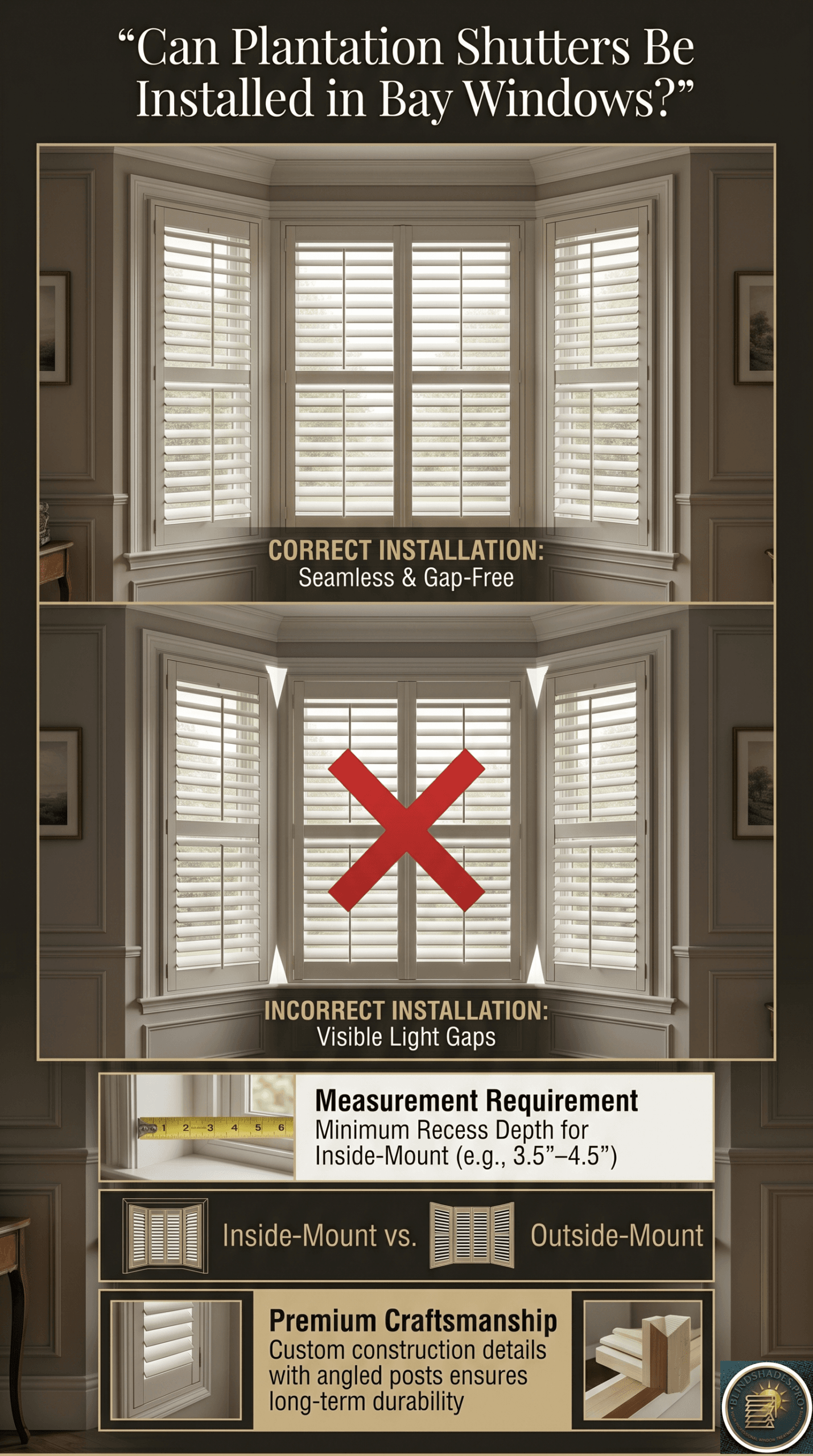
Key Takeaways:
- Bow windows are easier to treat than bay windows because their panels are joined at only 10 to 15 degrees to each adjacent panel (versus 30 to 45 degrees for bay windows); this smaller angle means faux wood blinds with 2.5 to 3 inch headrails that would fail the headrail interference test at a bay window’s sharp corners may fit cleanly at a bow window’s gentler junctions; most treatments that work for standard single windows also work for bow window individual panels
- Bow window panels are nominally equal-sized (unlike bay windows where the center panel is significantly wider than the side panels); this means a bow window can often be ordered as 4, 5, or 6 identical treatments at one width rather than three different-sized treatments; always verify by measuring each panel individually and confirm all are within 1/8 inch before ordering identical quantities
- Bow windows are typically casement windows that open by cranking outward; an inside-mount treatment must be raised or retracted before the casement can be opened; a fixed or stationary treatment (such as an inoperable cellular shade) on a bow window casement panel will prevent the window from opening; specify top-down bottom-up cellular shades or cordless lift shades that can be moved out of the casement’s swing path
- The full bow panoramic curtain approach — curtains on a single curved rod following the bow’s arc — emphasizes the bow’s architectural curve as the room’s focal point; individual per-panel treatments per pane emphasize precise independent light control; the choice depends on whether the bow is primarily a design statement or a functional light-control system
- A standard 6-panel bow window with panels approximately 14 inches wide by 48 inches tall covers approximately 28 square feet of glass; uncovered at a solar heat gain coefficient of approximately 0.86, this produces approximately 10,836 BTU per hour of summer solar heat gain; individual cellular shades reduce this by 60 to 75 percent, saving approximately $100 to $280 per cooling season
⭐ Quick Answer — What Are the Best Window Treatments for a Bow Window?
- Bow Windows Are Easier to Treat Than Bay Windows — The Two Reasons: Most guides treat bow window treatment options as equivalent in difficulty to bay windows. They are not. Bow windows are significantly easier to treat for two structural reasons. (1) Smaller joint angle: 10 to 15 degrees per panel-to-panel junction (vs 30 to 45 degrees for bay windows). The headrail interference problem that forces homeowners to use slim-profile treatments at bay window corners is much less severe at bow window junctions. Faux wood blinds with 2.5 to 3 inch headrails that would fail the cardboard clearance test at a 30-degree bay corner typically pass a bow window’s 10-degree junction. Most standard window treatment types fit bow window panels. (2) Narrower individual panels: typically 14 to 27 inches each (vs bay window center panels at 36 to 48 inches). Narrower panels accommodate more treatment types at any depth. The result: bow windows accept a wider range of treatment options with fewer fitting constraints than bay windows
- Equal Panels — Order One Width × 4, 5, or 6 (With One Important Check): The best bow window treatment options benefit from a key ordering simplification: bow window panels are nominally equal-sized, unlike bay windows where the center panel is significantly wider. A bow window treatment order can be as simple as: one panel width × number of panels (4, 5, or 6), all at the same product, fabric, and color. The verification before ordering identical quantities: measure each panel individually at top, middle, and bottom; if all measurements are within 1/8 inch of each other, order identical treatments at the narrowest reading. If any panel differs by more than 1/8 inch from the others, measure and order each panel individually. Older construction check: some pre-1980 bow windows used graduated panel widths (center panels slightly wider than edge panels) to achieve the curve; if the center panel measures 24 inches and the edge panels measure 22 inches, order each at its own dimension
- The Casement Rule — Treatment Must Be Raisable Before the Window Cranks Open: Bow window treatments face a specific operational constraint: bow windows are primarily casement windows that open by cranking outward. Champion Window confirms “bow windows are usually made up of casements that open with a crank.” An inside-mount treatment must be able to be raised or retracted before the casement sash cranks open — a stationary or inoperable treatment on a casement bow panel will prevent the window from opening for ventilation. Best for casement bow windows: cordless lift cellular shades (raise fully before opening); top-down bottom-up (TDBU) cellular shades (raise from bottom to clear the sash while keeping the top section down for privacy — the ideal specification); motorized cellular or Roman shades (raise remotely before cranking). Avoid: permanently mounted valances without an operable treatment below; any fixed inoperable shade on a panel that must be opened for ventilation
- Full Bow Curved Curtain vs Individual Per-Panel — The Decision Framework: Two approaches exist for bow window treatment options. (1) Full bow curved curtain: a single curved rod follows the bow’s arc; floor-length panels sweep across the entire opening; the bow’s curve is the room’s architectural focal point; light control is all-or-nothing (full curtain open or closed). Best for: living rooms where the bow is the design statement; Victorian, colonial, and traditional homes; rooms where dramatic fabric impact is the priority. (2) Individual per-panel treatments: each panel has its own shade or blind; each operates independently; precise light control at each section; bow reads as a series of individual windows rather than a unified curve. Best for: bedrooms where independent light control matters; rooms where casement ventilation through specific panels is important; contemporary homes with clean horizontal lines. The rule: if the bow IS the room’s focal point, go full bow curtain; if the bow is a FUNCTIONAL window, go individual per-panel
- Energy Calculation and the Curved vs Straight Cornice Choice: Bow window treatments for energy efficiency: a 5-panel bow window with panels approximately 18 inches wide by 48 inches tall covers approximately 30 square feet of glass. Uncovered at SHGC 0.86, this produces approximately 11,610 BTU per hour of summer solar heat gain. Cellular shades reduce this by 60 to 75 percent, saving approximately $100 to $280 per cooling season. For visual unification with a cornice or valance: curved cornice following the bow arc = architecturally consistent with the bow’s geometry; best for Victorian, colonial, and traditional homes. Straight cornice across the bow chord = geometric contrast; intentionally contemporary; works in modern homes where the straight horizontal line is a deliberate design choice. The simple rule: curved cornice matches traditional architecture; straight cornice suits modern and transitional homes
- Best Sources: 1-inch wood/faux wood and cellular shade recommendations for bow windows → Blinds.com bow window treatments · Motorized Roman shades, cordless safety, and free in-home bow window consultation → Budget Blinds bow window guide · Six bow window treatment ideas and style guide → Norman USA bow window treatment ideas
⚠️ The Best Treatment Types for Bow Windows Ranked and the Casement Compatibility Table: Bow window treatment options ranked by combined fit, operation, aesthetics, and energy performance: (1) 1-inch faux wood blinds per panel: slim 1.5-inch headrail; clears any 10-degree bow junction; adjustable light control; casement-compatible when raised; Blinds.com recommendation confirmed. (2) 9/16-inch cellular shades per panel: best energy performance; TDBU specification for casement-specific bow panels; 60 to 75 percent solar heat gain reduction. (3) Roman shades per panel: soft fabric and horizontal fold lines complement the bow curve; motorized recommended for edge panels that are harder to reach manually. (4) Full bow curved curtain on curved rod: architectural statement; full bow visual unity; requires 4 to 6 panels at 2 to 2.5 times fullness. (5) Plantation shutters per panel: premium architectural treatment; 10 to 15-degree bow junctions typically do not require angled posts (unlike bay windows at 30 to 45 degrees); standard frame corners usually sufficient. Casement compatibility: cordless lift cellular = YES (raise fully). TDBU cellular = YES (raise from bottom). Motorized = YES (remote). Stationary/inoperable = NO (prevents window opening). Roman shade (cordless) = YES (raise fully). 1-inch blind (cordless) = YES (raise fully). Stationary valance only = N/A (decorative; no coverage). For the bay window comparison including the headrail interference test, treatment depth chart, and the full cardboard clearance protocol, see What Are the Best Blinds for Bay Windows. See the full bow vs bay treatment comparison below.
💡 The Bow Window Energy Table and the Complete Panel Width Reference: Bow window treatment options for energy efficiency vary by panel count. 4-panel bow at 20 inches wide by 48 inches tall per panel = approximately 26.7 square feet of glass; uncovered solar gain approximately 10,334 BTU per hour; cellular shades save approximately $90 to $250 per cooling season. 5-panel bow at 18 inches wide by 48 inches tall = approximately 30 square feet; uncovered solar gain approximately 11,610 BTU per hour; cellular save $100 to $280 per cooling season. 6-panel bow at 14 inches wide by 48 inches tall = approximately 28 square feet; uncovered solar gain approximately 10,836 BTU per hour; cellular save $100 to $270 per cooling season. All figures at SHGC 0.86 uncovered; 60 to 75 percent reduction with cellular shades; $0.12 per kWh utility rate. Panel width implications for treatment selection: panels at 14 to 18 inches are narrow enough that nearly any treatment style fits easily within the recess; depth constraints that affect bay window selection are rarely an issue for standard bow window panels. Most standard inside-mount treatments with headrails up to 3 inches deep will pass the clearance test at a bow window’s 10 to 15-degree junction. For the full curtain-specific specifications including fullness ratios, panel count calculation, grommet header binding on curved rods, and the radiator clearance rule, see What Are the Best Curtains for a Bay Window. See the full casement compatibility table below.
📖 Read the complete guide below for: the bow vs bay structural comparison table (3 vs 4-6 panels; 30-45-degree vs 10-15-degree joints; equal vs unequal panel widths; casement vs mixed operation), why bow windows are easier to treat than bay windows (smaller angle; narrower panels; equal width ordering), the equal panel verification protocol (measure each individually; within 1/8 inch = order identical; graduated width check for older construction), the five treatment options ranked (1-inch faux wood / cellular TDBU / Roman / full bow curved curtain / plantation shutters), the casement compatibility table (TDBU and cordless = yes; stationary = no), the full bow curved curtain vs individual per-panel decision framework, the energy calculation by bow panel count (4-panel 26.7 sq ft / 5-panel 30 sq ft / 6-panel 28 sq ft; BTU/hr and annual savings), and the curved vs straight cornice choice by architectural style.
Bow Window Treatment Options — How Bow Windows Differ From Bay Windows
Understanding the structural differences that determine which treatments work.
Definition: A bow window is a set of four to six window panels arranged in a gentle curved arc. Unlike a bay window (three panels at sharp 30 or 45-degree angles), a bow window uses multiple panels at small equal angles — typically 10 to 15 degrees per joint — to form a smooth curve. The result is a rounded, sweeping appearance that projects gently from the exterior wall.
The key structural differences that affect treatment selection:
| Feature | Bay Window | Bow Window |
|---|---|---|
| Number of panels | 3 | 4, 5, or 6 |
| Panel sizes | Center wider than sides | All panels nominally equal |
| Angle between panels | 30–45 degrees | 10–15 degrees per joint |
| Window operation type | Mix: picture + casements/double-hung | Primarily casements |
| Typical projection depth | 13–19 inches (deep) | Less projection; wider span |
| Treatment order complexity | Three different widths | One width × 4, 5, or 6 |
| Treatment depth constraint | Significant at 30–45° corners | Less severe at 10–15° joints |
| Total glass area | Approx. 24 sq ft (typical) | Approx. 24–28 sq ft (typical) |
Why Bow Windows Are Easier to Treat Than Bay Windows
The most important insight absent from all bow window treatment guides.
All guides that cover both bow and bay windows treat them as equivalent challenges. Bow windows are significantly easier to treat for three reasons:
Reason 1 — Smaller angle at junctions: Bow window panels join at 10 to 15 degrees per panel-to-panel junction. Bay window side panels join at 30 to 45 degrees to the center panel. This smaller angle means the headrail interference problem that affects bay windows (see What Are the Best Blinds for Bay Windows) is much less severe for bow windows. A faux wood blind with a 2.5 to 3-inch headrail that would fail the cardboard clearance test at a 30-degree bay corner may fit cleanly at a bow window’s 10-degree junction.
Reason 2 — Narrower individual panels: Typical bow window panel widths are 14 to 27 inches (a 5-panel bow at 100 inches total = approximately 20 inches per panel). Typical bay window center panels are 36 to 48 inches wide. Narrower panels allow the full range of treatment types to fit in the recess without depth or headrail issues.
Reason 3 — Equal panel widths (usually): Bay windows require measuring each of three panels of different sizes. Bow windows typically require measuring one representative panel and ordering it multiplied by the number of panels. This simplifies the entire order process.
The Equal Panel Width Simplification — and the Verification Protocol
The ordering simplification and the one check that prevents mistakes — absent from all guides.
Because bow window panels are nominally equal in width, a bow window treatment order can be:
- Panel width: __ inches
- Quantity: 4 (or 5 or 6 depending on the bow configuration)
- Same product, same fabric, same color for all panels
The critical verification: Even though bow window panels are manufactured at equal widths, slight installation variations and frame settling can create small dimensional differences. Before ordering identical quantities:
- Measure each panel individually at three horizontal positions (top, middle, bottom)
- Record all measurements
- If all panel measurements are within 1/8 inch of each other: order identical treatments at the narrowest reading
- If any panel differs from the others by more than 1/8 inch: measure and order each panel individually
The graduated panel check for older construction: Some older bow windows (pre-1980) used graduated panel widths to achieve the curve — with the center panels slightly wider than the edge panels. This is less common in modern construction but worth checking in older homes. If the center panel measures 24 inches and the edge panels measure 22 inches: order each at its own dimension rather than using the center measurement for all.
The Casement Window Interaction — the Treatment Operation Issue Absent From All Guides
The fundamental constraint specific to bow windows.
Unlike bay windows (which typically use a fixed center picture window plus side casements or double-hung windows), bow windows are primarily casement windows throughout — each panel opens by cranking outward. Champion Window confirms: “bow windows are usually made up of casements that open with a crank.”
Why this matters for treatment selection: An inside-mount treatment on a casement bow window panel must be raised or retracted before the casement sash can crank open. If a treatment cannot be moved out of the sash’s operating path, the window cannot open.
Treatments that allow casement access:
| Treatment | Casement Compatible? | How |
|---|---|---|
| Cordless lift cellular shade | YES | Raise fully before opening window |
| Top-down bottom-up (TDBU) cellular | YES | Raise from bottom to clear sash |
| Motorized cellular shade | YES | Raise via remote before cranking |
| 1-inch faux wood blind (cordless) | YES | Raise fully before opening |
| Roman shade (cordless) | YES | Raise fully before opening |
| Stationary inoperable cellular shade | NO | Shade cannot be moved; window cannot open |
| Permanently mounted valance only | N/A | No coverage; window opens freely |
The specification: For bow windows where ventilation through the casement panels matters: specify cordless lift or motorized treatments rather than stationary fixed treatments. Top-down bottom-up cellular shades are particularly effective because they can be raised from the bottom (clearing the casement sash) while still providing privacy from the top section remaining down.
The Best Treatments for Bow Windows
Ranked by the combination of fit, operation, aesthetics, and energy performance.
Option 1 — 1-Inch Faux Wood Blinds per Panel (Best Overall)
Blinds.com recommends: “1-inch wood or faux wood blinds as the best options” for bow windows, citing “customizability, durability, natural decor and small gaps.”
For bow windows specifically:
- 1-inch headrail depth (approximately 1.5 inches): clears even tight 10-degree bow junctions without any modification
- Adjustable light control at every panel
- Each panel operates independently
- Compatible with casement operation (raise before cranking)
- Available in dozens of stain and paint finishes
Option 2 — 9/16-Inch Cellular Shades per Panel (Best Energy Performance)
Cellular shades provide insulation alongside light filtering. For a 6-panel bow window at approximately 28 sq ft of glass:
- Uncovered SHGC ~0.86 → approximately 10,836 BTU/hr summer heat gain
- With cellular shades (SHGC ~0.20–0.35): heat gain reduced to approximately 2,000–4,000 BTU/hr
- Reduction of 60–75%; annual cooling saving approximately $100–$280 per season
TDBU cellular shades are the strongest recommendation for casement bow windows — the shade can be raised from the bottom to clear the crank mechanism while keeping the top section down for privacy.
Option 3 — Roman Shades per Panel (Best Soft Aesthetic)
Roman shades offer fabric texture and color while providing clean horizontal lines that complement the bow’s curve. Budget Blinds confirms: “Roman shades can be motorized to change the lighting with a touch of a button.”
For bow windows: specify motorized Roman shades if the upper panels are difficult to reach manually (bow windows are typically wide and the edge panels may be harder to access). Roman shades in a fabric matching any wall-mounted drapes create a cohesive layered look.
Option 4 — Full Bow Curved Curtain on a Single Rod (Best Panoramic Effect)
The alternative to individual per-panel treatments: a curved curtain rod follows the bow window’s arc and holds a set of floor-length curtain panels that sweep across the entire bow opening.
The full bow vs individual panel decision:
- Full bow curtain: the bow’s curve is the design statement; fabric follows the arc; light control is all-or-nothing (either the full curtain is open or closed)
- Individual per-panel treatments: precise independent light control; each panel can be adjusted separately; bow reads as a series of individual windows rather than a unified curved feature
Best for:
- Full bow curtain: living rooms where the bow is the focal point; Victorian and traditional homes where the bow’s curve is architecturally significant; rooms where decorative impact is the priority
- Individual per-panel: bedrooms where precise light control matters; rooms where ventilation through specific panels is important; contemporary homes where clean lines are the priority
Option 5 — Plantation Shutters per Panel (Premium; Architectural)
Custom plantation shutters on a bow window make an architectural statement that reinforces the bow’s value and elegance. The 10-15 degree junction between bow panels is less demanding for shutter corner specifications than the 30-45 degree junction of bay windows — standard shutter posts (not angled posts) can often be used at bow window junctions.
The Curved vs Straight Cornice for Bow Windows
The visual architecture decision absent from all guides.
When a unifying decorative element is desired at the top of the bow window treatment set, two choices exist:
Curved cornice following the bow arc:
- Follows the bow window’s curved face exactly
- Viewed from outside: appears as a continuous curved element
- Architecturally consistent with the bow’s geometry
- Best for: Victorian, colonial, traditional, and craftsman homes where the bow’s curve is a period-appropriate feature
Straight cornice across the bow chord:
- A flat horizontal cornice spanning straight across the bow opening from one side to the other
- Creates a geometric contrast between the straight cornice and the curved window behind it
- Architecturally intentional in contemporary and modern homes where the geometric tension is an aesthetic choice
- Best for: contemporary and transitional homes where a clean horizontal line is preferred over following the curve
The simple rule: match the cornice to the home’s architecture. A curved cornice in a Victorian home; a straight cornice in a modern home.
The Bow Window Energy Calculation
The specific calculation absent from all bow window treatment guides.
Bow window glass area varies by configuration:
| Configuration | Panel Size | Total Glass Area | Uncovered Solar Gain (Peak Summer) |
|---|---|---|---|
| 4-panel bow | 20″W × 48″T each | 26.7 sq ft | ~10,334 BTU/hr |
| 5-panel bow | 18″W × 48″T each | 30 sq ft | ~11,610 BTU/hr |
| 6-panel bow | 14″W × 48″T each | 28 sq ft | ~10,836 BTU/hr |
At uncovered single-pane SHGC of approximately 0.86 and 450 BTU/hr/sq ft peak summer radiation. Cellular shades reduce to approximately 25–35% of the uncovered figure — saving 60–75% of this solar heat load.
Where to Order
For bow window treatments with product selection guidance: Blinds.com at blinds.com/windows/bow-window-coverings — recommended 1-inch wood and faux wood blinds; cellular shades; Roman shades; specific bow window guidance on what treatments work best for equal-panel configurations.
For motorized Roman shades and full bow window treatment design consultation: Budget Blinds at budgetblinds.com/blog/the-best-window-treatment–for-bow-windows — free in-home consultation; motorized Roman shades; woven shades; full bow window approach; cordless safety options.
For bow window treatment inspiration and style guides: Norman USA at normanusa.com/blog/6-bow-window-treatment-ideas-to-inspire-you — six treatment ideas with aesthetics-focused guidance; shutter, cellular, and Roman shade styling approaches; faux wood blinds for high-humidity bow windows.
Frequently Asked Questions
What are the best window treatment options for a bow window? The best window treatment options for a bow window are 1-inch faux wood or wood blinds on each individual panel for precise independent light control and a natural aesthetic, 9/16-inch cellular shades for maximum energy efficiency with TDBU operation for casement clearance, Roman shades for a soft fabric look with motorization available for hard-to-reach panels, and full curved curtains on a single curved rod for a panoramic fabric treatment that emphasizes the bow’s architectural curve. Individual per-panel treatments are generally easier to order and install on bow windows than on bay windows because bow panels are joined at only 10 to 15 degrees rather than the 30 to 45 degrees of bay windows.
Are bow windows harder to treat than bay windows? No, bow windows are generally easier to treat than bay windows for three reasons. First, bow window panels are joined at only 10 to 15 degrees per junction, which means the headrail interference problem that affects bay windows at 30 to 45 degree corners is much less severe. Second, bow window panels are nominally equal in width, so all treatments can often be ordered at the same width multiplied by the number of panels rather than three different widths. Third, bow window panels are typically narrower (14 to 27 inches each) than bay window center panels, allowing most standard treatment types to fit in the recess.
Why do bow windows need special treatment consideration for casements? Bow windows are primarily casement windows that open by cranking outward, unlike bay windows which typically include a fixed center picture window. An inside-mount treatment on a casement bow window panel must be able to be raised or retracted before the casement sash can be cranked open. A stationary or inoperable treatment will prevent the window from opening. Top-down bottom-up cellular shades are the most casement-compatible bow window treatment because they can be raised from the bottom to clear the casement operating path while keeping the top section down for privacy.
What is the full bow curtain approach and when is it better than individual treatments? The full bow curtain approach uses a single curved curtain rod following the bow window’s arc and floor-length panels that sweep across the entire bow opening as one unified treatment. It is better than individual per-panel treatments when the bow window is the room’s primary architectural focal point and the curved arc should be emphasized as a design statement, when the room’s style prioritizes dramatic fabric softness over precise light control, and in Victorian, colonial, and traditional homes where the bow’s graceful curve is architecturally significant. Individual per-panel treatments are better when independent light control at each panel is needed, when casement ventilation matters, or when the room is contemporary and clean horizontal lines are preferred.
How much energy do bow window treatments save? Cellular shades on a typical 5-panel bow window covering approximately 30 square feet of glass can reduce summer solar heat gain by 60 to 75 percent. An uncovered 5-panel bow window at a solar heat gain coefficient of approximately 0.86 produces approximately 11,610 BTU per hour of summer solar heat gain. Cellular shades reduce this to approximately 2,900 to 4,600 BTU per hour, saving approximately $100 to $280 per cooling season depending on climate and local utility rates.
Related Guides on BlindShades.pro
- The Best Bay Window Blinds & Shades Buying Guide
- What Are the Best Blinds for Bay Windows
- Can You Put One Blind Across a Bay Window
- How Do You Measure a Bay Window for Blinds
- Are Cellular Shades Good for Bay Windows
By Michael Turner | 30 Years Home Improvement Expertise | Updated 2026 | BlindShades.pro
