What Are the Best Blinds for Flat Roof Skylights?

Authored By Michael Turner -30 Years Home Improvement Expertise | Updated 2026 | BlindShades.pro
Updated on July 15, 2026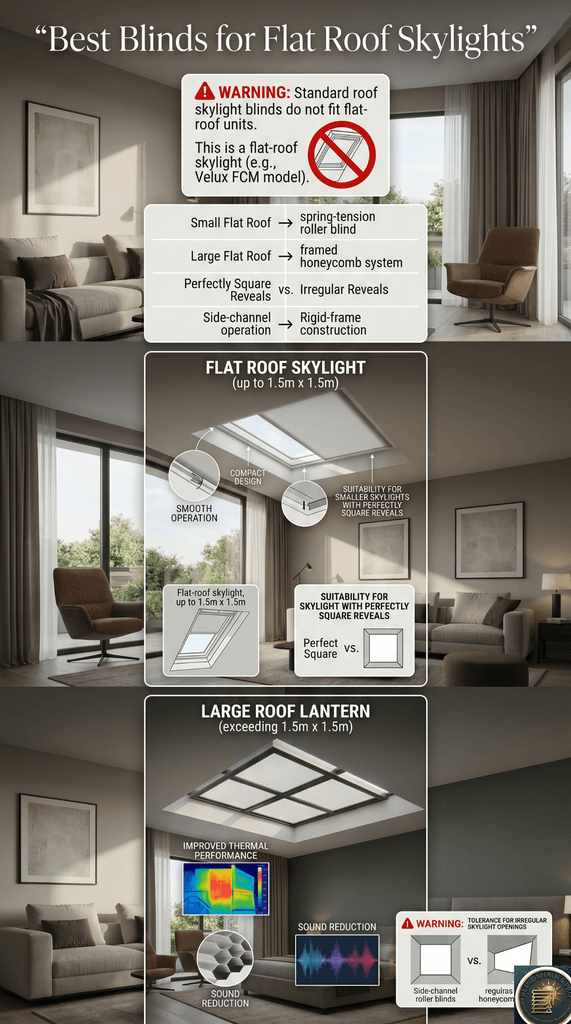
Key Takeaways:
- Flat roof skylights require the strongest tension systems of any skylight type because gravity acts at full force (100 percent) against the blind fabric at zero degrees; a 30-degree pitched skylight has only 50 percent of gravity working against the fabric; a 45-degree skylight has 71 percent; this means flat roof skylight blind systems require approximately 2 times the tension of systems designed for 30-degree pitched skylights
- The SkyFit Manual Blind is available only up to 1.5 meters by 1.5 meters; beyond this size, the spring tension mechanism cannot maintain adequate tension across the full fabric width and the center will sag; for flat roof skylights larger than 1.5 meters in either dimension, specify the LanternLITE Honeycomb system which uses a 4-sided rigid frame that holds all four edges of the fabric
- Standard Velux pitched roof blind products (DKL blackout roller, FSC solar pleated, FHL translucent roller) are NOT compatible with Velux FCM flat roof skylights; flat roof Velux skylights require the dedicated Velux flat roof blind product line including the anti-heat blind for curved and flat glass rooflights and the blackout blind for flat glass rooflights; these use completely different bracket and mounting systems
- The SkyFit roller blind requires a very square reveal (the recessed area below the glass inside the ceiling); if the reveal is not square, the blind fabric tracks at an angle with one side advancing ahead of the other; the LanternLITE Honeycomb blind with its 4-sided adjustable frame is more forgiving of reveal irregularities common in UK home extensions
- Honeycomb blinds for flat roof skylights provide a soundproofing benefit in addition to insulation; the honeycomb air buffer below the glass dampens impact sound transmission from rainfall, hailstones, and debris on the flat glass surface; this is particularly relevant for rooms directly below large flat roof rooflights in high-rainfall climates
⭐ Quick Answer — What Are the Best Blinds for Flat Roof Skylights?
- Why Flat Roof Skylights Need Specialist Blinds — The Gravity Load Is Maximum: Flat roof skylight blinds require the strongest tension systems of any skylight type. At 0 degrees (flat), the full weight of the blind fabric acts directly downward — 100 percent gravity load. At 45 degrees, only 71 percent of the weight acts against the fabric. At 60 degrees, only 50 percent. A flat roof skylight experiences approximately 40 percent more gravitational force against the blind than a standard 45-degree pitched skylight — requiring proportionally stronger spring mechanisms. Standard window blinds and even standard pitched-skylight blind systems fail instantly on flat glass because the fabric immediately sags away from the glass. Specialist flat roof skylight blind systems are engineered specifically for this horizontal gravity condition: the SkyFit spring-tension roller (for skylights up to 1.5m × 1.5m) and the LanternLITE Honeycomb 4-sided frame system (for larger openings). Skylight Blinds Direct confirms: “these unique structures sit at an unusual angle, meaning that normal blinds will be hindered by the natural weight of gravity”
- The Size Rule — SkyFit Up to 1.5m × 1.5m; LanternLITE Above That: For flat roof skylight blinds, the correct specification depends on the skylight size. SkyFit Manual Blind (up to 1.5m × 1.5m): a 3-sided spring-tension roller blind that runs in side channels and sits flush with the bottom edge of the ceiling reveal; spring-operated mechanism pulls down and locks; push the handle in to release and allow the cassette to retract the fabric; optional 1m to 2m telescopic pole for reach. SkyFit requires a very square reveal — if the ceiling reveal is not square (diagonal measurements differ by more than 10mm), the blind tracks at an angle. LanternLITE Honeycomb (above 1.5m × 1.5m, or for any size with an irregular reveal): 4-sided rigid frame holds all four edges of the honeycomb fabric; no maximum size limitation for standard residential openings; Skylight Blinds Direct confirms the 4-sided frame is “more forgiving when it comes to out-of-square recesses, which is a common issue in many homes, especially older ones”; available in manual, electric, or solar-powered operation
- Velux FCM Flat Roof Blinds vs Velux Pitched Roof Blinds — NOT Compatible: A critical specification error when ordering flat roof skylight blinds for a Velux FCM product: standard Velux pitched roof blind products with DKL, FSC, and FHL codes are designed for GGL, GGU, and GPL pitched roof windows only. They use clip-in bracket systems that match the sash frame of pitched roof windows. VELUX UK lists a completely separate product line for flat roof windows including: anti-heat blind for curved and flat glass rooflights; anti-heat blind for dome with glazing; blackout blind for curved and flat glass rooflights; blackout energy pleated blind for dome with glazing. These flat roof Velux products use a different bracket system, different frame orientation, and different mounting geometry. Before ordering any Velux blind for a flat roof skylight: confirm the window code contains FCM, VCM, or VCS (flat roof), then order from the Velux flat roof blind product line only. Velux DKL and FSC codes cannot physically attach to FCM frames
- The Recess Squareness Check and the Three Flat Roof Skylight Types: Before selecting a flat roof skylight blind, confirm the reveal squareness and the skylight type. Squareness check: measure both diagonals of the ceiling reveal opening; if they differ by more than 10mm, specify LanternLITE Honeycomb (forgiving 4-sided frame) rather than SkyFit (requires square). Three flat roof skylight types with different blind requirements: (1) Flat glass rooflight (standard curb-mounted flat glass): SkyFit or LanternLITE depending on size. (2) Curved glass rooflight / CurveTech dome (Velux FCM series): slightly curved glass for water drainage; blind hangs below the dome, not against the curved glass surface; Velux anti-heat blind for curved glass required; LanternLITE fills the reveal edge-to-edge minimizing the air gap at the perimeter. (3) Plastic dome (GRP or polycarbonate): dome rises above roof plane; blind mounts inside the ceiling reveal below the dome opening; LanternLITE Honeycomb recommended for UV protection (polycarbonate transmits UV unless specially coated)
- The Soundproofing Benefit and the Exterior Option for Flat Roof Skylights: Two additional considerations for flat roof skylight blinds. (1) Soundproofing from rain: flat glass skylights receive every raindrop at a perpendicular angle — maximum impact energy transmitted to the glass and into the room as noise. A LanternLITE Honeycomb blind below the flat glass creates a trapped air buffer that dampens rain and hailstone impact sound transmission. Skylight Blinds Direct confirms honeycomb blinds “reduce the commonplace noise caused by rainfall or other gentle impacts.” This is particularly relevant for bedrooms and offices below flat roof rooflights in UK and northern European climates. (2) Exterior option: Roof Windows 4 You confirms external awning blinds are “8 times more effective at reducing heat than regular internal blinds” for flat roof skylights because they block solar radiation before it reaches the glass; exterior blinds must be weather-resistant (IP65 minimum) and motorized; the practical standard for most residential installations is interior LanternLITE Honeycomb providing 40 to 60 percent heat reduction
- Best Sources: SkyFit vs LanternLITE side-by-side comparison including squareness requirement and 1.5m size limit → Skylight Blinds Direct SkyFit vs Honeycomb guide · Full flat roof window type guide including lantern vs dome vs flat glass blind selection → Skylight Blinds Direct flat roof guide · External awning blinds 8× more effective for flat roof skylights → Roof Windows 4 You external blinds
⚠️ The Complete Flat Roof Skylight Blind Selection Table: Flat roof skylight blinds by scenario: Flat glass rooflight up to 1.5m × 1.5m with square reveal = SkyFit Manual Blind (spring roller; side channels; flush with ceiling; 3-year guarantee; optional telescopic pole). Flat glass rooflight above 1.5m × 1.5m = LanternLITE Honeycomb (4-sided frame; manual/electric/solar; no size limit). Any flat roof skylight with irregular reveal (diagonal difference above 10mm) = LanternLITE Honeycomb (forgiving 4-sided frame; avoid SkyFit). Bedroom or office flat roof skylight = LanternLITE Honeycomb blackout + soundproofing benefit for rain impact noise. South or west-facing flat roof skylight where summer heat is the priority = consider exterior awning blind (8x more effective at heat reduction than interior) plus interior LanternLITE for privacy and insulation. Velux FCM flat roof skylight = Velux flat roof dedicated blind product line only (anti-heat or blackout for curved and flat glass rooflights). Velux GGL or GGU pitched roof window mistakenly classified as flat roof = standard Velux DKL or FSC blind (correct product). LanternLITE Zip Roller option: an alternative to the Honeycomb for larger openings using a tensioned zip enclosed in cassette and side channels rather than a 4-sided frame; cord and wire-free design; near-identical to the Honeycomb but with a slimmer fabric profile; available in manual, electric, or solar-powered. For the measurement protocol including round-UP rule, pitch angle as third order dimension, and the squareness diagonal check protocol, see How Do You Measure a Skylight for Blinds. See the full three skylight types guide below.
💡 The Velux Flat Roof Product Line and the SkyFit Spring Mechanism Explained: For Velux flat roof skylight blinds, the dedicated product line includes: anti-heat blind for curved and flat glass rooflights; anti-heat blind for dome with glazing; blackout blind for curved and flat glass rooflights; blackout energy pleated blind for dome with glazing. None of these use the DKL, FSC, or FHL product codes of the pitched roof blind line. The flat roof Velux products are ordered from the VELUX UK flat roof blinds page under “Blinds for flat roof windows.” The SkyFit spring mechanism detail: the blind pulls down through the side rails and locks when the handle is released (the handle locks against the side channel). To release the lock and allow the cassette to retract the fabric upward, the handle is pushed inward toward the window — this releases the catch and the spring in the cassette pulls the fabric upward into the headbox. The mechanism is specifically engineered to hold the fabric taut against the full 100 percent gravity load of horizontal installation without requiring any continuous hand force. For flat skylights above approximately 1m wide, a 1m to 2m telescopic pole is included or available as an accessory to operate the handle from below without climbing a ladder. Specialist Blinds (April 2026) confirms over 25 years of experience fitting skylight and conservatory blinds and offers bespoke fitting services for any shaped flat roof or lantern roof skylight, including irregular and non-rectangular openings. For the motorized worth-it analysis and the solar-powered motor ceiling-position advantage applicable to flat roof skylights, see Are Motorized Skylight Blinds Worth the Cost. See the full SkyFit vs LanternLITE comparison below.
📖 Read the complete guide below for: the three flat roof skylight types (flat glass rooflight / curved CurveTech dome / plastic GRP dome) and how each changes blind selection, the gravity magnitude comparison (flat = 100% load; 45 degrees = 71%; 60 degrees = 50%), the SkyFit vs LanternLITE size rule (SkyFit up to 1.5m × 1.5m square reveal; LanternLITE for larger or irregular reveals), the Velux FCM flat roof blind incompatibility with standard Velux DKL and FSC pitched roof blinds, the recess squareness check (10mm diagonal tolerance for SkyFit), exterior awning blinds 8× more effective than interior, the honeycomb soundproofing benefit against rain impact noise, and the CurveTech dome profile and its effect on blind air gap at the perimeter.
Flat Roof Skylight Blinds — The Three Skylight Types and Why Each Matters
The type classification absent from all competitor guides — each type requires different blind products.
“Flat roof skylight” covers three distinct products with different blind requirements.
Type 1 — Flat Glass Rooflight (Standard Flat Roof Skylight)
The most common residential flat roof skylight. A flat, horizontally-installed glass unit in a raised curb frame. The glass surface is flat, installed at 0 degrees relative to the ground (or a minimal drainage slope of approximately 3–5 degrees).
Best blind options:
- SkyFit Manual Blind (for skylights up to 1.5m × 1.5m): spring-tension roller; flush with ceiling reveal
- LanternLITE Honeycomb (for skylights above 1.5m × 1.5m): 4-sided frame system; insulation + soundproofing
- LanternLITE Zip Roller (for minimal cord design): tensioned zip enclosed in side channels
Velux FCM products: Velux FCM flat glass rooflights use the Velux “Blackout blind for curved and flat glass rooflights” — a dedicated product line separate from their pitched roof blind range.
Type 2 — Curved/Domed Glass Rooflight (CurveTech or Upstand-Mounted Dome)
A flat roof skylight with a slightly curved or domed glass surface. Velux FCM/VCM series uses CurveTech glass specifically designed for efficient water drainage. The glass curves upward slightly above the roof plane.
Key blind implication: The blind cannot lay flat against the curved glass surface. It hangs in the air below the dome’s opening, held by the surrounding frame. Saratoga Roofing (2026) confirms Velux CurveTech glass is “designed for efficient water drainage” — this domed profile creates a larger air gap between the glass and the blind perimeter.
Best blind options:
- Velux Anti-heat blind for curved and flat glass rooflights (specifically designed for this product type)
- LanternLITE system with 4-sided frame that fills the reveal edge-to-edge, minimizing the air gap at the perimeter
Type 3 — Plastic Dome Skylight (GRP or Polycarbonate)
Circular or rectangular domes made from glass-reinforced plastic (GRP) or polycarbonate. Common in older residential and commercial flat roof applications. The dome profile rises significantly above the roof plane.
Key blind implication: The dome itself provides some diffusion of incoming light. Polycarbonate transmits UV radiation unless specially coated. A blind mounts inside the ceiling reveal below the dome opening (not against the dome surface itself).
Best blind options:
- LanternLITE Honeycomb below the dome opening (insulation + UV protection inside the reveal)
- Skylight Blinds Direct confirms these domes require blinds mounted in the reveal below the dome, not against the dome surface
The Gravity Problem at Flat Pitch — Why Flat Roof Skylights Are the Hardest
The magnitude comparison absent from all competitor guides.
Skylight Blinds Direct confirms: “These unique structures sit at an unusual angle, meaning that normal blinds will be hindered by the natural weight of gravity.”
The gravity magnitude by pitch angle:
| Skylight Pitch | Gravity Component (against fabric) | Relative Difficulty |
|---|---|---|
| 0° (flat) | sin(90°) = 100% of fabric weight | Maximum — hardest |
| 15° (low-pitch) | sin(75°) = 97% | Near-maximum |
| 30° (standard) | sin(60°) = 87% | High |
| 45° (standard operable) | sin(45°) = 71% | Moderate |
| 60° (steep) | sin(30°) = 50% | Moderate |
For a flat roof skylight, 100% of the blind fabric’s weight acts directly downward — the maximum possible gravity load. This requires approximately 15–40% more spring tension than a 45-degree skylight system and approximately 20% more than a standard 30-degree pitched skylight.
The SkyFit spring mechanism: Skylight Blinds Direct confirms: “The blind pulls down through the side rails locking whenever the handle is released. The handle is then pushed in toward the window releasing the lock, which enables the cassette to retract the fabric.” This spring-tension cassette is specifically engineered for the full gravity load of horizontal and near-horizontal skylight installations.
The SkyFit vs LanternLITE Decision — Which System for Your Size
The maximum size guide absent from all competitor guides.
The two primary product categories for flat roof skylight blinds serve different size ranges.
SkyFit Manual Blind — For Skylights Up to 1.5m × 1.5m
Skylight Blinds Direct confirms: “available in a number of sizes up to 1.5m x 1.5m.”
How SkyFit works: A 3-sided roller blind that runs in side channels and sits flush with the bottom edge of the ceiling reveal. The spring-tension cassette retracts the fabric when the handle is pressed and locks it in any position when released.
The 1.5m limitation: The spring mechanism can maintain adequate tension across fabric widths up to 1.5 meters. Beyond this, the center of the fabric sags under gravity — the same “belly” effect described in Article 42-1 for standard blinds.
Squareness requirement: Skylight Blinds Direct confirms: “SkyFit requires a very square recess for optimal installation, which may not be the case in all homes, especially older ones.” If the reveal is not square, the blind tracks at an angle with one side advancing ahead of the other.
For out-of-square reveals: specify LanternLITE Honeycomb instead.
LanternLITE Honeycomb Blind — For Skylights Above 1.5m × 1.5m
The LanternLITE Honeycomb uses a 4-sided rigid frame system rather than just 2-sided channels. The frame holds all four edges of the honeycomb fabric, distributing tension evenly across the full fabric area regardless of size.
Skylight Blinds Direct confirms: “its 4-sided frame is also more forgiving when it comes to out-of-square recesses, which is a common issue in many homes.”
Key advantages over SkyFit:
- No size limitation for standard residential skylights
- Forgiving of reveal irregularities (4-sided frame adjusts)
- Superior insulation (honeycomb air-trapping structure adds R-value)
- Soundproofing benefit from rainfall impact (see section below)
- More robust and less prone to operational faults
Available operations: Manual, electric, or solar-powered battery operation (Skylight Blinds Direct confirmed).
LanternLITE Zip Roller Blind
An alternative to the Honeycomb for larger skylights where a slimmer fabric profile is preferred. Uses a tensioned zip enclosed within the cassette and side channels rather than a framed system.
Skylight Blinds Direct describes: “a cord and wire-free option…near-on identical to the [Honeycomb], with the exception of a tensioned zip that stays fully enclosed within the cassette and side channels.”
Velux FCM Flat Roof Blinds — The Incompatibility Warning
The product mismatch absent from all competitor guides.
The VELUX UK flat roof blinds page (velux.co.uk) confirms a distinct product line for flat roof windows, separate from their pitched roof blind range:
Velux flat roof blind products (for FCM/VCM/VCS):
- Anti-heat blind for curved and flat glass rooflights
- Anti-heat blind for dome with glazing
- Blackout blind for curved and flat glass rooflights
- Blackout energy pleated blind for dome with glazing
Why these are NOT the same as pitched roof Velux blinds: The standard Velux pitched roof blinds (DKL, FSC, FHL codes) use brackets that clip into the side channels of the pitched roof window sash frame. The flat roof Velux products (FCM, VCM series) have a completely different frame geometry, different mounting points, and different operating orientation. A DKL blackout roller blind clips into a GGL pitched roof window; it has no way of attaching to an FCM flat roof skylight frame.
The practical check: Before ordering any Velux blind for a flat roof skylight:
- Confirm the window model code on the data plate
- Check whether the code contains FCM, VCM, or VCS (flat roof) vs GGL, GGU, GPL (pitched roof)
- Order from the Velux flat roof blind product page, not from the standard Velux blind range
Exterior vs Interior for Flat Roof Skylights
The exterior blind option absent from all flat roof skylight blind guides.
Roof Windows 4 You confirms: external awning blinds “are eight times more effective at reducing heat than regular internal blinds.”
For flat roof skylights specifically: An exterior blind mounted on the roof surface above the skylight blocks solar radiation before it reaches the glass — no heat enters the building envelope. An interior flat roof blind blocks light after the solar energy has already partially heated the room through the glass.
The exterior option specification: For south-facing flat roof skylights where summer heat gain is the primary concern: exterior roller shades mounted on the exterior roof surface around the skylight curb are the most effective heat reduction method.
Practical considerations:
- Exterior flat roof blinds must be UV-resistant and waterproof (fully exposed to weather)
- Motorized operation is essential (you cannot reach an exterior roof-mounted blind from inside)
- The motor and control system must be weatherproof to IP65 standard minimum
The interior option: For most residential installations: LanternLITE Honeycomb inside the reveal provides the practical standard — 40–60% heat gain reduction at a fraction of the installation complexity of exterior blinds.
The Soundproofing Benefit for Flat Roof Skylights
The acoustic benefit absent from all flat roof skylight blind guides.
Skylight Blinds Direct (LanternLITE guide) notes: “with soundproofing properties too, [the honeycomb blind] reduces the commonplace noise caused by rainfall or other gentle impacts to your roof lantern.”
Why flat roof skylights have a noise problem: A flat glass skylight or rooflight is installed horizontally — directly in the path of rainfall, hailstones, and debris on the roof surface. Each raindrop or hailstone impact on the glass transmits vibration directly through the glass and into the room as impact sound.
Unlike a pitched roof window where the rain impact angle is oblique (the drop hits the angled glass at a glancing angle), a flat roof skylight receives every raindrop at a perpendicular angle — maximum impact energy transmitted to the glass.
How the honeycomb blind reduces rain noise: A honeycomb blind installed below the flat glass skylight creates a trapped air buffer between the glass and the room interior. This air mass acts as an acoustic absorber — damping the sound waves transmitted from the glass before they reach the room occupants. The honeycomb structure’s cellular air pockets provide additional acoustic absorption compared to a single-layer roller blind fabric.
This benefit is particularly relevant for:
- UK and northern European homes where flat roof extensions experience frequent rainfall
- Bedrooms below flat roof skylights where rain noise disrupts sleep
- Home offices below flat roof rooflights where rain noise interferes with concentration
The Recess Squareness Check for Flat Roof Skylights
The critical pre-purchase assessment absent from all guides.
Before choosing between SkyFit and LanternLITE for a flat roof skylight, check the reveal squareness.
How to check: Measure both diagonals of the ceiling reveal opening (the recessed area below the glass):
- Diagonal 1: top-left corner to bottom-right corner
- Diagonal 2: top-right corner to bottom-left corner
If both diagonals are within 10mm (approximately 3/8 inch) of each other: the reveal is sufficiently square for SkyFit installation. If the diagonals differ by more than 10mm: specify LanternLITE Honeycomb (4-sided adjustable frame) rather than SkyFit.
Why UK extension reveals are often out-of-square: Flat roof skylights in home extensions are typically set into timber ceiling rafters or concrete upstands. The reveal dimensions depend on the accuracy of the framing — which in practice varies by 5–20mm in many residential extensions. This is more variable than manufactured skylight frames, which are factory-built to precise tolerances.
The SkyFit blind requires the reveal to be square because the side channels run vertically; if the reveal is wider at one end, one channel must deviate from vertical, causing the blind to track toward the wider end. The LanternLITE 4-sided frame has adjustable corner hardware that accommodates reveal irregularities without tracking issues.
Flat Roof Skylight Blind Summary Table
| Factor | SkyFit Manual | LanternLITE Honeycomb | LanternLITE Zip Roller | Exterior Awning |
|---|---|---|---|---|
| Maximum size | 1.5m × 1.5m | Any residential size | Any residential size | Any size |
| Squareness required | YES (critical) | NO (4-sided frame forgiving) | NO | N/A |
| Heat reduction | 30–50% | 40–60% | 30–50% | Up to 8× interior |
| Insulation | Basic spring roller | Honeycomb R-value | Basic roller | N/A |
| Soundproofing | Minimal | YES | Minimal | YES (before entry) |
| Velux FCM compatible | NO — use Velux FCM blind | NO — use Velux FCM blind | NO — use Velux FCM blind | For any flat skylight |
| Reveal squareness | Critical | Forgiving | Moderate | N/A |
| Operation | Manual (spring + telescopic pole) | Manual / electric / solar | Manual / electric | Motorized required |
Related guides: flat glazing is one architecture of a larger decision — sloped, domed and manufactured units are all covered in the best skylight blinds and shades guide.
Where to Order
For the SkyFit vs LanternLITE comparison for flat roof skylights: Skylight Blinds Direct at skylight-blinds-direct.co.uk/blog/manual-roof-blinds-skyfit-v-honeycomb-openview-manual-blind — detailed side-by-side comparison; squareness requirement; size limitations; robustness; 3-year guarantee.
For full guide on which flat roof blind type works for flat glass vs lantern vs dome: Skylight Blinds Direct at skylight-blinds-direct.co.uk/blog/will-blinds-work-on-a-flat-roof — flat roof window vs roof lantern vs dome; SkyFit for small; LanternLITE for large; blackout vs anti-glare fabric; spring mechanism guide.
For external awning blinds for maximum heat reduction on flat roof skylights: Roof Windows 4 You at roofwindows4you.co.uk/product-category/blinds/internal-roof-window-blinds/flat-roof-window-blinds-internal-roof-window-blinds — external awning blinds 8× more effective than internal; Fakro and Velux compatible; heat reduction priority.
Frequently Asked Questions
What are the best blinds for flat roof skylights? The best blinds for flat roof skylights depend on the skylight size and type. For flat glass rooflights up to 1.5 meters by 1.5 meters, the SkyFit Manual Blind is the primary option — a spring-tension roller blind that runs in side channels flush with the ceiling reveal. For skylights above 1.5 meters in either dimension, the LanternLITE Honeycomb system uses a 4-sided rigid frame that eliminates the size limitation, is more forgiving of reveal irregularities, provides better insulation, and adds soundproofing against rainfall impact.
Why do flat roof skylights need specialist blinds? Flat roof skylights experience 100 percent of the blind fabric’s weight acting directly downward under gravity — the maximum possible gravity load for any skylight installation. A standard window blind or even a standard pitched-roof skylight blind does not have sufficient spring tension to hold fabric taut horizontally. Flat roof skylight blind systems are engineered specifically for horizontal installation, with stronger spring mechanisms (SkyFit) or 4-sided frame systems (LanternLITE) that compensate for the full gravity load.
Can Velux pitched roof blinds fit on Velux FCM flat roof skylights? No. Standard Velux pitched roof blinds with DKL, FSC, and FHL codes are designed for pitched roof windows including GGL, GGU, and GPL models. They use a clip-in bracket system that matches the sash frame of pitched roof windows. The Velux FCM flat roof skylight has a completely different frame geometry and requires the dedicated Velux flat roof blind product line, which includes the anti-heat blind for curved and flat glass rooflights and the blackout blind for flat glass rooflights.
What happens if the ceiling reveal is not square for a flat roof skylight blind? If the ceiling reveal is not square, a SkyFit roller blind will track at an angle with one side of the fabric advancing ahead of the other, making the blind non-functional. The LanternLITE Honeycomb blind with its 4-sided adjustable frame is more forgiving of reveal irregularities. Before ordering a SkyFit, measure both diagonals of the reveal opening — if they differ by more than approximately 10 millimetres, specify the LanternLITE Honeycomb system instead.
Do flat roof skylight blinds provide soundproofing against rain? Honeycomb blinds for flat roof skylights provide a soundproofing benefit by creating a trapped air buffer between the glass and the room interior. This air mass dampens the impact sound waves from rainfall and hailstones on the flat glass surface. The soundproofing benefit is most noticeable for rooms below large flat roof rooflights in high-rainfall climates where rain impact noise on horizontal glass is a regular occurrence. SkyFit roller blinds provide minimal acoustic benefit compared to the honeycomb structure.
Related Guides on BlindShades.pro
- The Best Skylight Blinds & Shades Buying Guide
- What Are the Best Blinds for Skylights
- What Are the Best Velux Skylight Blinds
- How Do You Measure a Skylight for Blinds
- How Do Skylight Blinds Reduce Heat and Glare
By Michael Turner | 30 Years Home Improvement Expertise | Updated 2026 | BlindShades.pro
