What Are the Best Blinds for Large Sliding Glass Doors?

Authored By Michael Turner -30 Years Home Improvement Expertise | Updated 2026 | BlindShades.pro
Updated on July 15, 2026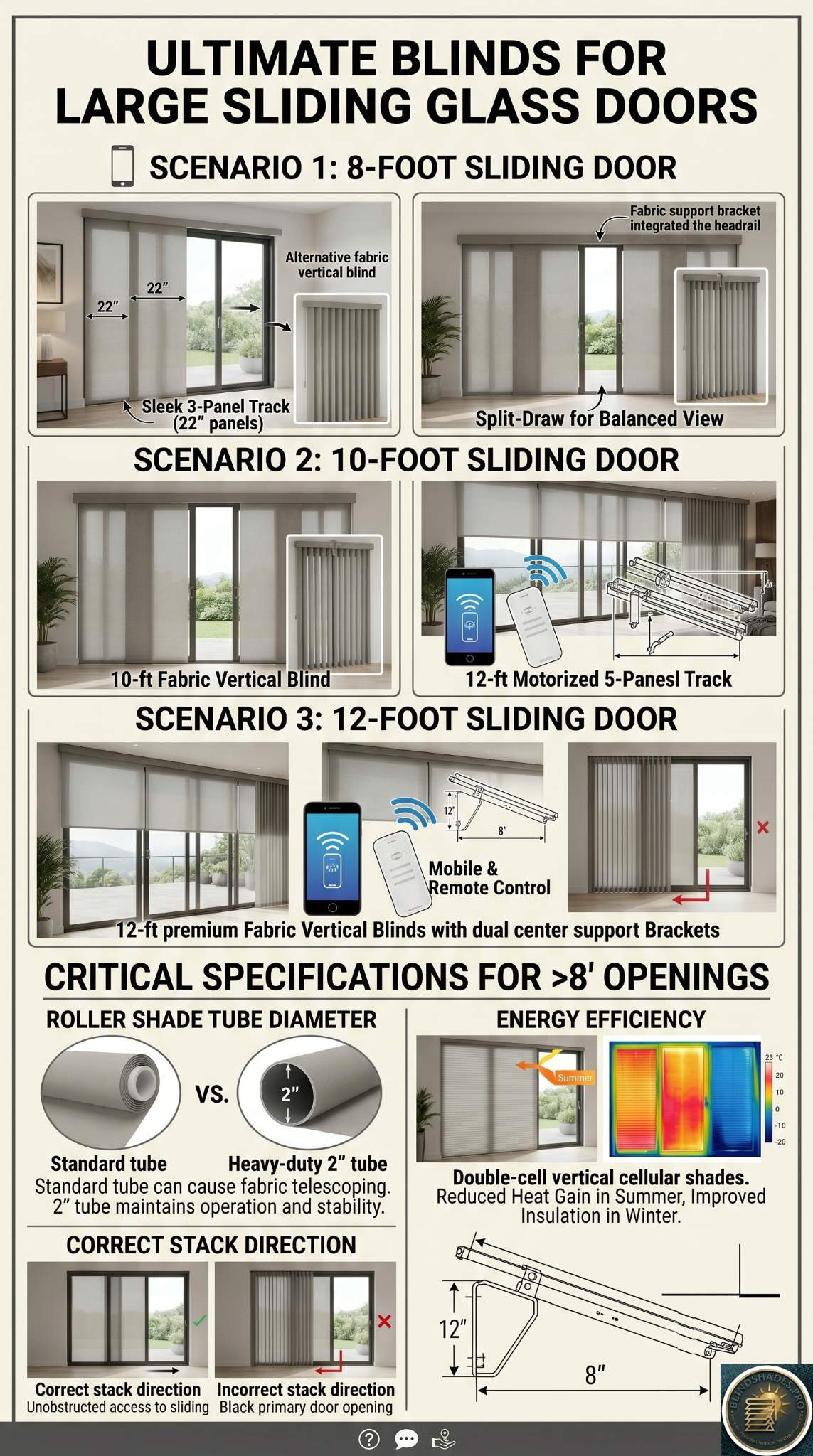
Key Takeaways:
- The width of a large sliding glass door determines which treatment is correct — there is a specific recommendation at each size breakpoint; under 8 feet = any vertical treatment works including standard vertical blinds, 3-panel panel track, or single roller shade; 8 to 10 feet = panel track is recommended over vertical blinds because panel track provides wider coverage per panel and reduces the number of components at risk of failure; 10 to 12 feet = split draw is required for vertical blinds (not optional), roller shades should be specified as two narrower panels to avoid the telescoping failure mode, and a center support bracket is needed on all headrails; 12 feet and wider = tandem/coupled roller shades or motorized panel track are required, and motorization transitions from convenient to effectively necessary for daily practical use
- The most common failure mode on wide single roller shades for large sliding glass doors is fabric telescoping — when a standard diameter roller tube (1.5 inches) spans more than approximately 8 to 10 feet, the fabric winds unevenly onto the tube as it rolls up, causing one side to rise higher than the other; the visible result is a blind that is perpetually crooked; the fix is a reinforced large-diameter tube at 2 to 2.5 inches, which is only available in custom-engineered wide-span roller shades, not retail off-the-shelf products; always confirm tube diameter before ordering any roller shade for an opening wider than 8 feet
- Double-cell vertical cellular shades provide a significantly greater energy saving on large sliding glass doors than anywhere else in the home; a standard window is approximately 18 square feet; a standard 6-foot by 8-foot sliding glass door is 48 square feet — 2.67 times larger; upgrading from single-cell (R-2) to double-cell (R-4) on a 48 square foot sliding glass door saves proportionally more energy than the same upgrade on a window; Blindsgalore confirms vertical cellular shades achieve R-values up to R-4 with double-cell construction
- For 10-foot and wider sliding glass door openings, fabric vanes are the correct specification over vinyl for mechanical durability reasons, not just aesthetics; a 12-foot opening requires approximately 34 vinyl vanes weighing 17 to 25 lbs total — at or above the rating of standard traverse mechanisms; fabric vanes for the same opening weigh approximately 10 to 15 lbs, which is within the safe operating range of standard mechanisms; at wide spans, vinyl vane weight can exceed mechanism capacity and cause premature carrier and traverse failure
- The split draw direction for triple-panel sliding glass doors must match the direction the sliding panel opens; triple-panel doors have two fixed panels and one sliding panel at one-third or two-thirds of the opening width; if the sliding panel opens to the right, the blind must be specified with a stack to the right (or split draw); a blind stacked to the wrong side requires traversing the full blind every time the door is used, which eliminates one of the primary operational advantages of vertical treatments for sliding glass doors
Related guides: for the full decision — the stack rule, draw direction, measuring and every treatment lane — see the complete sliding glass door blinds & shades guide.
⭐ Quick Answer — What Are the Best Blinds for Large Sliding Glass Doors?
- The Width Breakpoint Framework — What Changes at 8, 10, and 12 Feet: The best blind for a large sliding glass door is determined by the opening width — there is a specific recommendation at each size breakpoint. Under 8 feet: any vertical treatment works — standard vertical blinds with wand control, 3-panel panel track, or single roller shade with standard tube; no center support bracket needed. 8 to 10 feet: panel track is recommended over vertical blinds; Blindsgalore (March 2026) confirms “panel track blinds are best for wide sliding glass doors over 8 feet”; roller shades at this width require a minimum 2-inch diameter tube to prevent fabric telescoping. 10 to 12 feet: split draw is required (not optional) for vertical blinds and panel track; roller shades should be specified as two narrower panels (tandem/coupled system) rather than one wide shade; a center support bracket is required on all headrails to prevent center sag and vane tilt. 12 feet and wider: motorized panel track or motorized tandem/coupled roller shades are required — manual traversal of a 12-foot blind from one end is not practical for daily residential use; wand control traversal at this width requires walking 12 feet while pulling the treatment; Graywind confirms motorized panel track for widths up to 177 inches
- The Fabric Telescoping Failure — Why Wide Roller Shades Veer to One Side and How to Prevent It: The most common failure mode on large sliding glass door roller shades is fabric telescoping. PlantationShuttersHouston (April 2026) confirms: “When a roller shade is too wide for its internal tube, the fabric begins to ‘telescope’ or veer to one side as it rolls up.” Standard retail roller shade tubes are 1.5 inches in diameter — adequate for widths up to approximately 72 to 84 inches. At 10 feet (120 inches), a standard 1.5-inch tube is too long and too thin to resist the bending load of the fabric weight, causing the tube to bow slightly at the center. This bow makes the fabric wind faster at the bowing point, creating an uneven roll where one side rises higher than the other after 100 to 200 raise-lower cycles. The solution: reinforced large-diameter aluminum tubes at 2 to 2.5 inches. PlantationShuttersHouston confirms: “Custom blinds use reinforced, large-diameter aluminum tubes that resist bending under the weight of the fabric, ensuring the blind rolls up perfectly straight every time.” Before ordering any roller shade for a large sliding glass door opening wider than 8 feet, confirm the tube diameter. If the retailer cannot confirm a minimum 2-inch tube, do not purchase for this application
- The Tandem/Coupled Roller System and Center Support Bracket — Two Requirements Most Buyers Never Hear About: Two mechanical specifications for large sliding glass door blinds at 10+ feet that are absent from all competitor guides. (1) Tandem/coupled roller system: for openings wider than 10 to 12 feet, two separate roller shades are mounted side-by-side on a shared headrail/valance; both operate simultaneously from a single control — one cord or one motor; Yoolax confirms “Coupled Roller Shades provide synchronized lifting with one control, offering smooth fabric flow and a unified appearance”; PlantationShuttersHouston confirms “for wider areas, we use a coupled system to bridge the gap seamlessly.” The tandem system eliminates both the weight and tube-diameter constraints of a single super-wide shade — each shade covers approximately half the opening at a width where standard construction is reliable. (2) Center support bracket: vertical blind and panel track headrails spanning 10+ feet without a center support bracket sag 0.25 to 0.5 inches at the midpoint under the weight of the vanes or panels; this flexing tilts the carriers at the center of the span forward; the vanes attached to tilted carriers hang at an angle rather than vertically; in the closed position, the angled center vanes create visible light gaps; AAA Blind confirms: “if additional brackets are needed, space them evenly” from the end brackets positioned 3 inches from each end; for a 10-foot headrail: 3 brackets total (ends + 1 center at 60 inches); for a 12-foot headrail: 4 brackets total (ends + 2 intermediate at 48 and 96 inches)
- Vinyl vs Fabric Vanes at 10+ Feet — A Mechanism Durability Decision, Not an Aesthetic One: For large sliding glass doors 10 feet and wider, fabric vanes are the correct specification for mechanical durability reasons that every guide ignores when discussing vinyl vs fabric. A standard 89mm vinyl vertical blind vane at 84 inches height weighs approximately 0.7 lbs; a fabric vane of identical dimensions weighs approximately 0.4 lbs. For a 10-foot (120-inch) opening: approximately 34 vanes; vinyl total weight approximately 24 lbs; fabric total weight approximately 14 lbs. Standard traverse mechanism headrails are rated for approximately 15 to 20 lbs. At 34 vinyl vanes and 24 lbs, the mechanism operates at or above its capacity rating — not enough to fail immediately, but enough to cause accelerated wear that results in mechanism failure within 2 to 3 years of daily use at 10+ daily door cycles. At 34 fabric vanes and 14 lbs, the mechanism operates well within its safe rating and will reach its full design life. The rule: for all large sliding glass door vertical blind applications at 10 feet and wider, specify fabric vanes regardless of aesthetic preference; reserve vinyl for openings under 8 feet or where wipe-clean is the overriding priority. This weight consideration is entirely absent from all standard vinyl vs fabric vane guides
- The Energy Return and the Split Draw Direction — Two Final Specifications for Large Sliding Glass Doors: (1) Energy return on double-cell cellular shades: the energy case for double-cell over single-cell vertical cellular shades is proportionally larger on large sliding glass doors than anywhere else in the home; a standard bedroom window is approximately 18 square feet; a standard 6-foot by 8-foot patio sliding glass door is 48 square feet — 2.67 times larger; upgrading from single-cell (R-2) to double-cell (R-4) on a 48 square foot sliding glass door saves approximately 360 BTU per hour on a typical winter day — equivalent to running a 100-watt electric heater continuously just for this one door; Blindsgalore confirms double-cell vertical cellular shades achieve R-values up to R-4 for sliding glass door applications. (2) Split draw direction for triple-panel sliding doors: on a triple-panel sliding door (two fixed panels, one sliding), the sliding panel is at one-third or two-thirds of the opening width; always confirm which panel slides and which direction before specifying stack direction; a blind stacked on the wrong side requires traversing the full blind every time the door is used; if the sliding panel opens to the right, specify single stack right or split draw; never specify single stack left on a door where the sliding panel opens to the right. For the full installation protocol and bracket placement guide, see [How Do You Install Blinds on Sliding Glass Doors](/guide/install-sliding-glass-door-blinds/)
- Best Sources: Fabric telescoping on wide roller shades; reinforced 2.5-inch tubes; coupled system for 12+ feet; dual solar and blackout on one bracket → PlantationShuttersHouston custom roller blinds guide (April 2026) · Panel track best for 8+ feet; double cell R-4; 20% stack-back rule; split draw for center-open; motorized for wide spans → Blindsgalore panel track vs vertical vs horizontal guide (March 2026) · Coupled roller shades synchronized lifting; motorized sliding glass door systems; app and remote control → Yoolax motorized sliding glass door blinds
⚠️ Motorization Threshold — When Manual Operation Becomes Impractical on Large Sliding Glass Doors: Every guide mentions motorization as a convenience option for large sliding glass door blinds. No guide provides the actual width at which manual operation transitions from inconvenient to genuinely impractical. Graber Blinds acknowledges: “Because of their size, sliding doors require window treatments that are relatively tall, which means cords and other manual controls might be hard to reach for some people.” The practical assessment: under 96 inches (8 feet) = manual wand control fully practical, standard wand traverses full width in one sweep; 96 to 120 inches (8 to 10 feet) = manual is manageable, operator walks with the wand across the width, motorization is a convenience upgrade; 120 to 144 inches (10 to 12 feet) = manual wand traversal requires the operator to walk 10 to 12 feet while pulling, or position at the far end of the opening, motorization is strongly recommended; 144 inches and wider (12+ feet) = manual operation of any traversing blind system at this width is not practical for 10+ daily cycles, motorization is required not optional. Motorization options by system: vertical blinds = motorized traverse headrail from Bali or Hunter Douglas PowerView; panel track = motorized traverse rail from Yoolax or Graywind (up to 177 inches motorized width); roller shades = motorized tube motor from Yoolax, SmartWings, or Graywind; rechargeable battery or hardwired. See the full motorization assessment by width below.
💡 The Complete Treatment Recommendation by Opening Width — Quick Reference: For large sliding glass doors, the correct treatment specification changes at four width breakpoints. Under 72 inches: vertical blinds or 3-panel panel track; standard tube roller shade; no center support bracket; wand control adequate. 72 to 96 inches: panel track preferred; 3 panels at 24-inch width; roller shade with 2-inch tube recommended; center support bracket recommended for vinyl vanes. 96 to 120 inches: panel track with 4 to 5 panels and split draw; fabric vertical vanes (vinyl at 27+ vanes begins approaching mechanism weight limit); center support bracket required; tandem roller shade or single roller with 2-inch reinforced tube; motorization strongly recommended. 120 to 144 inches: motorized panel track (5 to 6 panels) or motorized tandem/coupled roller shades; center support brackets required (2 intermediate); fabric vanes only for vertical blinds (24+ vanes at vinyl weight exceeds standard mechanism rating); motorization required for daily practical use. 144 inches and wider: motorized panel track or motorized tandem roller shades; professional installation recommended for headrail alignment on spans over 12 feet. Top products by width: Graywind motorized panel track (manual up to 153 inches; motorized up to 177 inches; Alexa/Google Home/Apple HomeKit); Blindsgalore vertical cellular shades (12 to 192 inches; double-cell R-4); Yoolax motorized coupled roller shades (synchronized dual-panel operation); SelectBlinds panel track with MeasureSafe guarantee. For the panel count and panel junction calculation specific to wide sliding glass doors, see What Are the Best Panel Track Blinds for Sliding Glass Doors. See the full width breakpoint framework below.
📖 Read the complete guide below for: the width breakpoint framework (under 8ft/8-10ft/10-12ft/12+ft with specific treatment, panel count, tube spec, bracket count, and motorization changes at each), fabric telescoping on standard 1.5-inch roller tubes (reinforced 2-2.5 inch diameter required for 8+ feet; PlantationShuttersHouston April 2026 confirmed), the tandem/coupled roller system (two shades on shared headrail; synchronized control; seam position vs door stile; Yoolax confirmed), the center support bracket requirement (0.25-0.5 inch sag without support; forward-tilted carriers; light gaps at center; 3 brackets for 10-foot span; 4 for 12-foot), the motorization threshold (10ft = strongly recommended; 12ft = required; wand traverse impractical above 12ft), split draw direction for triple-panel doors (sliding panel at 33%/67%; wrong-side stack = traverse full blind every use), energy return quantified (48 sq ft = 2.67× window; double-cell R-4 saves 360 BTU/hr vs single-cell R-2), and vinyl vs fabric vane weight at wide spans (34 vinyl = 24 lbs; exceeds standard mechanism 15-20 lbs; 34 fabric = 14 lbs = within rating).
Best Blinds for Large Sliding Glass Doors — The Width Breakpoint Framework
The specification that changes at 8 feet, 10 feet, and 12 feet — absent from every buying guide.
<strong>Large sliding glass door blinds</strong> are not a single specification. What works correctly on a 6-foot standard patio slider fails on a 10-foot triple-panel slider and becomes impractical on a 12-foot stacking glass wall. The width breakpoints determine everything — treatment type, panel count, tube specification, support bracket placement, and whether motorization is optional or required.
Under 8 Feet (Standard 2-Panel Sliding Glass Door)
Most standard residential patio doors fall in this range: 60 inches (5 feet) to 84 inches (7 feet). Any vertical treatment works at this width:
- Vertical blinds: standard headrail; no center support bracket needed; wand control practical
- Panel track (3-panel): 22-inch panels for 66-inch opening; comfortable manual wand operation
- Single roller shade: standard tube diameter (1.5-inch) works for this width without telescoping risk
- Vertical cellular shades: standard headrail; wand control; single or double cell
Stack-back space required: 20% of total blind width = approximately 12 to 14 inches on one side for single stack, 6 to 7 inches on each side for split draw. Blindsgalore (March 2026) confirms: “plan for about 20% of your door width” for stacking space.
8 to 10 Feet (Wide 2-Panel or Narrow Triple-Panel)
At this width, standard specifications begin to have performance limitations. Blindsgalore confirms: “Panel track blinds are best for wide sliding glass doors over 8 feet.”
Panel track (3–4 panels) — preferred at this width: Three or four panels of 20 to 24 inches each cover this width with fewer individual components than vertical blinds. Fewer components = fewer points of mechanical failure at a width that will see thousands of traversal cycles over its service life.
Vertical blinds at this width: At 96 to 120 inches, a vertical blind headrail starts to benefit from a center support bracket. Without one, the headrail can flex slightly under the weight of approximately 22 to 28 vinyl vanes, causing the center vanes to lose their vertical alignment and allowing light gaps to form at the center of the opening.
Roller shades at this width: A single roller shade at 96 to 120 inches requires a tube diameter larger than the standard retail 1.5-inch. Specify minimum 2-inch tube diameter to prevent the fabric telescoping failure mode (see below). PlantationShuttersHouston (April 26, 2026) confirms: “Custom roller blinds can often span up to 12 or 14 feet in a single unit using heavy-duty industrial tubes.”
Stack-back space required: 20% of 96 to 120 inches = 19 to 24 inches for single stack. Split draw reduces this to 10 to 12 inches per side.
10 to 12 Feet (Triple-Panel or Wide 2-Panel)
At this width, several specifications that were optional below 8 feet become required.
Panel track (4–5 panels) — optimal specification at 10 to 12 feet: For a 120-inch (10-foot) opening: 5 panels × 24 inches = 120 inches. Panel junctions at 24, 48, 72, 96 inches. The sliding panel stile on a triple-panel door falls at approximately 40 inches or 80 inches. Verify no panel junction falls within 3 inches of the stile position. For a 144-inch (12-foot) opening: 6 panels × 24 inches — an even number for split draw center-open configuration.
Vertical blinds — fabric vanes required at 10+ feet (see weight section): Approximately 28 to 34 vanes at this width. Center support bracket required for both 10-foot and 12-foot headrails. Motorization strongly recommended (see motorization threshold section below).
Roller shades — specify two narrower panels, not one wide: For openings of 10 to 12 feet, a tandem/coupled roller system is the correct specification — two roller shades on a shared headrail that operate synchronously. Yoolax confirms: “Coupled Roller Shades provide synchronized lifting with one control, offering smooth fabric flow and a unified appearance.” This eliminates the telescoping risk on wide single shades while maintaining a unified appearance.
Stack-back space required: 20% of 120 to 144 inches = 24 to 29 inches for single stack. At this width, split draw is the practical default — 12 to 14 inches per side.
12 Feet and Wider (Stacking Glass Doors, Bi-Fold Glass Walls)
At 12 feet and beyond — three-panel stacking systems, four-panel bi-fold glass walls, corner glass door installations — standard residential blind specifications no longer apply.
Motorized panel track — the default specification at 12+ feet: Manual wand traversal of a 12+ foot panel track from one end of the opening is physically impractical for daily use. For a 12-foot opening, the person operating the blind must walk across 12 feet while pulling the wand, or position themselves at the far end — neither is a viable daily routine. Motorized traversal is effectively required at this width.
Tandem/coupled roller shades: PlantationShuttersHouston confirms: “For wider areas, we use a ‘coupled’ system to bridge the gap seamlessly.” Two separate roller shades mounted side-by-side, operated by a single motor or synchronized cord, cover the full 12+ foot opening without the weight or tube-diameter limitations of a single super-wide shade.
Vertical blinds at 12+ feet: Technically possible but increasingly impractical. 34+ vinyl vanes weighing 17–25 lbs total approaches or exceeds standard traverse mechanism ratings. Two center support brackets required for a 144-inch span. Motorization required.
For the complete installation protocol once your treatment is selected, see How Do You Install Blinds on Sliding Glass Doors.
The Fabric Telescoping Problem — Why Wide Roller Shades Fail Without the Right Tube
The most common failure mode on large sliding glass door roller shades — absent from every guide.
PlantationShuttersHouston (April 2026) identifies this directly: “When a roller shade is too wide for its internal tube, the fabric begins to ‘telescope’ or veer to one side as it rolls up.”
What telescoping looks like: A roller shade that telescopes raises unevenly — one side winds faster onto the tube than the other. The blind does not raise in a straight horizontal line. After 100–200 raise-lower cycles, the fabric is visibly angled when raised, with one side several inches higher than the other. The shade may also bind in the brackets when raised because the fabric roll is uneven.
Why it happens: Standard retail roller shade tubes are 1.5 inches in diameter. A 1.5-inch tube is adequate for widths up to approximately 72 to 84 inches. As width increases, the tube length increases, and the tube’s resistance to flexing decreases. A longer, thinner tube bends slightly under the weight of the fabric at the center of the span. This slight bow causes the fabric to wind faster at the bowing point, creating an uneven roll.
The solution: Reinforced large-diameter tubes at 2 to 2.5 inches diameter. PlantationShuttersHouston confirms: “Custom blinds use reinforced, large-diameter aluminum tubes that resist bending under the weight of the fabric, ensuring the blind rolls up perfectly straight every time.”
The practical specification rule:
- Under 72 inches: standard 1.5-inch tube; any retailer
- 72–96 inches: 1.75-inch tube recommended; confirm before ordering
- 96–120 inches: 2-inch tube required; custom only
- 120+ inches: tandem/coupled system preferred; if single, 2.5-inch tube minimum
Budget and off-the-shelf roller shades for large sliding glass doors almost never specify tube diameter. Always ask the retailer: “What is the tube diameter on a roller shade at this width?” If they cannot confirm a minimum 2-inch tube for a 10-foot wide shade, do not purchase for this application. For the full roller shade specification for sliding glass doors, see Are Roller Shades Good for Sliding Glass Doors.
The Tandem/Coupled Roller System — What It Is and When to Specify It
The large-opening roller shade solution most guides name but none explain.
A tandem or coupled roller shade system consists of two separate roller shades mounted side-by-side on a single continuous headrail/valance. Each shade covers half the opening independently but both operate from a single control — one cord or one motor raises and lowers both shades simultaneously, maintaining a unified appearance.
When to specify tandem vs single:
| Opening Width | Specification | Reason |
|---|---|---|
| Under 84 inches | Single roller shade | Standard tube sufficient; single operation |
| 84–120 inches | Single with 2-inch tube (custom) | Reinforced tube prevents telescoping |
| 120–144 inches | Tandem/coupled OR single with 2.5-inch tube | Weight and tube limits approach; tandem eliminates both |
| 144+ inches | Tandem/coupled required | No practical single-unit solution at this width |
The visual difference: A tandem system has a visible seam at the center where the two shades meet. At 144 inches (12 feet), this seam falls at 72 inches — the center of the opening. On a triple-panel sliding glass door where the door stile is already visible at this location, the seam is hidden by existing door hardware. On a 2-panel wide slider without a visible center stile, the seam is visible when the shades are lowered.
The coupled operation advantage: Yoolax confirms: “Coupled Roller Shades provide synchronized lifting with one control, offering smooth fabric flow and a unified appearance.” The synchronization means both shades rise to exactly the same height every time — no manual adjustment needed to maintain visual alignment between the two shade panels.
The Center Support Bracket — When Required and Where to Position
The installation detail that prevents headrail sagging on 10+ foot openings — absent from all buying guides.
Vertical blind and panel track headrails are aluminum extrusions designed to span their rated width without deflection. However, the weight of the vanes or panels hanging from the headrail creates a distributed downward load. At wide spans, this load causes the headrail to flex slightly at the center.
The consequence of center headrail sag: For vertical blinds: when the headrail sags 0.25 to 0.5 inches at the center, the carriers at the center of the span tilt forward instead of hanging vertically. The vanes attached to tilted carriers do not hang straight — they angle slightly away from the door. When the vanes are in the closed position, the tilted center vanes create a visible light gap at the center of the blind.
When center support brackets are required:
- Under 96 inches (8 feet): not typically required for standard vane weights
- 96 to 120 inches (8 to 10 feet): recommended for vinyl vane installations; optional for fabric vane installations
- 120+ inches (10+ feet): required for all vane materials
How to position center support brackets: AAA Blind and Shutter Factory confirms: “Place one bracket at each end of the headrail, about 3 inches in from the ends. If additional brackets are needed, space them evenly.”
For a 120-inch (10-foot) headrail: end brackets at 3 inches from each end + one center bracket at 60 inches = three brackets total. For a 144-inch (12-foot) headrail: end brackets + two intermediate brackets at 48 inches and 96 inches = four brackets total.
The center support bracket mounts to the wall above the sliding door frame — it supports the underside of the headrail at the midpoint without interfering with the traversal of vanes or panels through that position.
The Motorization Threshold — At What Width Does Manual Become Impractical?
The practical operational limit absent from every large sliding glass door guide.
Graber acknowledges: “Because of their size, sliding doors require window treatments that are relatively tall, which means cords and other manual controls might be hard to reach for some people.” But no guide provides the specific width at which manual operation transitions from inconvenient to impractical.
The practical assessment by width:
Under 96 inches (8 feet): Manual wand control is fully practical. A standard wand traverses the full width from one side of the door in a single sweep.
96–120 inches (8–10 feet): Manual wand control is manageable but requires the operator to walk with the wand across the width. For a single-blind operation, this is acceptable. If the door is operated 10+ times per day, the walk adds up. Motorization is a convenience upgrade, not a requirement.
120–144 inches (10–12 feet): Manual wand traversal of a panel track or vertical blind from one end requires the operator to walk 10 to 12 feet while pulling. For a panel track, 4 to 5 panels must be pulled one by one or via a continuous cord. For vertical blinds, the wand sweep covers the full width but the operator must be positioned correctly. Motorization is strongly recommended at this width.
144+ inches (12+ feet): Manual operation of any traversing blind system at this width is not practical for daily residential use. A 12-foot blind traversed from one end requires either: (a) walking the length while pulling, or (b) using a long extension wand. Neither is realistic for 10+ daily operations. Motorization is required, not optional.
Motorization options by system:
- Vertical blinds: motorized traverse headrail (Bali, Hunter Douglas PowerView, Somfy); remote, app, or voice control
- Panel track: motorized traverse rail (Yoolax, Graywind); compatible with Alexa, Google Home, Apple HomeKit
- Roller shades: motorized tube motor (Yoolax, SmartWings, Graywind); rechargeable battery or hardwired
Split Draw Direction for Triple-Panel Sliding Glass Doors
The specification most buyers get wrong — and why it makes the blind impractical to use.
Standard 2-panel sliding glass doors have one fixed panel and one sliding panel. The sliding panel opens to one side. The blind stack direction should match the opening direction — stack where the door opens, so the blind clears the active door zone when traversed.
Triple-panel sliding glass doors: Triple-panel systems (2 fixed + 1 sliding, or 1 fixed + 2 sliding) are increasingly common in open-plan living rooms and bedroom-to-patio transitions. On a 12-foot triple-panel with 4-foot panels, the sliding panel is at one-third or two-thirds of the opening width.
The wrong-side stack problem: If the sliding panel opens to the right (the right 4-foot panel slides right and stacks behind the center panel) and the blind is specified with single stack to the left, the operator must: traverse the entire blind from left to right before the right door panel can open without contacting the blind. Every single time. If the sliding panel opens to the right and the blind is specified with single stack to the right, the operator only needs to traverse the right-side third of the blind — a much shorter sweep.
The specification rule:
- Confirm which panel slides and which direction it opens
- Specify single stack on the same side as the opening direction
- For 2-panel sliding doors where either panel slides: specify split draw (center-open) to maximize flexibility
For the full panel count and junction position calculation for sliding glass doors, see What Are the Best Panel Track Blinds for Sliding Glass Doors.
The Energy Return Calculation — Why Double Cell Matters More on Large Sliding Doors
The proportional energy case for cellular shades on large glass surfaces — absent from all guides.
Every guide mentions that cellular shades are more energy efficient than other blind types. None quantifies why large sliding glass doors specifically are the most important application for double-cell construction.
The glass area mathematics:
- Standard bedroom window: 36 × 48 inches = 12 square feet of glass
- Standard patio sliding glass door: 72 × 96 inches = 48 square feet — 4× larger
- Wide 10-foot sliding glass door: 120 × 96 inches = 80 square feet — 6.7× larger
The heat transfer calculation: Heat loss or gain through glass = area × (temperature difference) ÷ R-value
For a 48 square foot sliding glass door on a day when the outdoor temperature is 30°F colder than indoor:
- Single-cell cellular shade (R-2): 48 × 30 ÷ 2 = 720 BTU/hour heat loss
- Double-cell cellular shade (R-4): 48 × 30 ÷ 4 = 360 BTU/hour heat loss
- Savings: 360 BTU/hour — equivalent to running a 100W electric heater just for this one door
For a standard 12 square foot window with the same calculation: the savings are 90 BTU/hour — four times less. The energy case for double-cell over single-cell is four times stronger on a standard patio sliding glass door than on a typical window.
Blindsgalore confirms: double-cell vertical cellular shades achieve “R-values up to R-4” for sliding glass doors. This is the treatment where the upgrade from single-cell to double-cell delivers its maximum return.
Vinyl vs Fabric Vanes — The Weight Specification for 10+ Foot Openings
Why fabric vanes are the mechanical requirement at wide spans — not just an aesthetic preference.
Most guides discuss vinyl vs fabric vanes in terms of aesthetics (vinyl = utilitarian, fabric = elegant) and cleaning (vinyl = wipe-clean, fabric = vacuum). Neither frame the weight consideration that applies specifically to large sliding glass doors.
The weight calculation: A standard 89mm (3.5-inch) vinyl vertical blind vane at 84 inches height weighs approximately 0.7 lbs. A fabric vane of the same dimensions weighs approximately 0.4 lbs.
| Opening Width | Vane Count (approx) | Vinyl Total Weight | Fabric Total Weight | Mechanism Rating |
|---|---|---|---|---|
| 72 inches | 20 vanes | 14 lbs | 8 lbs | Standard: 15–20 lbs ✅ |
| 96 inches | 27 vanes | 19 lbs | 11 lbs | Standard: 15–20 lbs ⚠️ |
| 120 inches | 34 vanes | 24 lbs | 14 lbs | Standard: 15–20 lbs ❌ |
| 144 inches | 41 vanes | 29 lbs | 16 lbs | Heavy-duty required ❌/✅ |
The practical implication: for a 10-foot (120-inch) large sliding glass door with vinyl vanes, the total vane weight of approximately 24 lbs exceeds the standard traverse mechanism’s rated capacity. The traverse mechanism will function initially but will experience accelerated wear and earlier failure — typically within 2 to 3 years of daily use. With fabric vanes at the same width (14 lbs), the mechanism operates within its safe rating and will last its full design life.
The specification: For all large sliding glass door vertical blind applications at 10 feet and wider, specify fabric vanes regardless of aesthetic preference. Reserve vinyl for openings under 96 inches or for applications where wipe-clean is the priority over mechanism longevity.
The Complete Treatment Recommendation by Opening Width
| Opening Width | Best Treatment | Panel/Vane Spec | Motorization | Center Support |
|---|---|---|---|---|
| Under 72 inches | Vertical blinds OR panel track | 3 panels or 20 vanes | Optional | No |
| 72–96 inches | Panel track preferred | 3 panels × 24 inches | Optional | Recommended |
| 96–120 inches | Panel track OR fabric vertical | 4–5 panels; fabric vanes | Strongly recommended | Required (1 center) |
| 120–144 inches | Motorized panel track OR tandem roller | 5–6 panels or 2 rollers | Required | Required (2 centers) |
| 144+ inches | Motorized panel track OR motorized tandem roller | 6+ panels or 2+ rollers | Required | Required |
Top Products for Large Sliding Glass Doors
Graywind Manual/Motorized Panel Track — Best for 8–12 Foot Openings
Manual panel track up to 153 inches wide; motorized up to 177 inches; Alexa, Google Home, Apple HomeKit compatible; 21 color options in fabric, solar, and blackout. The motorized variant is the practical default for 10+ foot large sliding glass doors where manual traversal is no longer ideal. Confirmed by blog.graywindblinds.com (September 2025).
Blindsgalore Vertical Cellular Shades — Best Energy Performance on Large Glass
Vertical cellular shades accommodating widths from 12 to 192 inches; single and double cell construction; double cell R-value up to R-4; motorized wand option; blackout and light-filtering fabrics. The double-cell specification delivers its maximum energy return on large 8+ foot sliding glass door glass areas. Blindsgalore product page confirmed.
Yoolax Motorized Coupled Roller Shades — Best for 12+ Foot Openings
Motorized coupled/tandem roller shades; synchronized control for dual-roller applications; app, remote, and voice control; appropriate for 12-foot and wider large sliding glass door openings where a single-unit roller shade is not practical. Yoolax confirmed for sliding glass door applications.
SelectBlinds Panel Track — Best Custom Value with MeasureSafe
Custom-built panel tracks with MeasureSafe measurement guarantee (free remake for sizing errors); wand control standard; available in light-filtering, room-darkening, and blackout fabrics; appropriate for 8 to 12 foot large sliding glass door applications. See our complete guide: What Are the Best Panel Track Blinds for Sliding Glass Doors.
Related guides: For complete buying advice, see our ceiling track systems guide.
Frequently Asked Questions
What are the best blinds for large sliding glass doors? The best blind for a large sliding glass door depends on the width. For 8 to 10 foot openings, panel track blinds are the top recommendation — Blindsgalore confirms panel track is best for wide sliding glass doors over 8 feet. For 10 to 12 foot openings, motorized panel track or tandem/coupled roller shades are correct. For 12 feet and wider, motorized traversal is required for daily practical use. All large sliding glass door openings over 10 feet benefit from fabric vanes over vinyl for mechanical durability, and double-cell vertical cellular shades for maximum energy return.
What is the widest single roller shade I can order for a large sliding glass door? PlantationShuttersHouston confirms custom roller blinds can span up to 12 to 14 feet in a single unit using reinforced heavy-duty industrial aluminum tubes of 2.5-inch diameter. For retail products, most roller shades max out at 96 to 120 inches without a reinforced tube, and fabric telescoping is a common failure mode beyond 84 inches on standard 1.5-inch tubes. Always confirm the tube diameter before ordering any roller shade for an opening wider than 8 feet.
Why do vertical blinds sag in the middle on large sliding glass doors? Vertical blind headrails sag at the center when the headrail spans more than approximately 8 to 10 feet without a center support bracket. The weight of 28 to 34 vanes creates a distributed downward load that causes the aluminum headrail to flex slightly at the midpoint. This flexing tilts the central carriers forward, causing those vanes to hang at an angle rather than vertically. The fix is a center support bracket mounted to the wall above the door frame at the headrail midpoint.
Should I use vinyl or fabric vanes for large sliding glass door vertical blinds? For large sliding glass doors 10 feet and wider, specify fabric vanes rather than vinyl. Vinyl vanes for a 10-foot opening weigh approximately 19 to 24 lbs total — approaching or exceeding the rated capacity of standard traverse mechanisms. Fabric vanes at the same width weigh approximately 11 to 14 lbs, which is within the safe operating range of standard mechanisms. Fabric vanes in wide-span installations last significantly longer before mechanism failure, regardless of aesthetic preference.
Do I need motorized blinds for a large sliding glass door? Motorization is strongly recommended for openings 10 feet and wider, and effectively required for openings 12 feet and wider. For a 12-foot sliding glass door, manually traversing a panel track or vertical blind from one end requires walking 12 feet while pulling the treatment — this is not practical for 10 or more daily operations. Motorized systems with remote, app, or voice control eliminate this operational burden entirely.
Related Guides on BlindShades.pro
- The Best Sliding Glass Door Blinds & Shades Buying Guide
- How Do You Measure Sliding Glass Door Blinds
- What Are the Best Panel Track Blinds for Sliding Glass Doors
- Are Roller Shades Good for Sliding Glass Doors
- What Are the Best Blackout Blinds for Sliding Glass Doors
- How Do You Install Blinds on Sliding Glass Doors
By Michael Turner | 30 Years Home Improvement Expertise | Updated 2026 | BlindShades.pro
