Are Vertical Blinds Still Good for Sliding Glass Doors?

Authored By Michael Turner -30 Years Home Improvement Expertise | Updated 2026 | BlindShades.pro
Updated on July 15, 2026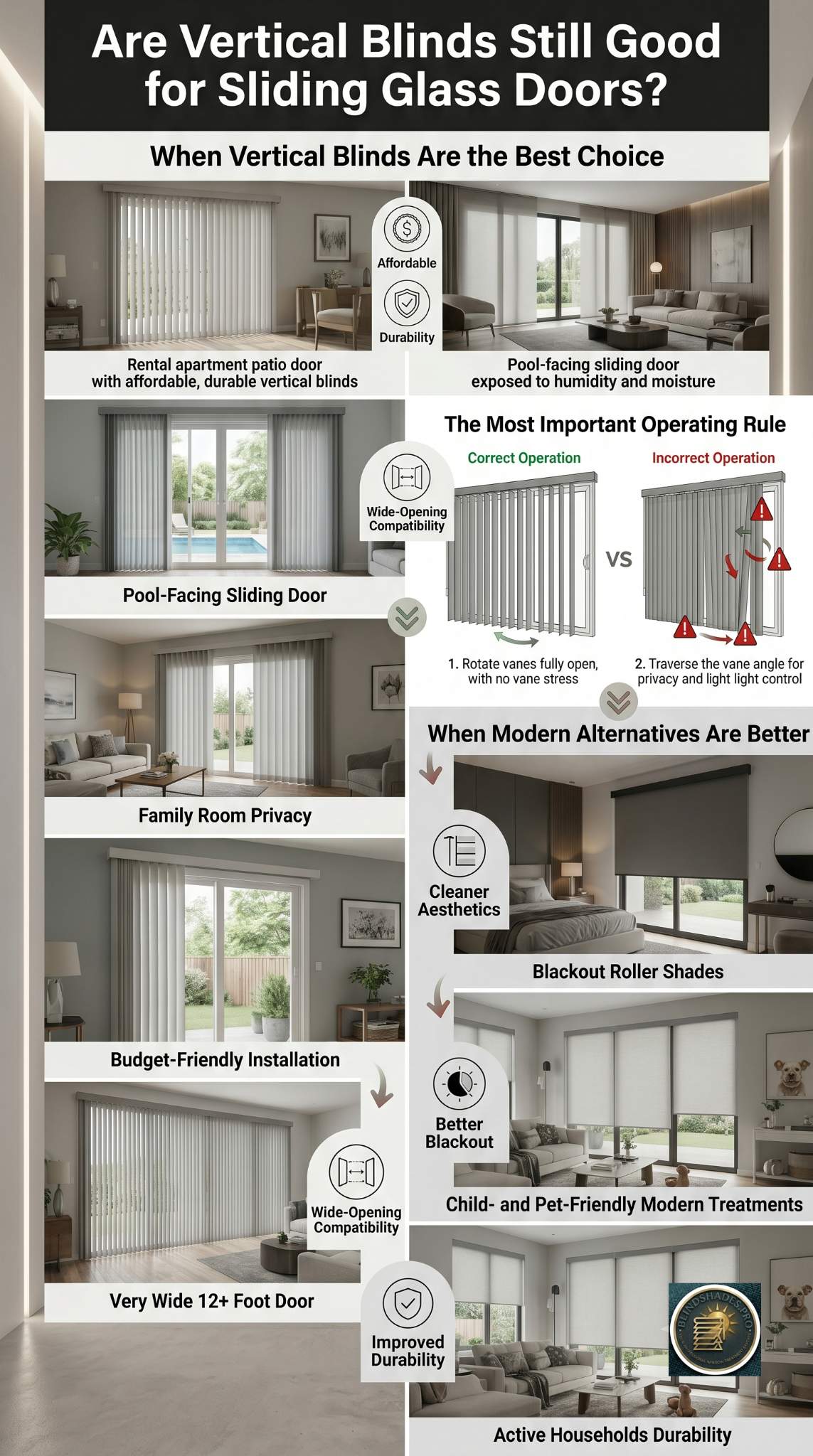
Key Takeaways:
- Vertical blinds for sliding glass doors are still good in 2026 for five specific scenarios: budget-conscious patio doors ($30–100 total); rental or flip properties where individual $5–25 vane replacements are cost-effective; high-humidity and pool-facing doors where vinyl is the only wipe-clean water-resistant option at low cost; very wide openings of 12 feet or more where vertical blinds span up to 192 inches in a single headrail without motorization; and rooms where adjustable partial privacy through the day is the primary goal — the rotatable vane is the only sliding glass door treatment that provides infinitely variable privacy without raising or lowering the entire blind
- The most critical vertical blind operating rule that prevents the most common failure: always rotate the vanes to the fully open position (perpendicular to the glass) before traversing; Fix My Blinds confirms “first, make sure to fully tilt the vanes to the open position before trying to draw them across the window”; traversing partially tilted vanes forces the resistance of adjacent angled vanes through the plastic carrier stem — the weakest component in the system — which causes the stem to snap at its base; this is the most common vertical blind failure on sliding glass doors and it is entirely preventable by following the correct sequence every time: (1) rotate to full open, (2) traverse, (3) rotate to desired angle
- The rattle and clacking noise that makes homeowners replace vertical blinds is caused by three distinct mechanisms — each with a different fix: vane-to-vane clacking from air displacement when the door opens is fixed by specifying a bottom connector chain (keeps vanes flat); carrier-to-headrail grinding when traversing is fixed by specifying a quality headrail with self-lubricating aluminum components (Blindsgalore confirmed); floor-level spacer chain rattling from door vibration is fixed by foam-lined chain; understanding which of these three is occurring leads directly to the correct fix rather than a full replacement
- S-curve vanes interlock adjacent vane edges when closed, reducing the light gap at each vane junction by approximately 50% compared to flat vanes; Blinds Chalet confirms S-curve vanes provide “a drapery-like look and tighter closure”; for living room patio doors where aesthetics matter and daytime blackout performance is a priority, S-curve is the correct specification; for high-traffic sliding glass doors traversed 10+ times per day, flat vanes are more forgiving because the S-curve interlocking edge creates more friction during rapid traversal and increases carrier stem stress
- Vertical blinds are NOT the best choice for sliding glass doors in three scenarios: premium modern living spaces where the aesthetic goal is a contemporary, minimalist look (panel track blinds are the correct specification for this use case); bedroom patio doors that require complete blackout for sleeping — even S-curve vinyl vanes allow visible light at vane edges that cellular shades or blackout roller shades do not; and homes where children or pets regularly handle the vanes directly (physical bending of vinyl vanes by a child or pet is the most common physical damage mode and is not repairable — bent vanes must be replaced)
⭐ Quick Answer — Are Vertical Blinds Still Good for Sliding Glass Doors?
- The Most Important Vertical Blind Operating Rule — Breaking It Causes the Most Common Failure: Vertical blinds for sliding glass doors have one non-negotiable operating rule: always rotate the vanes to the fully open position (perpendicular to the glass) before traversing the wand to move the vanes across the door. Fix My Blinds confirms: “First, make sure to fully tilt the vanes to the open position before trying to draw them across the window.” The mechanical reason: when vanes are partially tilted at 30 to 60 degrees and the user pulls the wand to traverse, each vane encounters resistance from the adjacent partially-tilted vane it must push past; this resistance transfers through the plastic carrier stem — the narrow plastic hook connecting the carrier to the vane’s top slot — at approximately 3 to 5 Nm of torque; at this force level, the standard plastic stem snaps at its base; the vane falls; the same failure happens on the next stem if the rule continues to be ignored. Stoneside confirms the carrier stem connection as the component “where the vane got caught in your patio door and cracked.” The correct sequence every time: (1) rotate to full open position; (2) traverse to desired stack position; (3) rotate to the desired tilt angle. Fifteen seconds. Prevents the most common mechanical failure on sliding glass door vertical blinds
- Bottom Chain vs No Chain — The Specification That Stops Vane Billowing on Sliding Glass Doors: Standard vertical blinds for sliding glass doors ship with no connector between vane bottoms. When the sliding door is opened quickly, the air displacement pressure wave hits the hanging vanes and pushes them outward in an arc — typically 4 to 8 inches from the door face. The billowing vanes swing back and contact adjacent vanes, causing the “clacking” noise most associated with vertical blinds, and over time the repeated swinging causes vanes to misalign from their carrier clips. The bottom chain solution: a connector chain runs horizontally along all vane bottoms, linking them together; the chain constrains vane movement so vanes cannot billow outward when the door opens; Blinds Chalet confirms this is available as an option on heavy-duty headrails. The trade-off: the bottom chain creates a physical element at floor level across the full opening width; for households with young children (trip hazard), cats (the chain becomes a toy and suffers damage), and elderly or mobility-limited occupants (trip hazard), the bottom chain should be omitted; for homes without these concerns, always specify the bottom chain on sliding glass door vertical blinds; tall vanes (90+ inches) have more pendulum swing than shorter vanes and benefit more significantly from the bottom chain
- S-Curve vs Flat Vanes and 89mm vs 127mm Width — Two Specification Decisions No Guide Addresses: Two vertical blind sliding glass door specifications absent from all competitor guides. (1) S-curve vs flat vanes: flat vanes create a straight wall of vinyl or fabric when closed, with a small light gap at each vane junction; S-curve vanes have an S-shaped cross-section that causes adjacent vane edges to interlock when closed, reducing the light gap at each junction by approximately 50%; Blinds Chalet confirms S-curve vanes “interlock for tighter closure and a drapery-like look, reducing light gaps while creating softer, flowing lines on large spans.” For living room patio doors where aesthetics and light closure matter: S-curve is the correct specification. For high-traffic sliding glass doors traversed 10 or more times per day: flat vanes are more forgiving because the S-curve interlocking edge creates more friction during traversal, adding carrier stem stress at high cycle counts. (2) 89mm vs 127mm vane width: standard 89mm (3.5-inch) vanes produce approximately 17 vanes per 60-inch opening; wider 127mm (5-inch) vanes produce approximately 12 vanes per 60-inch opening; fewer vanes means 29% fewer carrier stems and 29% fewer traversal failure points on a standard door — a meaningful durability advantage on high-traffic patio doors; 127mm vanes also give a more modern, panel-track-like appearance when open; 89mm provides finer light-angle control increments (more vanes equals more gradual privacy adjustment)
- The Rattle Noise Diagnostic — Three Causes, Three Different Fixes: The clacking and rattling that leads homeowners to replace otherwise functional vertical blinds for sliding glass doors comes from three distinct sources — each requiring a different fix. (1) Vane-to-vane clacking from air displacement when the door opens: the fix is a bottom connector chain that keeps vane bottoms aligned and prevents the outward swing that causes contact. (2) Carrier grinding when traversing: a grinding or scraping resistance when pulling the traversal wand indicates worn or low-quality carrier mechanisms without self-lubricating properties; Blindsgalore confirms “hardware quality matters more than most people realize — a smooth, quiet headrail is the difference between vertical blinds you love and vertical blinds that drive you crazy” — the fix is upgrading to a quality headrail with aluminum construction and self-lubricating components; short-term: apply silicone spray lubricant (not WD-40, which attracts dust) to the headrail track. (3) Floor-level chain rattling from door vibration: when the bottom chain is present and the door creates vibration, the metal chain contacts vane edges at floor level; the fix is foam-lined or fabric-wrapped chain that cushions metal-to-vane contact. Identifying which of these three is occurring leads directly to the correct fix and prevents an unnecessary full replacement
- Energy Performance and the 5-Scenario Worth-It Verdict: Vertical blinds for sliding glass doors add approximately R-1.0 to R-1.5 to a double-pane door (total R-2.0 to R-2.5 with the glass); vertical cellular shades (single cell) achieve approximately R-3.5, saving approximately 160 BTU per hour more than vinyl vertical blinds on a standard 48 square foot patio door — a price premium payback of approximately 3 to 5 years. Standard vinyl verticals and panel track fabric panels perform nearly identically for energy. The worth-it verdict by scenario: vertical blinds are STILL THE BEST CHOICE for: budget patio doors ($30 to $100 total — no treatment matches this price-to-coverage ratio); rental or flip properties (individual $5 to $25 vane replacements make them the lowest-cost-to-maintain option); high-humidity or pool-facing doors (vinyl is the only wipe-clean water-resistant treatment at low cost; cellular shades trap moisture and roller shade fabrics can mold); very wide openings of 12 feet or more (Blindsgalore confirms vertical blinds span up to 192 inches without motorization); rooms needing daily adjustable partial privacy (the rotatable vane is the only sliding glass door treatment providing variable privacy without raising or lowering the full blind). Vertical blinds are NOT the best choice for: premium modern living spaces (panel track is the correct specification); bedroom patio doors requiring true blackout (even S-curve vanes allow light at edges); homes where children or pets physically handle the vanes (physical bending of vinyl vanes is permanent and not repairable)
- Best Sources: Aluminum headrails with self-lubricating components; wand handles rotation and traversal; heavy-duty headrail with metal pinions; vinyl 3.5-inch in 10+ colors; custom ship 5-7 days → Blindsgalore vertical blinds for sliding glass doors · Best when opening is wide and frequently used; miss for blackout-required or fabric-forward; vinyl = durability; practical vs modern alternative comparison → Better Blinds Plus vertical blinds for sliding glass doors (March 2026) · Always tilt to open before traversing; carrier gear failure; spacer strap train break; wand tilt mechanism repair guide → Fix My Blinds vertical blind troubleshooter
⚠️ Carrier Stem Lifespan by Traffic Level — Specifying the Right Hardware Before It Fails: Fix My Blinds confirms the practical consequence of carrier stem failure on vertical blinds for sliding glass doors: “Finding the correct carrier with the same turning ratio as existing parts is very difficult — we recommend hiring a professional repair person or purchasing a new headrail.” The implication: when carrier stems fail, headrail replacement is often the only practical fix. Specifying the correct hardware upfront based on door traffic frequency prevents this. Standard plastic carrier stems are rated for approximately 15,000 open-close cycles — at 10 daily door cycles, approximately 4 years before failure risk increases significantly. Reinforced composite carrier stems are rated for approximately 30,000 or more cycles — approximately 8 or more years at the same usage. Vinyl vanes at 0.7 pounds each create more carrier stem stress than fabric vanes at 0.4 pounds per vane, which is why fabric vanes are the mechanical requirement (not merely aesthetic preference) at 10+ foot opening widths. Blinds Chalet confirms: “Look for a heavy-duty headrail with self-aligning carriers and metal pinions for smooth rotation — quality tracks improve vane alignment, reduce jamming, and extend lifespan especially on wide doors.” Traffic-based specification: under 5 daily cycles = standard headrail with plastic stems; 5 to 10 cycles = standard to mid-grade; 10 to 15 cycles = heavy-duty headrail with reinforced composite carriers; 15 or more cycles per day = heavy-duty commercial-grade headrail with metal pinion carriers and fabric vanes. Blinds Chalet also confirms: “Order extra vanes at the time the order is placed” — replacement vanes may not match if the original colour is discontinued. See the full carrier stem lifespan table below.
💡 The 3 Scenarios Where Vertical Blinds Are NOT the Best Choice — With the Correct Alternative for Each: Vertical blinds for sliding glass doors fail three specific use cases — and all three have a better alternative. (1) Premium modern living space: flat vinyl vanes clacking against each other in an open-plan living room conflict with a contemporary minimalist aesthetic; the correct specification is panel track blinds — wide fabric panels slide quietly on a ceiling or wall-mounted track, creating clean architectural lines with no individual vanes; panel tracks cost more ($80 to $200+) but deliver the modern appearance that vertical blinds cannot; see [What Are the Best Panel Track Blinds for Sliding Glass Doors](/guide/panel-track-blinds-sliding-glass-doors/). (2) Bedroom patio door requiring true blackout: even S-curve vinyl vanes in a full outside-mount overlap allow visible light at vane edges in a completely dark room; for a sleeping environment where complete darkness is required, the correct specification is a blackout roller shade or blackout cellular shade where the opaque fabric physically blocks all light without the structural gaps inherent in a multi-vane system; Better Blinds Plus (March 2026) confirms: “vertical blinds are also usually not the first choice if your goal is the strongest blackout-style performance”; see [What Are the Best Blackout Blinds for Sliding Glass Doors](/guide/blackout-blinds-sliding-glass-doors/). (3) Homes where children or pets physically handle the vanes: a child reaching through the vanes to see outside, or a dog pushing through to track a squirrel, bends the vinyl at the carrier slot; bent vinyl vanes take a permanent set and cannot be straightened reliably; this physical damage mode is not repairable — bent vanes must be replaced; for households with young children or large dogs who regularly use the patio door, the correct specification is panel track (no individual vanes to bend) or roller shade (single fabric panel). Jack Cooper (December 2025) confirms: “Vertical blinds were made to control light, privacy, and movement across wide spaces — what’s different now is their appearance, how they work, and how they fit into modern homes.” See the full worth-it verdict by scenario below.
📖 Read the complete guide below for: the traversal sequence rule (open → traverse → tilt; partial tilt transfers 3-5 Nm through carrier stem = stem snaps; Fix My Blinds confirmed), bottom chain vs no chain (vanes billow 4-8 inches without chain; trip hazard trade-off; household-type table), S-curve vs flat vanes (50% less light gap; Blinds Chalet confirmed; flat for high-traffic high-cycle doors), 89mm vs 127mm vane width (29% fewer failure points at 127mm; more modern look; finer control at 89mm), the 3-noise-source diagnostic (vane clacking = bottom chain; carrier grinding = self-lubricating headrail; chain rattling = foam-lined chain), carrier stem lifespan by traffic (plastic ~15,000/4yr; composite ~30,000+/8yr; vinyl heavier = more stem stress), energy R-value comparison (vinyl vertical = R-2.0-2.5; cellular = R-3.5; 160 BTU/hr difference; 3-5 year payback for cellular), and the full worth-it verdict (5 scenarios BEST: budget door, rental, pool-facing, 12+ ft wide, daily partial privacy; 3 NOT BEST: modern living room, blackout bedroom, children/pets handling vanes).
Are Vertical Blinds Still Good for Sliding Glass Doors — The 2026 Verdict
The honest evaluation — 5 scenarios where vertical blinds are the right answer and 3 where they are not.
<strong>Vertical blinds for sliding glass doors</strong> have a mixed reputation: universally installed through the 1980s and 1990s, associated with office buildings and rental apartments through the 2000s, and now undergoing a re-evaluation as homeowners discover that the alternatives — panel tracks, roller shades, cellular shades — solve different problems at higher costs.
Jack Cooper (December 2025) framed it correctly: “Vertical blinds survived because they address challenges that horizontal blinds and roller shades often cannot. What’s different now is their appearance, how they work, and how they fit into modern homes.”
Better Blinds Plus (March 2026) provided the honest use-case framing: “They’re usually at their best when the opening is wide, used frequently, and you want a practical solution that stacks out of the way. They can be a miss when you’re prioritizing a softer, fabric-forward design look.”
The right answer in 2026 is neither “vertical blinds are outdated” nor “vertical blinds are always the best choice.” The answer is scenario-specific.
The One Operating Rule That Prevents the Most Common Failure
The mechanical explanation behind the most frequently broken vertical blind rule — absent from every guide.
Every vertical blind instruction sheet includes some version of this rule. Fix My Blinds states it directly: “First, make sure to fully tilt the vanes to the open position before trying to draw them across the window.”
Most buyers read this, nod, and then forget it by day three of use.
What happens mechanically when the rule is broken:
A vertical blind carrier stem is a small plastic (or composite) hook that connects the carrier — which slides along the headrail track — to the slot at the top of the vane. The carrier stem is the narrowest, most stressed component in the entire system.
When vanes are partially tilted (at 30, 45, or 60 degrees, for example) and the user pulls the wand to traverse, each vane encounters resistance from the adjacent partially-tilted vane it is pushing against. This resistance force transfers directly through the carrier stem.
At approximately 3 to 5 Nm of torque — easily generated by a firm pull on the traversal wand — a standard plastic carrier stem snaps at its base. The vane falls. The next traversal attempt produces the same result on the next stem.
Stoneside confirms: “It’s a problem with the gears inside of each carrier… the gear may be completely enclosed inside the carrier. In that case, the entire carrier would need replacing.”
The correct sequence — every single time:
- Rotate the wand to the full open position (vanes perpendicular to the glass — you can see through the opening)
- Traverse the vanes to the desired stacked position using the same wand
- Rotate the wand to the desired privacy angle
Fifteen seconds. Three steps. Prevents the most common vertical blind failure on sliding glass doors.
For the complete installation and maintenance protocol, see How Do You Install Blinds on Sliding Glass Doors.
Bottom Chain — The Specification That Stops Vanes from Billowing
The optional bottom connector chain and why it matters specifically for sliding glass doors.
Standard vertical blinds ship with independent bottom-weighted vanes — no chain or connector links the vane bottoms together. When a sliding glass door is opened quickly, the air displacement creates a pressure wave that hits the hanging vanes and causes them to billow outward in an arc.
The “flying vane” problem: Without a bottom chain, a quickly opened sliding glass door sends the nearest vanes billowing outward — they swing out 4 to 8 inches from the door face, contact adjacent vanes, cause vane-to-vane clacking, and sometimes swing into the path of someone walking through the door. Over time, the repeated swinging causes vanes to misalign from their carrier clips.
The bottom chain solution: A connector chain runs horizontally along the bottom edges of all the vanes, linking them together. When the door opens, the chain constrains the vane movement — vanes can still sway slightly but cannot billow outward. The chain maintains alignment and eliminates the clacking from vane-to-vane contact.
The trade-off: The bottom chain creates a physical element at floor level across the opening. For households with young children, the chain can be a trip hazard. For homes with cats, the chain is an interactive toy. For pool-facing patio doors where people walk through frequently while wet, the chain adds a floor-level slip risk.
The specification decision:
| Household | Bottom Chain | Reason |
|---|---|---|
| No children, no pets | ✅ Specify | Eliminates vane billowing and clacking |
| Elderly or mobility-limited occupants | ❌ Omit | Floor-level trip hazard |
| Households with young children | ❌ Omit | Trip hazard and tangle risk |
| Households with cats | ❌ Omit | Cats will play with and damage the chain |
| Pool or high-traffic door | Assess | Slip risk from wet feet; consider omitting |
| Tall vanes (90+ inches) | ✅ Strongly consider | Taller vanes have more pendulum swing without chain |
S-Curve vs Flat Vanes — Which to Specify for a Sliding Glass Door
The correct vane profile for each sliding glass door application — absent from all guides.
Both S-curve and flat vanes are available in vinyl and fabric at 89mm (3.5-inch) width. The cross-section profile determines how the vanes interact when closed and how they behave during traversal.
Flat vanes: When closed, flat vanes create a uniform straight wall of vinyl or fabric. Adjacent vane edges overlap very slightly (0.1 to 0.2 inches) to close the opening without gaps — but a small amount of light still passes at each vane-edge junction. Flat vanes traverse freely without friction between adjacent vanes.
S-curve vanes: When closed, the S-shaped cross section of each vane causes the curved edge of one vane to partially overlap the curved edge of the adjacent vane. Blinds Chalet confirms S-curve vanes “interlock for tighter closure and a drapery-like look, reducing light gaps compared to flat vanes while creating softer, flowing lines on large spans.” The light gap at each vane junction is reduced by approximately 50% compared to flat vanes.
The sliding glass door use-case decision:
| Application | Best Profile | Why |
|---|---|---|
| Living room patio door, aesthetics matter | S-curve | Drapery-like appearance when closed; tighter closure |
| Bedroom patio door, blackout priority | S-curve + outside mount overlap | Maximizes light blockage at vane edges |
| High-traffic door, 10+ daily traversals | Flat | S-curve interlocking edge increases friction during traversal; adds carrier stem stress at high cycles |
| Office or utility area, budget priority | Flat | Lower cost; easier to source replacement vanes |
| Modern interior, contemporary look | S-curve fabric | Softer, more intentional appearance than flat vinyl |
| Rental property, low-maintenance | Flat vinyl | Cheapest replacement vane; simplest to replace |
89mm vs 127mm Vane Width — The Specification Most Buyers Don’t Know Exists
The wider vane option and its specific advantages for sliding glass door applications.
Standard vertical blinds use 89mm (3.5-inch) vanes — the industry standard. A less commonly known option: 127mm (5-inch) vanes.
89mm (3.5-inch) — Standard:
- 17 vanes per 60-inch opening; 28 vanes per 96-inch opening
- Compatible with most replacement vane programs
- Finer light control angle increments (more vanes = more overlap positions)
- Widely available; lowest cost
127mm (5-inch) — Wide:
- 12 vanes per 60-inch opening; 19 vanes per 96-inch opening
- 29% fewer vanes = 29% fewer carrier stems = 29% fewer failure points
- Fewer components to traverse = faster daily operation
- More modern appearance when open — resembles panel track from a distance
- More glass visible when vanes are in open position
- Less common; replacement vanes harder to source
For sliding glass doors specifically: The 127mm vane’s durability advantage is most relevant on high-traffic patio doors with daily cycles. Fewer carrier stems means fewer components subject to the traversal-sequence failure described above. For a 10-foot wide sliding glass door (120-inch) with 127mm vanes: approximately 24 vanes vs 34 at 89mm — 10 fewer failure points that need to survive thousands of daily traversal cycles.
For precision light control in a south-facing living room where the sun angle changes throughout the day: 89mm provides more gradual privacy adjustment increments.
The Rattle Noise Diagnostic — Three Causes, Three Fixes
The one guide buyers need before replacing vertical blinds they could repair.
The most common reason homeowners replace vertical blinds that still function mechanically is noise. Three entirely different noise sources are often conflated as a single “vertical blinds are noisy” problem — each has a distinct cause and fix.
Noise Type 1 — Vane-to-Vane Clacking (Air Displacement)
Sound: Rhythmic clacking or clicking when the sliding glass door is opened or closed. Cause: The pressure wave from the opening door pushes the nearest vanes outward; they swing and contact adjacent vanes. Fix: Specify a bottom connector chain on the next order. The chain keeps vane bottoms aligned and prevents the swinging that causes contact. Alternative fix: S-curve vanes whose interlocked edges slightly dampen the vane-to-vane contact force.
Noise Type 2 — Carrier Grinding (Headrail Quality)
Sound: Grinding, scraping, or stiff resistance when traversing the wand. Cause: Worn or low-quality carrier mechanisms rubbing against the headrail track. Carriers without self-lubricating components accumulate friction over time. Fix: Replace the headrail or upgrade to a quality headrail with aluminum construction and self-lubricating components. Blindsgalore confirms: “Hardware quality matters more than most people realize. A smooth, quiet headrail is the difference between vertical blinds you love and vertical blinds that drive you crazy.” Short-term fix: Apply a small amount of silicone spray lubricant to the headrail track (not WD-40 — petroleum-based lubricants attract dust and worsen the problem over time).
Noise Type 3 — Chain Rattling (Vibration)
Sound: Low-frequency rattling at floor level when the door vibrates from opening or closing. Cause: The metal bottom chain vibrates against the vane edges when the door creates floor vibration. Fix: Foam-lined or fabric-wrapped chain reduces metal-to-vane contact noise. Available as an accessory from some retailers. Alternative: Remove the bottom chain and accept the vane billowing trade-off if the rattling is the primary problem.
The Energy Performance of Vertical Blinds vs Alternatives on Sliding Glass Doors
The R-value comparison applied specifically to a 48 square foot patio door — absent from all guides.
Every guide mentions that cellular shades are more energy efficient. None quantifies the actual difference in the context of a sliding glass door.
R-value comparison for a standard 6×8 foot patio sliding glass door (48 sq ft):
| Treatment | R-Value (added to glass) | Heat Loss Savings vs Bare Glass on 48 Sq Ft Door |
|---|---|---|
| Bare double-pane glass | R-2 baseline | — |
| Vinyl vertical blinds (closed) | R-2.0–2.5 | Approximately 240 BTU/hr saved on a cold day |
| Fabric vertical blinds (closed) | R-2.5–3.0 | Approximately 300 BTU/hr |
| Panel track (no cellular, closed) | R-2.0–2.5 | Approximately 240 BTU/hr |
| Vertical cellular shades (single cell) | R-3.5 | Approximately 400 BTU/hr |
| Vertical cellular shades (double cell) | R-4.0–4.5 | Approximately 450 BTU/hr |
The practical implication: Standard vinyl vertical blinds provide approximately the same insulation as panel track at the same price point. The meaningful upgrade is cellular shades — adding approximately 160 BTU/hr more than vinyl vertical blinds on a standard patio door. At typical energy costs, this 160 BTU/hr difference saves approximately $30–50 per year in heating season — the price premium for cellular shades over vertical blinds pays back in approximately 3 to 5 years on a large patio door.
For homeowners whose primary concern is energy efficiency rather than aesthetics or operation: vertical cellular shades are the correct specification, not vertical blinds. For homeowners for whom energy efficiency is secondary: vertical blinds and panel tracks perform nearly identically.
The Worth-It Verdict — 5 Scenarios Where Vertical Blinds Win and 3 Where They Don’t
✅ Vertical Blinds Are Still the Best Choice
Scenario 1 — Budget patio door: At $30 to $100 for a complete installation, no other treatment provides comparable coverage and function at this price. Panel track blinds start at $80 to $200; roller shades at $60 to $150; cellular at $100 to $300. For homeowners who want a functional, properly-sized treatment without a significant budget commitment: vertical blinds remain the answer.
Scenario 2 — Rental property or flip house: Individual vane replacements cost $5 to $25 each. The full blind replacement is inexpensive. Tenants will not treat a $500 panel track with care. Vertical blinds’ repairability and low replacement cost make them the rational choice for investment properties.
Scenario 3 — High-humidity or pool-facing door: Vinyl vertical blinds are wiped clean with a damp cloth and are moisture-resistant. Roller shade fabrics can develop mold and mildew with repeated moisture exposure. Cellular shades trap moisture in their honeycomb cells. Panel track fabric panels absorb moisture. For doors that open to pools, hot tubs, coastal environments, or kitchens: vinyl vertical blinds are the only low-cost treatment that handles moisture without degradation.
Scenario 4 — Very wide openings (12+ feet): Blindsgalore confirms vertical blinds span up to 192 inches (16 feet) in a single outside-mount headrail without motorization. Panel track at 12+ feet effectively requires motorized traversal. Vertical blinds at 12+ feet require only a longer wand sweep. For very wide openings where cost is a constraint: vertical blinds are the only treatment that doesn’t require motorization as the opening grows.
Scenario 5 — Daily partial-privacy adjustment: The rotatable vane is the only sliding glass door treatment that provides continuously variable privacy without raising or lowering the entire blind. A roller shade is either up or down. A panel track is either open or closed. Vertical blind vanes can be angled to block the specific direction of an unwanted sightline — a neighbor’s window at 45 degrees to the left — while maintaining full light and view in other directions. For rooms where this adjustability is the primary functional goal: vertical blinds are the only correct specification.
❌ Vertical Blinds Are Not the Best Choice
Scenario 6 — Premium modern living space: If the interior design goal is contemporary and minimalist, flat vinyl vanes clacking against each other conflict with the aesthetic. Panel track blinds provide the modern, architectural look with wide fabric panels and quiet operation. See our guide What Are the Best Panel Track Blinds for Sliding Glass Doors.
Scenario 7 — Bedroom patio door requiring true blackout: Even S-curve vinyl vanes in a full outside-mount overlap allow visible light at the vane-edge junctions in a completely dark room. For a bedroom where true blackout sleeping conditions are required, specify a blackout roller shade or blackout cellular shade. See What Are the Best Blackout Blinds for Sliding Glass Doors.
Scenario 8 — Homes with children or pets who handle the vanes: Physical bending of vinyl vanes by a child reaching through the vanes, or a dog pushing through them to see outside, bends the vinyl at the carrier slot. A bent vane cannot be straightened reliably — the vinyl takes a permanent set. This is not a carrier stem failure (mechanical) but a physical damage mode (material). Families with young children or large dogs who use the patio door frequently should specify a panel track (no individual vanes to bend) or a roller shade (single fabric panel). For the full comparison of all treatment types for sliding glass doors, see What Are the Best Blinds for Large Sliding Glass Doors.
Carrier Stem Lifespan — Specifying the Right Hardware for Your Door Traffic
The durability specification absent from every vertical blind buying guide.
Fix My Blinds is direct: “Finding the correct carrier with the same turning ratio as existing parts is very difficult. We recommend hiring a professional repair person or purchasing a new headrail.”
The practical implication: when carrier stems fail, the headrail effectively needs replacement. Specifying the correct hardware upfront prevents this.
By traffic level:
| Daily Door Cycles | Traffic Level | Hardware Specification |
|---|---|---|
| Under 5 cycles | Low traffic (formal room, infrequent use) | Standard headrail; plastic carrier stems |
| 5–10 cycles | Moderate traffic (primary patio door, living room) | Standard to mid-grade headrail; standard carriers |
| 10–15 cycles | High traffic (primary entrance patio door) | Heavy-duty headrail; reinforced composite carriers; self-lubricating track |
| 15+ cycles | Very high traffic (family home, primary entrance) | Heavy-duty commercial-grade headrail; metal pinion carriers; fabric vanes (lighter weight) |
Blinds Chalet confirms: “Look for a heavy-duty headrail with self-aligning carriers and metal pinions for smooth rotation. Quality tracks improve vane alignment, reduce jamming, and extend lifespan — especially on wide doors.”
Related guides: verticals are one of four lanes — how they compare against panel track, cellular and roller systems is mapped in our sliding glass door buying guide.
Frequently Asked Questions
Are vertical blinds still good for sliding glass doors in 2026? Yes, for specific applications: budget patio doors; rental properties; high-humidity and pool-facing doors; very wide openings of 12 feet or more; and rooms where adjustable partial privacy throughout the day is the goal. For premium modern living spaces, true blackout bedroom doors, or homes where children and pets handle the vanes daily, panel track blinds or blackout roller shades are better specifications.
Why do my vertical blinds clack and rattle when I open the sliding glass door? There are three distinct noise sources on vertical blinds for sliding glass doors. Vane-to-vane clacking from the air pressure wave of the opening door is fixed by specifying a bottom connector chain. Carrier-to-headrail grinding when traversing indicates worn or low-quality headrail hardware and is fixed by upgrading to a self-lubricating aluminum headrail. Floor-level chain rattling from door vibration is fixed by foam-lined chain or by removing the bottom chain.
Should I choose S-curve or flat vanes for a sliding glass door? S-curve vanes for living rooms and bedroom patio doors where aesthetics and tighter light closure matter — Blinds Chalet confirms S-curve vanes interlock for tighter closure and a drapery-like look. Flat vanes for high-traffic doors traversed 10 or more times per day, where the S-curve’s interlocking edge creates additional traversal friction and carrier stem stress. Flat vinyl is also the correct specification for rental properties and any location where replacement vane sourcing is a priority.
What is the most important rule for operating vertical blinds on a sliding glass door? Always rotate the vanes to the fully open position (perpendicular to the glass) before traversing the wand to move the vanes across the door. Fix My Blinds confirms this as the critical operating rule. Traversing partially tilted vanes forces resistance through the plastic carrier stems — the weakest component — causing them to snap. This is the most common mechanical failure on sliding glass door vertical blinds and is entirely preventable by following the correct sequence: open fully, then traverse, then tilt to angle.
Are vertical blinds energy efficient on sliding glass doors? Vertical blinds add approximately R-1.0 to R-1.5 to a double-pane sliding glass door. Vinyl vertical blinds closed provide approximately the same insulation as a comparable panel track. Vertical cellular shades provide approximately 30 to 50 percent more insulation than standard vertical blinds, saving approximately 160 BTU per hour more on a standard 48 square foot patio door — a savings that repays the price premium in approximately 3 to 5 years. For maximum energy performance, vertical cellular shades are the correct specification, not standard vertical blinds.
Related guides: For complete buying advice, see our ceiling track systems guide.
Related Guides on BlindShades.pro
- The Best Sliding Glass Door Blinds & Shades Buying Guide
- What Are the Best Blinds for Large Sliding Glass Doors
- What Are the Best Panel Track Blinds for Sliding Glass Doors
- Are Roller Shades Good for Sliding Glass Doors
- What Are the Best Blackout Blinds for Sliding Glass Doors
- How Do You Keep Sliding Glass Door Blinds From Sliding
By Michael Turner | 30 Years Home Improvement Expertise | Updated 2026 | BlindShades.pro
