How Do You Maximize Natural Light in a Basement With Blinds?

Authored By Michael Turner -30 Years Home Improvement Expertise | Updated 2026 | BlindShades.pro
Updated on May 27, 2026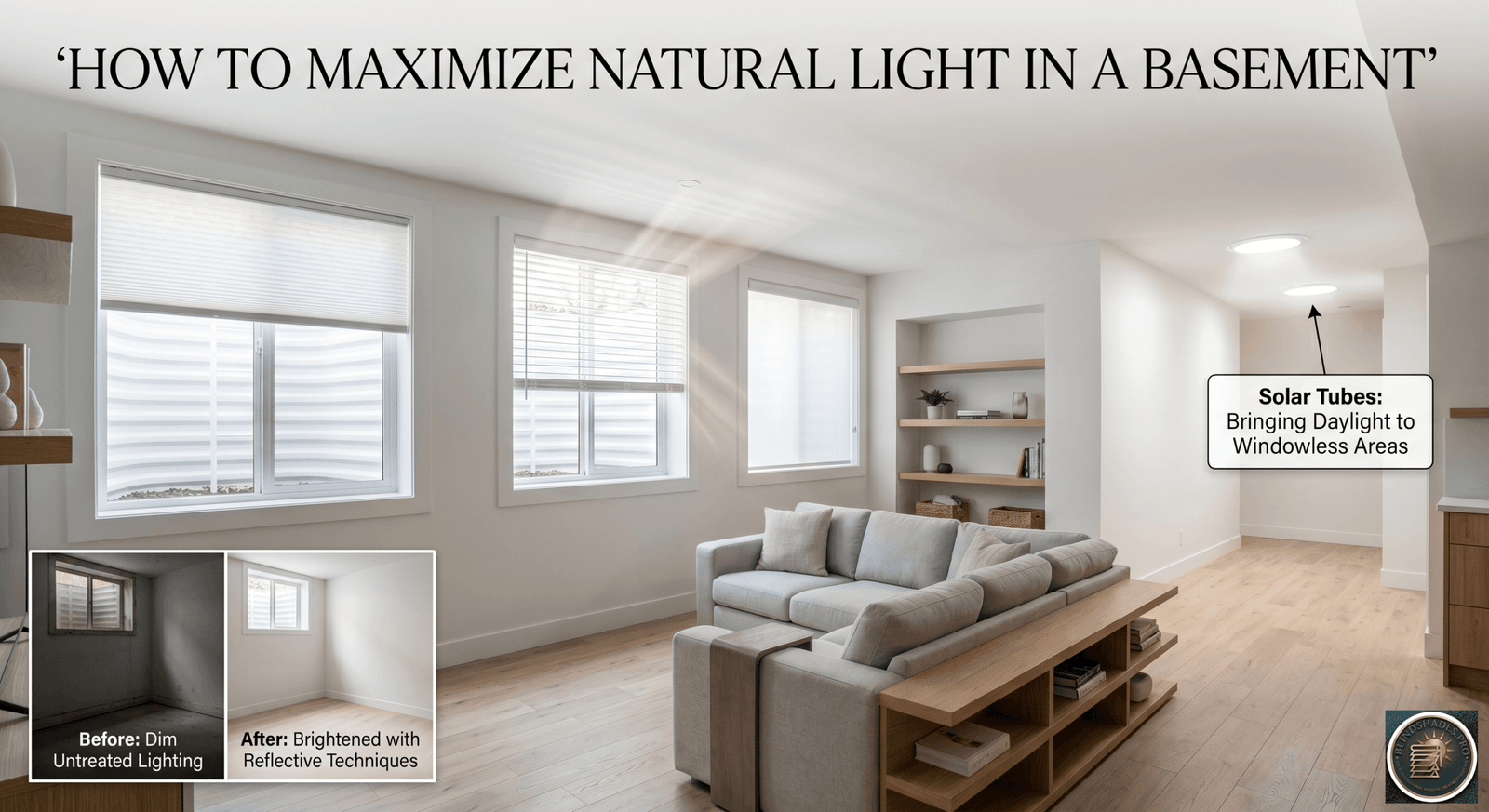
Key Takeaways:
- A below-grade basement window provides only 200 to 800 lux at the glass compared to 5,000 to 10,000 lux from an above-grade window — no window treatment multiplies available light, only the raised blind position preserves it
- White diffuse reflection (80 to 85 percent) spreads light across all surfaces for whole-room brightness; silver metallic reflection (85 to 90 percent) concentrates light in a targeted direction for ceiling bounce
- Horizontal Venetian slats angled 30 to 45 degrees upward create ceiling bounce — low-angle sunlight reflected to the ceiling distributes across the whole basement room
- Painting the interior of the window well with white gloss exterior paint increases reflected light into the window; standard grey corrugated steel absorbs and scatters incoming light
- East and west-facing basement windows receive the most useful low-angle morning and afternoon sunlight that penetrates deepest into the room; north-facing windows receive diffuse sky light only
⭐ Quick Answer — How Do You Maximize Natural Light in a Basement With Blinds?
- The Lux Reality — No Blind Multiplies Available Light: The first fact about basement window blinds and natural light: a 24×16 inch below-grade basement window provides only 200–800 lux at the glass on a clear day. An above-grade living room window provides 5,000–10,000 lux. No window treatment multiplies available light — every treatment reduces it to some degree. The best blind for basement light is a blind fully raised during daylight hours. Reading and computer work require 300–500 lux — meaning one basement window provides adequate working daylight within 3–6 feet of the glass, but not for the whole room
- Ceiling Bounce — Slat Angle at 30–45 Degrees Upward: The most effective technique for distributing basement window natural light with a horizontal Venetian blind: angle the slats 30–45 degrees upward toward the ceiling. Incoming sunlight reflects off the angled slat face and bounces toward the ceiling surface, which then distributes the light broadly across the full basement room. For low-angle morning/evening sun (10–20 degrees above horizontal): optimal slat angle is 30–35 degrees. For steeper midday sun (50–70 degrees): 50–60 degrees. This is distinct from both the privacy position (slats angled downward) and the fully open horizontal position
- Window Well Interior White Paint — The Highest-ROI Light Improvement: Standard corrugated galvanised steel window wells reflect approximately 40–60% of incoming sunlight and scatter it in random directions. Painting the interior surfaces of the well with high-gloss white exterior paint increases reflection to approximately 80–85% and concentrates more reflected light toward the window opening. Apply rust-inhibiting primer first, then 2 coats of white gloss exterior paint. Reapply every 3–5 years. The improvement is most visible on partly cloudy days when diffuse sky light is the primary light source entering the well
- Compass Orientation — East and West Windows Penetrate Deepest: Direction matters for basement window blinds natural light. East-facing: low-angle morning sun (10–30 degrees above horizontal) enters at a shallow angle that penetrates deepest into the basement — fully raise the blind every morning. West-facing: same but afternoon. South-facing: high-angle midday sun (50–70 degrees) illuminates only a narrow strip immediately inside the window — ceiling bounce slat angle redistributes this. North-facing: diffuse sky light only (50–300 lux) — fully raise the blind every day and never use a semi-opaque treatment; every lumen counts
- White vs Silver — Diffuse vs Directional Reflection: Two different reflection strategies for basement window blinds: White (80–85% diffuse) scatters reflected light in all directions — best for whole-room brightness, illuminating all walls, ceiling, and floor surfaces evenly. Silver/metallic (85–90% directional) reflects light in a more concentrated direction — best for targeted ceiling bounce where you want a beam of reflected light hitting a specific ceiling area. For general Zone B1 living area basement brightening: white diffuse. For a targeted ceiling bounce setup where the blind is angled to concentrate light on a specific ceiling zone: silver metallic
- Best Sources: Basement natural light and treatment selection → Milton Blinds basement light guide · TDBU and outside mount for basement → Blinds to Go basement guide · Light-filtering basement range → Blindsgalore light-filtering range
⚠️ Outside Mount Preserves 19–25% More Open Glass and Solar Tube for Windowless Areas: For basement window blinds and natural light, inside-mount installation loses glass area even when the blind is “fully raised.” A faux wood Venetian blind stack when raised sits approximately 3–4 inches inside the window recess, covering 72–96 square inches of a 24×16 inch window — reducing the effective open glass area by 19–25%. Outside mount positions the headrail above the window frame on the wall; when raised, the blind stack sits entirely above the glass with 100% of the glass unobstructed. For small basement windows where every square inch matters, outside mount preserves significantly more light during the hours the blind is raised. And for basement areas without direct window access — home offices or living areas on the interior side of the basement floor plan — a solar tube (10-inch diameter minimum) running from the roof through the building to a ceiling diffuser delivers approximately 200–400 lux of daylight independently of window position, matching the contribution of a single basement window on a clear day. Solar tubes are IBC-compliant at 7-foot basement ceiling heights and provide consistent daylight without any window treatment management. For the full basement specification guide, see What Are the Best Blinds for Basement Windows. See the full lux reality table below.
💡 Window Well Cover Light Transmission — Replace Before UV Yellowing Cuts Output by Half: The window well cover type significantly affects how much light reaches basement window blinds. Dome polycarbonate (UV-stabilised): 80–90% light transmission; 8–12 year lifespan; self-draining maintains clarity long-term — the best specification. Flat polycarbonate (standard): 80–90% initially but UV exposure causes yellowing; drops to 40–60% transmission by year 5–7 — replace before this threshold. Corrugated plastic: 40–60% transmission; does not self-drain; accumulates debris. Metal grate: 60–80% transmission; 20+ year lifespan; debris enters. If your flat polycarbonate window well cover is more than 5 years old, it may be cutting your basement window light by up to 50% through UV yellowing — replace with a dome UV-stabilised cover before investing in any window treatment change. A new dome cover costs $30–$80 and may deliver more light improvement than any blind selection change at any price. For the full privacy and light combination specification, see How Do You Add Privacy to Ground-Level Basement Windows. See the full window well cover comparison below.
📖 Read the complete guide below for: the lux reality table (200–800 basement vs 5,000–10,000 above-grade and the 3–6 foot useful room distance), the four genuine light-maximising techniques (white diffuse reflection / slat ceiling bounce / white well paint / solar tube), the ceiling bounce slat angle by sun entry angle (30–35 degrees for low-angle morning sun, 50–60 degrees for steep midday), the compass orientation guide by window direction (east/west deepest penetration, north every-lumen-counts, south ceiling bounce most useful), the white diffuse vs silver directional reflection comparison, the window well cover transmission table (dome polycarbonate vs flat vs corrugated), the outside mount 19–25% glass area preservation, and the outside mount specification for light maximisation.
Basement Window Blinds and Natural Light – The Lux Reality
Definition: A lux is the SI unit of illuminance – the amount of light per unit area reaching a surface. It measures the actual brightness available for human activity rather than the raw intensity of a light source.
The most important fact for basement natural light planning – and the fact absent from every guide covering basement window blinds and natural light:
The available lux comparison:
| Window Position | Typical Lux at Glass (Clear Day) | Useful Room Distance |
|---|---|---|
| Above-grade living room (3×5 ft window, south-facing) | 5,000-10,000 lux | Entire room benefits |
| Above-grade bedroom (double-hung, 2×4 ft) | 3,000-7,000 lux | Entire room benefits |
| Basement window (24×16 inches, in window well, south-facing) | 200-800 lux | 3-6 feet from window |
| Basement window (24×16 inches, north-facing) | 50-300 lux | 1-3 feet from window |
The practical implication:
No window treatment multiplies the available lux. A window treatment can only preserve more or less of the 200 to 800 lux available from a basement window. A solar shade transmitting 3% of incident light delivers 6 to 24 lux into the basement – adequate only for basic orientation, not for reading or working.
The maximum natural light from a basement window is achieved by fully raising the blind during daylight hours – no treatment at all delivers 100% of the available lux. This is the starting point: the correct question is not “which blind maximises light” but “which blind delivers maximum light when raised AND meets the other requirements for that zone.”
The Four Genuine Light-Maximising Techniques
These four techniques, used together, provide the greatest improvement to basement natural light within the constraints of the available lux:
Technique 1 – White Diffuse Reflection (Blind Colour Selection)
The physics: A white surface reflects approximately 80-85% of incident light in a diffuse (scattered) pattern – light leaves the white surface in all directions. A cream or off-white surface reflects approximately 75-80%. A dark grey or brown surface reflects approximately 10-30%.
The application: The room-facing surface of the raised blind is not in the light path – it faces away from the window when raised. The room-facing surface of the lowered blind, however, is in the full view of any interior light source and reflects that interior light back into the room. More importantly, a white blind in the lowered position reflects ambient room light from above back into the space adjacent to the window.
The correct specification: White or off-white blind colour for any Zone B1 finished basement position where natural light is a priority. No dark wood tones, grey, or brown. The colour difference between a white faux wood Venetian and a walnut faux wood Venetian in the same position produces a meaningfully different room brightness perception.
Technique 2 – Slat Angle Ceiling Bounce
This technique is absent from all competitor guides.
The physics: When a horizontal Venetian blind slat is angled upward toward the ceiling, low-angle incoming sunlight from a basement window strikes the slat face and reflects toward the ceiling. The ceiling (typically white or off-white) then acts as a secondary reflector, distributing the light diffusely across the full basement volume.
This is called ceiling bounce lighting – the same technique used in professional photography to soften direct light from a flash by bouncing it off a white ceiling.
The optimal angle:
The sun’s angle of entry through a basement window varies by time of day and season:
- Morning/evening (east or west-facing window): sun at approximately 10-20 degrees above horizontal
- Midday (south-facing window, summer): sun at approximately 50-70 degrees above horizontal in northern latitudes
- Midday (south-facing window, winter): sun at approximately 20-35 degrees above horizontal
For morning/evening low-angle sun (10-20 degrees): slat angle of 30-35 degrees upward from horizontal provides the optimal reflection toward the ceiling.
For midday high-angle sun (50-70 degrees): slat angle of 50-60 degrees upward is needed to redirect the steep light toward the ceiling – at this angle the slat provides partial privacy as well.
Practical guidance: Set slats at 30-45 degrees upward toward the ceiling at the start of each day. This is distinct from the standard “tilt to close for privacy” position (slats angled downward) and the “fully open” horizontal position. The 30-45 degree upward position is the light-optimising setting.
Technique 3 – Window Well Interior White Paint
This is the highest-ROI light improvement for window well basement windows and is absent from all guides.
A standard basement window well is lined with corrugated galvanised steel in grey or silver. The corrugated grey surface:
- Reflects approximately 40-60% of incident sunlight (less than white)
- Scatters reflected light in random directions (corrugation causes irregular reflection angles)
- Directs less reflected light toward the window opening and more toward the surrounding soil and well edge
The solution: Paint the interior surfaces of the window well with high-gloss white exterior paint. White gloss reflects approximately 80-85% of incident light with a more directional reflection that concentrates more reflected sunlight toward the window opening rather than scattering it in all directions.
Implementation:
- Clean the corrugated steel well interior thoroughly (remove rust, debris, and standing water)
- Apply a rust-inhibiting primer coat to any rusted areas
- Apply 2 coats of high-gloss white exterior paint (oil-based for durability in wet conditions)
- Reapply every 3-5 years as the paint chalks from UV exposure
Expected light improvement: The interior-painted window well delivers noticeably more light into the basement window – the visible difference is clearest on partly cloudy days when diffuse light is scattered by the clouds and the well interior reflection provides a meaningful portion of the window’s total light input.
Technique 4 – Solar Tube Augmentation for Interior Basement Areas
This solution, absent from all guides, delivers daylight independent of window position.
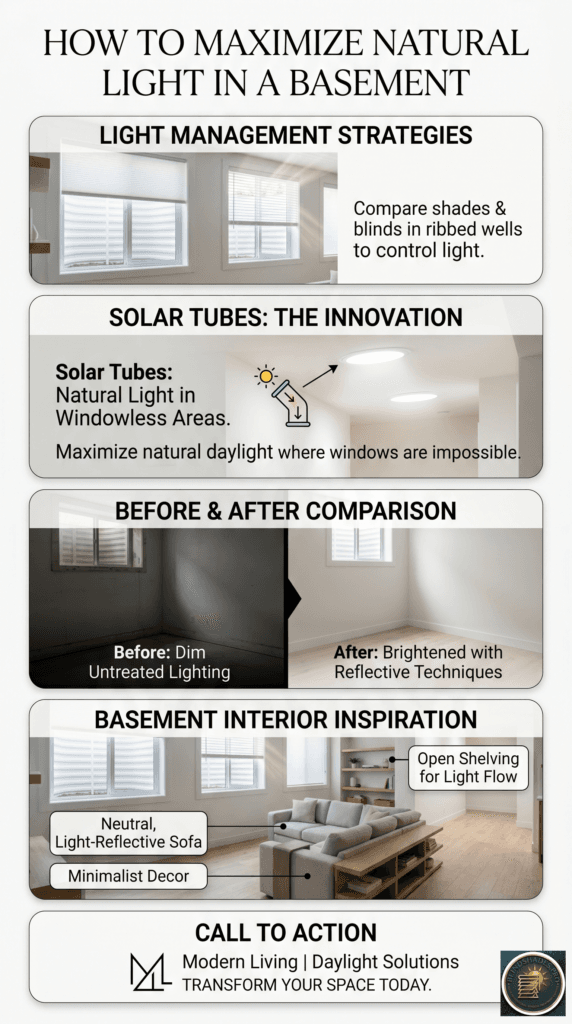
Definition: A solar tube (also called a sun tunnel, light tube, or tubular daylight device) is a reflective tube running from a dome on the roof surface through the building structure to a diffuser installed in the ceiling. It delivers daylight from the roof level to the interior regardless of window position.
For basements: Solar tube systems with extended tube lengths can reach from the roof through two or more floors to a basement diffuser. A 10-inch diameter solar tube provides approximately 200-400 lux of daylight at the diffuser on a clear day – comparable to the daylight available from a small basement window.
The application for basement light: A basement home office, bedroom, or living area with windows on only one wall (typically the exterior-facing wall of a walkout or above-grade portion) can receive supplemental daylight from a solar tube in the areas away from windows. Combined with maximised window blind specification, the solar tube provides practical working-level daylight in areas that window treatments alone cannot reach.
Key specification:
- Minimum 10-inch diameter for meaningful light output in a basement
- Specify UV-stable polycarbonate dome (not flat cover) for self-draining and long-term clarity
- Diffuser at basement ceiling level positioned in the area most needing additional daylight
The Compass Orientation Factor
The direction your basement windows face determines the quantity and quality of available natural light – and this changes the blind specification.
North-facing basement window: Receives only diffuse sky light – no direct sunlight at any time of year. Typical lux: 50-300 at the glass. Every lux matters – specify the most transparent available treatment (solar shade 1-3% or simply raise the blind fully during the day). No glare management needed. Light-filtering treatments that reduce the already-limited diffuse light are counterproductive.
South-facing basement window: Receives direct sunlight for a significant portion of the day, but the sun’s angle is high (50-70 degrees above horizontal in summer midday). The steep incoming angle means direct sun illuminates a narrow strip immediately inside the window. Solar shade specification appropriate for glare management during direct sun periods. Ceiling bounce slat angle is most valuable on south-facing windows because it redirects the steep-angle sunlight toward the ceiling and distributes it further into the room.
East-facing basement window: Receives low-angle morning sun (10-30 degrees above horizontal during the morning hours). This shallow sun angle is the most useful for basement windows because the light penetrates deepest into the room along a near-horizontal path. No treatment provides more morning light than a fully raised blind. After morning hours, the east-facing window receives only diffuse sky light.
West-facing basement window: Same as east-facing but reversed – maximum light in the afternoon hours. The low afternoon sun at 10-30 degrees above horizontal penetrates deepest into the west-facing basement room. Most valuable for afternoon basement use (home office, living area).
The practical guidance: For a basement with both north and south windows (typical of a finished basement below a full-width house): use the north-facing windows for consistent diffuse light all day (fully raised blind during daylight hours) and manage the south-facing windows with ceiling-bounce slat angle for morning and evening low-angle sun periods.
The Window Well Cover Light Transmission Comparison
| Window Well Cover Type | Light Transmission | Longevity | Light Maintenance |
|---|---|---|---|
| No cover (open well) | 100% | N/A | Blocked by leaves, snow, debris seasonally |
| Dome polycarbonate (UV-stabilised) | 80-90% | 8-12 years | Self-draining; maintains clarity long-term |
| Flat polycarbonate (standard) | 80-90% initially | 5-7 years | Yellows from UV; drops to 40-60% by year 7 |
| Corrugated plastic | 40-60% | 5-8 years | Does not self-drain; collects debris |
| Metal grate | 60-80% | 20+ years | Blocks no light but allows debris entry |
Recommendation: Dome polycarbonate UV-stabilised cover provides the best long-term light transmission for basement window wells. Replace flat polycarbonate covers every 5-7 years before UV yellowing significantly reduces light input.
The Outside Mount Specification for Light Maximisation
All guides mention outside mount makes windows “appear larger.” The specific light benefit is more concrete:
An inside-mount blind on a 24×16 inch basement window covers the full 384 square inches of glass opening. When the blind is raised, the blind stack (faux wood Venetian raised: approximately 3-4 inches deep) sits at the top of the window recess, covering approximately 72-96 square inches of the glass even when “fully raised” – reducing the effective open glass area by 19-25%.
An outside-mount blind on the same window has its headrail positioned above the window frame on the wall. When raised, the blind stack sits entirely above the glass area on the wall surface. The full 384 square inches of glass is unobstructed. The outside-mount blind also typically extends 2-3 inches beyond the frame on each side, preventing the light gap visible around inside-mount blinds when they are raised.
For small basement windows where every square inch of glass matters: outside-mount specification preserves 19-25% more open glass area when the blind is raised.
For the complete basement window specification guide, see What Are the Best Blinds for Basement Windows.
The Light-Reflecting vs Light-Filtering Blind Summary
| Blind Type | When Raised | When Lowered | Best Basement Use |
|---|---|---|---|
| Fully raised (no treatment) | 100% light | No privacy | Not practical |
| White solar shade 1-3% | Not applicable (full window) | 85-97% light, daytime privacy | Zone B1 south-facing (glare management) |
| White light-filtering roller shade | 100% when raised | 15-25% light transmission | Zone B1 general light-filtering |
| White faux wood Venetian (30-45 degree upward slat) | 100% when raised | Light via slat gaps + ceiling bounce | Zone B1 – best light management |
| White cellular shade | 100% when raised | 10-20% light transmission | Zone B1 – insulation priority |
| Cream or off-white in any material | Slightly less than white | Slightly less reflective | Acceptable alternative to white |
Where to Order
For white light-filtering treatments (Zone B1 light-maximising specification): Milton Blinds basement natural light guide at miltonblinds.com covers the light-filtering fabric selection for Canadian basement windows. Blinds to Go basement window treatments at blindstogo.com for the TDBU light configuration and outside-mount sizing guidance.
For light-filtering faux wood Venetian in white or off-white (primary Zone B1 specification): Blindsgalore light-filtering range at blindsgalore.com/blinds/light-filtering-blinds – specify: white or off-white, routeless construction, outside mount for maximum open glass area.
Frequently Asked Questions
How do you maximize natural light in a basement with blinds? The most effective techniques for maximising basement window blinds and natural light are: fully raise the blind during daylight hours rather than keeping any treatment partially lowered; specify white or off-white blind colours for maximum light reflection from the room-side surface; angle horizontal Venetian slats at 30 to 45 degrees upward toward the ceiling to create ceiling bounce that distributes light across the full basement; paint the interior of the window well with high-gloss white paint to concentrate reflected sunlight into the window; and use outside mount to preserve the full glass area when the blind is raised.
How much natural light does a basement window actually provide? A below-grade basement window measuring 24 by 16 inches in a window well provides approximately 200 to 800 lux of daylight at the glass on a clear day. An above-grade living room window provides 5,000 to 10,000 lux. Reading and computer work require 300 to 500 lux, meaning a single basement window provides adequate working daylight within 3 to 6 feet of the window but not for the full basement room. No window treatment multiplies the available lux – the best blind for basement light is one that is fully raised during daylight hours.
What colour blind maximises natural light in a basement? White blind colours maximise natural light in a basement. White surfaces reflect approximately 80 to 85 percent of incident light diffusely – scattering light in all directions to illuminate all room surfaces. Off-white and cream reflect approximately 75 to 80 percent. Dark wood tones such as walnut or mahogany reflect only 10 to 30 percent of incident light. The difference between a white faux wood Venetian blind and a walnut faux wood Venetian blind in the same basement position produces a measurably different room brightness perception over the full day.
What is the slat angle for maximum natural light on basement Venetian blinds? For maximum natural light from basement Venetian blinds, set the slats at 30 to 45 degrees upward toward the ceiling. This angle reflects incoming sunlight toward the ceiling surface, which then acts as a secondary reflector distributing the light broadly across the full basement room. The optimal angle depends on the sun’s entry angle through the window: low-angle morning or evening sun entering at 10 to 20 degrees above horizontal reflects best at a 30 to 35 degree slat angle; higher midday sun entering at 50 to 70 degrees reflects best at a 50 to 60 degree slat angle.
Does painting a window well white really improve basement natural light? Yes – painting the interior of a window well with high-gloss white exterior paint meaningfully improves basement natural light by concentrating reflected sunlight into the window opening rather than scattering it. Standard corrugated galvanised steel well interiors reflect approximately 40 to 60 percent of incident sunlight in random directions due to the corrugated surface geometry. White gloss paint reflects approximately 80 to 85 percent with a more directional concentration toward the window. The improvement is most noticeable on partly cloudy days when diffuse sky light enters the well from above and the well interior reflection provides a meaningful portion of the window’s total light input.
Related Guides on BlindShades.pro
- The Best Basement Window Blinds and Shades Buying Guide
- What Are the Best Blinds for Basement Windows
- What Are the Best Window Treatments for a Basement Bedroom
- Are Cellular Shades Good for Basement Windows
- How Do You Add Privacy to Ground-Level Basement Windows
By Michael Turner | 30 Years Home Improvement Expertise | Updated 2026 | BlindShades.pro
