Best Window Treatments for a Medical Office or Healthcare Waiting Room

Authored By Michael Turner -30 Years Home Improvement Expertise | Updated 2026 | BlindShades.pro
Updated on July 14, 2026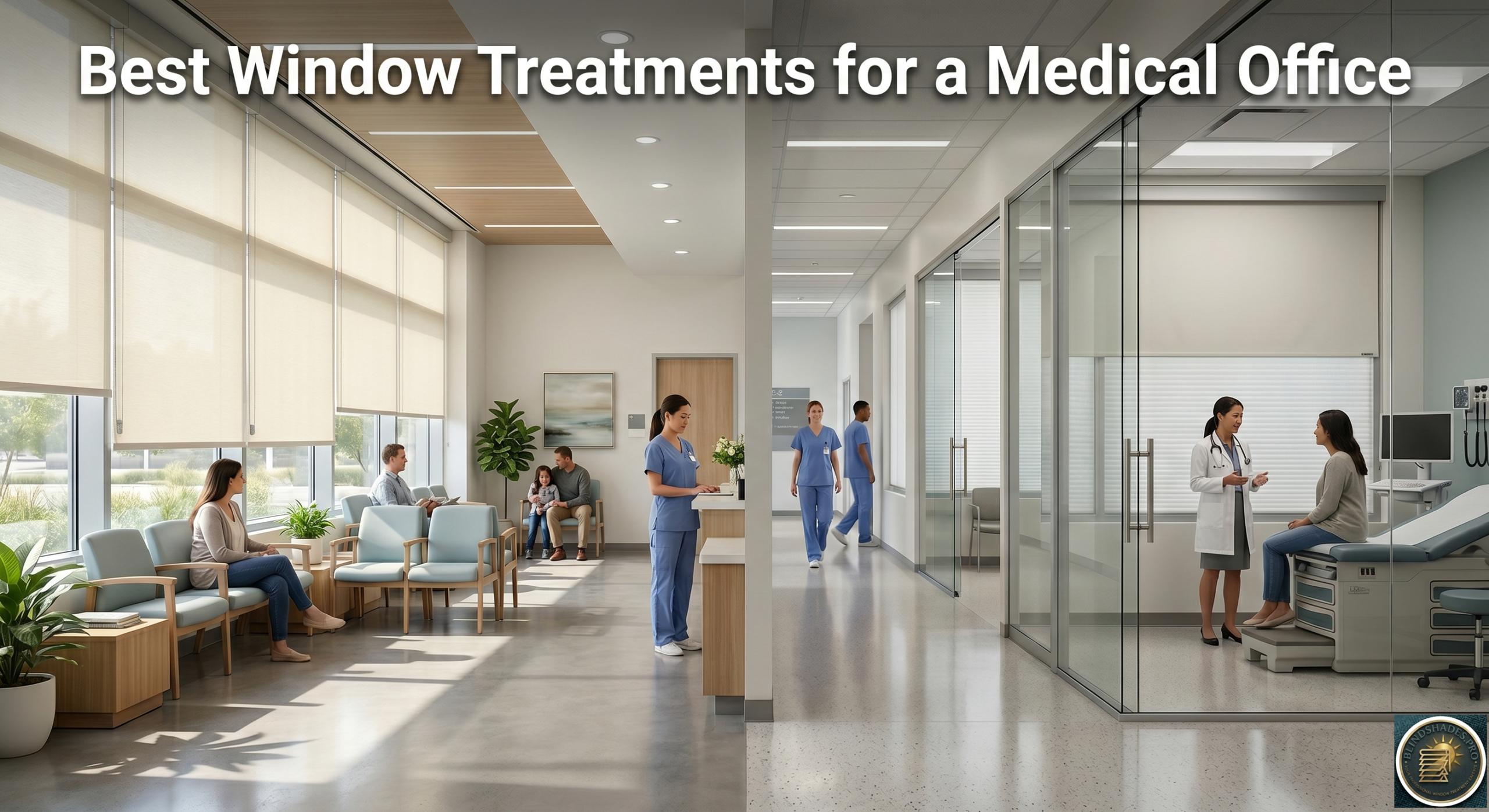
⭐ Quick Answer — Best Window Treatments for a Medical Office or Healthcare Waiting Room
- The Four Compliance Frameworks: Healthcare window treatments must satisfy: HIPAA visual privacy (no PHI visible through windows) · NFPA 101 Section 18.3.3 flame resistance (all fabric must pass NFPA 701 testing) · APIC quaternary ammonium disinfectant compatibility · EBD research showing daylight access reduces patient anxiety and length of stay
- The Evidence-Based Design Case for Daylight: Ulrich (1984) in Science journal documented surgical patients with window views had 0.74 shorter hospital stays and required fewer analgesics. Huisman et al. (2012) documented daylight reduces anxiety in healthcare waiting rooms. Specify solar shades — not blackout — in waiting rooms and patient lounges to preserve therapeutic natural light
- Room-by-Room Specification: Waiting room: 3–5% solar shade, warm neutral, NFPA 701 certified · Exam room: blackout + sealed side channels, motorized (hands-free) · Consultation office: 3–5% solar shade exterior; room-darkening on glass partitions · Procedure room: motorized blackout, hardwired, inherently FR · Reception desk: solar shade + privacy film on glass partition at screen height
- IPC Cleaning Compatibility: Request quat disinfectant compatibility certification from the fabric manufacturer (APIC standard: quaternary ammonium compounds). Also confirm hydrogen peroxide and 70% isopropyl alcohol compatibility. For high-risk areas — specify window film or integral between-glass blinds: no fabric surface, no cleaning protocol required
- Pediatric and Immunocompromised Areas: Specify GREENGUARD Children & Schools certified fabrics (more stringent than standard GREENGUARD) — confirms low VOC, formaldehyde-free, and PFAS-free material standards appropriate for vulnerable patient populations
- Best Sources: Full NFPA 701 + APIC documentation → Insolroll commercial healthcare programme · Standard medical office → Blindsgalore commercial (specify NFPA 701) · Privacy film → 3M Fasara (via authorised commercial dealer)
⚠️ The Three Critical Compliance Points Most Healthcare Window Treatment Guides Miss: (1) NFPA 101 Section 18.3.3 is a legal requirement, not a recommendation. All curtains, draperies, and loosely hanging fabrics in healthcare occupancy buildings must pass NFPA 701 flame resistance testing. Specify inherently flame-resistant fabrics (not chemically treated) — chemical FR treatments degrade through repeated clinical cleaning and lose certification. (2) HIPAA covers visual eavesdropping of PHI. Any window through which a patient’s registration data, X-ray, screen, or consultation is visible requires a window treatment or film rated for visual privacy. (3) Blackout shades in waiting rooms are evidence-based design errors. The EBD literature consistently shows natural light reduces patient anxiety and supports recovery — specify solar shades in waiting rooms, not blackout. See the full compliance framework guide below.
💡 Acoustic HIPAA Compliance + Window Film as Clinical Alternative: Healthcare waiting rooms have an underappreciated acoustic HIPAA risk — reception desk conversations carrying across a reverberant room. Cellular (honeycomb) shades provide NRC 0.10–0.20 sound absorption vs bare window NRC 0.00, reducing the reverberant noise level that allows PHI eavesdropping. Paired with a lined fabric drape (NRC 0.20–0.35) the combination meaningfully reduces conversation carry across the waiting room. And for exam rooms facing corridors — consider 3M Fasara frosted window film as a clinical alternative to fabric: permanent HIPAA-compliant visual privacy, wipeable with any clinical disinfectant, no mechanism to fail, no fabric surface to clean. See the window film clinical alternative guide below.
📖 Read the complete guide below for: the four compliance frameworks (HIPAA, NFPA 101, APIC, EBD research) with specific code section references, the room-by-room specification matrix for all 5 healthcare room types, IPC fabric cleaning chemical compatibility (quats, hydrogen peroxide, isopropyl), GREENGUARD Children & Schools for pediatric areas, window film as clinical alternative to fabric, the acoustic HIPAA eavesdropping specification, and supplier recommendations with full compliance documentation.
The Four Compliance Frameworks Every Healthcare Window Treatment Must Address
Every competitor guide on healthcare window treatments treats this as an aesthetic and functional decision. In regulated healthcare environments — it is a compliance decision. Four overlapping regulatory frameworks govern window treatment selection.
Framework 1 — HIPAA Privacy Compliance
The Health Insurance Portability and Accountability Act (HIPAA) Privacy Rule (45 CFR Part 164) requires covered healthcare entities to protect the privacy of patients’ Protected Health Information (PHI) — including information that could be observed visually.
The window treatment HIPAA connection: In a medical office, PHI may be visible through windows in several scenarios:
- Reception desk areas visible from the waiting room through glass partitions (patients can observe other patients’ registration information)
- Consultation room windows visible from a corridor (passersby can observe a patient receiving a diagnosis)
- Exam rooms with windows facing a public footpath or parking lot (patients visible to exterior observers)
- X-ray lightboxes or computer screens visible through glass
Window treatment specification for HIPAA compliance:
- Consultation rooms and exam rooms facing public areas: 1–3% openness solar shade or room-darkening shade to prevent external viewing of PHI
- Reception glass partitions facing waiting room: frosted window film or translucent window covering rated for privacy at eye level
- Staff workstations visible from waiting room: privacy window film or opaque roller shade for workstation-level coverage
The HIPAA specification principle: Any window through which PHI could be observed must have a window treatment rated for visual privacy at the relevant viewing angle and floor level.
Framework 2 — Infection Prevention and Control (IPC)
The Association for Professionals in Infection Control and Epidemiology (APIC) establishes the cleaning chemical standards used in healthcare facilities.
Standard healthcare disinfectants: The primary healthcare surface disinfectant category is quaternary ammonium compounds (quats) — effective against a broad spectrum of healthcare-associated pathogens. Secondary options include hydrogen peroxide-based disinfectants (for enhanced efficacy against C. difficile and other spore-forming pathogens) and isopropyl alcohol (70%) for spot disinfection.
Window treatment fabric compatibility: Not all commercial window treatment fabrics survive repeated application of quaternary ammonium disinfectants. Incompatible fabrics degrade, fade, or develop surface crazing that creates micro-harboring surfaces for pathogen accumulation.
Specification for IPC compliance:
- Request a cleaning protocol compatibility sheet from the fabric manufacturer confirming quat disinfectant compatibility
- Specify fabrics rated for healthcare cleaning frequencies (minimum 3 complete surface wipe-downs per day)
- Confirm the antimicrobial treatment is built into the fibre (not surface-applied) for durability through cleaning cycles — see Pleated Shades for a Commercial Office — Antimicrobial Fabric Options for the built-in vs surface-applied distinction
- For high-infection-risk areas (procedure rooms, immunocompromised patient areas): consider hard surface alternatives (window film, integral between-glass blinds) that eliminate fabric surfaces entirely
Framework 3 — NFPA 101 Life Safety Code — Healthcare Occupancy
NFPA 101 (Life Safety Code) classifies healthcare facilities as Healthcare Occupancy, which carries specific requirements for interior finish materials including window treatments.
The flame resistance requirement: Under NFPA 101 Section 18.3.3 (for new healthcare occupancies) and 19.3.3 (for existing), all curtains, draperies, and similar loosely hanging fabrics must pass NFPA 701 Standard Methods of Fire Tests for Flame Propagation of Textiles and Films.
What this means in practice: NFPA 701 certification must be documented at the time of installation and maintained through the product’s service life. Fabric treatments that pass NFPA 701 testing lose certification if the flame-retardant treatment degrades through repeated laundering or chemical cleaning.
Specification for NFPA 101 compliance:
- Specify fabrics with inherently flame-resistant construction (not chemically treated) for healthcare applications — inherent FR fabrics maintain flame resistance through the fabric’s usable life regardless of cleaning
- Request NFPA 701 test documentation at ordering — do not rely on supplier verbal assurances
- For high-risk areas: specify fiberglass-core solar shade fabrics (Phifer SheerWeave, Mermet) which are inherently non-combustible
Framework 4 — Evidence-Based Design and Patient Outcomes
This is the clinical framework that no competitor guide cites — and it is the strongest argument for specifying window treatments that preserve daylight rather than block it.
The Roger Ulrich study (1984): Published in Science journal, Ulrich’s landmark study compared surgical patients in rooms with window views of nature versus rooms facing a brick wall. Patients with window views had shorter postoperative hospital stays (mean 7.96 vs 8.70 days), required fewer moderate-strength analgesics, and received fewer negative nurse evaluations.
Subsequent evidence-based design research: Research by Marni Huisman et al. (2012) in Health Environments Research and Design Journal documented that access to natural light in healthcare waiting rooms measurably reduces patient-reported anxiety. Chaudhury et al. (2009) documented that daylight exposure in clinical environments reduces cortisol levels and supports circadian rhythm regulation, which benefits healing and recovery.
The specification implication: Window treatments in healthcare waiting rooms and patient-facing spaces should be specified to preserve natural daylight rather than block it. The evidence-based design literature argues for:
- Solar shades that reduce glare and UV without eliminating daylight
- Automated shades that lower only during direct glare periods
- Avoiding heavy blackout treatments in waiting rooms and patient lounges unless required for privacy
The Room-by-Room Healthcare Window Treatment Specification
This is the practical specification matrix no competitor guide provides.
Waiting Room
Primary requirements: Calming environment, natural daylight preservation, acoustic comfort, UV protection for patient comfort.
Evidence-based design requirement: Maintain access to natural light and ideally exterior views — daylight reduces patient anxiety per Huisman et al. (2012).
Specification:
- 3–5% openness solar shade in warm neutral colour (earth tones, beige, soft grey)
- Outside mount to cover frame perimeter and eliminate side light gaps
- NFPA 701 certified fabric
- Quat-compatible cleaning surface
- If motorized: schedule to lower only during direct sun periods, preserving daylight when sun angle is not directly problematic
Cellular shade alternative:
- Single-cell or double-cell cellular shade provides acoustic benefit (NRC 0.10–0.20) that meaningfully reduces the reverberant noise level in waiting rooms — important for HIPAA eavesdropping prevention at reception desk areas and for reducing anxiety-inducing ambient noise
- Earth tone cellular shades in the waiting room create the “home-like atmosphere” that Blinds Chalet and Naka’s Drapery both identify as clinically beneficial for patient comfort
Exam Room
Primary requirements: Complete visual privacy during patient examination (patient dignity and HIPAA), easy-to-clean surfaces.
Specification:
- Blackout roller shade with side-sealed channel mounting to eliminate all light gaps
- Outside mount at minimum 2–3 inches beyond all frame edges
- Sealed side channels or track system for complete light elimination
- Inherently flame-resistant fabric (NFPA 701 compliant)
- Motorized for hands-free operation (healthcare staff should not touch window treatment surfaces after sterile field preparation)
- White or light-coloured shade facing into the exam room for optimal exam lighting diffusion
HIPAA specification note: For exam rooms with windows facing corridors or other clinical areas — consider frosted window film on the glass as a permanent, maintenance-free alternative that provides guaranteed visual privacy without a fabric surface that requires cleaning.
Consultation Office (Physician/Therapist)
Primary requirements: Privacy for discussion of sensitive health information, comfortable ambient light for face-to-face consultation, acoustic privacy.
Specification:
- 3–5% solar shade on exterior windows — maintains natural light while providing daytime privacy from exterior observers
- For therapy/psychiatry offices specifically: room-darkening or blackout heavy fabric shade or drape on interior-facing glass partitions — provides the sound-dampening that psychiatrist consultations require
- Earth tones and warm neutrals in consultation rooms are supported by evidence-based design literature as reducing patient anxiety during difficult conversations
Acoustic privacy note: Fabric drapes with a liner in consultation offices provide meaningful sound attenuation for patient conversation privacy — reducing the risk of HIPAA eavesdropping from adjacent spaces. A lined drape provides NRC 0.20–0.35, compared to 0.00 for bare windows.
Procedure Room / Minor Surgery Suite
Primary requirements: Complete light control for procedure-specific illumination, hands-free operation (sterile field considerations), NFPA 701 compliance.
Specification:
- Full blackout motorized roller shade — hands-free operation is mandatory (no cord operation during procedures)
- Side-sealed or track-mounted for complete light exclusion
- Inherently fire-resistant fiberglass or non-combustible fabric
- Hardwired motorization for reliability (no battery maintenance requirement in surgical environments)
- White or light-coloured facing side — reflects procedure lighting upward rather than absorbing it
Reception Desk Area
Primary requirements: Glare control on computer screens (staff productivity), visual privacy from waiting room patients who should not be able to observe PHI on computer screens or registration forms.
Specification:
- 3–5% solar shade on exterior windows to reduce screen glare (see How Do I Reduce Computer Screen Glare From Office Windows)
- For glass partitions between reception and waiting room: one-way mirror film or frosted privacy film at screen height (approximately 36–54 inches from floor) — allows staff to see the waiting room without patients observing screens
- One-way mirror film maintains the open visual connection between staff and waiting patients (important for patient management) while preventing PHI observation
GREENGUARD Certification for Pediatric and Immune-Compromised Areas
For healthcare facilities treating pediatric patients, oncology patients, transplant patients, or other immune-compromised populations — standard GREENGUARD certification is not adequate.
GREENGUARD Children & Schools certification (the more stringent UL standard) certifies that materials meet strict chemical emissions standards, including VOC, formaldehyde, and aldehydes, appropriate for environments occupied by vulnerable populations.
Specification for vulnerable population areas:
- Pediatric waiting rooms and exam rooms: specify GREENGUARD Children & Schools certified fabric materials
- Oncology and transplant units: specify GREENGUARD Children & Schools plus PFAS-free, formaldehyde-free material content documentation
- Request manufacturer’s complete material content declaration including any chemical treatments (antimicrobial, flame retardant) for compatibility with the facility’s environmental health standards
Available fabrics: Phifer SheerWeave and Mermet commercial solar shade fabrics publish full material content documentation and can be specified with GREENGUARD certification for applicable healthcare applications.
The Window Film Alternative — The Clinical Case for Hard Surfaces
No competitor guide presents window film as an alternative to fabric window treatments in healthcare settings. For specific clinical applications — it is the superior specification.
Where window film outperforms fabric window treatments in healthcare:
Exam rooms facing corridors: A semi-permanent frosted or one-way privacy window film on the door glass or corridor-facing window provides HIPAA-compliant visual privacy without any fabric surface that requires regular cleaning. The film surface can be wiped with any clinical disinfectant. No mechanism to fail, no fabric to launder, no motor to service.
Clinical imaging and radiology reading rooms: Rooms requiring absolute light exclusion for radiological image reading. Blackout window film permanently applied to the glass provides light exclusion without a shade mechanism that introduces particulate shedding in sensitive diagnostic environments.
Clean rooms and sterile compounding areas: Pharmacy compounding areas and other sterile environments cannot have fabric surfaces that shed particles or fiber. Integral between-glass blinds (hermetically sealed between two panes of glazing) or blackout window film are the only appropriate specifications.
The specification principle for healthcare: Before specifying a fabric window treatment for any healthcare space — evaluate whether window film or integral blind provides equivalent function with lower infection control burden. For spaces where fabric can be justified, ensure full IPC protocol compatibility.
The Acoustic Case for Healthcare Waiting Rooms
Healthcare waiting rooms have a documented acoustic problem that window treatments can meaningfully address — and which is never discussed by competitor guides.
The HIPAA acoustic eavesdropping risk: HIPAA requires not only visual but auditory protection of PHI. Patients at a reception desk should not be clearly audible to others in the waiting room. Reverberant noise in waiting rooms — caused by hard surfaces including bare windows — allows reception desk conversations to carry across the room. The American Journal of Infection Control has noted that healthcare waiting room acoustic design is an underappreciated HIPAA compliance factor.
The anxiety amplification problem: Research on healthcare waiting room design documents that ambient noise level is one of the primary drivers of patient anxiety. Hard-surface waiting rooms with reverberant noise create a measurably more stressful environment than acoustically treated waiting rooms. Cellular shades and lined drapes contribute meaningful NRC values to the waiting room’s total sound absorption.
The acoustic specification for medical waiting rooms: Specify cellular (honeycomb) shades for exterior windows in waiting rooms — they provide both the daylight management and evidence-based calming effect that all competitor guides recommend, plus NRC 0.10–0.20 acoustic absorption that competitor guides don’t quantify.
Related guides: medical is one row of the establishment matrix — see the best office and commercial blinds and shades guide for the full spec-first system.
Where to Order — Healthcare Window Treatment Specifications
For NFPA 701 certified, antimicrobial, IPC-compatible specifications: Insolroll commercial healthcare programme — the most complete healthcare certification documentation available including ASTM G21 antimicrobial, NFPA 701, GREENGUARD, PFAS-free, and formaldehyde-free. Full IPC compatibility documentation on request.
For standard medical office and waiting room specifications (not acute care): Blindsgalore commercial programme — NFPA 701 certified fabrics on request, motorized options, antimicrobial fabric selection. SelectBlinds commercial — accessible mid-range pricing for medical office (not acute care) applications.
For privacy window film (exam rooms, reception partitions): 3M Fasara privacy film — frosted and one-way mirror options for clinical partition applications. Available through 3M authorised commercial window film dealers.
Frequently Asked Questions
What are the best window treatments for a medical office waiting room? For medical office waiting rooms — specify 3 to 5 percent openness solar shades in warm earth tones or neutral colours. Research by Huisman et al. published in Health Environments Research and Design Journal documents that access to natural light in healthcare waiting rooms measurably reduces patient anxiety. Solar shades preserve daylight and exterior views while controlling glare — supporting patient well-being rather than blocking the beneficial daylight that heavy treatments eliminate. Cellular honeycomb shades are an alternative that adds acoustic absorption (NRC 0.10 to 0.20) to reduce waiting room noise and HIPAA eavesdropping risk from reception desk conversations.
Do healthcare window treatments need to be NFPA 701 certified? Yes — for healthcare occupancy buildings under NFPA 101 Life Safety Code. NFPA 101 Section 18.3.3 requires that all curtains, draperies, and similar loosely hanging fabrics in healthcare facilities pass NFPA 701 flame resistance testing. Request documented NFPA 701 certification at ordering rather than relying on verbal assurances. For maximum durability — specify inherently flame-resistant fabrics (fiberglass-core solar shades or inherent FR polyester) rather than chemically treated fabrics whose flame resistance degrades with cleaning.
What cleaning chemicals are safe for medical office window treatments? Quaternary ammonium compounds (quats) are the primary healthcare surface disinfectant per APIC guidelines. Request a cleaning protocol compatibility sheet from the window treatment fabric manufacturer confirming quat disinfectant compatibility before ordering for healthcare applications. Some fabrics are tested and rated for quat compatibility; others degrade over repeated application. For rooms requiring enhanced disinfection protocols — hydrogen peroxide-based disinfectants and 70 percent isopropyl alcohol compatibility should also be confirmed. For any room where fabric cannot be reliably sanitized — consider frosted window film or integral between-glass blinds as maintenance-free alternatives.
Do medical office window treatments need to be HIPAA compliant? Yes — to the extent that window treatments affect the visual privacy of Protected Health Information. HIPAA’s Privacy Rule requires covered entities to protect PHI from unauthorized observation. Windows through which patients could observe other patients’ registration details, computer screens with PHI, or clinical consultations require window treatments or film rated for visual privacy at the relevant viewing angle. Exam room windows facing public areas require sufficient opacity to prevent observation of patients during examination — blackout or room-darkening specification with sealed side channels.
What window treatments are recommended for pediatric medical waiting rooms? For pediatric healthcare areas — specify fabrics with GREENGUARD Children & Schools certification (the more stringent UL standard appropriate for vulnerable populations) rather than standard GREENGUARD. Additionally confirm materials are PFAS-free and formaldehyde-free. For the pediatric waiting room specification — cellular shades in warm neutral colours with NFPA 701 inherent flame resistance and GREENGUARD Children & Schools certification provide the combination of acoustic comfort, daylight preservation, and material safety appropriate for pediatric patient environments.
Related Guides on BlindShades.pro
- The Best Office & Commercial Blinds & Shades Buying Guide — the complete commercial specification guide
- Pleated Shades for a Commercial Office — Antimicrobial Fabric Options — antimicrobial fabric specification including built-in vs surface-applied treatment
- Are Solar Shades Worth It for a Commercial Office — the commercial solar shade specification with WELL and LEED framework
- How Do I Reduce Computer Screen Glare From Office Windows — glare control specification for reception desk workstations
- The Best Cellular Shades Buying Guide — cellular shade acoustic and insulation specification in full depth
By Michael Turner | 30 Years Home Improvement Expertise | Updated 2026 | BlindShades.pro
