Why Won’t My Cordless Blinds Go Up or Down? The Symptom Gate

Authored By Michael Turner -30 Years Home Improvement Expertise | Updated 2026 | BlindShades.pro
Updated on July 24, 2026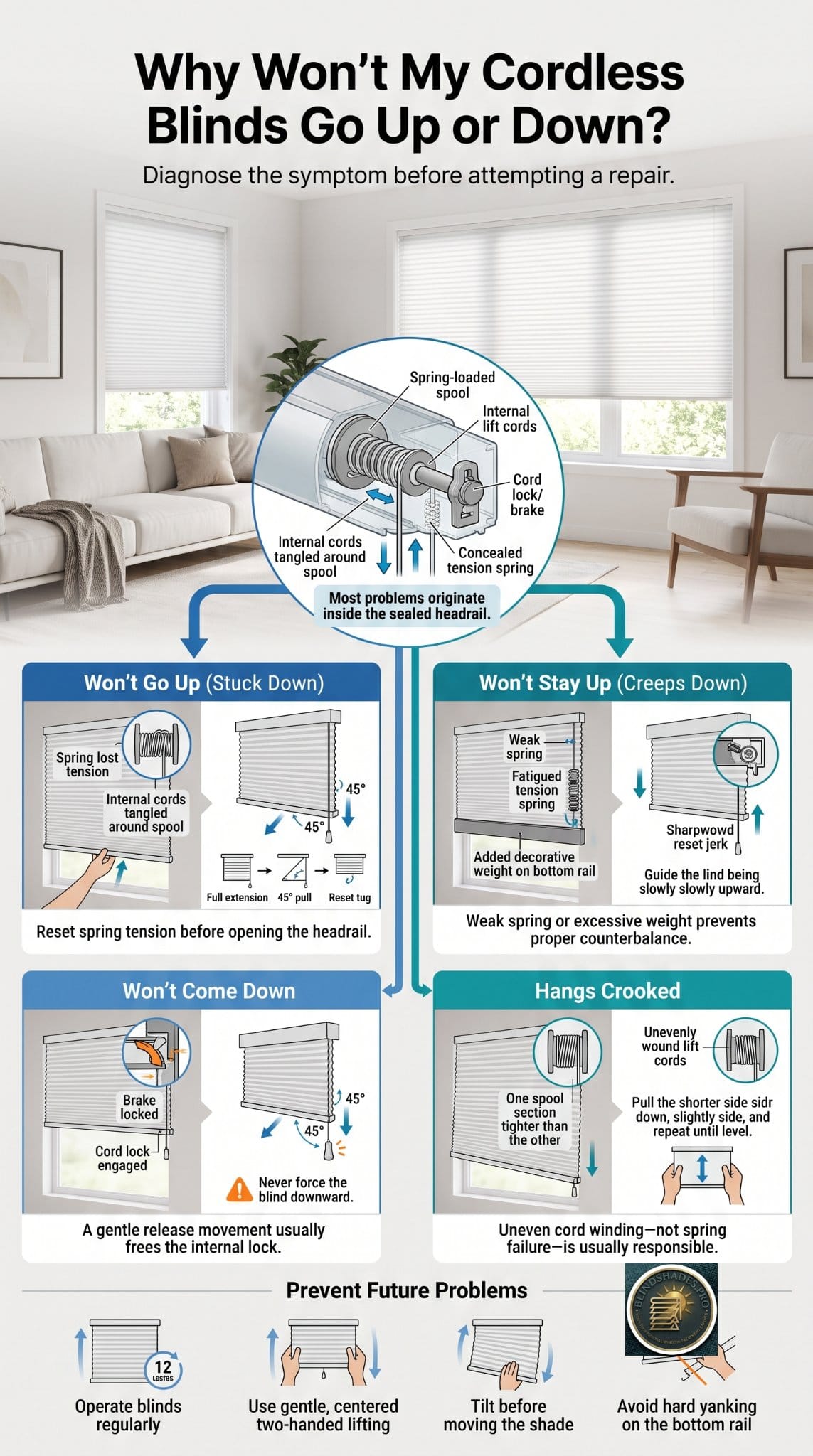
By Michael Turner — 30 years in window treatments
Why won’t my cordless blinds go up or down almost always comes back to one part — the internal spring has lost, jammed, or been overpowered in its tension — and the first fix is free: extend the blind fully, pull the bottom rail toward you at roughly forty-five degrees, and tug down firmly two or three times to re-engage the spring. That jog resolves an enormous share of “broken” blinds in under a minute. But the right second move depends on which of four symptoms you have — won’t go up, won’t stay up, won’t come down, or hangs crooked — and the advice in circulation piles all four into one heap. This guide gates by symptom, orders every fix by invasiveness, and says honestly when the spring is dead and the answer is a replacement, not an afternoon.
Key Takeaways
- Diagnose before touching anything: the four symptoms have four different causes, and the wrong fix for your lane wastes an afternoon or bends a rail.
- The free jog comes first, always. Full extension, forty-five-degree pull, two or three firm downward tugs — it re-tensions the spring and costs nothing.
- A blind that creeps down has a weight problem or a tired spring; a blind locked shut usually has a stuck brake or a knot; one side hanging low is a cord-winding problem, not a spring problem.
- The jog can fail — and when it fails after correct technique, that’s diagnostic information, not a reason to repeat it harder.
- Repair-or-replace is decided by where you bought the blind. Budget stock blinds are replaced; custom blinds are serviced; the line between them is real.
⭐ Quick Answer — Why Won’t My Cordless Blinds Go Up or Down?
Why won’t my cordless blinds go up or down almost always traces to the hidden spring-tension mechanism — and the first fix is free:
- Start with the reset jog: lower the blind fully, pull the bottom rail outward at about forty-five degrees, and tug down firmly two or three times — the re-tensioning move Blinds.com’s own repair demonstration has taught for over a decade.
- Then gate by symptom: won’t go up is tension or a knot; creeping down is a tired or overpowered spring; locked shut is a stuck brake — often from a too-hard pull, as JustAnswer’s troubleshooting experts note; one low side is uneven cord winding, fixed with the level re-pull.
- Work the ladder cheapest-first: exercise a dormant mechanism, dab lubricant into the two small holes on the center string path, audit added weight — disassembly is the last rung, not the first.
- A failed reset is information: done correctly from full extension and still failing, the spring is likely broken internally — budget stock blinds from Home Depot and similar are usually cheaper to replace than repair, while custom blinds are worth servicing.
- Prevent the next failure: the three operating moves in how cordless blinds work stop most faults before they start, the honest lifespan record is in how long cordless blinds last, and the mechanisms that survive longest are ranked in our Cordless Blinds & Shades guide.
Why Won’t My Cordless Blinds Go Up or Down?
The Symptom Gate (Up · Stay · Down · Level)
Because the mechanism is sealed inside the headrail, every failure looks the same from the outside — a blind that ignores you. Inside, four different things go wrong, and each announces itself through a distinct symptom. Repair guides across the industry converge on spring tension loss as the most common culprit, and they’re right; but tension loss explains the blind that creeps or won’t lift, not the one locked shut by its own brake or hanging low on one corner. Gate yourself first:
| Symptom | Most likely cause | First move | If that fails |
|---|---|---|---|
| Won’t go up (stuck down) | Spring lost tension, or internal cords knotted around the spool | The reset jog: full extension, forty-five-degree pull, firm downward tugs | Exercise cycles, then lubricate; knot check last |
| Won’t stay up (creeps down) | Spring tired or overpowered — too heavy a shade, added décor weight, or years of fatigue | Sharp downward jerks at full extension, then guide slowly to the top | Find the tension dial or screw inside the rail; remove added weight |
| Won’t come down | Brake or cord lock stuck engaged — often after a too-hard pull | Gentle forty-five-degree outward pull with a light downward tug to trip the lock | Check for a cord pinched at the lock; never force it downward |
| Hangs crooked, one side low | Internal cords wound unevenly — a section problem, not a spring problem | The level re-pull: pull down on the short side while slightly lifting the long side, alternating until even | Check friction clips; retrain with level, centered operation |
Two causes hide behind all four lanes. The first is dormancy: a mechanism uncycled for months stiffens, and parts sellers list “the blind hasn’t been moved in a while” as a genuine failure cause — the cure is exercise, a dozen full up-down cycles. The second is the too-hard pull: yanking a cordless blind is itself a listed cause of the won’t-go-down lock-up, so one frustrated afternoon can manufacture the next fault. The habits that prevent all of this — tilt-first, the release move, the level two-handed guide — are the subject of how cordless blinds work, and worth thirty seconds before any repair.
The Fix Ladder — Cheapest and Safest First
Work down, never up. The industry’s fix lists are sound individually and unordered collectively; readers end up popping headrail caps before trying a thirty-second jog. Here is the same toolbox arranged by invasiveness:
| Rung | Fix | How | When it’s the answer |
|---|---|---|---|
| 1 | The reset jog | Full extension, forty-five-degree outward pull, two or three firm downward tugs | Tension loss — the majority of stuck blinds |
| 2 | Exercise cycles | A dozen slow, full, level up-down cycles | Dormant mechanisms, stiff after months unused |
| 3 | The two-holes lube | A dab of silicone or light lubricant into the two small holes on the center string path into the mechanism, then cycle fully to work it in | Grinding, hesitant, or squeaky travel |
| 4 | The level re-pull | Short side down, long side slightly up, alternate to even | Crooked and curving blinds |
| 5 | Weight audit | Remove decorative additions; confirm the shade isn’t oversized for its spring | Creeping blinds that jog fine but won’t hold |
| 6 | Tension dial or screw | Locate the adjuster inside the headrail end and add tension incrementally | Creep that survives the jog and the weight audit |
| 7 | Cap-off knot check | Take the blind down, remove headrail or bottom-rail caps, untangle or unknot the internal cords | Blinds locked hard with a physical stop mid-travel |
| 8 | Fork retension (roller styles) | Roller out of its bracket; turn the flat spot on the center rod with a kitchen fork to rewind the spring | Roller shades that lost their spring wind entirely |
Rung three exists almost nowhere in print: widely demonstrated in repair videos but rarely written down, there are two small holes right on the center string path up into the mechanism — a dab of lubricant in each, then a few full cycles, is the thirty-second version of a mechanism service. Rung eight is its country cousin from the fix-it forums: roller-style cordless shades carry their spring in the tube, and the flat spot on the center rod takes an ordinary kitchen fork as a rewinding tool. One caution before rung seven: if the knot traces back to a trip through the washing machine, the untangling has its own rules — cleaning cordless blinds covers what water does to the internal cords.
What If the Forty-Five-Degree Reset Doesn’t Work?
The field teaches one trick and goes silent when it fails — and it fails often enough that the freshest voices on the subject are people reporting exactly that. A recent community thread put it plainly: tried the forty-five-degree trick, blind still won’t lift, and the most-endorsed reply was to call a blind repair professional.
A failed jog is not a verdict on your technique; it’s information. Run this checklist in order:
| Check | What it tells you |
|---|---|
| Was the jog done from full extension? | A half-lowered reset re-engages nothing — this alone rescues a share of “failed” attempts |
| Is the symptom actually won’t-go-DOWN? | That was never a tension problem; jogging harder sets the lock tighter — use the gentle lock-trip instead |
| Has the blind been exercised and lubricated? | Rungs two and three wake the mechanism the jog alone can’t |
| Does a correct jog still fail repeatedly? | The spring is likely broken or detached internally — the blind-industry insider’s diagnosis in one community thread was exactly “your cordless spring may be broken internally” — or the shade’s weight has permanently defeated its spring budget |
When the fourth row is your answer, you’re no longer troubleshooting; you’re deciding between a repair bill and a replacement — the next section’s arithmetic. What you should not do is keep yanking: the too-hard pull that causes lock-ups is the same motion as an angry tenth reset attempt.
Repair or Replace? The Honest Arithmetic
No commercial fix guide will tell you this plainly, so the community record has to: whether a dead spring is worth fixing depends almost entirely on where the blind came from.
| Situation | Verdict | Why |
|---|---|---|
| Budget stock blind, spring dead | Replace | Big-box blinds rarely come with repair service; sending one back at your own cost exceeds its price. The community’s blunt phrasing: at best you ship it to the vendor, at your expense |
| Budget stock blind, knot or crooked | Fix it yourself | Rungs one through seven cost nothing and these faults aren’t fatal |
| Custom or premium blind, any fault | Service it | Custom makers and dealers repair their mechanisms; premium brands hold parts, and warranty terms often cover spring failure |
| Repeated failures across a cheap set | Replace up a tier | A household of blinds that keep breaking is a build-quality story, not bad luck — the full durability record is in how long cordless blinds last |
| Tall, wide, or heavy windows breaking springs | Change mechanism, not brand | Oversized shades defeat springs by design; motorized operation removes the spring from the equation |
| Any blind still under warranty | Claim first | Spring mechanisms are the standard warranty item; photograph the fault before any DIY that could void it |
The replace lane has one consolation: stock cordless blinds are inexpensive enough that replacement often costs less than an hour of professional repair — and if the last one died young, the buying decision deserves better inputs this time, which is what where to buy cordless blinds is for. If the blind failed because it was trimmed too short for its mechanism’s working length, that’s a preventable death worth understanding before the next purchase — the rules are in cutting cordless blinds to size.
Avoid These Mistakes
- Fixing before diagnosing. The jog is the right first move for three lanes and the wrong move entirely for a blind that won’t come down — gate first.
- Resetting from half-mast. The jog only works from full extension; most “the trick didn’t work” reports start here.
- Forcing the direction that’s stuck. A locked brake tightens under force; rails bend, and the too-hard pull is itself a listed cause of the fault.
- Opening the headrail first. Rungs one through six need no disassembly; caps-off is a last resort, not a first instinct.
- Greasing with the wrong lubricant. A tiny dab of light or silicone lubricant at the two holes is the dose; soaking the mechanism collects dust and gums the spool.
- Replacing a blind that only needed exercise. Dormant mechanisms present as dead ones; a dozen cycles costs nothing to try.
Who Should Attempt Which Fix?
✔ Do it yourself: the reset jog, exercise cycles, the two-holes lube, the level re-pull, weight audits, and tension-dial adjustments — no tools, no disassembly, no risk beyond ten minutes.
✖ Think twice before DIY: cap-off knot surgery on a blind under warranty (photograph first, claim first) · fork retension if you’ve never handled a wound spring (it releases with force) · any repair on a custom or premium blind whose maker offers service · repeated spring surgery on a budget blind — at that price, replacement is the repair.
The Bottom Line
Why won’t my cordless blinds go up or down: the spring-tension mechanism has lost its grip, and which of four ways it failed decides everything. Gate by symptom, start with the free forty-five-degree reset jog from full extension, and work down the ladder — exercise, lubricate, level re-pull, weight audit, tension adjuster — before any disassembly. When a correctly executed jog fails repeatedly, stop tugging and start deciding: budget blinds get replaced, custom blinds get serviced, and oversized windows get a different mechanism entirely.
If the verdict is replacement, buy better than the blind that just died — the mechanisms with the strongest survival records are ranked in our complete Cordless Blinds & Shades buying guide, and the habits that keep the next one alive are three moves long in how cordless blinds work.
FAQ
How do you reset cordless blinds? Lower the blind as far as it will go, pull the bottom rail toward you at roughly forty-five degrees, and tug down firmly two or three times — this re-engages the internal spring. For a blind that creeps down, use sharper downward jerks at full extension, then guide it slowly all the way up.
Why are my cordless blinds stuck and won’t go down? That lane is usually a stuck brake or cord lock, often set by a too-hard pull — not a tension problem. Use a gentle outward pull at forty-five degrees with a light downward tug to trip the lock free. Never force the stuck direction; the lock tightens under force and rails bend.
Why won’t my cordless blinds go up on one side? One side hanging low means the internal cords wound unevenly — a section problem, not a spring failure. Pull down gently on the shorter side while lifting the longer side slightly, alternating until level, then retrain the blind with centered, two-handed, level operation to stop it recurring.
Why won’t my Home Depot cordless blinds go up? Stock big-box blinds run the same spring mechanism as everything else: jog it from full extension first, then exercise and lubricate. If the spring is genuinely dead, replacement usually beats repair at that price tier — budget blinds rarely carry repair service, and shipping one back at your cost exceeds its value.
How do you fix a cordless blind mechanism without tools? Most of the ladder is tool-free: the reset jog, a dozen exercise cycles for a dormant spring, the level re-pull for crooked blinds, and removing added weight. The only near-tool trick is a dab of lubricant into the two small holes on the center string path — applied by hand, worked in by cycling.
When should I replace cordless blinds instead of repairing them? When a correctly executed reset fails repeatedly on a budget blind, when the spring has failed more than once, or when the shade is oversized for its mechanism. Custom and premium blinds are worth servicing — makers hold parts and warranties commonly cover springs. Budget blinds are usually cheaper to replace than to professionally repair.
Related Guides
- Best Cordless Blinds & Shades — the complete buying guide
- How Do Cordless Blinds Work? — the mechanism and the three moves that prevent these faults
- How Long Do Cordless Blinds Last? — the durability record, both sides
- Cordless vs Motorized Blinds — when the spring should become a motor
- Can You Cut Cordless Blinds to Size? — the minimum-length rules that keep mechanisms alive
- How to Clean Cordless Blinds — washing without knotting the cords
- Where to Buy Cordless Blinds — buying better than the one that died
