Cordless vs Motorized Blinds: The Three Gates

Authored By Michael Turner -30 Years Home Improvement Expertise | Updated 2026 | BlindShades.pro
Updated on July 25, 2026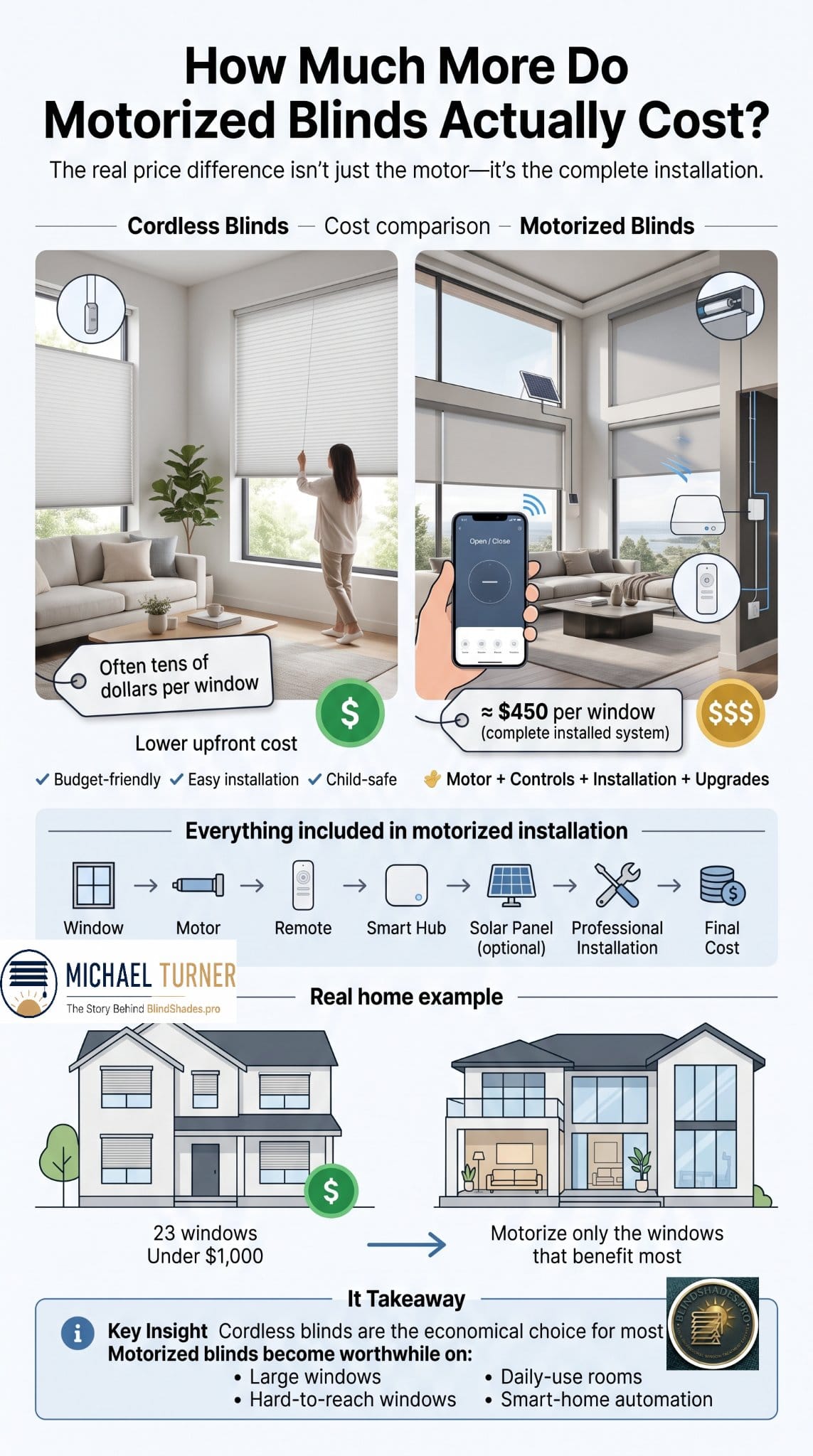
By Michael Turner — 30 years in window treatments
Cordless vs motorized blinds is decided by reach before it is decided by anything else: if you can stand at the window and move the bottom rail comfortably, cordless is the better buy, and if you can’t — or you’re adjusting the same handful of windows several times a day — motorized starts earning its price. Smart-home integration is the tiebreaker, not the reason. And there is a third question almost nobody asks before ordering, which is where the regret in this category actually comes from: not should I motorize, but how is the motor going to get its power.
Key Takeaways
- Reach is gate one. A window you can operate by hand doesn’t need a motor, however nice the app is.
- Window count is gate two. One motorized shade is a gadget; several adjusted daily is the point at which people describe the upgrade as worth it.
- Power is gate three, and it’s the one people skip — battery, hardwired, solar, or plug-in is a decision made at purchase and expensive to reverse.
- Motorized is not automatically smart. Some motorized shades take a remote and nothing else, with no scheduling and no presets.
- On safety they tie. Both remove the hanging cord entirely; the honest gain from motorizing is access, not child safety.
⭐ Quick Answer — Cordless vs Motorized Blinds
Decide cordless vs motorized blinds with three gates, in order — reach, then window count, then how the motor gets its power:
- Gate 1 — reach decides most homes: a window you can comfortably work by hand is a cordless window; once it needs a stool, a pole or a stretch, motorizing stops being a luxury — the other answers to that problem are in reaching blinds on tall windows.
- Gate 2 — count and cadence: one motorized shade is a gadget; several moved morning and evening is where owners describe the upgrade paying for itself.
- Gate 3 — the power route nobody asks about: battery, hardwired, solar or plug-in behave nothing alike over years, and the wiring choice expires the day the drywall goes up.
- They tie on safety: Blindsgalore concedes both options remove the traditional cord hazard entirely — so buy motorization for access, not for child safety.
- Cost is not close: Blindster puts cordless lifts on the budget-friendly side while motors and remotes carry the premium, and Gotcha Covered frames motorization as the smart-home path — the manual picks are ranked in our Cordless Blinds & Shades guide, the powered field in our Motorized & Smart Blinds guide.
Cordless vs Motorized Blinds: Which Should You Choose?
The Three Gates (Reach · Count · Power)
Take the gates in order and most people have their answer inside a minute. Gate one is reach. Cordless blinds ask you to touch the bottom rail, so the window has to be reachable without ceremony — the mechanism itself is simple and well understood, and how cordless blinds work explains why the spring and brake need your hands to be there. The moment a window needs a step stool, a pole, or a stretch on tiptoe, the entire cost comparison changes, because you are no longer choosing between convenience levels — you’re choosing between a window you use and a window you leave shut. Owners describe exactly that failure in the field: one long-running discussion about an unreachable window ends with the group agreeing that short of a remote-controlled blind, there is no good answer, and another homeowner notes plainly that shorter people struggle with cordless blinds much past about six feet of drop. That is the practical threshold — call it the step-ladder test, and it is the single most useful line in this comparison. If reaching the window already requires a ladder, reaching blinds on tall windows is the problem you’re actually solving, and motorization is one of three answers there.
Gate two is count and cadence. A motor on one window in a spare room is an expensive novelty. Several windows moved morning and evening is a different equation, and the owner reports flip accordingly: in one widely read discussion about whether motorized cellular shades actually get used, the top account calls automated shades running up and down several times a day the biggest single payoff of their whole home-automation setup. The reverse is just as well documented — the same category of buyer, with eight or more battery-powered windows, describes the charging cycle as a chore that outlives the novelty.
Gate three is power, and it decides how happy you’ll be in year three. The industry summary of motorized ownership is usually one clause about occasional battery charging. That clause hides four genuinely different products, covered in its own section below.
| Factor | Cordless | Motorized | Which gate decides it |
|---|---|---|---|
| Operation | Manual push or pull on the bottom rail | Remote, app, or voice; some models add a wall switch | Gate 1 |
| Upfront cost | The budget-friendly side of the aisle, per Blindster’s Nov 2025 comparison | Higher, for the motor, remote, and any hub | Gate 2 |
| Ongoing upkeep | Nothing to charge; the spring is the only wear part | Charging, battery replacement, or a hardwired power check | Gate 3 |
| Best window | Standard height, within comfortable reach | Tall, heavy, wide, or awkwardly placed | Gate 1 |
| Noise | Silent | A soft motor sound during travel, as The Blind Man Charlotte NC notes | Neither — a preference |
| Safety | No accessible cord | No accessible cord | Neither — they tie |
| Long-run failure | Spring tension fades with heavy use | Motor, battery, or hub obsolescence | Gate 3 |
The safety row deserves saying out loud, because three of the pages selling this comparison lean on it. Blindsgalore, writing in February 2026, concedes the point before making it: both options are dramatically safer than anything with a traditional cord, and only then does the argument for motorized begin. Read the concession, not the conclusion. If child and pet safety is what sent you looking, cordless already delivers it — that case is examined in full in are cordless blinds child-safe. What motorizing buys you is access, not a safer house.
How Much More Do Motorized Blinds Actually Cost?
Enough that the answer should be a number, and the field almost never gives one. Blindster’s November 2025 comparison puts it as cordless lifts being more budget-friendly while motorized lifts carry a higher price tag for the motors and remotes; buyhomeblinds, writing in April 2026, reaches the same verdict from the other direction, calling cordless the stronger pick on price, safety, and daily ease. Covering Windows adds the honest footnote that traditional corded blinds still carry the lowest initial price of the three, which matters mainly as a reminder that you are paying for the absent cord as well as the motor.
For anything better than “higher,” you have to read owners. The most complete account comes from a homeowner who documented a full Zigbee-and-hardwired shade project and reported an average of roughly four hundred and fifty dollars per blind once measuring, installation, solar panels, motors, and upgrades were counted — an all-in figure, not a sticker figure, and the most honest number in circulation. At the other end, off-the-shelf cordless cellular shades routinely land in the tens of dollars per window, which is why one homeowner could report outfitting twenty-three windows for under a thousand dollars using big-box cordless cellular blinds. The spread is not subtle, and it is the reason gate two exists: motorization has to be justified per window, and most homes only have a few windows that justify it. The full picture for the manual side sits in how much cordless blinds cost.
Battery, Hardwired, Solar, or Plug-In?
This is the decision the comparison pages skip, and the one owners regret. “Motorized” describes the motor, not the wire, and the four power routes behave nothing alike over years.
| Power route | How it works | The failure mode | Who it suits |
|---|---|---|---|
| Rechargeable battery wand or built-in pack | Charge every few months via a cable or removable pack | Charging becomes a chore as window count rises | One to three windows, or a retrofit |
| Hardwired to line or low voltage | Permanent supply run to the window during construction | Impossible to add cleanly once walls are closed | New builds, remodels, whole-home plans |
| Solar-assisted | A small panel trickle-charges the battery at the window | Only works with genuinely sun-facing glass, and can’t rescue a sealed throwaway motor | Sunny exposures with an accessible panel mount |
| Plug-in adapter | The motor runs from a nearby outlet | Visible cable, and outlet placement rarely matches window placement | Rentals and single windows near power |
Two owner-sourced rules cut through it. The first is a threshold: an experienced installer in one long-running smart-home discussion advises that once you are dealing with three or more blinds, or higher daily usage, hardwiring is the sensible route — under that, batteries are fine. The second is a warning about the remodel window, and it is the loudest single voice in the community record: a homeowner who skipped wiring during their renovation was told by their electrician to do it then, and the group’s verdict was blunt — pulling wire after the drywall goes up is a miserable job. If your walls are open right now, that is a decision with an expiry date on it.
Two smaller cautions belong here as well. Home outlets and blind motors do not speak the same electrical language, so the plan of “I’ll just plug it into the wall” needs the correct adapter rather than improvisation. And adding a solar panel to an inexpensive sealed motor is a poor investment — one solar-focused discussion warns that certain rechargeable cells with charging circuitry can push a higher voltage than the blind expects while charging. The battery experience genuinely can be excellent when the hardware is good: owners of premium motorized shades report months between charges, and one reports two years across several windows without changing a battery at all. That range — months to years to constant nuisance — is the product of this table, not of the brand name on the box.
Is Motorized the Same as Smart?
No, and buying as though it were is the most common disappointment in this category. The distinction is drawn by only one writer in this field, a dealer post from 2022 separating automated from motorized window coverings — and it deserves better circulation than it gets. A motorized shade has a motor. A smart shade takes instructions from a system. An automated shade acts on its own, on a schedule or a sensor, without you.
The gap between them is not theoretical. One owner discovered after purchase that their motorized shades from a major online retailer had no presets at all, which meant no scenes and no scheduled positions — the shades moved on command and did nothing else. If the appeal of motorizing is waking to open blinds, that single specification decides whether you get it, and it is rarely on the product page in plain language. Ask for three things before ordering: whether the shade holds preset positions, what system it speaks to, and whether it works from a wall control when the network is down.
The retrofit path deserves equal billing, because it changes the whole calculation. You do not have to choose motorized at purchase. Owners routinely add motors to blinds they already own — self-installed tilt motors on standard slat blinds, bridge devices that give a remote-controlled shade a voice assistant, and light-sensor motors added to existing pull-down shades. It is the same instinct that drives people the other way, toward converting corded blinds to cordless. Buying cordless now and motorizing the two windows that annoy you later is a legitimate strategy, and often the cheapest correct answer. When you do reach that point, the full field is ranked in our motorized and smart blinds buying guide.
Avoid These Mistakes
- Motorizing for safety. Both types remove the accessible cord. Pay for reach, cadence, or integration — not for a hazard cordless already eliminated.
- Skipping the power decision. Choose battery, hardwired, solar, or plug-in deliberately at order time; retrofitting a wire into a finished wall is the expensive version.
- Assuming motorized means schedulable. Confirm presets and system compatibility before ordering, or you may own a remote-controlled shade and nothing more.
- Motorizing a window you can reach. A comfortable window is a cordless window; spend the difference on the awkward one down the hall.
- Ignoring the treatment underneath. A motor doesn’t fix a poorly built shade — how the manual versions hold up is covered in how long cordless blinds last, and a stiff or sticking shade needs diagnosis rather than automation.
Who Should Choose Which?
✔ Choose cordless if: your windows are within comfortable reach · you’re covering a whole house on a budget · you want nothing to charge, pair, or update · you rent, or expect to move · you like the silence and the clean look · you’d rather motorize one or two windows later than all of them now.
✖ Choose motorized instead if: the window needs a ladder, a pole, or a stretch · the treatment is heavy, wide, or a tall specialty shade · you adjust the same windows several times daily · you want scheduling, sensors, or voice control · you’re building or renovating with the walls open · mobility makes hand operation genuinely difficult — the strongest reason on this list, and the one worth paying for without hesitation.
The Bottom Line
Cordless vs motorized blinds resolves cleanly for most homes: cordless everywhere you can reach, motorized where you can’t, and the power route decided on purpose rather than discovered later. Safety doesn’t break the tie, price favours cordless by a wide margin, and the smart-home dream is worth confirming in the specification before it’s paid for. Most houses are a mix, and there is nothing inconsistent about that — one motorized stairwell window and eleven cordless ones is a sensible house.
If cordless is where you’ve landed, the picks that run the mechanism best are ranked in our complete Cordless Blinds & Shades buying guide — and if you’re still weighing the category itself, start with are cordless blinds worth it.
FAQ
Are motorized blinds worth the extra cost? On the right windows, yes. Tall, heavy, or hard-to-reach glass and treatments you adjust several times a day justify the premium, and owners of multi-shade setups describe daily automation as their best home upgrade. On a standard reachable window, the extra spend buys convenience you may not notice after a month.
Can you convert cordless blinds to motorized later? Often, yes. Add-on tilt motors, retrofit lift motors, and bridge devices that link a remote-controlled shade to a voice assistant are all in common use. Buying cordless now and motorizing only the awkward windows later is frequently the cheapest correct route, though results vary by mechanism and shade weight.
Do motorized blinds have to be hardwired? No — rechargeable batteries, solar assist, and plug-in adapters all work. Hardwiring matters most at scale: experienced installers suggest it once you’re past a few blinds or running them heavily, and the wiring is far easier to run while walls are open than after they’re closed.
Which is safer, cordless or motorized blinds? They tie on the hazard that matters. Both remove the accessible pull cord entirely, which is the child and pet risk the industry redesigned around. Motorized adds convenience and hands-free operation, not a further safety category, so choose between them on reach, usage, and power rather than on safety claims.
Related Guides
- Best Cordless Blinds & Shades — the complete buying guide
- Best Motorized & Smart Blinds — the full motorized field, ranked
- Are Cordless Blinds Worth It? — the category verdict
- How to Reach Blinds on Tall Windows — all three answers to the reach problem
- How Long Do Cordless Blinds Last? — the durability record, adjudicated
- Cordless Top-Down Bottom-Up Shades — the manual version of the feature people motorize for
- How Do Cordless Blinds Work? — the spring, the brake, and the three moves
