How Much Do Cordless Blinds Cost?

Authored By Michael Turner -30 Years Home Improvement Expertise | Updated 2026 | BlindShades.pro
Updated on July 26, 2026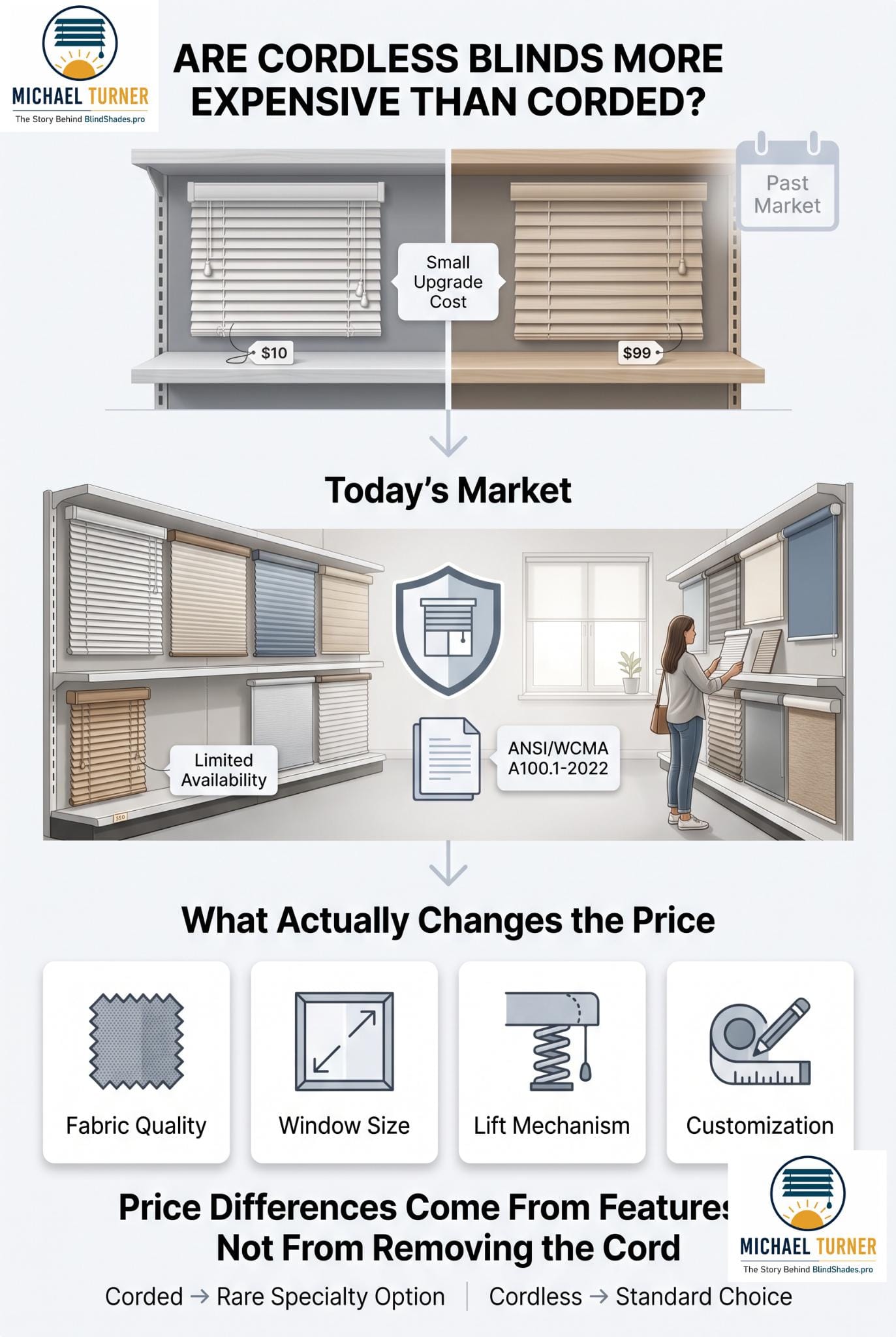
By Michael Turner — 30 years in window treatments
Cordless blinds cost from under ten dollars for a stock vinyl mini blind to over four hundred for a custom cordless roman shade — and the same window can land anywhere in that range depending on four things you control. Most homes buying standard-size faux wood or cellular land between roughly twenty and sixty dollars a window. Home Depot publishes a cordless range of twelve to one hundred ninety-eight dollars; The Shade Store publishes two hundred to four hundred forty. Both are honest — they sell different products through different channels, which is why “how much” has no single answer until you know which multipliers apply to your windows. The surprise sits underneath the question: the claim that cordless costs extra now measures against a product you can barely buy.
Key Takeaways
- The realistic band for most homes is twenty to sixty dollars a window in standard sizes; stock vinyl goes under ten, premium custom into the hundreds.
- Four multipliers set the number — size, material, mechanism and channel — and they compound rather than add.
- The cordless “upgrade fee” is largely obsolete. Safety standards pushed stock blinds to cordless, so there is no cheaper corded baseline left to upgrade from.
- List price is a starting position. Discounts of 45% and more sit on this category continuously, so timing changes the bill more than brand does.
- Whole-house totals cluster by route: owners report five hundred to a thousand for a big-box house, several thousand once custom cellular or installation enters.
⭐ Quick Answer — How Much Do Cordless Blinds Cost?
Cordless blinds cost about twenty to sixty dollars per window for standard-size faux wood, vinyl or cellular, dropping under ten dollars for basic stock vinyl and climbing past two hundred ninety for premium custom shades — and four multipliers decide where your own windows land:
- Size steps, it does not slide. Retailers stock in width brackets, so a window an inch over a bracket costs like the bracket above it — and past the widest bracket you pay custom.
- The published ranges disagree for a reason. Home Depot lists cordless from twelve to one hundred ninety-eight dollars while The Shade Store lists two hundred to four hundred forty — different catalogues, both honest.
- Mechanism is its own tier. Top-down bottom-up costs more than plain lift, and owners who added motors and smart control report about four hundred fifty dollars a blind installed.
- Whole houses cluster by route, not brand. Owners report five hundred to a thousand dollars for a big-box house and several thousand once custom cellular or installation enters — the channel decision is in where to buy cordless blinds.
- The cordless “upgrade fee” is obsolete. Safety standards pushed stock blinds to cordless, so there is no cheaper corded baseline left — and the entry tier is the one owners report failing first, with picks ranked in our cordless blinds and shades guide. Wirecutter names a seventy-two-dollar Home Depot option among its blackout picks.
How Much Do Cordless Blinds Cost?
The Four Multipliers (Size · Material · Mechanism · Channel)
Cordless blinds cost what they cost because of four variables that multiply against each other rather than adding up. A small vinyl mini with a basic spring sits at one end; a wide double-cell blackout cellular shade with a top-down bottom-up mechanism, measured and installed by a consultant, sits at the other — roughly fiftyfold apart, on the same wall.
| Multiplier | Cheapest end | Dearest end | What it does |
|---|---|---|---|
| Size | Stock widths under 27 inches | Oversize and extra-wide | Steps up at each stock bracket, then jumps at custom |
| Material | Vinyl, aluminium mini | Double-cell cellular, real wood, roman fabric | Roughly doubles across the ladder |
| Mechanism | Basic spring lift | Top-down bottom-up, motorised | Adds a tier of its own regardless of fabric |
| Channel | Big-box stock shelf | In-home consultation | Sets both the floor and the ceiling |
Size is the multiplier people underestimate. Retailers stock in width brackets — under 27 inches, 27 to 35, and 35 to 47 are the common ones — and the price steps at each boundary rather than sliding smoothly. A window an inch over a bracket costs like the bracket above it, and past the widest bracket you leave stock pricing entirely and pay custom. The weight and mechanism limits that come with width are in cordless blinds for large windows.
Material roughly doubles as you climb. Vinyl and aluminium minis are cheapest, faux wood sits above them, cellular above that, double-cell blackout and real wood above that again; cordless curtains and roller shades price separately from slatted blinds. The same products are sold as push-up blinds or as window blinds without cords, and how the mechanism works is identical whichever name is on the label. Blindster lists a two-inch premium faux wood at twelve dollars fourteen and a no-tools top-down bottom-up cellular shade in a small size at fifty-four sixty-eight — more than four times, at the same modest width.
Mechanism is a tier of its own. Basic spring lift is the baseline; top-down bottom-up costs more because there are two moving rails; motorised costs more again, with owners who added motors, solar panels and smart control reporting about four hundred fifty dollars a blind installed. Whether that earns its place is weighed in cordless versus motorised blinds.
Channel sets the boundaries. The same faux wood blind is a different price on a shelf, on an online custom site, and in a consultant’s sample book — a decision laid out in where to buy cordless blinds.
What Should You Expect to Pay Per Window?
Expect twenty to sixty dollars a window for standard-size cordless faux wood, vinyl or cellular, and treat anything outside that as a different tier rather than a bargain or a rip-off. Published listings cluster into four bands.
| Tier | Per window | What you get | Best for |
|---|---|---|---|
| Stock basic | Under ten to about thirteen dollars | Vinyl or aluminium mini, stock widths, light filtering | Rentals, utility rooms, temporary cover |
| Stock faux wood | About twenty to thirty dollars | Two-inch faux wood, stock widths, cut in store | Most rooms in most houses |
| Custom faux wood or cellular | About thirty to sixty dollars | Exact measurements, more colours, blackout options | Odd sizes, bedrooms, matched sets |
| Premium and specialty | Two hundred ninety dollars and up | Roller, solar, roman, designer materials | Feature rooms, whole-home schemes |
Real listings anchor each band. Walmart lists a cordless Mainstays light-filtering blind at seven dollars eighty-four on roughly 4,800 reviews. Home Depot’s StyleWell pre-cut mini sits at eleven ninety-eight, its Home Decorators Collection line at fifty-seven ninety-eight across about 9,300 reviews. Blinds.com custom faux wood runs twenty-eight forty-eight to forty-five eighty-nine, and The Shade Store publishes cordless roller and solar at two hundred ninety dollars, flat roman at four hundred five.
⚠️ Read the review count before the price. Some of the cheapest listings carry ratings built on one or two reviews — five stars on two buyers tells you nothing, 4.0 on 6,400 tells you plenty. The tier also predicts survival: the entry tier is the one owners report failing first.
Per-window numbers only matter once you multiply them, which almost nobody publishing on this subject does.
What Does a Whole House Cost?
A whole house costs the per-window figure times your window count, plus a step change if any window needs custom sizing — and owner-reported totals cluster more tightly by route than by brand. These are figures homeowners published about their own completed jobs, not quotes.
| Reported job | Windows | Reported total | Route |
|---|---|---|---|
| Whole house, big-box cellular line | 23 | Under a thousand dollars | Lowe’s stock |
| Mixed faux wood and blackout cellular | 7 | About a thousand dollars | Roughly a hundred each for faux wood, a hundred seventy-five each for double-cell blackout |
| Whole house, big-box own brand | Every room | About five hundred dollars | Home Depot Home Decorators Collection |
| Custom cellular, top-down bottom-up, several oversize | 18 | About thirty-six hundred dollars | Levolor custom |
| One-bedroom condo, measured and installed | Whole condo | About thirty-eight hundred dollars ⚠️ Canadian quote | In-home consultation |
The pattern matters more than any single number. A big-box house lands in the hundreds; a custom cellular house lands in the thousands. The gap is not prestige but the four multipliers compounding — custom sizing, upgraded material, a second rail, and a channel that bills labour.
Two rules make this usable. Count your windows and sort them by whether they take a stock width, so only the odd ones need custom money. Then price your three busiest windows one tier up, because daily use wears a mechanism out. In-store cutting is the cheapest route to matched blinds, and the measuring discipline it demands is in can you cut cordless blinds to size.
Are Cordless Blinds More Expensive Than Corded?
Not meaningfully any more, because the corded baseline the comparison depends on has largely left the shelf. The claim in circulation — Factory Direct Blinds puts cordless at slightly more than corded, usually under a hundred dollars as an upgrade — was accurate when both sat side by side in the same store. That is no longer the ordinary situation.
The ANSI/WCMA A100.1-2022 safety standard, published through the Window Covering Safety Council, eliminates free-hanging operating cords on made-to-order window coverings and requires stock products to be cordless or to have inaccessible cords. It is an availability constraint, not a prohibition — corded products still exist in specific configurations — but the practical effect in a big-box aisle is that cordless is the stock product, and owners hunting corded replacements report exactly that.
So the honest framing is not whether to pay extra for cordless but which cordless tier you are buying. Any remaining gap is a specification difference — fabric, size, mechanism — not a fee for the absence of a cord. The full comparison, including what the people who genuinely want cords should do instead, sits in cordless versus corded blinds, and the case for the category overall is weighed in are cordless blinds worth it.
Why Do Published Price Ranges Disagree So Much?
Because each retailer publishes the range of what it happens to sell, and those catalogues barely overlap. Set them side by side and the disagreement resolves.
| Retailer | Published range | Rating (reviews) | What the range reflects |
|---|---|---|---|
| The Home Depot | Twelve to one hundred ninety-eight dollars | 4.7 (3,900) | Stock minis to custom faux wood |
| Blinds.com | Twenty-eight to one hundred fifty-one dollars | 4.7 (2,600) | Online custom, no stock floor |
| American Blinds | Forty-six to two hundred fifty-two dollars | 4.8 (681) | Mid-market custom only |
| Factory Direct Blinds | Seventy-seven to one hundred ninety dollars | 4.2 (537) | Narrow custom band |
| The Shade Store | Two hundred to four hundred forty dollars | 4.4 (2,800) | Premium, designer channel |
One thing distorts every figure above: this category is discounted more or less permanently. Reductions of 45% sit on multiple listings simultaneously, alongside 20% offers and, on one retailer’s cordless page, a list price near six hundred ninety-five dollars against a selling price of about two hundred seventy-eight. When that much of the field is marked down at once, list price is a starting position rather than a value — so order free swatches, then buy into the promotional email that follows, a sequence covered in where to buy cordless blinds.
Avoid These Mistakes
- Budgeting from one price you saw once. A single listing in a single width is not the category. Price your own windows by bracket.
- Forgetting the stock-width steps. A window an inch over a bracket costs like the bracket above it, and past the widest bracket you pay custom.
- Buying the cheapest tier for windows you use daily. Entry mechanisms fail first, and they fail on the busy windows — see how long cordless blinds last.
- Paying list price. Something in this category is discounted at any given moment; not waiting for it is a choice.
- Treating a five-star rating on two reviews as evidence. Check the base before the price.
- Comparing an in-home quote to an online cart. The quote includes measuring and installation labour, the largest line in a consultant total.
Who Should Buy Which Tier?
Buy the stock basic tier if: ✔ The room is a rental, garage, laundry or spare bedroom, and the window takes a common stock width ✖ Not for a window you operate every single day
Buy stock faux wood if: ✔ You want the best value across most rooms, and your windows fit stock brackets a service desk can trim ✖ Not if you need blackout fabric or an unusual colour
Buy custom faux wood or cellular if: ✔ Windows are non-standard, bedrooms need blackout, or several must match exactly ✖ Not if a stock size would have fitted with a trim
Buy premium or installed if: ✔ Windows are tall, numerous or awkward, and you are paying for measuring, installation and specification rather than fabric ✖ Not for one or two ordinary windows, where the premium buys little
The Bottom Line
Cordless blinds cost about twenty to sixty dollars a window in standard sizes, under ten at the stock vinyl floor, and two hundred ninety and up in premium custom — and your own number falls out of four multipliers: size, material, mechanism and channel. Count your windows, sort them by whether they take a stock width, put the busy ones a tier up, and expect a big-box house in the hundreds and a custom cellular house in the low thousands. Ignore the cordless “upgrade fee” — the corded baseline behind it has left the shelf. Whatever tier you choose, order swatches first and buy into a discount, because list price here is almost never the real price.
Ready to price your own windows? Shortlist products in our complete cordless blinds and shades guide and check live pricing before you commit to a tier.
FAQ
Are cordless blinds more expensive? Barely, and less than the claim suggests. Retailers describe cordless as an upgrade costing under a hundred dollars more, but safety standards pushed stock blinds to cordless, so the cheaper corded baseline has largely gone. Remaining differences come from size, fabric and mechanism.
What is the average cost of blinds? An average here is close to meaningless, because published ranges run from about twelve dollars to over four hundred. The useful figure is the band most homes buy in: roughly twenty to sixty dollars a window for standard-size cordless faux wood or cellular.
How much do blinds cost generally? Stock vinyl and aluminium minis start under ten dollars, faux wood sits in the twenties and thirties, custom cellular reaches the fifties and sixties, and premium roller, solar or roman shades begin near two hundred ninety. Size, material, mechanism and channel decide where you land.
How much do cordless blinds cost at Home Depot? Home Depot publishes a cordless range of twelve to one hundred ninety-eight dollars against a store rating of 4.7 across about 3,900 reviews. Pre-cut stock minis sit near twelve dollars, faux wood in the twenties to forties, Home Decorators Collection lines in the high fifties.
How much do cordless blinds cost at Walmart? Walmart carries the category’s lowest entry prices, with cordless Mainstays light-filtering blinds near seven dollars eighty-four and room-darkening vinyl near nine twenty-six, both on review bases in the thousands. These are stock sizes with basic spring mechanisms and no cutting service.
Are cordless blinds cheaper on Amazon? Sometimes on stock sizes, but the saving narrows once you count what is missing: no measuring help, no cutting service and no fit guarantee. On a marketplace the individual seller rather than the platform handles a failed mechanism under warranty, which matters on a spring-lift product.
Related Guides
- Best Cordless Blinds & Shades — the complete buying guide
- Can You Cut Cordless Blinds to Size? — the cheapest route to matched blinds
- Are Cordless Blinds Worth It? — the honest verdict on the category
- Cordless vs Corded Blinds — the upgrade question in full
- Cordless vs Motorised Blinds — when powered earns its premium
- Best Motorised & Smart Blinds — the powered category in full
- Cordless Top-Down Bottom-Up Shades — the mechanism premium
- Cellular vs Roller Cordless Shades — the material call
