Do Cordless Blinds Work on Large Windows?

Authored By Michael Turner -30 Years Home Improvement Expertise | Updated 2026 | BlindShades.pro
Updated on July 26, 2026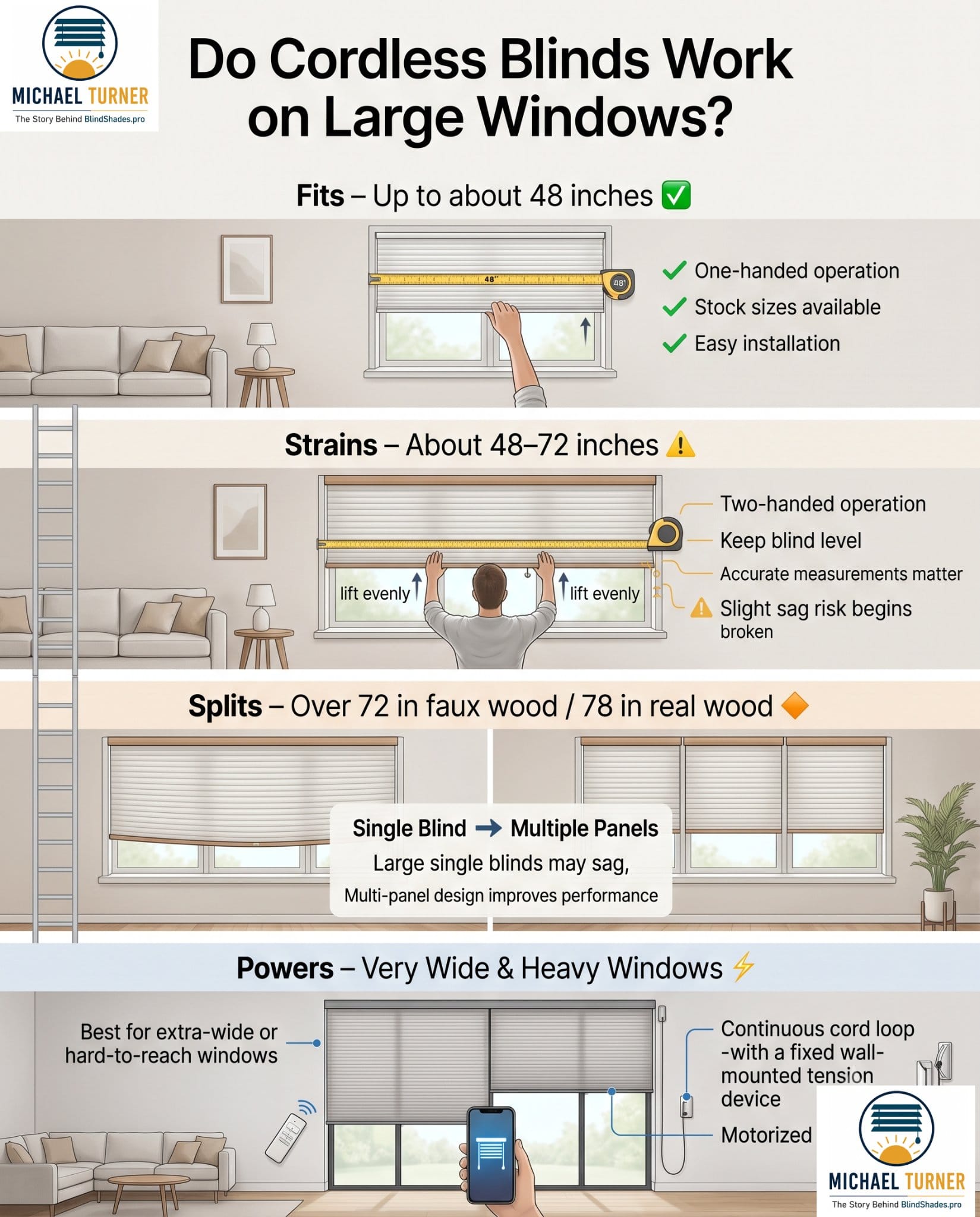
By Michael Turner — 30 years in window treatments
Yes — up to roughly 72 inches wide. Past that, most manufacturers stop building a single cordless blind and start splitting the span across two or three panels on one headrail. That number is published, not guessed: Blinds.com lists its cordless blackout cellular shades as available up to 72 inches wide, and Blinds Chalet states that faux wood over 72 inches and real wood over 78 typically require multiple blinds. Between about 48 and 72 inches cordless still works, but needs two hands and a level pull. The failure past the limit is not the spring giving out — it is sag, which is why the fix is usually to divide the window rather than motorise it.

Key Takeaways
- About 72 inches is the practical cordless ceiling for a single blind; real wood reaches roughly 78 because it is lighter than faux wood.
- Between 48 and 72 inches cordless works but changes. Two hands at the centre of the bottom rail, every time.
- Sag is the wide-window failure, not spring failure — and splitting the span prevents it where a motor does not.
- Two or three blinds on one headrail is a factory cordless option, with independent lifts and one shared valance.
- Wide and tall are different problems. Width is about weight; height is about reach, and it has a different answer.
⭐ Quick Answer — Do Cordless Blinds Work on Large Windows?
Yes — cordless blinds work on large windows up to about 72 inches wide, and above that the industry supplies two or three panels on one shared headrail rather than a single blind:
- 72 inches is the published ceiling. Blinds.com lists its cordless blackout cellular shades as available up to 72 inches wide; real wood blinds reach roughly 78 because they are lighter than faux wood.
- From 48 inches it becomes a two-handed product. SelectBlinds notes that very wide or heavy blinds may need two hands — grip the bottom rail at its centre and keep it level the whole way.
- The failure is sag, not the spring. One blind carrying weight across a long unsupported span droops over time, which is exactly why width limits exist.
- Split the span instead of motorising it. Two or three panels on one headrail is a documented factory cordless option: independent lifts, one continuous valance, and no panel spanning the full width — the same logic as running one blind across a bay window.
- Wide and tall are different problems. Blindsgalore reserves motorisation for extra-large or heavy shades; if your window is high rather than wide, start with reaching blinds on tall windows, and shortlist products in our cordless blinds and shades guide.
Do Cordless Blinds Work on Large Windows?
The Width Ladder (Fits · Strains · Splits · Powers)
Almost every source says cordless struggles on “very large” or “extra-wide” windows without defining those words. Published specifications do define them, and they cluster tightly enough to build a ladder from.
| Band | Width | What happens | What to do |
|---|---|---|---|
| Fits | Up to about 48 in | One-handed, stock sizes available | Buy stock, trim at a counter |
| Strains | About 48 to 72 in | Two hands; level pull mandatory; sag risk begins | Buy custom, lighter fabric |
| Splits | Over about 72 in faux wood, 78 in real wood | A single blind sags and binds | Two or three panels, one headrail |
| Powers | Very wide and heavy, or out of reach | Weight beats hand operation | Motorise, or a continuous loop |
Fits. Below roughly 48 inches you are in normal stock territory — retailers bracket stock widths under 27, 27 to 35, and 35 to 47 inches — and a cordless blind this size behaves exactly as designed.
Strains. From about 48 inches the blind gets heavy enough that technique matters. SelectBlinds notes that very wide or heavy blinds may require two hands, and that is the honest description: not broken, just a two-handed product. Grip the bottom rail at its centre and keep it level through the whole travel. Measuring tolerance tightens here too — SelectBlinds asks buyers to compare three width measurements and warns that a variance beyond a quarter inch can stop a blind fitting, and wide openings are the likeliest to be out of square.
Splits. Past roughly 72 inches the industry itself stops selling one blind — the threshold worth knowing before you shop, and the subject of its own section below.
Powers. A motor earns its place when the span is both very wide and heavy — a wide blackout cellular shade — or when the window is out of reach. Blindsgalore agrees: cordless works for most windows, but for extra-large or heavy shades motorised is often better. The comparison sits in cordless versus motorised blinds, and the powered category is ranked in our motorised and smart blinds guide.
One quiet admission is worth noting: Blinds.com’s premium cellular listing says continuous cord loops let larger shades operate more smoothly — so at the top of the size range the industry’s answer is sometimes to reintroduce a cord. Current safety standards require a continuous-loop product to ship with a permanently attached tension device, which makes that a specification choice rather than a step backwards.
What Actually Goes Wrong on a Wide Cordless Blind?
Not the spring, usually. Wide blinds fail in five specific ways, and four of them are geometry rather than mechanism.
| Symptom | What is actually happening | The fix |
|---|---|---|
| Sags over time | One blind carrying weight across a long unsupported span | Split the span |
| Curves inward | Pulled off-centre, so internal cords wind unevenly | Both hands, centre, level |
| Hangs crooked | One side wound more cord than the other | Pull level; each cord run serves its own section |
| Gouges wall corners | Pushed up from one end, so the rail swings | Two hands — the community’s loudest complaint |
| “Becoming too short” | Internal cords tangled or worn in the headrail | Service or replace; not a fit problem |
Blinds Chalet states the sag issue plainly: large windows covered with a single blind tend to sag over time, and this does not occur with multiple shades on one headrail. That sentence explains why width limits exist at all — the constraint is unsupported span, not spring strength.
The other four are the same underlying error, and owners describe it consistently: pull down level with the slats level or the curve appears, because each vertical line running down the blind is a cord for its own section. If your blind has already stopped moving, work through why cordless blinds won’t go up or down before blaming the width, and see how long cordless blinds last for how the tiers age under this load.
How Do You Cover a Window Wider Than 72 Inches?
You buy two or three blinds on one headrail — a standard factory cordless option, not a workaround. A current manufacturer specification sheet for cellular shades lists “Multiple Shades on One Headrail: Cordless Lift” as a documented feature alongside the standard cordless and motorised lifts, which is the clearest evidence that this is how the industry solves wide spans.
| Option | How it works | Best for |
|---|---|---|
| 2-on-1 headrail | Two panels, one continuous headrail and valance, independently operated | Most wide windows and patio doors |
| 3-on-1 headrail | Three panels under one headrail | Very wide spans, including 120-inch openings |
| Two separate blinds | No shared headrail or valance | Tight budgets; a visible gap between units |
| One motorised blind | Motor carries the weight instead of your arm | When an unbroken single expanse matters most |
The advantages are practical. Each panel operates independently, so you can raise the section over a doorway while the rest stay down — useful on a patio slider. The shared headrail and valance keep one clean top line, so it reads as a single treatment. And because no panel spans the full width, sag disappears.
⭐ The trade-off nobody mentions: a split introduces a meeting point, and that seam passes a thin line of light. In a living room it is invisible. In a blackout bedroom, plan for it — accept the line, or use an outside mount that overlaps generously. For a bay, whether to run one blind across the whole opening is covered in one blind across a bay window; for sliders and very wide glass see blinds for large sliding glass doors and roller blinds for large windows. Splitting also raises the bill, since you buy two or three mechanisms — arithmetic in what cordless blinds cost.
Which Cordless Blinds Handle Width Best?
The lightest option at a given width wins, because weight per square foot is the real constraint. Two facts from published guidance make this actionable, and both are counter-intuitive.
| Material | Behaviour at width | Verdict for large windows |
|---|---|---|
| Cellular, larger cell | Bigger cells are lighter per square foot | ✔ Best choice — the community’s default for wide windows |
| Real wood | Lighter than faux wood, so available wider | ✔ Good to about 78 in |
| Faux wood | Heavier than real wood, so capped sooner | ⚠️ Split past about 72 in |
| Vinyl / aluminium mini | Light, but flexes and bends at width | ⚠️ Fine to mid-widths, poor beyond |
First, Blinds.com states that its largest cell size is lighter per square foot than smaller cells, so a shade spanning a large opening supports itself with no threat of sagging and no extra reinforcement. On a wide window the bigger cell is a structural choice as much as an aesthetic one — which is why owners with genuinely wide windows keep recommending cellular to each other; our cellular and honeycomb shades guide covers cell sizes in detail.
Second, faux wood is heavier than real wood, so it cannot be built as large. Anyone assuming the cheaper material is the tougher engineering choice has it backwards at width. If your wide blind also needs trimming, width cutting is a store-counter job — rules in can you cut cordless blinds to size.
Wide or Tall — Which Problem Do You Actually Have?
These get discussed as one question and they are not. Width is a weight problem; height is a reach problem, and they have different solutions.
A wide window at normal height needs a split, a lighter fabric and two-handed technique. A tall window needs none of that — it needs you to reach the bottom rail. One owner in a design discussion put it exactly right, choosing motorised shades not because the windows were wide but because they were so high. That is a height decision wearing a width costume; the escalation from poles to top-down-bottom-up to motors is in how to reach blinds on tall windows.
One published recommendation deserves adjudication rather than repetition. Budget Blinds suggests tall or high-angle windows might work better with traditional corded blinds, because the cord aids reach. The logic is sound; the recommendation is not, because current safety standards moved stock products to cordless or inaccessible-cord designs precisely to remove reachable hanging cords. Reach is a real problem with cordless-compatible answers — a wand, a pole, a top-down configuration, or a motor. Reintroducing a dangling cord trades one problem for a worse one.
Avoid These Mistakes
- Ordering one blind for a span over 72 inches. It will sag. Split it instead.
- Operating a wide blind one-handed. Off-centre pulls cause the curve, the crooked hang and the gouged corners at once.
- Assuming faux wood is the tougher choice at width. It is heavier than real wood and caps sooner.
- Choosing a small cell size on a wide shade. Smaller cells weigh more per square foot — exactly wrong for a long span.
- Measuring a wide opening once. Wide windows are the least square; take three widths and mind a variance beyond a quarter inch.
- Treating a tall window as a wide one. Reach has its own solutions, and going back to cords is not one of them.
Who Should Use Cordless on a Large Window?
Cordless works well if: ✔ The opening is under about 72 inches, or you will split it across panels, and you choose a larger cell or another light fabric ✖ Not if you want one unbroken blind across a very wide, heavy span
Split across one headrail if: ✔ The span is over about 72 inches, or it is a patio slider where independent panels help ✖ Not if a light line at the meeting point would spoil a blackout bedroom
Motorise if: ✔ The blind is both very wide and heavy, or the window is out of comfortable reach ✖ Not as a first response to width alone, where a split costs less and solves more
The Bottom Line
Cordless blinds work on large windows, with a real ceiling: about 72 inches for a single blind, stretching to roughly 78 in real wood because it is lighter than faux. From 48 inches up, expect a two-handed product and pull it level from the centre. Past the ceiling, the answer the field almost never gives is to split the span across two or three panels on one shared headrail — a documented cordless option that removes the sag a single wide blind develops. Choose the larger cell size to cut weight, measure in three places, and save motorisation for windows that are heavy as well as wide, or simply out of reach.
Ready to shortlist? Compare current options in our complete cordless blinds and shades guide, and check top-down bottom-up configurations if the window is tall as well as wide.
FAQ
How wide can cordless blinds be? About 72 inches for a single cordless blind in most product lines — Blinds.com publishes a 72-inch maximum on its cordless blackout cellular shades. Real wood reaches roughly 78 inches because it is lighter than faux wood. Wider openings are supplied as multiple panels on one headrail.
Are cordless blinds good for big windows? Yes, within the width limit and with the right fabric. Under about 72 inches a cordless blind performs normally, though from roughly 48 inches it becomes a two-handed product. Choose a larger cell size or lighter material, because weight per square foot is the real limit.
Can you get cordless blinds for a 120-inch wide window? Yes, but as three panels on one shared headrail rather than a single blind. A 3-on-1 configuration keeps one continuous valance and top line while each panel operates independently, and because no panel spans the full width, sag does not occur.
What size cordless blind do I need for a 38-inch wide window? A 38-inch opening sits in the standard range, so a stock or custom cordless blind that width works with no special consideration. Measure in three places and use the narrowest figure for an inside mount; for an outside mount, add overlap each side instead.
Do cordless blinds sag on wide windows? A single blind spanning a very wide opening can sag over time, which is why width limits exist. Splitting the span across panels on one headrail prevents it, and a larger cell size reduces the weight per square foot that causes it.
Are cordless or corded blinds better for large windows? For width, cordless is fine to the published limits and a split solves the rest. Corded is sometimes recommended for tall windows because the cord aids reach, but safety standards moved stock products away from reachable hanging cords — a wand, pole, top-down configuration or motor answers height better.

Related Guides
- Best Cordless Blinds & Shades — the complete buying guide
- How to Reach Blinds on Tall Windows — the height problem, solved separately
- What Do Cordless Blinds Cost? — what a split span costs
- One Blind Across a Bay Window — the split question for bays
- Best Roller Blinds for Large Windows — the roller alternative
- Blinds for Large Sliding Glass Doors — very wide glass
- Best Cellular & Honeycomb Shades — cell sizes and weight
- Best Motorised & Smart Blinds — the powered category
