How Long Do Cordless Blinds Last? The Two Clocks

Authored By Michael Turner -30 Years Home Improvement Expertise | Updated 2026 | BlindShades.pro
Updated on July 24, 2026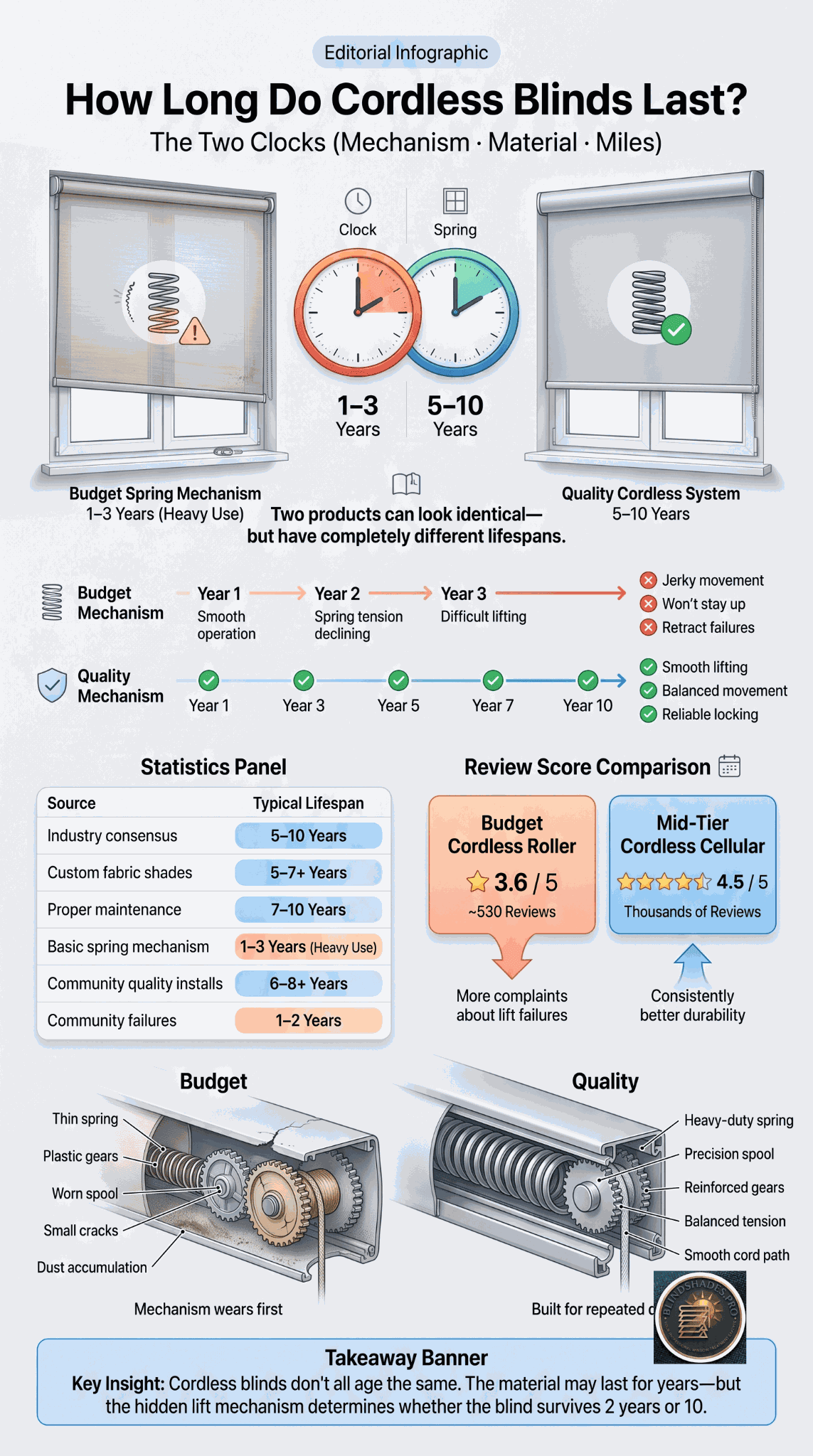
By Michael Turner — 30 years in window treatments
How long do cordless blinds last has two honest answers, because the category runs on two different clocks: quality mechanisms genuinely deliver the five-to-ten-year span the industry advertises, while basic spring-loaded mechanisms can lose tension within one to three years of heavy use — a figure the industry itself publishes, quietly, beneath the headline. Both numbers are true. They describe different products. The households who report every cordless blind breaking and the households at year six with daily use are both telling the truth about different springs — and which clock you get is decided at purchase, not by luck. This guide reconciles the numbers the sellers won’t, adjudicates the community’s durability war, and reframes lifespan the way it actually works: as a budget of cycles, not a count of years.
Key Takeaways
- Two clocks, one category: five to ten years is the quality-mechanism span; one to three years under heavy use is the basic-spring span — and the industry’s own materials state both.
- The angry reviews and the happy ones are both right. Broken-every-set households and still-perfect-at-year-six households bought different mechanisms and cycled them differently.
- Years are the wrong unit. A spring holds a budget of cycles; a bedroom blind used twice daily spends that budget ten times faster than a formal-room blind touched twice a month.
- Material sets the ceiling, mechanism sets the floor: faux wood and vinyl bodies outlast fabric, but no body outlives a dead spring.
- The route tells you the clock: premium and custom lines carry serviceable mechanisms and warranties that cover springs; budget stock blinds are built to be replaced.
⭐ Quick Answer — How Long Do Cordless Blinds Last?
How long do cordless blinds last has two honest answers, because the category runs on two clocks — and which one you get is decided at purchase:
- The quality clock reads five to ten years: the industry consensus Blindsgalore and its peers publish, with faux wood and vinyl at the top of the range and fabric or cellular shades averaging five to seven.
- The budget clock reads one to three: the same industry’s fine print — visible in velablinds’ own tier table — states that basic spring-loaded mechanisms may lose tension within one to three years of heavy use.
- Both community camps are right: the broke-every-set households and the year-six daily-use households bought different mechanisms — verified retail listings show the split in public, with budget lines a full star below mid-tier lines on the same shelves.
- Count cycles, not years: a twice-daily bedroom blind spends its spring’s budget thirty times faster than a formal-room blind — put the quality mechanism, like the seven-to-ten-year builds SelectBlinds describes, on the windows you actually touch.
- Protect the budget you bought: the three gentle-operation moves in how cordless blinds work prevent the yank tax, a failing spring gets the fix ladder in why cordless blinds won’t go up or down, and the mechanisms with the strongest survival records are ranked in our Cordless Blinds & Shades guide.
How Long Do Cordless Blinds Last?
The Two Clocks (Mechanism · Material · Miles)
Ask the sellers and the answer converges with suspicious neatness: five to ten years across the industry, seven to ten for quality units with proper care, five to seven for custom fabric shades. Ask the community and the answer splinters: entire households of broken blinds on one side, sets surviving six-plus years of children’s rooms on the other. The reconciliation is hiding in the industry’s own fine print — the same guidance that headlines five-to-ten also states that basic spring-loaded mechanisms may lose tension within one to three years of heavy use, and at least one seller prints the split as a product table: basic spring-loaded, one to three years, can be jerky and difficult to lift; advanced systems above it.
That is not one product with variable luck. That is two products wearing one name — and everything else on this page follows from telling them apart.
The Numbers Audit — Who Claims What, and Which Clock They’re Describing
| Source | Published figure | Which clock it’s really describing |
|---|---|---|
| Industry consensus (multiple national sellers) | Five to ten years | The quality clock — mid-tier and up, normal use |
| Custom-blind guidance | Five to seven-plus for custom fabric units | The quality clock, fabric material ceiling |
| Maintenance-focused guidance | Seven to ten with proper care | The quality clock, best case |
| ⭐ The same industry’s mechanism note | One to three years under heavy use, basic spring-loaded | The budget clock — the confession that explains the complaint file |
| Community survivor record | Six-plus years, kids’ rooms, daily cycles; “still working perfectly”; eight-year cellular installs | The quality clock, witnessed |
| Community casualty record | Every blind in the house broken through ordinary daily use; retract failures inside one to two years | The budget clock, witnessed |
| ⭐ Verified retail review base | A major retailer’s budget cordless roller line sits at three-point-six stars across roughly five hundred thirty reviews — while mid-tier cordless cellular lines at the same retailers run four-and-a-half stars across thousands | The two clocks, quantified side by side in public |
Read the last row twice, because it settles the argument without a single anecdote: the same shelves, the same review system, and a full star of daylight between a budget mechanism and a mid-tier one. The one-to-three-year clock isn’t a smear from angry forums — it’s visible in the sellers’ own ratings.
The War, Adjudicated
The community fought this out for years, and both sides win — about different blinds.
| Evidence | Camp | Resolution |
|---|---|---|
| “Broken every single set in my home literally just opening and closing them daily” | Prosecution | Budget clock, high daily cycles — the exact combination the one-to-three-year note predicts |
| Blinds that destroy wall corners unless pushed up carefully | Prosecution | An operation-and-build interaction: corner pulls jam cheap mechanisms, and the flailing rail does the damage |
| A household’s full set failing retraction inside one to two years, vendor return at own cost | Prosecution | Budget clock plus the big-box service gap — replacement was always the design |
| “Cordless blinds are terrible… you can’t find corded in store anymore” | Prosecution | A protest against the budget clock becoming compulsory as corded stock disappears |
| Buy-it-for-life set: six-plus years in kids’ rooms, opened and closed daily | Defense | Quality clock under the heaviest duty cycle there is — the mechanism tier absorbing what budget springs can’t |
| “All the cordless shades I’ve ever used are still working perfectly” | Defense | Quality clock, normal use |
| Cellular installs at year eight, “they make all the difference” | Defense | Quality clock, light-fabric advantage — the easiest load a spring can carry |
| Cat households reporting child-safe cordless sets holding up | Defense | Quality clock plus the category’s structural edge: nothing dangling to destroy |
The verdict: the category is fine; the budget tier is disposable. And one background fact raises the stakes — with corded blinds phased off most shelves for child safety, cordless isn’t a choice anymore. Which clock you get is the only decision left, and the comparison that used to matter is settled in cordless vs corded blinds.
Years Are the Wrong Unit — Count Cycles Instead
A spring mechanism doesn’t know what year it is. It knows how many times it has been cycled, and how hard. Think of the mechanism as carrying a budget of lift cycles — thousands for a budget spring, several times that for a quality one — and every published year-figure as that budget divided by an assumed daily use.
Run your own division. A bedroom blind raised every morning and lowered every night spends about seven hundred thirty cycles a year; a formal-room blind adjusted twice a month spends twenty-four. Multiply across a whole house and the busiest three windows typically absorb more cycles than every other window combined — which is exactly where the mechanism tier should go. The same budget spring that dies “within one to three years” in the bedroom would coast for a decade in the formal room — both outcomes on the same clock, both matching someone’s review. This is why identical products earn one-star and five-star reviews simultaneously, and why the honest buying rule is duty-based: put the quality mechanism on the windows you touch daily, and let the budget tier cover the windows you barely operate.
Two taxes drain the budget faster than the cycle count says. The yank tax: the industry’s own guidance notes that gentle, balanced lifting from the center prevents spring fatigue while yanking and forcing stuck blinds breaks internal components — meaning rough operation doesn’t just risk a jam today, it spends tomorrow’s cycles. The three moves that avoid it take thirty seconds to learn in how cordless blinds work. And the oversize tax: a spring sized to its limit carries every cycle under maximum strain — wide, tall, and heavy treatments age fastest, which is why oversized windows are the standing case for motorized operation instead of a bigger spring.
The Lifespan Levers
| Lever | Effect on span | How much you control it |
|---|---|---|
| Mechanism tier | The floor: basic springs fatigue in one to three heavy-use years; quality springs and motors run five to ten-plus | Fully — decided at purchase, visible in price tier and review bases |
| Material | The ceiling: faux wood and vinyl bodies last toward ten years; fabric and cellular average five to seven | Fully — matched to room in bathroom and kitchen picks |
| Daily cycle count | The divisor: twice-daily use spends a spring’s budget thirty times faster than twice-monthly | Partly — assign mechanism tier by duty |
| Operating habits | The yank tax: center-rail, level, gentle operation preserves cycles; forcing stuck blinds spends them | Fully — three learnable moves |
| Size and weight | The strain multiplier: oversized shades age on an accelerated clock | Fully — mechanism choice at purchase |
| Sun and moisture | Fades fabric, warps cheap vinyl, stiffens mechanisms in humid rooms | Partly — material choice and placement |
Which Clock Are You Buying? The Route Table
| Route | Expected clock | The tell |
|---|---|---|
| Big-box stock and cut-down blinds | Budget clock on most lines — some mid-tier survivors | No repair service; returns at your cost; built to be replaced. Cut shades are commonly non-refundable, so the cutting rules matter twice |
| Custom online retailers | Quality clock on their mid and upper lines | Warranty terms that name the mechanism; review bases in the thousands at four-and-a-half stars |
| Premium dealers and custom makers | The long clock | Serviceable mechanisms, parts held, springs covered — repair is a real option, per the arithmetic in the fix guide |
The route decision — including which specific retailers sit in which lane, and the warnings the community has filed against a few of them — is its own guide: where to buy cordless blinds.
Avoid These Mistakes
- Reading five-to-ten as a promise on a budget blind. That figure describes the other clock; the one-to-three note describes yours.
- Judging the category by its cheapest tier. The complaint file is real and almost entirely budget-mechanism, high-duty-cycle stories.
- Putting the cheap spring on the busiest window. Duty-match the tier: quality mechanisms where you touch daily.
- Spending cycles on bad habits. Yanking, corner pulls, and forcing stuck blinds all draw down the budget — and forcing is how fixable faults become fatal ones.
- Oversizing a spring and blaming the brand. Past a width and weight point, the honest mechanism is a motor.
- Replacing like-for-like after an early death. A blind that died young is a tier lesson, not a rebuy instruction.
Who Gets the Long Clock?
✔ The long clock goes to: buyers who match mechanism tier to duty cycle · light cellular fabrics on quality springs · faux wood and vinyl in honest conditions · households running the three gentle-operation moves · appropriately sized shades on standard windows · anyone who checks warranty terms for the word “mechanism” before buying.
✖ The short clock finds: budget springs on twice-daily windows · oversized and heavy shades on standard mechanisms · yank-and-force operation · humid rooms wearing moisture-sensitive builds · households that rebuy the failed tier · anyone treating the category’s cheapest shelf as representative.
The Bottom Line
How long do cordless blinds last: five to ten years on the quality clock, one to three under heavy use on the budget clock — and both numbers come from the industry’s own guidance, one in the headline and one in the fine print. The war in the reviews is two truths passing each other: broken-every-set households bought the short clock and cycled it hard; year-six households bought the long clock. Count cycles, not years; duty-match the mechanism tier; operate gently; and let oversized windows graduate to motors.
The mechanisms with the strongest verified survival records — review bases, warranty terms, and tier by tier — are ranked in our complete Cordless Blinds & Shades buying guide, and whether the category earns its premium at all is settled in are cordless blinds worth it.
FAQ
Do cordless blinds last longer than corded blinds? Generally yes — the industry’s consensus is that cordless blinds often outlast corded because there are no exposed pull strings to fray, tangle, or snap, and lifting force spreads evenly from the bottom rail instead of loading one side cord. The exception is the budget-spring tier, whose mechanisms can fatigue faster than a well-kept cord ever would.
What is the average lifespan of blinds? Across the category, five to ten years is the working average: faux wood and vinyl toward ten, fabric and cellular shades five to seven, and premium or motorized systems running past ten. Heavy daily use, harsh sun, humidity, and rough operation all pull real-world spans below the averages.
Why did my cordless blinds stop working? Usually the spring — lost tension, a jammed brake, or tangled internal cords — and often it’s recoverable: the free reset jog and the ordered fix ladder resolve most cases without tools. Work through the symptom-gated diagnosis in our fix guide before assuming the mechanism is dead.
How long do cordless blinds last according to Reddit? Both extremes, honestly reported: households that broke every budget set through ordinary daily use, and buy-it-for-life households at six-plus years of daily cycles in kids’ rooms. Read together, the record shows mechanism tier and duty cycle deciding everything — the community disagrees about products, not physics.
Are cordless blinds more durable than corded? Structurally they remove the most common corded failure — the exposed cord — and distribute lift force more evenly, so quality cordless mechanisms are genuinely more durable in daily use. Budget spring mechanisms reverse the advantage; a fatigued spring fails sooner than most cord systems, which is why tier matters more than type.
Do cordless blinds break easily? The budget tier can — basic springs may lose tension within one to three years of heavy use, and that tier generates most of the breakage complaints. Mid-tier and premium mechanisms, operated gently and sized correctly, reliably reach five to ten years. Break-resistance is bought at purchase, not hoped for afterward.
Related Guides
- Best Cordless Blinds & Shades — the complete buying guide, tier by tier
- Are Cordless Blinds Worth It? — the category verdict
- Why Won’t My Cordless Blinds Go Up or Down? — the fix ladder for the failing clock
- How Do Cordless Blinds Work? — the three moves that preserve the cycle budget
- Cordless vs Corded Blinds — the comparison the phase-out settled
- Cordless vs Motorized Blinds — where oversized windows should graduate
- Where to Buy Cordless Blinds — which routes sell which clock
