How Do Cordless Blinds Work? The Three Moves

Authored By Michael Turner -30 Years Home Improvement Expertise | Updated 2026 | BlindShades.pro
Updated on July 24, 2026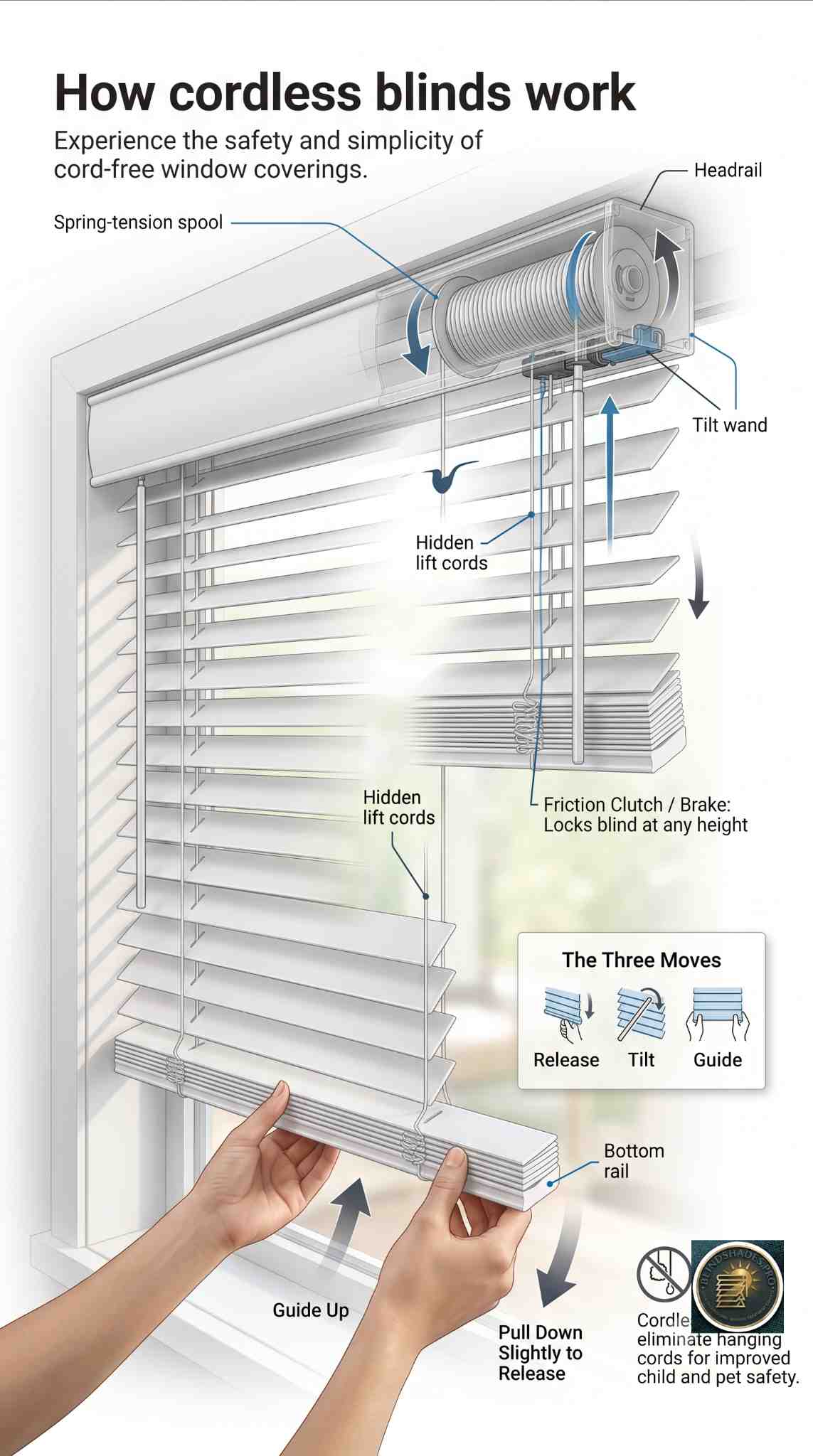
By Michael Turner — 30 years in window treatments
How do cordless blinds work is answered by two parts you never see: a spring-loaded spool inside the top headrail that winds the lift cords in and out, and a brake that balances the blind’s weight so it stops wherever you let go. Pull the bottom rail down and you unwind the spool against the spring; push up and the spring reels it back in. The only trick is three ordered moves — tilt, release, guide — and once you know them, most “broken” cordless blinds turn out to be fine. The surprise underneath: cordless blinds are not actually cordless, and that one fact explains half of what goes wrong with them.
Key Takeaways
- Two hidden parts do everything: a spring-tension spool storing the lift cords, and a brake holding any position without the blind flying up or crashing down.
- “Cordless” means no dangling cords, not no cords. The lift cords still run inside, threaded through the slats or fabric to keep everything level.
- Operation is three moves in order — tilt the slats flat, release with a small downward pull, then guide from the center with both hands.
- Lifting and tilting are separate systems: the bottom rail lifts, the wand (or rail rotation) tilts.
- Most mysteries aren’t breakage — a blind that won’t move usually needs the release move or a level pull, not a repair.
⭐ Quick Answer — How Do Cordless Blinds Work?
How do cordless blinds work comes down to two hidden parts: a spring-loaded spool in the headrail that winds the internal lift cords, and a brake that balances the blind’s weight so it locks wherever you let go:
- The spring does the lifting: pulling the bottom rail down unwinds the spool and loads tension; pushing up lets it reel the blind back in — the mechanism Lowe’s builds into most stock cordless blinds.
- The brake does the parking: it counterbalances the hanging weight so the shade stops at any height without flying up or crashing down.
- “Cordless” means no dangling cords, not no cords: as The Shade Store explains, the lift cords still run inside the slats or fabric — which is why level, two-handed operation matters.
- The trick is three ordered moves: tilt slats flat, give a small downward release pull, then guide from the center — most blinds that seem broken just need the sequence, and the real fixes live in why cordless blinds won’t go up or down.
- Safety is the design’s whole point: nothing reachable dangles — the standard Home Depot and every major retailer now sell to — and the mechanisms that run it best are ranked in our Cordless Blinds & Shades guide, with the honest lifespan record in how long cordless blinds last.
How Do Cordless Blinds Work?
The Three Moves (Tilt · Release · Guide)
Inside the headrail sits a spool under spring tension. The lift cords — still present, just hidden — run from the bottom rail up through the slats or fabric onto that spool. Pulling the rail down unwinds the spool and loads the spring; pushing up lets the spring retract and rewind. The brake makes it usable: it balances the blind’s hanging weight against the spring’s pull, so the shade neither rockets up nor slides down, and parks wherever your hands leave it. Some designs use a friction clutch instead of a pure spring — same job, different part — and some budget models put a push-button lock on the bottom rail.
That’s the machine. The skill is three moves, in order, each preventing a specific failure.
What’s Actually Inside the Headrail?
| Part | What it does | What it explains later |
|---|---|---|
| Spring-loaded spool | Stores and releases the internal lift cords as the blind moves | Spring fatigue over years is the classic won’t-stay-up failure — the fix lives in why your cordless blinds won’t go up or down |
| Brake (or friction clutch) | Counterbalances the blind’s weight; locks any position | Why the release move exists — you’re unsticking the brake, not forcing the spring |
| Internal lift cords | Thread through slats or fabric, keep the blind level as it winds | Why one-corner pulls tilt and jam it, why washing can knot it, why “cordless” is a safety word rather than an engineering one |
| Tilt wand or rail rotation | Rotates slats open and closed — separate from lifting | The privacy control; lifting never needed for light adjustment |
| Minimum working length | The mechanism needs enough travel to keep tension balanced | Why shortening too far interferes with operation — the rules are in can you cut cordless blinds to size |
The middle row is the one the industry states and never develops. As one manufacturer puts it plainly: despite the name, cordless blinds aren’t cordless — the cords are tucked inside. That single fact is why the operating rules below exist, why a washed blind can emerge with a knot in its heart, and why the safety claim is precise: no accessible cords for a child or pet to reach, not no cords anywhere — the case itself is examined in are cordless blinds child-safe.
What Is the Trick to Operating Cordless Blinds?
There is one, and it’s three moves in sequence.
| Move | How to do it | The mistake it prevents |
|---|---|---|
| 1. Tilt | Twist the wand (or rotate the rail) until slats sit flat and horizontal before any lift | Lifting through closed slats binds the internal cords — the top cause of “stuck” venetians |
| 2. Release | Give the bottom rail a small, gentle pull down first, even when you want it up | Frees the brake; shoving upward against a locked brake is how rails bend and springs strain |
| 3. Guide | Both hands, center of the bottom rail, moving level | One-corner pulls wind the cords unevenly — the blind tilts, curves inward, and jams |
Then let go — the brake parks it. If your blind has the small clear handle on the bottom rail, use it: fingers on fabric leave marks, half the reason cleaning cordless blinds has its own rules. And if a blind ignores all three moves, entertain the community’s favorite misdiagnosis before condemning the category: more than one baffled owner has discovered their stubborn “cordless” blind was a corded blind with the cord snapped off.
How Does Each Type of Cordless Blind Work?
The mechanism wears five outfits. Venetian and mini blinds run the spool-and-slat system above, with the wand doing tilt duty — flat for view, angled up for daytime privacy, which is where privacy control actually lives. Cellular shades are the smoothest of the family: light fabric, low spring load, no slats to bind — their trade-offs against rollers are drawn in cellular vs roller cordless shades. Roller shades wrap the fabric around a sprung tube, rolling up like a projector screen. Push-button models move the lock to a visible button on the rail. And cordless vertical blinds — searched for, rarely explained — swap lifting for traversing: a wand walks the vanes along the track and rotates them, cordless in the same no-dangling-cords sense.
Motorized blinds answer the same question with a battery motor instead of a spring — a different purchase with different math, weighed in cordless vs motorized blinds.
Avoid These Mistakes
- Forcing a locked brake. Up-shoves without the release pull strain the spring and bend rails. Small pull down first, always.
- One-corner operation. The internal cords wind unevenly, the blind curves and sticks, and repeated corner-pulls are how bottom rails end up gouging wall corners.
- Lifting through closed slats. Tilt flat first; bound slats read as “broken” when nothing is.
- Shortening past the mechanism’s minimum. Cordless designs need working length to keep tension balanced — check the cutting rules before any trim.
- Blaming the category for a fatigued spring. Springs do wear — how long the mechanism genuinely lasts, and which builds last longest, is the subject of how long do cordless blinds last.
Who Should Choose Cordless Operation?
✔ Best for: households with young children or pets (nothing dangling to reach) · reachable windows you adjust by hand daily · bedrooms and living rooms wanting clean lines · renters and anyone who values zero setup beyond mounting · light-to-medium shades where the spring works easiest.
✖ Not ideal for: windows above comfortable reach — that problem has its own solutions in reaching blinds on tall windows · very wide or heavy treatments that tax the spring · anyone unwilling to operate by touch · deep-set windows where daily hand access is awkward · whole-home automation plans, where motorized is the honest answer.
The Bottom Line
How do cordless blinds work: a hidden spring-loaded spool winds internal lift cords, a brake balances the weight, and your hands replace the dangling pull cord — tilt flat, release with a small downward pull, guide level from the center, let go. The name describes what a child can reach, not what’s inside; respecting the hidden cords is the entire operating skill, and the three moves make the category’s most common “defects” disappear before they’re born.
If the mechanism suits your windows, the picks that run it best are ranked in our complete Cordless Blinds & Shades buying guide — and if yours already refuses to move, start the diagnosis at why cordless blinds won’t go up or down.
FAQ
What is the trick to cordless blinds? A small downward pull before any move — it releases the internal brake. Then guide the bottom rail with both hands from the center, keeping it level so the hidden cords wind evenly, and tilt slats flat before lifting on venetian styles. Those three moves resolve most blinds that seem stuck or broken.
How do cordless blinds go up and down? A spring-loaded spool in the headrail winds the internal lift cords: pulling the bottom rail down unwinds the spool against spring tension, pushing up lets the spring retract it, and a brake balances the blind’s weight so it locks at any height you release. No external cord is involved.
How does the mechanism on cordless blinds work? The core is a tension spring driving a cord spool, paired with a brake — some designs use a friction clutch instead — hidden in the top rail. Internal cords still thread through the slats to keep the blind level; “cordless” refers to the absence of dangling, reachable cords rather than the absence of cords.
What are the disadvantages of cordless blinds? You must reach the blind to operate it, tall windows get awkward, heavy or oversized treatments strain the spring, and the mechanism can fatigue with years of daily cycles. Fit and build quality decide most of it — the honest durability record, both sides of it, is examined in our lifespan guide.
Related Guides
- Best Cordless Blinds & Shades — the complete buying guide
- Why Won’t My Cordless Blinds Go Up or Down? — the full fix ladder
- How Long Do Cordless Blinds Last? — the durability war, adjudicated
- Cordless vs Motorized Blinds — when the spring should become a motor
- Can You Cut Cordless Blinds to Size? — the minimum-length rules
- How to Clean Cordless Blinds — without knotting the hidden cords
- Are Cordless Blinds Child-Safe? — what the safety claim actually covers
