Are Cordless Blinds Child-Safe? The Four Qualifications

Authored By Michael Turner -30 Years Home Improvement Expertise | Updated 2026 | BlindShades.pro
Updated on July 27, 2026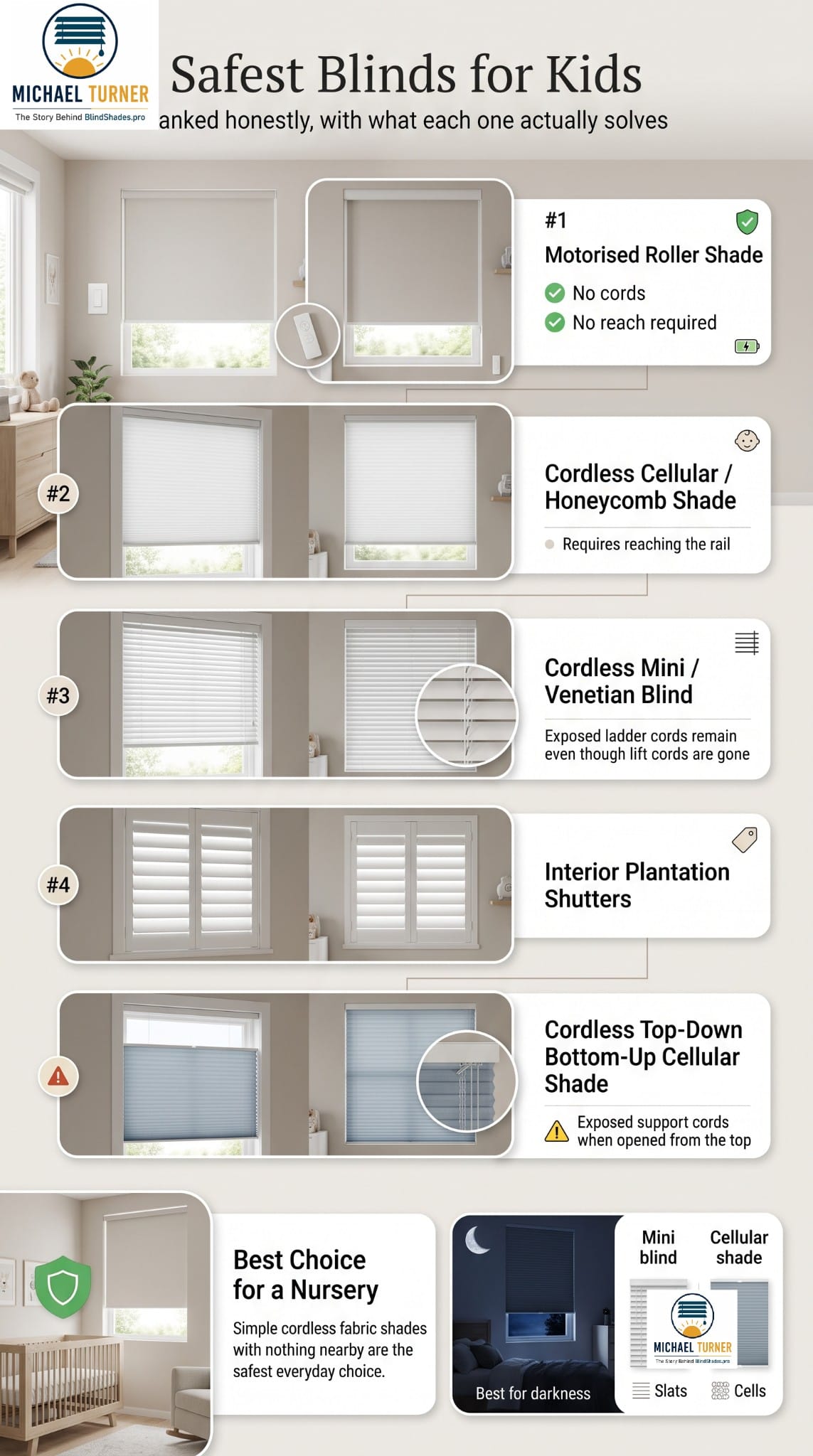
By Michael Turner — 30 years in window treatments
Are cordless blinds child-safe: yes, and the Consumer Product Safety Commission states it more strongly than any retailer does — cordless window coverings are the only option that eliminates the strangulation hazard rather than merely reducing it. That is the finding, and if you have young children it should decide your purchase. What follows is what the field leaves out: the claim has been bid up in circulation until it is no longer true — one national page is titled “100% safe” — and the honest version carries four qualifications, one written into the industry’s own child-safety certification. Knowing them will not change what you buy. It will change where you put the crib.
Key Takeaways
- The verdict is yes, and it comes from the agency, not from sellers. The Commission’s guidance is that the safest option where young children are present is to go cordless.
- “Cordless” means no accessible cords, not no cords. Internal lift cords remain, and the industry’s Best for Kids certification says so in its own criteria.
- The hazard is defined by a measurement. Any accessible cord longer than eight inches counts, whether it is a pull cord, a continuous loop or an inner cord.
- Inner cords have their own death record. Of roughly two hundred deaths the Commission counted between 1991 and 2004, at least twenty came from inner cords — and those children were typically nine to twenty months old, in cribs placed near windows.
- The pet claim is not the child claim. The evidence for children is federal and quantified. The evidence for pets is retailer assertion, and it deserves to be labelled as such.
⭐ Quick Answer — Are Cordless Blinds Child-Safe?
Yes. Are cordless blinds child-safe is one of the few questions in this trade with a federal answer, and the qualification the field leaves out matters:
- The agency states it plainly. The Consumer Product Safety Commission advises going cordless where young children are present, and says cordless is the only option that ELIMINATES the strangulation hazard — retrofits reduce it, but do not remove it.
- “Cordless” means no reachable cords, not no cords. Internal lift cords still run through the slats or fabric, and the hazard is defined by a measurement: any accessible cord longer than eight inches.
- The certification says so itself. The Best for Kids programme run by the Window Covering Manufacturers Association certifies products with no cords, with inaccessible inner cords, or with accessible inner cords that cannot form a hazardous loop — so “100% safe” contradicts the label it is printed beside.
- Inner cords have their own record. At least twenty of roughly two hundred deaths counted between 1991 and 2004 came from inner cords, the children typically nine to twenty months old in cribs near windows — which is why the Window Covering Safety Council puts furniture placement alongside product choice.
- The blinds you already own are the risk. Replace anything bought before 2001, move cribs away from windows today, and see what can be done with corded blinds, the honest pet picture in cordless blinds for cats and pets, and the picks in our Cordless Blinds & Shades guide.
Are Cordless Blinds Child-Safe?
The Four Qualifications (Inner Cords · Reach · Pets · The Ones You Own)
Yes. If you are furnishing a home with young children, buy cordless and stop reading here if you like — every authority and every seller agrees, and for once they are right. The Commission calls corded window coverings one of the top hidden hazards in American homes, and the Window Covering Safety Council’s position is that parents should replace corded coverings with the cordless products available.
A decision this important deserves its limits stated. Four things are true alongside the verdict.
| What cordless removes | What it does not remove |
|---|---|
| The dangling pull cord a child can reach and wrap | The internal lift cords threaded through the slats or fabric |
| Continuous loops and bead chains at hand height | The need to reach the blind, which moves the operating point up |
| The cord a pet can chew or become tangled in | Every mechanism a determined animal can damage |
| The hazard on the blinds you buy | The hazard on the blinds already hanging in your house |
Read the right-hand column and you have the four qualifications. None of them argues against cordless. All four change what a careful parent does next.
What Does “Safer” Actually Mean Here?
It means no accessible cords, and that word does more work than the field admits. The standard and the federal rule both turn on a measurement rather than a category: any accessible cord longer than eight inches counts, whether it is an operating cord, a continuous loop or an inner cord. That is why a compliant product can still contain cords, and why “completely cord-free” describes very few real blinds.
The clearest proof is the certification the field tells you to look for. Best for Kids is administered by the Window Covering Manufacturers Association, tested by an independent laboratory and promoted by the Window Covering Safety Council. Its criteria admit three qualifying configurations: no cords at all; no operating cords with inaccessible inner cords; and — the one nobody quotes — no operating cords but accessible inner cords, provided they cannot form a hazardous loop under the standard’s test procedure.
⭐ So the industry’s own child-safety certification contemplates a certified product containing accessible inner cords. “One hundred per cent safe” is not an exaggeration of the truth; it contradicts the certification it is usually printed beside.
This matters because inner cords have a death record of their own. In the Commission’s accounting of roughly two hundred strangulation deaths between 1991 and 2004, at least twenty came from inner cords rather than pull cords. Those victims were typically nine to twenty months old, in cribs placed near windows — old enough to pull up and reach, not old enough to free themselves. It is also why the Commission advises replacing any covering bought before 2001, when inner-cord design changed.
The practical instruction that follows is the oldest advice in this field and still the most useful: keep cribs, beds, playpens and any climbable furniture away from windows entirely. Cordless is the product decision. Furniture placement is the one that costs nothing.
What Do the Numbers Actually Say?
Casualty figures circulate freely on this topic and they do not agree with each other. Because this is a page about children, every figure used here is one the Commission publishes, and the ones excluded are named rather than quietly dropped.
| Figure in circulation | Where it comes from | Used here? |
|---|---|---|
| About nine deaths a year, children under five | The Commission’s current published data | ✔ Yes |
| More than 200 incidents, children up to eight, January 2009 to December 2021, with a child dying in 48 per cent | The Commission, same releases | ✔ Yes |
| Injuries ranging from neck scarring to quadriplegia and permanent brain damage | The Commission | ✔ Yes |
| Eleven deaths a year | An older Commission estimate, since superseded | ✖ Out of date — the newer figure governs |
| Roughly one child a month | A national retailer’s safety page, dated June 2026 | ✖ Conflicts with the agency’s current annual figure |
| 440 deaths since 1973 | A news investigation’s own count | ✖ Journalism, not agency data |
| Eight children aged eight and under | A law firm’s summary | ✖ Misstates the Commission, which says nine, under five |
The point is not pedantry. A parent deciding whether this hazard is real deserves to know that the true number — about nine children under five every year, with a child dying in nearly half of all recorded incidents — is serious enough without inflating. Where figures conflict, the agency’s current data wins.
What Are the Safest Blinds for Kids?
Ranked honestly, with what each one actually solves.
| Option | What it solves | What it leaves |
|---|---|---|
| Motorised shades | Both cords and reach — nothing is handled at all | Cost, and a battery to maintain, weighed in cordless vs motorized blinds |
| Cordless cellular or roller | Accessible cords; simple fabric with few grab points | Inner cords, and the reach requirement — see best cellular and honeycomb shades |
| Cordless venetian or mini blinds | Accessible cords | Ladder cords between slats, which is a genuine difference from fabric shades |
| Shutters and fixed panels | Cords entirely | Cost, and no light adjustment by height |
| ⚠️ Cordless top-down bottom-up | The dangling operating cord | Cords that become exposed as the top rail drops — the caveat is in cordless top-down bottom-up shades |
For a nursery, the simplest fabric shade with nothing near it beats a clever configuration every time; the picks are in best blinds for a nursery and the bedroom range in best bedroom blinds. If the room needs darkness, cordless blackout blinds covers the fabric question, and the comparison parents ask most — slats or cells — is drawn in mini blinds vs cellular shades.
Are Cordless Blinds Safe for Cats and Other Pets?
Safer, yes — but this is where the field’s evidence runs out, and it is worth saying plainly. The federal guidance, the incident data and the certification programme are all about children. The pet claims repeated across the trade are retailer assertions with no equivalent data behind them.
What can be said is mechanical rather than statistical. A dangling cord is what a cat bats and a dog chews, and removing it removes that. What replaces it is a different set of problems: slats a cat will push through and bend, fabric cells that hold up poorly to claws, and the sill clips that close side gaps being precisely what an animal dislodges. Owners report both outcomes — cats that ignore fabric shades entirely, and cats that treat them as a climbing surface.
The honest summary: cordless removes the one pet hazard that is genuinely dangerous and leaves several that are merely expensive. Which products survive animals is a product question rather than a safety one, answered in cordless blinds for cats and pets — including the sill-clip conflict and the slats-versus-fabric split.
What About the Blinds You Already Own?
Every page on this subject tells you to buy cordless. Almost none tells a parent what to do tonight about the corded blinds already hanging in the house. This is the qualification with the shortest fuse.
| What you can do | How far it gets you |
|---|---|
| Replace with cordless | ⭐ The only measure the Commission says eliminates the hazard |
| Move cribs, beds and climbable furniture away from windows | Costs nothing, works immediately, and addresses the exact scenario in the inner-cord deaths |
| Anchor a continuous loop with a tension device fixed to the wall | Removes the loop hazard; required for compliance on loop products |
| Wrap cords high on a cleat or wind-up | ⚠️ Only works if used every single time, which is the reason it fails |
| Replace anything bought before 2001 | The Commission’s standing advice, because inner-cord design changed |
⚠️ Retrofit measures reduce the hazard; they do not eliminate it, and the Commission says so directly. Treat them as what you do this week, not the solution. If you are considering conversion rather than replacement, what is genuinely possible is set out in converting corded blinds to cordless, and the broader question of what can still be bought is in cordless vs corded blinds.
Renting? No federal rule requires a landlord to remove corded blinds from an occupied property — the standards govern manufacture and sale, not what is already installed. Tenants usually want something they can fit and remove without permission, which makes no-drill, tension and magnetic blinds the practical route. Ask in writing first; many landlords will replace an old corded blind on request, particularly a pre-2001 one.
Avoid These Mistakes
- Believing “one hundred per cent safe.” No blind is. The certification itself allows certain accessible inner cords, so treat that phrasing as marketing rather than a product claim.
- Buying cordless and leaving the crib where it is. The children in the inner-cord deaths were in cribs beside windows. Furniture placement is free and it is the measure that matches the evidence.
- Trusting a cleat. It only protects a child on the days an adult remembers to use it.
- Assuming a pet claim carries the same weight as a child claim. One is backed by federal data; the other is a sales line.
- Retrofitting a pre-2001 blind. Replace it. Its inner cords can form a loop that later designs were changed to prevent.
Who Should Choose What?
✔ Cordless is right if: you have children under six, or expect to · you are furnishing a nursery or a shared bedroom · you want the option the agency itself endorses · your windows are within reach, so the trade-off cordless makes is one you will not notice · you want a product decision that also satisfies the cordless blinds worth-it question.
✖ Go further than cordless if: the window is out of comfortable reach, where a shade nobody can operate gets left alone and reaching it becomes its own risk · you want no handling at all, which is motorisation · the existing blinds predate 2001 · you need certainty rather than improvement, in which case replacement beats every retrofit.
The Bottom Line
Are cordless blinds child-safe? Yes — decisively, on the authority of the agency that counts the deaths rather than the shops that sell the blinds. Cordless is the only option that eliminates the reachable-cord hazard, and every parent of a young child should be buying it. The four qualifications do not soften that: inner cords remain and have their own history, the certification says as much in its own criteria, the pet case is weaker than the child case, and the blinds already on your walls are the ones most likely to hurt someone. Buy cordless, replace anything from before 2001, and move the crib away from the window today.
The products that do this best are ranked in our complete Cordless Blinds & Shades buying guide.
FAQ
Are cordless blinds safe for children? Yes. The Consumer Product Safety Commission states that the safest option where young children are present is to go cordless, and that cordless is the only choice that eliminates the strangulation hazard rather than reducing it. The one qualification is that internal lift cords remain inside the blind.
What are the safest blinds for kids? Motorised shades rank first because neither cords nor reach are involved, followed by cordless cellular and roller shades, then cordless venetian blinds, which retain ladder cords between slats. Shutters remove cords entirely. Look for the Best for Kids certification label on packaging.
What are the disadvantages of cordless blinds? You must reach the bottom rail to operate them, which is awkward on tall windows, and the spring mechanism is the component that wears out. Neither disadvantage affects safety. The genuine safety caveat is that internal lift cords remain inside the slats or fabric.
Are cordless blinds safe for cats? Safer, because the dangling cord that animals chew and become tangled in is gone. But the pet claims made across the trade have no equivalent data behind them, unlike the child-safety case. Cats can still bend slats and climb fabric, and sill clips are easily dislodged.
Are blinds with cords illegal in rental property? No federal rule requires a landlord to remove corded blinds already installed. The standards govern manufacture and sale rather than existing installations. Tenants can ask in writing for a replacement, especially for pre-2001 blinds, or fit removable no-drill alternatives themselves.
What is Best for Kids certification? A third-party programme run by the Window Covering Manufacturers Association, with independent laboratory testing, identifying products suited to homes with young children. Qualifying products have no cords, or no operating cords with inaccessible inner cords, or accessible inner cords that cannot form a hazardous loop.
Related Guides
- Best Cordless Blinds & Shades — the complete buying guide
- Cordless vs Corded Blinds — what can still be bought, and why
- Cordless Blinds for Cats & Pets — the animal question, answered properly
- How Do Cordless Blinds Work? — the hidden cords, explained
- Can You Convert Corded Blinds to Cordless? — what is possible on blinds you own
- Cordless vs Motorized Blinds — when to go further
- How Long Do Cordless Blinds Last? — the durability record
