Can You Convert Corded Blinds to Cordless?

Authored By Michael Turner -30 Years Home Improvement Expertise | Updated 2026 | BlindShades.pro
Updated on July 26, 2026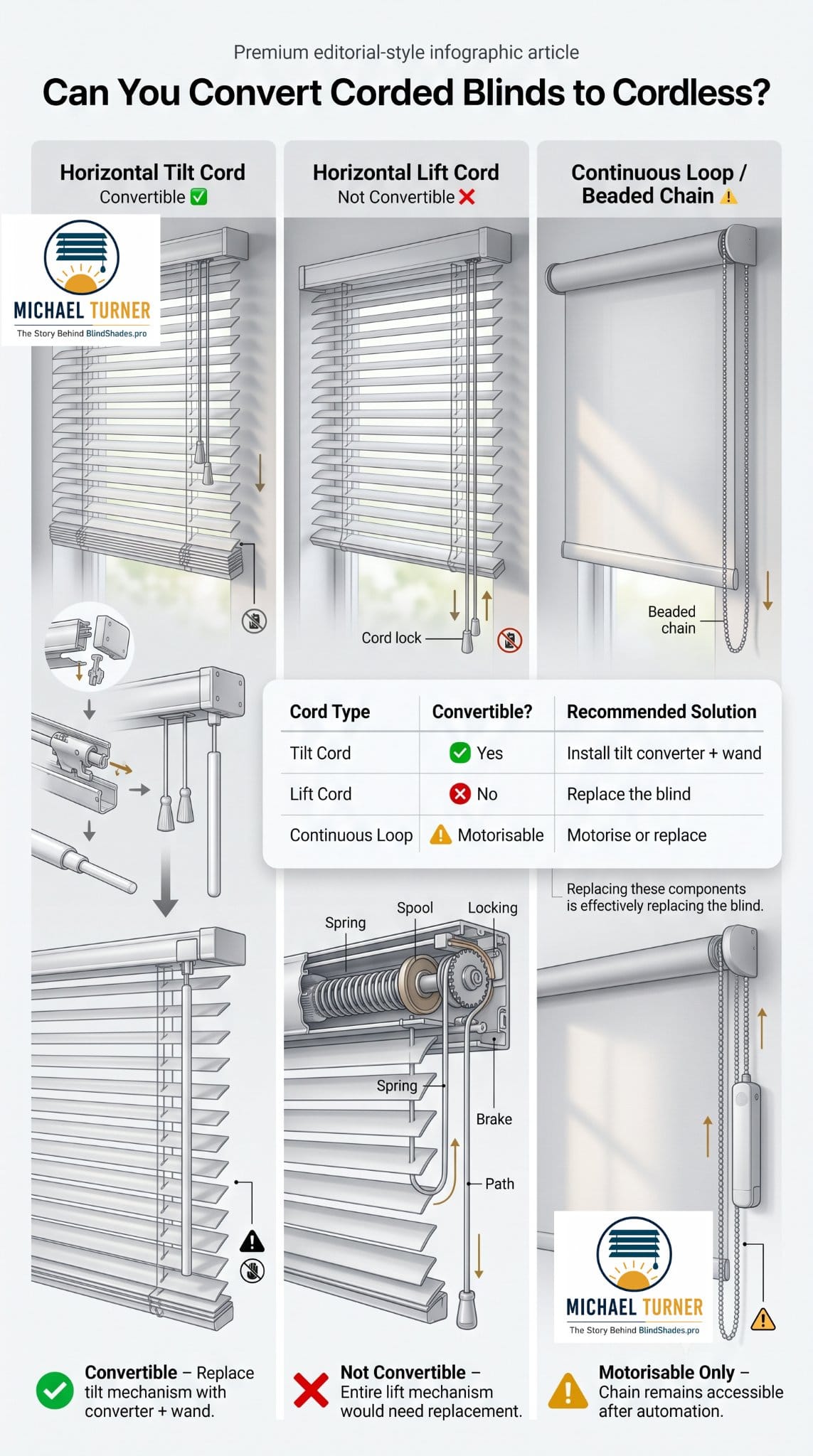
By Michael Turner — 30 years in window treatments
Sometimes — and which answer applies depends entirely on which of the three cords your blind has. A tilt cord, the one that twists the slats, converts genuinely and cheaply with a part sold for the purpose. A lift cord on a slatted blind does not, because the lift mechanism is the headrail: replacing it means replacing the blind. A continuous loop or bead chain can be motorised, but the loop stays hanging, which is not the same as going cordless. That distinction explains why one retailer says it is impossible while another says “absolutely” — they are answering about different cords. And if you are here because of a child, one correction: the free retrofit kit that Blinds.com, SelectBlinds and even the Consumer Product Safety Commission still point you toward has been suspended by the organisation that ran it.
Key Takeaways
- Tilt cords convert. Lift cords do not. A tilt converter is a cheap stock part; a lift conversion is a new blind.
- Motorising a chain loop is not going cordless. The chain remains, and so does the loop.
- ⚠️ The Window Covering Safety Council’s free retrofit kit program is suspended, per its own page — despite widespread advice to order one.
- The devices still work and are cheap to buy — cord cleats, tension devices, breakaway tassels, correctly set cord stops.
- Blinds made before 2001 should be replaced, not retrofitted. Their inner cords can form a loop a child’s neck can enter.
⭐ Quick Answer — Can You Convert Corded Blinds to Cordless?
Sometimes — whether you can convert corded blinds to cordless depends entirely on which of the three cords your blind has:
- Tilt cord — yes. The short cord pair that twists the slats can be swapped for a wand using a horizontal tilt converter. It is a stock part, a modest job, and it removes a real dangling hazard.
- Lift cord — no. On a slatted blind the spring, spool, brake and cord path are the headrail, which is why Blindsgalore says replacement is the only option. A rebuild is just a new blind with your old slats.
- Chain loop — motorisable, not cordless. A bead chain drops into a smart driver easily, but the chain stays hanging afterwards. Motorising a hazard does not remove it.
- ⚠️ The free retrofit kit program is suspended. The Window Covering Safety Council says so on its own retrofit page, even though major retailers and the Consumer Product Safety Commission still point you there. Buy the cleats and tensioners instead.
- Make the rest safe, then replace room by room. Anchor or split the loop, set cord stops within an inch or two of the headrail, move climbable furniture — and replace anything made before 2001. Cheaper than a rebuild: restringing. Start replacements in children’s rooms, per are cordless blinds child-safe and our cordless blinds and shades guide.
Can You Convert Corded Blinds to Cordless?
The Three Cords (Tilt · Lift · Loop)
Look at your blind before reading another word about it. There are three cords in this category, they fail differently, and only one converts.
| Your cord | How to identify it | Convertible? | What to do |
|---|---|---|---|
| Tilt cord | A short cord pair with tassels that twists the slats open and shut | ✔ Yes | Fit a tilt converter and a wand |
| Lift cord | The cord you pull to raise the blind, locking in a cord lock | ✖ No | Replace the blind |
| Continuous loop / bead chain | A closed loop or beaded chain running down one side | ⚠️ Motorisable only | Motorise, or replace |
The tilt cord is the genuine conversion. Take the blind down, remove the headrail end caps, untie the tassels and pull the corded tilt mechanism out. A horizontal tilt converter — Current Products Corp makes the one most installers use, stocked on Amazon — slides onto the tilt rod, the new gear snaps in, and you finish with a wand. A modest part, a modest job, and it removes a real dangling hazard.
The lift cord is where the disagreement comes from. Blindsgalore states it plainly: you cannot convert existing corded blinds to cordless, the mechanisms are completely different, replacement is the option. Vineyard Blind & Shutter agrees the lift mechanism is fundamentally different. A homeowner put it in one line — you would have to replace everything in the headrail. All correct, because on a slatted blind the spring, spool, brake and cord path are the headrail. Swapping them is not a conversion; it is buying a blind with your old slats attached. How that mechanism works is explained in how cordless blinds work.
The loop is the one people get wrong. A beaded chain drops into a smart driver and motorises easily — but the chain is still there afterwards, still a loop, still reachable. Motorising a hazard does not remove it.
Which Conversions Are Real, and What Do They Cost You?
Five projects get discussed under one heading. Only one is genuinely a conversion; the rest are rebuilds or substitutions.
| Product | The project | Honest verdict |
|---|---|---|
| Horizontal / venetian tilt | Tilt converter plus wand | ✔ A real conversion, cheap, permanent |
| Roller or zebra with a chain | Smart driver on the existing chain | ⚠️ Motorised, not cordless — chain stays |
| Roller shade | Swap in a spring-roller mechanism | ⚠️ A rebuild: new mechanism, old fabric |
| Roman shade | Universal cordless mechanism, transfer the fabric | ⚠️ A rebuild needing sewing skills |
| Slatted blind lift | Nothing available | ✖ Replace the blind |
So the real decision is three-way, and worth pricing before you buy any part.
| Route | What you buy | What you keep | When it wins |
|---|---|---|---|
| Convert | A tilt converter and wand | The whole blind | The tilt is corded and the lift is not |
| Rebuild | A new mechanism | Only the fabric | The fabric is custom or irreplaceable |
| Replace | A new cordless blind | Nothing | Corded lift, or the blind predates 2001 |
| Retrofit for safety | Cleats, tensioners, tassels | Everything, for now | You cannot replace every window yet |
Two of these deserve a warning. The roller rebuild and the Roman rebuild are real and people complete them, but you are buying a mechanism and keeping only the fabric — so compare against a new cordless shade first, because it is frequently close. Specialists generally recommend replacing a cord-lock Roman outright, and if the fabric is what you are attached to, that is the honest calculation; the ranked options are in our Roman shades guide.
And motorisation is a substitution, not an answer to this question — a different product at a different price, and what most published guidance on this topic actually describes. If it is what you want, the comparison sits in cordless versus motorised blinds and the category is ranked in our motorised and smart blinds guide. If you wanted to remove a cord, a motor on a chain loop does not do it.
If the blind is simply worn, restringing is cheaper and faster than either route — see venetian, mini or pleated restringing.
If You Can’t Convert Them, How Do You Make Them Safe?
This is what most people asking about conversion actually need, because replacing every corded blind at once is rarely realistic. There is a clear ladder — and one widely repeated instruction on it is out of date.
⚠️ The free retrofit kit program has been suspended. The Window Covering Safety Council’s own retrofit page states that the Retrofit Kit program is suspended, and recommends using only cordless products meeting current standards. That matters because the advice to order one is still everywhere — Blinds.com and SelectBlinds both tell readers to request a free kit, and the Consumer Product Safety Commission’s own cord page still gives the Council’s phone number for one. Do not build your plan around a kit arriving; the devices are inexpensive and sold everywhere.
| Step | What it does | How far it gets you |
|---|---|---|
| Anchor or split the loop | A continuous loop must be anchored to the wall with a tension device, or cut into two cords with breakaway safety tassels | Removes the loop — the specific entanglement risk |
| Fit a cord cleat or wind-up | Wraps loose cord high and out of reach | Good, but depends on being used every time |
| Set the cord stops | Positioned within one to two inches of the headrail when the blind is fully lowered | Limits how far inner cords can be pulled out |
| Move the furniture | Cribs, beds, chairs and bookcases away from windows | Removes the climbing route |
| Replace pre-2001 blinds | Older blinds have inner cords that can be pulled into a loop | ✔ The only complete fix for those |
Two honest limits. The Commission notes retrofit devices do not address the dangling pull-cord hazard on many common blinds, so cleats and tensioners reduce risk without eliminating it. And for blinds made before about 2001 the advice is replacement, not retrofit, because their inner cords can form a loop a child’s neck can enter. When you replace, look for the industry’s Best for Kids label — a third-party programme identifying products with no cords, no operating cords, or inner cords that cannot form a hazardous loop.
The safety case for cordless products, and what the claim does and does not cover, is examined in are cordless blinds child-safe — and if you are replacing room by room, are cordless blinds worth it and where to buy cordless blinds cover the decision and the counter.
What If You Want to Go the Other Way?
A quieter group wants the reverse — a cord back on a cordless blind — and they are not cranks. Owners who dislike cordless operation report exactly this: asking how to make a pull-up string for a cordless blind, hunting for corded replacements, finding corded stock has left the shelves.
The honest answer is not to add one. Any string you rig becomes an unanchored loop with none of the engineered safeguards — no tension device, no breakaway tassel, no cord stop — precisely the hazard the standards were written to remove, and it voids any remaining warranty.
What this group usually wants is reach, not a cord. The complaints cluster on windows too high to operate comfortably, and reach has cordless-compatible answers: a longer wand, a pole, a top-down configuration so the top rail comes to you, or a motor — the escalation is in how to reach blinds on tall windows, while cordless blinds for large windows covers width. If you genuinely prefer cords, the trade-offs are in cordless versus corded blinds.
Why Don’t They Sell Corded Blinds Anymore — and Are They Legal?
Because the standard changed, and the change constrains what can be sold rather than what you may own. The ANSI/WCMA A100.1-2022 standard, published through the Window Covering Safety Council and effective from June 2024, eliminated free-hanging operating and tilt cords on custom window coverings and requires stock products to be cordless or to have inaccessible cords; the 2022 revision also prohibits continuous cord loops and bead chains on horizontal slatted custom products, and the Commission has designated window covering cords a substantial product hazard.
So the corded blinds already hanging in your house are lawful to keep and use. What changed is availability — an availability constraint, not a prohibition on ownership — which is why the aisle looks different and replacements are cordless by default. Whether that was the right call for people who liked cords is argued in cordless versus corded blinds.
Avoid These Mistakes
- Assuming one answer covers every blind. Check each for tilt, lift or loop first.
- Believing a motor makes a blind cordless. A driver on a bead chain leaves the chain and the loop where they were.
- Ordering a free retrofit kit and waiting. The programme is suspended; buy the cleats and tensioners instead.
- Retrofitting a pre-2001 blind. Those inner cords can form a loop — replace rather than adapt.
- Rebuilding a Roman or roller without pricing a new one. Mechanism plus labour often costs about the same.
- Rigging your own pull cord on a cordless blind. No tension device, no breakaway tassel, no cord stop — all risk, no safeguards.
Who Should Convert, and Who Should Replace?
Convert if: ✔ Your blinds tilt with a cord but already lift without one — a tilt converter finishes the job cheaply ✖ Not if the lift is corded, where there is nothing to convert
Retrofit for safety, then replace gradually, if: ✔ You cannot replace a houseful at once — start with children’s bedrooms and sleeping areas ✖ Not if any blind predates 2001 — replace those first
Replace outright if: ✔ The lift is corded and a child or pet lives in or visits the home ✔ A rebuild’s numbers land close to a new shade ✖ Not before checking whether a tilt converter alone solves your problem
The Bottom Line
A tilt cord, yes — a converter and a wand, cheaply and permanently. A corded lift on a slatted blind, no, because the mechanism and the headrail are the same object, and anyone telling you otherwise is describing a rebuild or a motor. A chain loop can be motorised, but the loop stays. If children are the reason you are asking, do the safety ladder today — anchor or split the loop, fit cleats, set the cord stops within an inch or two of the headrail, move the furniture — and know the free kit program is suspended, so buy the parts. Replace anything made before 2001 rather than adapting it, and look for the Best for Kids label.
Ready to replace rather than adapt? Start with our complete cordless blinds and shades guide, or compare stock options in best venetian blinds and best mini blinds.
FAQ
Can I motorise my existing blinds? Often yes, and it is easier than converting. A beaded chain drops into a smart driver mounted beside the window, and a tilt add-on can turn a wand. But motorising is not going cordless — the chain remains in place, so it solves convenience rather than the hazard.
Why don’t they sell corded blinds anymore? The ANSI/WCMA A100.1-2022 standard eliminated free-hanging operating and tilt cords on custom window coverings and requires stock products to be cordless or have inaccessible cords, and it prohibits continuous loops and bead chains on horizontal slatted custom products. Retailers stopped stocking them as a result.
Are corded blinds legal? The corded blinds already in your home are lawful to keep and use. The standard restricts what may be sold rather than what households may own — an availability constraint, not a ban on ownership. Safety authorities do recommend replacing corded products where children live or visit.
Is it better to get cordless or corded blinds? For any home with children or pets, cordless, because there is no reachable cord. Corded still suits people who cannot comfortably reach a bottom rail — though a wand, pole, top-down configuration or motor all solve reach without a hanging cord.
Do cord cleats and tensioners actually work? They meaningfully reduce risk and are worth fitting immediately, but they are partial. A tension device removes the loop and a cleat keeps loose cord high, yet the Commission notes retrofit devices do not address the dangling pull cord on many blinds — and a cleat only works if used every time.
How do you baby-proof vertical blinds? Vertical blinds usually traverse on a chain or cord loop, so anchor that loop to the wall with a tension device, or replace the unit with a wand-operated version. Keep the loop off the floor and move climbable furniture away from the window.
Related Guides
- Best Cordless Blinds & Shades — the complete buying guide
- Are Cordless Blinds Child-Safe? — what the safety claim covers
- Cordless vs Corded Blinds — the phase-out, argued
- How to Reach Blinds on Tall Windows — reach without a cord
- Best Venetian Blinds — cordless replacements
- Best Vertical Blinds — for verticals and their loops
- Best Motorised & Smart Blinds — the powered category
