Are Cordless Blinds Worth It? The Five Conditions

Authored By Michael Turner -30 Years Home Improvement Expertise | Updated 2026 | BlindShades.pro
Updated on July 26, 2026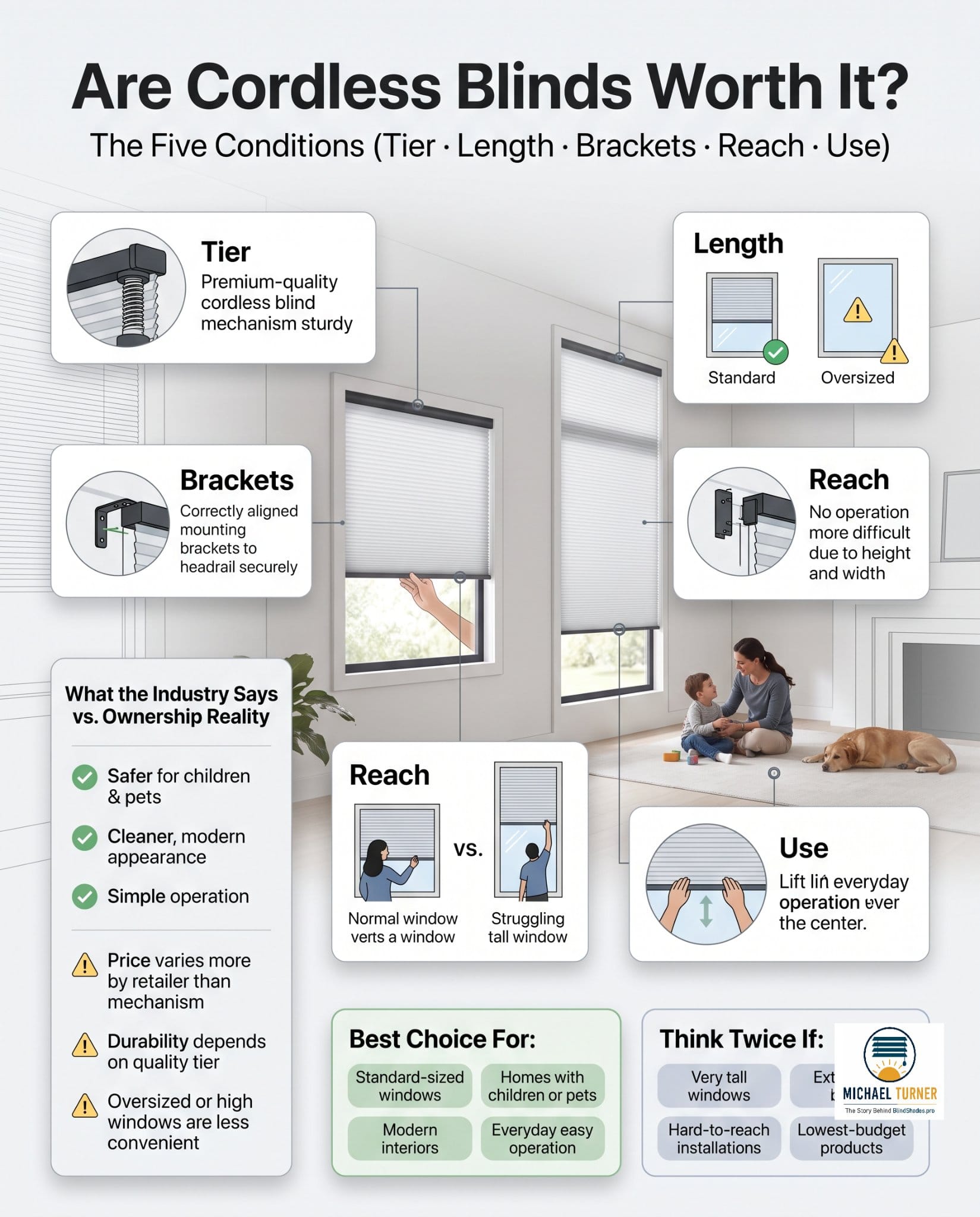
By Michael Turner — 30 years in window treatments
Are cordless blinds worth it depends on two answers you already have: whether the window is within comfortable reach, and whether children or pets live in the house — yes to the second and no problem with the first, and cordless is the right buy. But the blanket “yes” the industry hands out hides something the ownership record makes obvious: this category produces two completely different populations. One group has run the same blinds for years without a thought. The other has replaced sets repeatedly, gouged their wall corners, and thrown blinds in a skip. They aren’t lucky and unlucky — they bought different things, in different sizes, and were never told how to operate them.
Key Takeaways
- The honest verdict is conditional, not general — five variables decide which population you land in, and every one of them is knowable before you order.
- Tier decides more than brand. The budget spring is a different product from the mid-tier spring, sold on the same shelf.
- Ordering the exact drop is the single most common mistake — a blind ordered short of the sill never rests flat, and that one error generates most of the category’s rage.
- Nobody is told how to operate them, which is why breakage clusters in the first months rather than the fifth year.
- Reach is the real dividing line. Cordless didn’t remove the cord so much as move the control from hand height to window height.
⭐ Quick Answer — Are Cordless Blinds Worth It?
Cordless blinds are worth it when five conditions hold — tier, ordered length, bracket support, reach, and how often the window actually gets used:
- The safety case is real and settled: the dangling cord is gone from the room, which is the whole reason the industry redesigned — Lowe’s and Budget Blinds both frame it exactly that way.
- Tier decides durability, not brand: the entry spring and the mid-tier spring are different products on the same shelf — the argument is settled in how long cordless blinds last.
- Order the drop slightly past the sill, not to the exact measurement — a blind with nowhere to settle never rests flat, and that single ordering error generates most of the category’s complaints.
- Two hands, centre of the bottom rail, even pressure. One-corner pulls wind the internal cords unevenly; one-handed shoving is what gouges wall corners. Nobody is taught this at the point of sale.
- Reach is the real dividing line: cordless moved the control from hand height to window height, so a window you can’t comfortably reach is a window you’ll stop using — the fixes start free in reaching blinds on tall windows, and the picks that hold up are ranked in our Cordless Blinds & Shades guide. Stoneside makes the aesthetic case well.
Are Cordless Blinds Worth It?
The Five Conditions (Tier · Length · Brackets · Reach · Use)
Yes — for most standard windows in most homes, and the reasons the field gives are real. The strangulation hazard that drove the redesign is gone from the room. The look is cleaner. Operation is simpler in principle, since how cordless blinds work comes down to a spring, a brake and your hands. Every seller agrees, and for once it isn’t only marketing: Stoneside (January 2025) describes cordless as offering the functionality and style of a corded blind without the loose, dangling cord, and Blindsgalore (December 2025) calls it the better choice for most modern homes.
The problem isn’t the verdict; it’s that the verdict arrives unconditioned. No page in the field asks for whom, and the ownership record is full of people for whom the answer went the other way. Those two populations separate on five variables, cleanly enough that you can predict which one you’ll join before you pay.
| What the field says | Who says it | What the ownership record shows | The condition attached |
|---|---|---|---|
| Safer for children and pets | Lowe’s (Dec 2024), Budget Blinds (Nov 2021) | True, and the strongest claim in the category — with one caveat about inner cords | None on the hazard that matters |
| Only slightly more expensive than corded | The prevailing industry summary | SmartWings (Feb 2025) says cordless often costs more; owner totals for comparable jobs vary enormously | Where you buy multiplies the price far more than the mechanism does |
| Secure, durable, simple to use | Budget Blinds | True at mid-tier; the entry tier is a different product | Tier |
| Tension should hold for years without issues | Bringnox (2026) | Matches half the record and contradicts the other half | Tier + technique |
| Works great on standard-sized windows | A long-running Houzz thread, still circulating from 2016 | ⭐ The most honest sentence in the field — and note the qualifier | Width, brackets, and drop |
| Can be awkward on very high or oversized windows | The prevailing industry summary | Understated; this is the category’s defining failure | Reach |
“Standard-sized windows” is doing enormous work in that 2016 sentence, and a decade later nobody in the field has picked it up.
What Do Owners Actually Complain About?
Six complaints, and five of them have a root cause that isn’t the category. The complaints are usually summarised as a vague note that getting the tension right can take some fiddling — a remarkable way to describe a record containing gouged wall corners, sets tallied off one by one as they failed, blinds that died just past the return window, and one set that went straight in the skip.
| The complaint | How often it appears | Root cause | Resolvable? |
|---|---|---|---|
| It won’t stay up, or won’t catch | Very common | Spring fatigue, and heavily tier-dependent | Partly — buy above entry tier |
| It gouges the wall corner | Common | Shoving the rail up one-handed, at an angle | ⭐ Yes — technique |
| It hangs crooked or curves inward | Common | Uneven winding from a one-corner pull | ⭐ Yes — technique |
| It won’t reach the sill / won’t go all the way down | Common | Ordered to the exact drop instead of slightly longer | ⭐ Yes — ordering |
| Multiple sets failed within a year | Recurring | Entry tier plus daily use plus the above | Mostly |
| I can’t reach it | Recurring | The window, not the blind | Only by changing approach |
Three of those resolve with information no retailer supplies at the point of sale. An installer in the record demonstrates the operating technique to every customer, because otherwise they get it wrong — and if a product needs a demonstration but ships without instructions, early breakage isn’t a mystery. Where a blind has already started misbehaving, the diagnosis ladder is in why cordless blinds won’t go up or down, and the fuller argument about which springs last is in how long cordless blinds last.
The Five Conditions
| Condition | What good looks like | What missing it costs | Where to fix it |
|---|---|---|---|
| 1. Tier | Mid-range or better; a warranty that names the lifting mechanism | Early tension loss, jerky travel, replacement within a year or two | Durability by tier · where to buy |
| 2. Length | Drop ordered roughly half an inch to an inch past the sill so the rail rests flat | The rail never settles, the blind reads as broken, the owner forces it | Measuring and cutting rules |
| 3. Brackets | Enough mounting support for the width; extra centre brackets on wide runs | Sag, bowing, uneven winding, headrail flex | Large and wide windows |
| 4. Reach | Bottom rail reachable without a stool, a stretch, or a plan | A window you stop using, or a daily ladder | Reaching blinds on tall windows |
| 5. Use | Windows you operate regularly | ⭐ Counterintuitive — the least-used blinds fail first | Below |
Condition two resolves the loudest complaint in the category. Three owners arrive at the same rule independently, one after re-ordering a bedroom’s worth of blinds at his own expense: order the drop slightly longer than the sill. A blind cut to the exact measurement has nowhere to settle, so the rail hangs fractionally short, won’t sit flat, and reads as defective. It isn’t — it’s the wrong length, the one specification the buyer controls entirely.
Condition five surprises people. The daily-driver windows — kitchen, living room — survive, while guest rooms and formal spaces fail. The explanation offered in the record is that a spring left fully extended for years loses tension from sitting, not from working. The blinds you use least break first.
And the operating technique that governs conditions one through three: two hands, either side of the centre of the bottom rail, steady even pressure, no jerking. Around eight independent comments across five discussions converge on it; one owner broke set after set until somebody finally told her. Pull from one corner and the internal cords wind unevenly — the crooked hang, the inward curve, then the jam. Shove it up one-handed and you drive the rail into the wall corner. Those complaints are downstream of a technique nobody teaches.
Who Cordless Blinds Are Not Worth It For
There is a group the commercial field writes past entirely. Nine separate voices in the ownership record describe cordless blinds as a genuine accessibility problem: someone with chronic pain and a short stature dragging a step ladder around the flat daily; a seventy-five-year-old with a cabinet permanently in front of the window; a household of arthritic retirees with no children in it; a short renter who lost the top quarter of her view. One summary was blunter than anything a manufacturer will print — that a category requiring you to reach the top of the treatment discriminates against short people.
It follows from something that reframes the category: cordless didn’t eliminate the cord so much as relocate the interface. A pull cord hangs at hand height, reachable by anyone in the room. A bottom rail sits wherever the window sits. Every structural complaint here is downstream of that relocation — furniture in the way, counters in the way, ceilings too high, hands that can’t grip.
| If this is your situation | The honest answer |
|---|---|
| Reachable windows, children or pets at home | Cordless, without hesitation |
| Reachable windows, no children, and you value the look | Cordless — the aesthetic case stands on its own |
| High or awkward windows, small budget | Cordless plus a reaching tool; see the low-cost fixes first |
| High or awkward windows, budget available | ⭐ Motorized — this is what it’s for |
| Mobility, grip, height or reach limitations | Motorized on the windows you use; don’t accept a daily struggle |
| Furniture permanently in front of the window | Rethink the treatment, not just the mechanism |
Before spending on motors: the highest-voted solution in the largest reach discussion cost nothing — a socket taped to a broom handle to turn an unreachable wand, which its owner later said changed his daily life. The full escalation ladder, from free fixes upward, is in how to reach blinds on tall windows, and the powered options are ranked in our motorized and smart blinds guide.
One correction. Corded blinds are not illegal, despite the claim circulating widely. Under ANSI/WCMA A100.1-2022, effective June 2024, the Window Covering Safety Council describes a standard eliminating free-hanging operating and tilt cords on made-to-order products and requiring stock products to be cordless or have inaccessible cords — an availability constraint, not a prohibition. The same precision cuts the other way: the standard removed accessible cords, while internal lift cords remain inside the fabric, which is why the honest version of the safety case is set out in are cordless blinds child-safe.
Avoid These Mistakes
- Ordering the exact drop. Add a little length past the sill. This one decision prevents the most-reported complaint in the category.
- One-handed operation. Two hands, centre of the rail, even pressure. Free, and it protects both the mechanism and your walls.
- Buying the cheapest tier for a daily-use window. Entry springs and mid-tier springs are different products; match the tier to how hard the window works.
- Under-bracketing a wide blind. Width needs support — the wide-window rules exist for a reason.
- Buying cordless for a window you can’t reach. No amount of quality fixes geometry.
- Assuming price equals quality. The same blind carries very different prices through different channels — the cost breakdown shows where the multiplier actually lives.
Who Should Buy Cordless Blinds?
✔ Worth it for: households with young children or pets · standard, reachable windows · anyone who wants a clean uninterrupted look · renters and quick installs · light-to-medium shades where the spring works easiest · buyers willing to spend one tier above entry · anyone who’ll follow the length rule and the two-hand rule.
✖ Not worth it for: windows above comfortable reach without a plan · very wide or heavy treatments on an under-specified mechanism · anyone with grip, reach or mobility limitations who’d be forced into a daily struggle · rooms where furniture blocks the window · buyers set on the cheapest available option for a window used every day · households who’d genuinely rather have a cord and can source a compliant custom one.
The Bottom Line
Are cordless blinds worth it? Yes — with five conditions, and the field’s failure to state them is why this category has such a furious minority. Buy above the entry tier, order the drop a touch longer than the sill, bracket the width properly, confirm you can reach the rail, and know that rarely-touched windows fail first. Do those things and you’ll join the owners who forget they ever thought about it. Skip them and you’ll join the complainers — and blame the category, when four of the five causes were yours to control.
If you’re ready to choose, the picks that hold up are ranked in our complete Cordless Blinds & Shades buying guide — and if the durability question is what’s holding you back, that argument is settled in how long cordless blinds last.
FAQ
Are cordless blinds worth it? For reachable windows in homes with children or pets, yes — clearly. The category delivers on safety and appearance. The conditions that decide your experience are tier, ordered length, bracket support, reachability and how often the window gets used, and missing several at once is what produces the badly disappointed owners.
Are cordless blinds better than corded? Safer and cleaner-looking, yes. Easier to operate is situational: a cord can be reached from anywhere in the room, while a bottom rail sits at the window. For reachable windows cordless wins comfortably; for high, blocked or awkward windows, corded or motorized may serve you better.
Do cordless blinds break easily? The entry tier does, especially on daily-use windows operated one-handed. Mid-tier mechanisms hold up for years in the same conditions. Most reported breakage traces to spring fatigue, uneven pulling or forcing a blind that was ordered too short, rather than to a flaw in the design.
What are the disadvantages of cordless blinds? You must reach the blind to use it, heavy or oversized treatments strain the spring, the mechanism fatigues with hard use, and no instructions arrive in the box. Tall windows and blocked windows are the genuine weaknesses; the rest is mostly tier and technique.
Are cordless blinds harder to use than corded? Not harder, but less intuitive, which is why so many owners get it wrong at first. The technique is two hands at the centre of the bottom rail with steady, even pressure — no jerking and no corner pulls. Most owners are never shown this, and the damage shows up months later.
Are IKEA cordless blinds any good? Budget lines from large retailers behave like budget lines everywhere — fine on small, low-traffic windows, less durable on wide or daily-use ones. Judge by the mechanism tier and the warranty rather than the badge; the retailer-by-retailer picture is set out in our where-to-buy guide.
Related Guides
- Best Cordless Blinds & Shades — the complete buying guide
- How Long Do Cordless Blinds Last? — the durability argument, settled
- How to Reach Blinds on Tall Windows — the free fixes first
- How Much Do Cordless Blinds Cost? — where the price multiplier actually sits
- How Do Cordless Blinds Work? — the spring, the brake, and the three moves
- Do Cordless Blinds Work on Large Windows? — width, weight and bracket rules
- Are Cordless Blinds Child-Safe? — what the safety claim covers, precisely
- Can You Cut Cordless Blinds to Size? — measuring, trimming and the length rule
