Cordless Blinds for Cats and Pets: The Four Defences

Authored By Michael Turner -30 Years Home Improvement Expertise | Updated 2026 | BlindShades.pro
Updated on July 27, 2026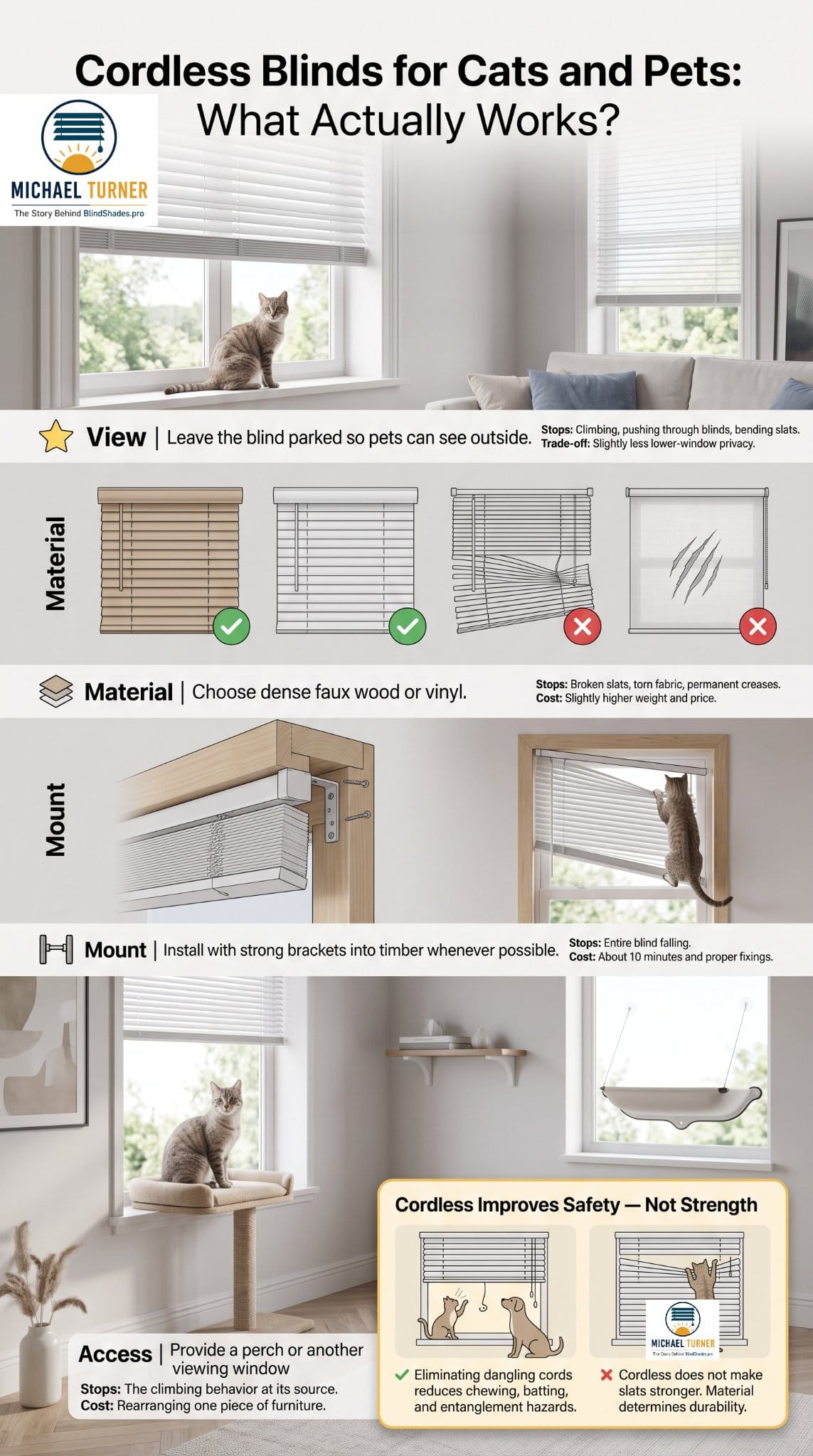
By Michael Turner — 30 years in window treatments
The honest answer on cordless blinds for cats and pets is that faux wood, vinyl and vertical vanes survive best — and that no blind survives a determined cat, which is why the most useful thing on this page is free and involves buying nothing. Ask cat owners rather than retailers and the top-voted answer in the largest discussion on the subject is that it is either cats or blinds, you cannot have both. The second is “none.” The third is worth reading twice: an owner who parks their cordless blinds eight to twelve inches up so the cats can see out. That is a diagnosis, not a product recommendation — the cat does not want your blind, it wants the window, and the blind is in the way.

Key Takeaways
- Material is the third-best defence, not the first. Give the animal the view and most of the damage stops before it starts.
- Cordless helps most on safety, not durability. Removing the dangling cord removes the hazard a pet can chew or become tangled in. It does nothing about claws.
- Faux wood and vinyl take the punishment best. Dense composite slats flex rather than snapping and wipe clean of fur and nose prints.
- Aluminium mini blinds are the consensus failure. Light, thin and easy to bend, they rarely survive a climbing cat or a curious dog.
- ⚠️ The tidy-fit advice and the pet advice conflict. The sill clips that close side light gaps are exactly what an animal knocks loose.
⭐ Quick Answer — Which Cordless Blinds Survive Cats and Pets?
Faux wood, vinyl and vertical vanes survive best — but the most useful advice about cordless blinds for cats and pets costs nothing:
- ⭐ Give the animal the view first. Owners report parking cordless blinds eight to twelve inches above the sill so cats can see out — and the attacks stop, because the blind is no longer in the way. It works because a cordless blind holds any position you leave it at, and Design 5 makes the same point commercially: pets see out below while you keep privacy above.
- Then choose the material. Dense faux wood and vinyl flex instead of snapping and wipe clean of fur and nose prints. Blindsgalore recommends aluminium and PVC for pet homes — ⚠️ but thin aluminium mini blinds are the single most-reported casualty, so split those two.
- Vertical vanes win on sliding doors. A cat pushes between them and they swing back rather than bending or snapping — the fit is covered in vertical blinds for sliding glass doors.
- ⚠️ Nothing is cat-proof. Retailers describe scratch resistance; owners describe a determined animal. The top-voted answer in the largest discussion on this subject is that it is either cats or blinds, and you cannot have both.
- Cordless helps with cords, not claws. Removing the dangling cord removes something a pet chews or gets tangled in — a real safety gain, evidenced in our child-safety guide — but it does not toughen the slats. Some retailers suggest real wood for pet homes; it is sturdy but scratches visibly. The picks are in our Cordless Blinds & Shades guide.
Cordless Blinds for Cats and Pets: What Actually Works?
The Four Defences (View · Material · Mount · Access)
They are in that order deliberately. The first costs nothing and prevents more damage than the other three combined, which is presumably why the order is inverted everywhere blinds are sold.
| The defence | What it stops | What it costs you |
|---|---|---|
| ⭐ View — leave the blind parked so the animal can see out | Climbing, pushing through, bending slats to make a gap | Some privacy at the bottom of the window |
| Material — dense faux wood or vinyl, never thin aluminium or sheer fabric | Snapped slats, torn fabric, permanent creasing | A little more money and weight |
| Mount — solid brackets, into timber where possible | The whole blind coming down under a climbing cat | Ten minutes and the right fixings |
| Access — a perch, a shelf, or a different window to occupy | The behaviour itself, at source | Rearranging one piece of furniture |
Cordless earns its place here for a reason the field blurs. Removing the dangling cord removes something a cat bats, a dog chews and a rabbit can become tangled in — a real safety improvement, covered in are cordless blinds child-safe, which is where the evidence on entanglement lives. What it does not do is make the slats stronger. A cordless blind and a corded blind of the same material fail identically under a cat, as how long cordless blinds last sets out.
No Blind Is Cat-Proof — and the Owners Say So
The phrase “cat proof blinds” is everywhere, and retailers write to it enthusiastically. One national retailer describes a faux wood blind as a rigid, tank-like barrier. Another recommends aluminium and PVC for their tight overlapping construction. A third opens by telling you to stop replacing broken blinds.
Now the other side. In a discussion running past 270 comments, the top-voted answer is that it is either cats or blinds and you cannot have both; the second is a one-word “none.” Not fringe replies — what the room agreed on.
Both sides are describing something real, and the disagreement is about which failure they mean.
| The field’s claim | What actually happens | Verdict |
|---|---|---|
| Faux wood is a rigid barrier that will not snap under a cat’s weight | Broadly true — dense composite flexes and recovers where thin metal creases | ✔ The best material bet |
| Vertical vanes let a cat push through without breaking them | True, and genuinely clever — but vanes unhook and need refitting | ✔ With a caveat: see fixing vertical blind vanes |
| Aluminium and PVC are both durable | ⚠️ Only half right — thin aluminium is the single most-reported casualty | ⚠️ Split the two: see aluminium vs vinyl mini blinds |
| Real wood suits homes with lots of pets | ⚠️ Sturdy, yes, but it scratches visibly and cannot be wiped hard | ⚠️ Style choice, not a durability one |
| Cordless shades are the safest choice for pets | ✔ On cords, yes. On claws, irrelevant | ✔ Right claim, wrong question |
| “Cat proof” | ✖ No such product | ✖ Scratch-resistant is the honest word |
⭐ The resolution is simple once stated: retailers are describing scratch resistance, owners are describing a determined animal with a goal. Both are accurate. Only one of them is what you are actually buying against. A blind can be genuinely tough and still lose to a cat that has decided the windowsill is its territory — and no material solves motivation.
Owner reports sharpen the point by contradicting each other. One household runs light-filtering cellular shades with two cats and reports no trouble. Another had a dog jump at a cellular shade and tear it. A third fitted inexpensive big-box cordless blinds that held up fine to two young cats. ⭐ The variable is the animal, not the blind. Retailers sell materials because they cannot sell you a different cat.
The Fix Nobody Sells: Leave It Up
The most valuable answer in that thread involved no purchase. The owner keeps their cordless blinds parked eight to twelve inches above the sill so the cats can see out. The cats stop attacking the blind, because the blind has stopped being an obstacle.
This works for a mechanical reason that is specific to this product. A cordless blind holds any position you release it at — that is what the brake in the headrail does, as explained in how cordless blinds work. A corded blind parked part-way needs its cord cleated at that height, and the cord is the thing you were trying to get rid of. So the cheapest defence against pet damage is a genuine cordless advantage, and no seller mentions it.
Two variations are worth knowing. If you need privacy at the bottom of the window, the paid version of this idea exists: a top-down bottom-up shade drops from the top and leaves the lower portion covered, which one retailer on this subject does recommend for exactly this reason — pets see out below while you keep privacy above. Read its own caveats first in cordless top-down bottom-up shades. And if the window simply cannot be left open, redirect rather than fortify: a perch or a shelf at a different window occupies the animal, and a cat with a better view loses interest in the worse one.
⚠️ One conflict to know about, because it cuts across advice we give elsewhere. Side light gaps are commonly closed with clips or channels fixed at the sill — and those are precisely what an animal knocks loose or chews. If you have pets, treat a tidy light seal and a durable installation as competing goals, and pick which one the room actually needs.
Which Animal, Which Failure?
The field writes as though pets were one category. They break blinds in completely different ways.
| The animal | How it fails | The defence that works |
|---|---|---|
| Climbing cat | Bent or snapped slats, whole blind pulled down, gaps forced to reach the glass | View first, then dense slats and solid brackets |
| Cat that just wants the sill | Fur, nose prints and paw marks rather than breakage | Wipeable slats — the method is in cleaning cordless blinds |
| Chewing dog | Bottom rail and lower slats destroyed; cords chewed through | Height and redirection; nothing at nose level survives determination |
| Jumping dog | Torn fabric shades, especially cellular | Slats over fabric on any window a dog reaches |
| ⚠️ Rabbits and small pets | Cords chewed at floor level — chewing and entanglement together | Cordless, and cords of any kind out of reach — the entanglement case |
The dog cases are where material genuinely decides the outcome. Fabric loses to a jump; a faux wood slat usually does not. On sliding doors the vertical route is the strongest recommendation on the whole page, because vanes give way and swing back rather than resisting and breaking — the range is in best vertical blinds and the door-specific fit in vertical blinds for sliding glass doors. What you should not put on a busy pet window is the thin aluminium mini blind, which owners and sellers agree bends easily and rarely survives a curious dog or a climbing cat — alternatives to mini blinds covers the replacements, and best mini blinds the picks if you buy one anyway.
It Is Already Damaged — Now What?
| What happened | Cause | Fix or replace? |
|---|---|---|
| Slats bent but not broken | A cat pushing through to reach the glass | Faux wood and vinyl often flex back; aluminium stays creased |
| A vane unhooked from the track | Pushed through a vertical blind | Refits by hand — a two-minute job |
| Fabric torn or clawed | A jump, or claws worked into a cell | ✖ Replace; fabric damage does not repair |
| Cords chewed | Reachable cord, or inner cords exposed at a gap | ⚠️ Restring if it is a slat blind; a chewed cordless mechanism is a replacement |
| The whole blind came down | Brackets pulled out under weight | Refit into timber or with proper anchors, then reassess the mount |
⭐ The honest note: on cheap stock blinds, replacement usually costs less than the time spent repairing — and if an animal has taken one down twice, the answer is not a third blind, it is the view or the perch. Cost comparisons are in what cordless blinds cost, and if the damage keeps recurring on one wide window, cordless blinds for large windows covers the split options that reduce what a single animal can reach.
Avoid These Mistakes
- Buying “cat proof.” Nothing sold under that phrase is. Buy scratch-resistant and manage the behaviour.
- Fitting thin aluminium on a pet window. It is the most-reported casualty in the category and the cheapest thing to get wrong.
- Fabric where a dog can jump at it. Cellular and sheer fabrics tear and do not repair.
- Skipping the mount. A climbing cat loads the brackets, not the slats. Fix into timber or use proper anchors.
- Closing every light gap in a pet home. Sill clips and channels are the first casualty. Choose the seal or the durability.
Who Should Choose What?
✔ Faux wood, vinyl or vertical if: an animal makes physical contact with the window · you are covering a sliding door, where vanes beat everything · the blind needs wiping down often · you want the material bet that owner reports support — the range starts at best faux wood blinds and the picks in our cordless guide.
✖ Think again if: you were about to buy fabric for a window a dog jumps at · the window is a cat’s main lookout and you plan to keep it fully closed · you need a perfect light seal and pet durability from the same product · the honest answer is a cheap replaceable blind you accept as consumable, plus a perch — see cellular vs roller cordless shades for what fabric does and does not survive.
The Bottom Line
The honest verdict on cordless blinds for cats and pets: faux wood and vinyl slats survive contact best, vertical vanes survive sliding doors best, and thin aluminium and delicate fabrics survive nothing. But the owners are right and the retailers are selling: no blind is cat-proof, and the phrase describes a wish rather than a product. Cordless is worth having here because it removes the cord an animal can chew or get caught in — a safety gain, not a toughness one. Then park the blind eight to twelve inches up, or give the animal a better window. The cheapest defence on this page is also the most effective one, and nobody can sell it to you.
The picks, mechanisms and price bands are in our complete Cordless Blinds & Shades buying guide.
FAQ
Which blinds survive cats best? Cordless faux wood or vinyl slats, because dense composite flexes rather than snapping and wipes clean of fur and nose prints. On sliding doors, vertical vanes win because a cat pushes through and they swing back. Thin aluminium mini blinds are the most-reported casualty.
Are cordless blinds cat-proof? No, and nothing is. Cordless removes the dangling cord a cat bats or chews, which is a genuine safety gain, but it does not strengthen the slats. Owners in the largest discussions on this subject are blunt that a determined cat beats any blind eventually.
What blinds are best for cat owners with sliding glass doors? Vertical blinds with vinyl or plastic vanes. A cat pushes between the vanes to reach the glass and the vanes swing back rather than bending or snapping. Individual vanes occasionally unhook from the track, which refits by hand in about two minutes.
Do cats chew cordless blinds? Cats are more likely to claw, climb and push than chew, though some do chew cords. That risk largely disappears with cordless, since there is no reachable operating cord. Dogs and rabbits are the persistent chewers, usually at the bottom rail or floor level.
Are cellular shades bad with pets? They are the most vulnerable format. Owner reports include a dog tearing one by jumping at it, though other households run cellular shades with cats and report no trouble. Claws work into the cells and the damage does not repair, so avoid them on any window a pet reaches.
How do you stop a cat destroying blinds? Give it the view. Owners report parking cordless blinds eight to twelve inches above the sill so the cat can see out, which removes the reason for the attack. Failing that, a perch at a different window redirects the behaviour more reliably than any material.
Related Guides
- Best Cordless Blinds & Shades — the complete buying guide
- Are Cordless Blinds Child-Safe? — where the entanglement evidence lives
- How to Clean Cordless Blinds — fur, nose prints and paw marks
- Cellular vs Roller Cordless Shades — what fabric survives
- Vertical Blinds for Sliding Glass Doors · Best Vertical Blinds — the sliding-door answer
- Aluminium vs Vinyl Mini Blinds · Alternatives to Mini Blinds — the material to avoid, and what to fit instead
- How to Fix Vertical Blind Vanes — when a vane unhooks
