Cellular vs Roller Cordless Shades: The Four Divides

Authored By Michael Turner -30 Years Home Improvement Expertise | Updated 2026 | BlindShades.pro
Updated on July 27, 2026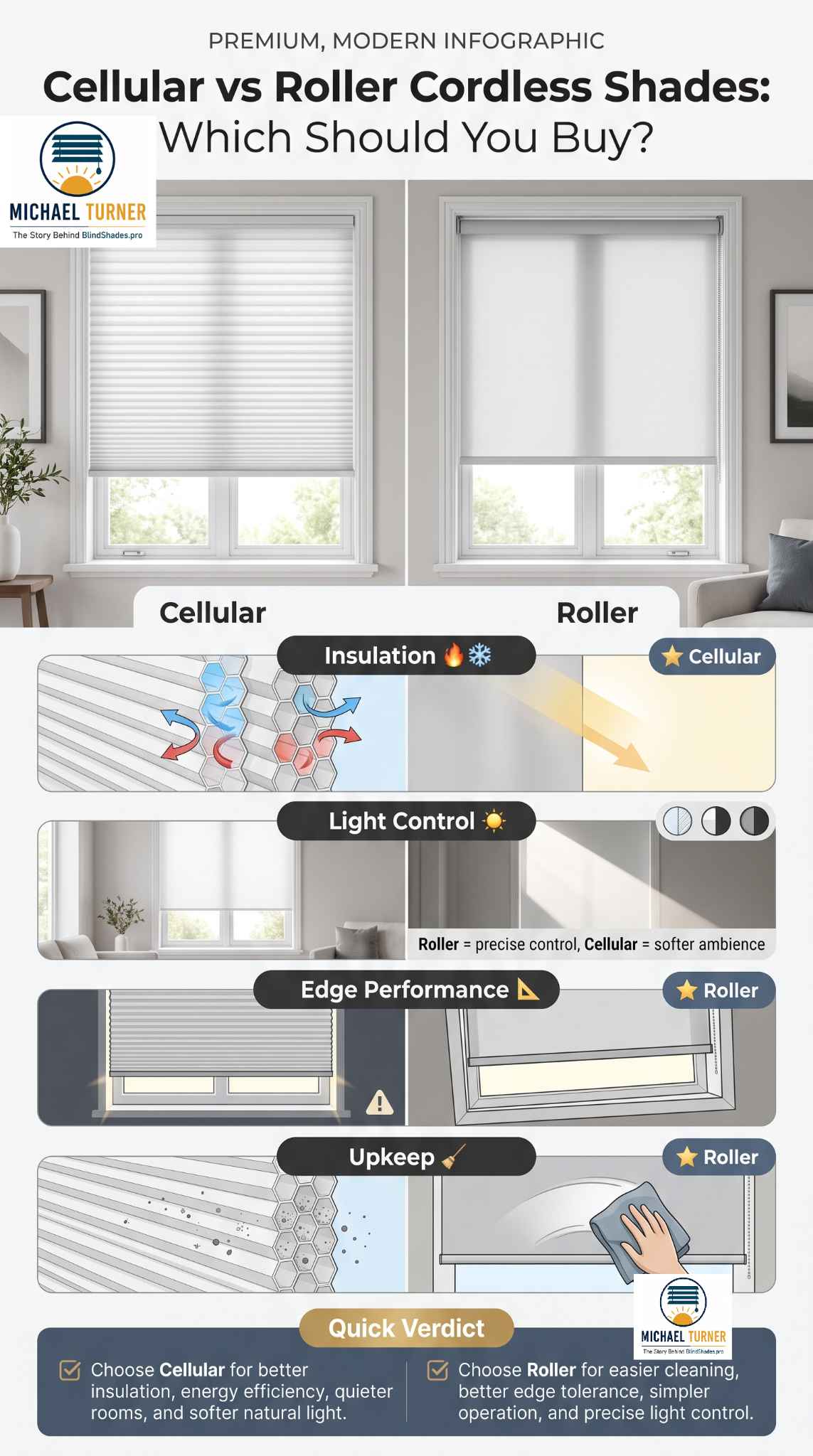
By Michael Turner — 30 years in window treatments
Cellular vs roller cordless shades comes down to one decisive win and two quiet losses: cellular insulates far better than roller and nothing else closes that gap, while roller is easier to clean, easier to fix, and less fussy about fit. The comparison you will read everywhere stops at the fabric, which is odd, because the word doing the work here is cordless — and cordless cellular and cordless roller are not the same machine. One stores a spring inside a tube at the top. The other hides a spool, a brake and lift cords threaded through the cells. They fail differently and they are repaired differently, and almost nobody says so. Two other things the trade repeats about cellular shades are contradicted by the people who own them.

Key Takeaways
- Cellular wins insulation, decisively. No roller fabric closes that gap. But the numbers published to prove it are unstandardised and should not be shopped on.
- Construction beats cell count. A window-facing cell with an internal foil layer outperforms a plain double cell — a distinction no R-value figure captures.
- The mechanisms differ. Roller keeps its spring in the top tube; cellular keeps a spool and brake in the headrail with cords running through the cells. That decides how each one breaks.
- Cellular is fussier about fit. Its edges leak light by geometry, and it holds a tighter measuring tolerance than roller does.
- Roller wins upkeep. A flat face wipes; honeycomb cells collect dust, insects and — in the wrong room — moisture and grease.
⭐ Quick Answer — Cellular vs Roller Cordless Shades
Cellular vs roller cordless shades is one decisive win and two quiet losses — and the deciding factor is usually your measurements, not the fabric:
- Cellular wins insulation outright. Trapped air in the honeycomb is a real thermal barrier; flat roller fabric has none. It matters because government energy guidance puts windows at roughly a quarter to a third of household heat loss.
- ⚠️ Do not shop on R-values. The figures quoted for cellular are retailer-published rather than measured to a common standard, and numbers in circulation for the same category span an order of magnitude. Buy on construction instead: a window-facing cell with an internal foil layer beats a plain second cell.
- ⭐ The two cordless mechanisms differ. A roller keeps its spring inside the top tube and has no lift cords at all; a cellular shade keeps a spool and brake in the headrail with cords running through every cell. They fail differently and are repaired differently.
- Cellular is the less forgiving purchase. Its pleats leave small triangular gaps at the sides — the opposite of the tighter-seal claim some sellers make — and it holds a tighter measuring tolerance than roller does.
- Roller wins upkeep and repair. A flat face wipes clean while cells collect dust and insects, and long-running owner discussion on Houzz finds cordless and corded shades last about as long as each other. Wet rooms favour roller for the same reason — see bathrooms and kitchens, bedrooms in blackout roller vs cellular, and the picks in our Cordless Blinds & Shades guide.
Cellular vs Roller Cordless Shades: Which Should You Buy?
The Four Divides (Insulation · Light · Edges · Upkeep)
Buy cellular for warmth and roller for simplicity — the four divides below explain why that is the actual shape of the decision, not a cop-out. Cellular takes one by a distance, roller quietly takes two, and the fourth is the one the trade gets backwards.
| The divide | Cellular | Roller | Who wins |
|---|---|---|---|
| Insulation | Trapped air in honeycomb cells is a genuine thermal barrier | Blocks glare and ultraviolet, but insulates little | ⭐ Cellular, and not narrowly |
| Light | Softens and diffuses; blackout versions available | A single flat panel; blocks more directly, with translucent through to full blackout | Roller for control, cellular for softness |
| Edges | ⚠️ Leaks at the edges by geometry, and holds a tight fit tolerance | More forgiving of an imperfect reveal | Roller — the opposite of what the trade says |
| Upkeep | Cells trap dust and insects; needs vacuuming | Flat face wipes clean in seconds | Roller, comfortably |
On light, the difference is character rather than quantity. Cellular diffuses, so a room stays evenly lit with the glare removed; roller behaves more like a shutter. Both are sold from translucent through to blackout, so if darkening is the goal the fabric grade matters more than the format — developed in cordless blackout blinds and, for bedrooms, in blackout roller vs cellular shades for bedrooms.
Two Cordless Mechanisms, Two Different Failures
Here is the section the comparison usually skips, and the one the question asks for. “Cordless” is not one mechanism — it describes two different pieces of engineering that share an outcome.
A cordless roller wraps its fabric onto a tube at the top, and the spring or clutch lives inside that tube. There are no lift cords at all — the fabric is the mechanism. A cordless cellular shade works the way the rest of the family does: a spring-loaded spool and a brake sit in the headrail, and internal lift cords run down through the cells to the bottom rail, as set out in how cordless blinds work.
| Cordless cellular | Cordless roller | |
|---|---|---|
| Where the mechanism lives | Headrail — spool and brake | Top tube — spring or clutch |
| Cords | Internal lift cords through every cell | None |
| Typical failure | Spring fatigue, brake slip, a cord knotting or snapping | The spring loses tension and the shade stops holding |
| The repair | Respooling or restringing — fiddly, and the cords run through the fabric | Retensioning the roller in its bracket, usually by hand |
| Can it be trimmed narrower? | ⚠️ Generally not — the internal cords prevent it | Often yes, within limits |
Three consequences follow that no fabric comparison surfaces. Roller has fewer parts to go wrong, and the fix is mechanical rather than surgical. Cellular cannot usually be cut down, because the lift cords run through the cells — part of why the category is priced as it is, and why measuring matters; the rules are in cutting cordless blinds to size. And washing is dangerous on both — water reaching a headrail or a tube damages the mechanism you cannot open, which is why cleaning cordless blinds treats immersion as the thing to avoid on either.
One long-standing owner view is worth repeating: cordless and corded versions of the same shade tend to last about as long, with use frequency and handling doing more than the mechanism. The wider durability record is in how long cordless blinds last.
Do Cellular Shades Really Insulate Better?
Yes, clearly — and this is the one divide where the answer is not close. Trapped air inside a honeycomb cell is a real thermal barrier; a flat roller fabric has nowhere to trap air. Every source agrees, and so do the people living behind them in cold climates.
The problem is the numbers used to prove it.
| The claim | Where it comes from | What to do with it |
|---|---|---|
| Cellular around R-3.4 to R-5.0; roller around R-0.9 to R-1.5 | Retailer-published, widely repeated | ⚠️ Directionally right, but unstandardised |
| Honeycomb around R-4, rising to about R-4.8 for a double cell | Owner reports comparing quotes | Useful as a sense of scale; the upgrade is marginal |
| Older honeycomb rated near R-0.42 | Also in circulation for the same category | ⚠️ Shows the spread — an order of magnitude |
| Honeycomb blinds retained about 63 per cent of heat, against 16 per cent for thermal-labelled curtains | Independent consumer testing | ⭐ The most trustworthy figure available |
| Windows account for roughly a quarter to a third of household heat loss | Government energy guidance | The reason any of this matters |
The honest conclusion writes itself: do not shop on R-values. They are published by sellers rather than measured to a common standard, and figures for the same category span an order of magnitude. What is attributable is the comparative testing, which puts honeycomb far ahead of what it was tested against.
⭐ Construction beats cell count. The upgrade that matters is not single-cell to double-cell — owners comparing quotes describe that step as marginal for the money. It is whether the window-facing cell carries an internal foil layer, which reflects rather than merely resisting. If you are buying for a harsh climate or a west-facing window, pay for construction first and cell count second. On very wide windows the calculation shifts again, because a double cell is heavier and weight is what taxes a cordless spring — covered in cordless blinds for large windows. The full thermal picture sits in best thermal insulated blinds and best cellular and honeycomb shades.
Two Things the Trade Says That Owners Don’t
Both of these are repeated confidently across the field. Neither survives contact with the people who bought the shades.
Claim one: cellular shades dampen sound. “Acoustic dampening” appears in retailer copy, and the traps-air explanation gets extended from heat to noise as though the two behaved alike. They do not. Owners who bought cellular partly for quiet are unanimous — the effect is between negligible and undetectable. Trapped air in a thin fabric cell is a poor barrier to sound, and a shade that does not seal to the reveal cannot attenuate much whatever its structure. If noise is the problem, the window is the answer.
Claim two: cellular seals tighter at the edges. This one is stated the other way round from reality. A cellular shade’s pleats create small triangular gaps where the folded edge meets the side of the reveal — a geometry problem, not a manufacturing defect, and it is why light halos along the sides of cellular shades are so commonly reported. A flat roller panel has no pleats and no triangles; it leaks at the sides too, but predictably and along a straight line, which is easier to solve with a side channel. Cellular also holds a tighter measuring tolerance: a few millimetres out and the fit that produces the insulation is the fit you have lost.
⭐ The practical upshot is a rule the trade will not print: cellular is the better performer and the less forgiving purchase. If you are confident of your measurements, or ordering from a company that measures for you, take the performance. If you are measuring yourself for the first time, roller punishes error less.
Which Should You Buy, Room by Room?
| Room | The pick | Why |
|---|---|---|
| Bedroom | Either, in blackout | Fabric grade decides darkness more than format — see blackout roller vs cellular for bedrooms |
| Living room, cold climate | ⭐ Cellular, foil-cell | The insulation gap is the whole reason to pay more |
| Kitchen or bathroom | Roller | Cells hold moisture, grease and dust — see cordless blinds for bathrooms and kitchens |
| Overlooked window needing daylight | Cellular, top-down bottom-up | The configuration exists in cellular — see cordless top-down bottom-up shades |
| Rental, or a first attempt at measuring | Roller | More forgiving of an imperfect reveal, and easier to clean at handover |
Two adjacent options are worth knowing before you commit. Pleated shades look like cellular but are a single layer with no trapped air, which is exactly why they cost less and insulate less — the distinction is drawn in pleated vs cellular shades and pleated blinds vs cellular shades. And roller shades versus roller blinds is a naming question rather than a product one, settled in roller blinds vs roller shades.
Avoid These Mistakes
- Shopping on R-values. The published figures are unstandardised and span an order of magnitude. Buy on construction and fit instead.
- Paying for a second cell before a foil cell. Owners describe single-to-double as a marginal upgrade. The reflective layer is the one that earns its money.
- Buying cellular for quiet. The people who tried it are unanimous. Noise is a glazing problem.
- Measuring cellular by eye. It holds a tighter tolerance than roller and leaks at the edges by design. Measure at three points, or have it measured.
- Putting cells in a steamy or greasy room. Honeycomb collects what the air carries, and you cannot wipe the inside of a cell.
Who Should Choose Which?
✔ Choose cellular if: heating or cooling costs are the reason you are buying · you live somewhere with real winters or a punishing west elevation · you want top-down bottom-up as an option · you want diffused rather than blocked light · you are confident measuring, or someone else is doing it · the room is dry and the window is reachable, as the cordless picks assume.
✖ Choose roller if: you want a flat modern face and minimal fuss · the room is a kitchen, bathroom or anywhere greasy or steamy · you would rather wipe than vacuum · you are measuring for the first time · you want the simpler mechanism and the easier repair · you are layering with curtains, where a flat panel sits better — see roller shades layered with curtains and the range in best roller shades.
The Bottom Line
Cellular vs roller cordless shades is a genuine trade rather than a ranking. Cellular takes insulation by a distance, and if warmth is why you are buying, nothing in the roller range competes — but pay for construction rather than cell count, and treat the R-values in circulation as marketing rather than measurement. Roller takes upkeep, repairability and tolerance for a slightly wrong measurement, which matters more than it sounds. And two of the things you will read about cellular — that it quietens a room and that it seals tighter at the edges — are contradicted by the people who own them. Buy cellular for performance you can measure on a heating bill. Buy roller for a shade that asks less of you.
Both formats, ranked with their mechanisms, are in our complete Cordless Blinds & Shades buying guide.
FAQ
Which is better, cellular or roller shades? Neither outright. Cellular insulates far better and offers top-down bottom-up options; roller is easier to clean, easier to repair and more forgiving of an imperfect measurement. Choose cellular for energy performance and roller for simplicity, and let the room decide rather than the category.
Do cellular shades really insulate better than roller shades? Yes, and by a wide margin — trapped air in the honeycomb is a real thermal barrier while flat roller fabric has none. Independent consumer testing put honeycomb blinds far ahead of thermal-labelled curtains. Treat the specific R-values quoted by sellers with caution.
Are cellular shades or roller shades cheaper? At the budget end the two overlap closely, and stock sizes of either can be had inexpensively. Custom cellular generally costs more, because the honeycomb construction is more complex and the internal cords mean the shade usually cannot be trimmed to fit afterwards.
Do cellular shades block noise? Barely. The claim comes from extending the trapped-air insulation argument from heat to sound, and owners who bought cellular shades hoping for quiet report little or no difference. Sound needs mass and sealing; a thin fabric cell provides neither. Glazing is the real fix.
What is the difference between 9/16 and 3/4 inch cellular shades? The measurement describes the pleat depth. Larger cells stack slightly taller and suit tall windows proportionally; smaller cells give a finer look on modest windows. No independent testing meaningfully separates their thermal performance, so treat construction and fabric as the deciding factors.
Do blackout cellular shades block more light than blackout roller shades? Both are sold in genuine blackout fabrics, so the fabric blocks comparably. The difference is at the edges: cellular pleats create small triangular gaps at the sides, while a flat roller leaks along a straight line that side channels can close more effectively.
Related Guides
- Best Cordless Blinds & Shades — the complete buying guide
- Blackout Roller vs Cellular Shades for Bedrooms — the same choice, one room deeper
- Cordless Blinds for Bathrooms & Kitchens — why cells struggle in wet rooms
- How to Clean Cordless Blinds · How to Clean Roller Shades — the upkeep divide in practice
- Do Blackout Roller Shades Block All Light? — the edge-gap question
- Best Cellular & Honeycomb Shades · Best Roller Blinds — the product ranges
