How to Clean Cordless Blinds Without Wrecking Them: The Three Zones

Authored By Michael Turner -30 Years Home Improvement Expertise | Updated 2026 | BlindShades.pro
Updated on July 27, 2026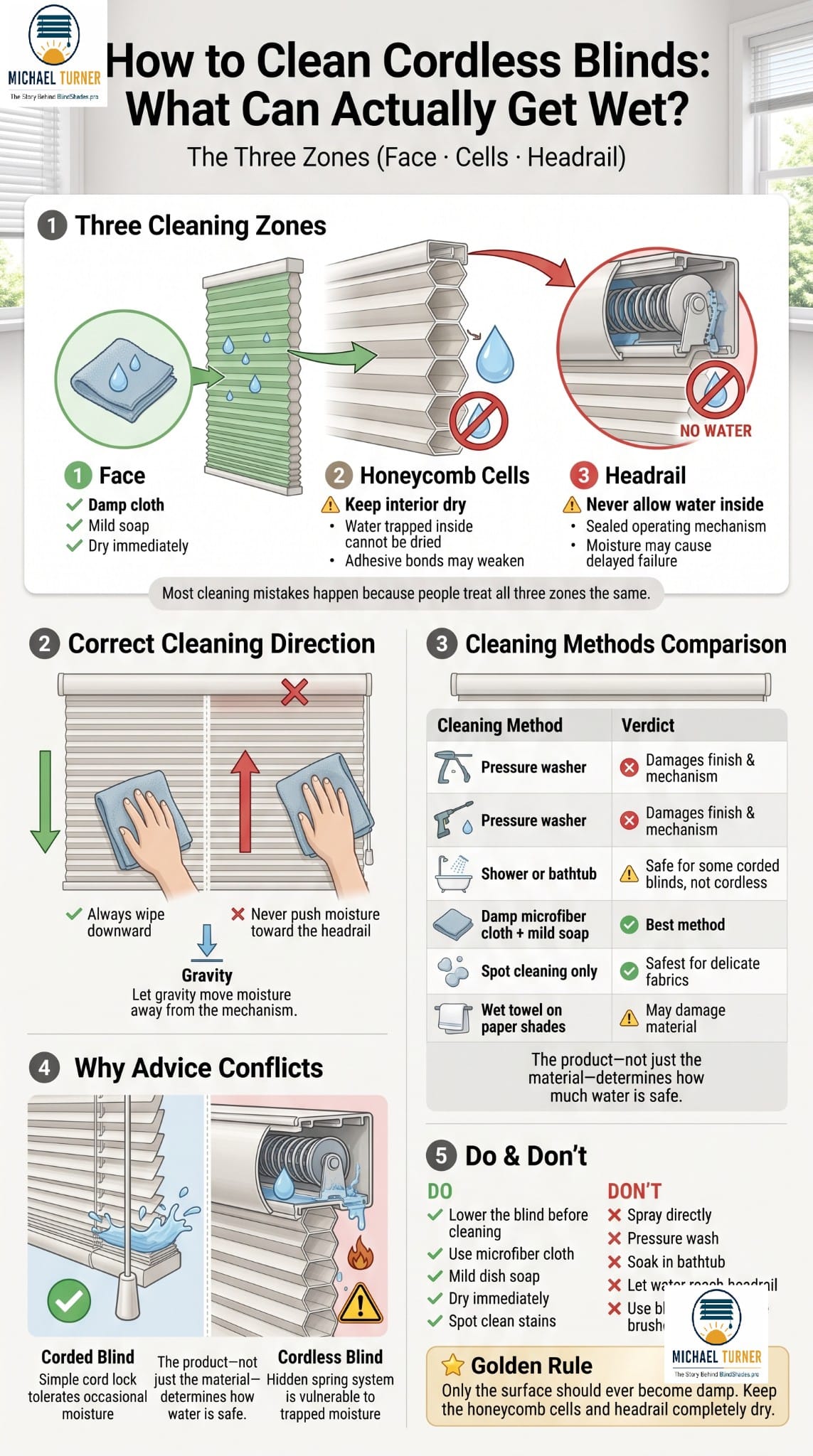
By Michael Turner — 30 years in window treatments
How to clean cordless blinds without wrecking them comes down to one question the advice never asks: which part of the blind is the water actually reaching? A cordless blind has three zones that tolerate completely different amounts of moisture. Its face will take a damp cloth all day. Its cells will take almost nothing and cannot be dried from the inside. Its headrail — where the spring, the spool and the brake live — will take nothing at all. Sort the advice by zone and the contradictions dissolve, and this subject has spectacular contradictions: for the same product you will be told to use a pressure washer, to clean them in the bath, and not to touch them with so much as a wet towel. One of those instructions will cost you a blind.

Key Takeaways
- The face, the cells and the headrail are three different problems. Almost every ruined shade is water that reached the wrong zone.
- Dry cleaning does most of the work. Vacuum on low suction with a soft brush first; the majority of what is on a blind is dust, and dust comes off dry.
- Damp, never wet. A microfiber cloth wrung until it is barely damp, then a dry cloth immediately behind it.
- Never submerge a cellular or fabric shade. Soaking the pleats can distort the shape and attack the adhesive that bonds the cells together — the shade is glued, not sewn.
- The bath and pressure-washer methods are not for cordless blinds. They are written for corded aluminium slats, where the mechanism is a cord lock rather than a sealed spring housing.
⭐ Quick Answer — How to Clean Cordless Blinds Without Wrecking Them
Yes, you can wash them — how to clean cordless blinds safely depends entirely on which part of the blind the water reaches:
- Dry first, and mostly dry. Most of what sits on a blind is dust, and dust comes off without water. Blindsgalore recommends a vacuum brush attachment on low suction, worked systematically left to right and top to bottom.
- Damp, never wet. Dyson puts the wet method at lukewarm water with a few drops of mild dish soap; wring the microfiber cloth until it is barely damp, wipe DOWNWARD, and follow immediately with a dry cloth.
- ⚠️ Never submerge a cellular or fabric shade. Soaking the pleats distorts the shape and attacks the adhesive that bonds the cells — the shade is glued, not sewn, and the inside of a cell cannot be dried.
- ⚠️⚠️ The headrail is the part that ends the blind. It holds the spring, spool and brake in a sealed housing you cannot open or dry, so water reaching it does its damage quietly — the shade often fails weeks later, as described in why cordless blinds stop working.
- Ignore the bathtub and pressure-washer methods. They come from corded aluminium blinds, where the headrail holds only a cord lock. Levolor spot-cleans with warm water and mild soap and warns that window-cleaning products discolour blind fabrics. Wet rooms make all of this constant — see bathrooms and kitchens and the picks in our Cordless Blinds & Shades guide.
How to Clean Cordless Blinds: What Can Actually Get Wet?
The Three Zones (Face · Cells · Headrail)
Start here, because every disagreement you will read about washing blinds is really a disagreement about which zone the writer had in mind.
| Zone | How wet can it get? | Why |
|---|---|---|
| Face — slats, or the outer surface of fabric | Damp cloth, wrung out, followed by a dry pass | Non-absorbent slats shed water; fabric faces tolerate blotting |
| ⚠️ Cells — the interior of a honeycomb shade | Effectively nothing wet | Water inside a cell cannot be reached, wiped or dried, and the cells are bonded with adhesive |
| ⚠️⚠️ Headrail — spring, spool, brake | Nothing at all, ever | A sealed housing you cannot open, dry or service; water that gets in stays in |
The third row is the one that makes cordless blinds different from the corded blinds most cleaning advice was written for. On a corded blind the headrail holds a cord lock — simple, and largely indifferent to a splash. On a cordless blind it holds the entire operating system under spring tension, as set out in how cordless blinds work. Water reaching it does not announce itself. The shade works fine that afternoon and fails weeks later, which is exactly why the connection so often goes unmade — the diagnosis lives in why cordless blinds won’t go up or down.
⭐ The practical rule that falls out of the zones: always work with the blind lowered and the cloth moving downward, never upward toward the headrail. Gravity is doing your risk management.
From Pressure Washer to “Not Even a Wet Towel”
The advice in circulation for this exact product spans a range you would not accept in any other category. All of the following are current, and all describe cleaning window blinds.
| The advice | Who says it | Verdict for a cordless blind |
|---|---|---|
| Lay them on the deck and use a pressure washer | A widely upvoted social-media method | ✖ Destroys the mechanism, and can strip slat finishes |
| Take them down and wash them in the shower or bath | Repeated in home-cleaning groups, and by Good Housekeeping | ⚠️ Written for blinds generally; ruinous on anything cordless |
| Damp cloth with mild dish soap, dried immediately | Dyson, Blindsgalore, and most manufacturers | ✔ The correct method |
| Spot-clean only, warm water and mild soap, avoiding window-cleaning products | Levolor, the manufacturer | ✔ Correct, and the most conservative |
| Not to be washed with detergent, or even cleaned with a wet towel | GoDear Design | ⚠️ Right for paper and some delicate fabrics, over-strict for slats |
Read that table and the disagreement resolves itself. Nobody is lying; they are describing different products. The tub method is genuinely fine for a corded aluminium venetian blind — that is where it comes from, and it has worked for decades. Applied to a cordless shade it delivers standing water directly into a sealed spring housing. The strictest advice is aimed at paper and delicate fabrics, where even a damp cloth marks the material.
⚠️ The one to be careful with is the bath instruction, because it carries the most authority and appears in general cleaning guidance that is not written with cordless mechanisms in mind. If you take one thing from this page: the format of your blind matters more than the material when deciding how much water is safe.
Architectural Digest adds a detail worth keeping regardless of method — wipe downward rather than upward, because upward pressure can unhook slats from their ladders. And The Blind Guyz is right that abrasive brushes and bleach weaken fabric and cause discolouration that no later cleaning reverses.
What Method Suits Your Blind?
| Material | Routine clean | Deep clean | Never |
|---|---|---|---|
| Faux wood, vinyl, aluminium slats | Vacuum, then damp cloth and dry pass | Damp cloth with mild dish soap, section by section | Submersion; abrasive pads |
| Cellular and honeycomb | Vacuum on low suction; compressed air or a vacuum nozzle to draw debris from cells | ⚠️ Blot spots only, and dry immediately | Immersion of any kind — see cellular vs roller cordless shades |
| Roller fabric | Vacuum, then wipe the flat face | Damp cloth, unrolled fully, dried before rolling up | Rolling it up damp — mildew forms inside the roll |
| Woven wood and paper | Dust or vacuum only | ⚠️ Dry methods only | Water, detergent and wet cloths alike |
The kitchen is a special case, because grease is not dust — it lands as a film and then binds dust to itself, so a dry pass will not lift it and a damp pass often just smears it. That job needs a degreasing approach rather than a harder scrub, covered in kitchen blinds and cooking smells and, for the material choice that avoids the problem, cordless blinds for bathrooms and kitchens.
How Do You Clean Blinds Without Taking Them Down?
For a cordless blind this is not a shortcut — it is the recommended approach, because removing and rehanging is where mechanisms get knocked and brackets get bent.
Lower the blind fully and, on slatted styles, tilt the slats flat. Vacuum on low suction with the soft brush attachment, working left to right and top to bottom, supporting each section with your free hand so nothing takes the strain. Then, if a damp pass is needed, wring the cloth until it is barely damp, wipe downward, and follow immediately with a dry cloth. Support the bottom rail as you go, and operate the blind afterwards with both hands at the centre — one-corner pulls after cleaning are a common way to finish the job with a crooked shade.
Two habits do more than any product. Clean before the film builds, because light regular passes never require the aggressive methods that cause damage. And exercise the mechanism — running a cordless shade through its full range regularly is manufacturer advice in its own right, and the shades that seize are usually the ones nobody touches. Method details for adjacent formats: venetian, vertical, mini, panel track, pleated and roller shades.
What If You Have Already Soaked One?
Every guide on this subject teaches prevention and stops there. Nobody tells you what to do at the point people actually go looking — after the shade has been washed and something has gone wrong. Here is that ladder, including the rungs where the honest answer is that it is over.
| What happened | Why | What to try | When to stop |
|---|---|---|---|
| The internal cord has knotted or bound | Wet cords swell and bind on the spool; owners report exactly this after washing cellular shades | Lower fully, work the slack back gently by hand, never force the rail | If the cord is frayed, or the knot is inside the headrail — that is a restring |
| It no longer holds position | Water reached the spring or brake | Leave it fully lowered and dry for several days, then exercise it through its full range repeatedly | If it still drifts, the spring is the fault — see how long cordless blinds last |
| It dries crooked or hangs unevenly | Dried under uneven tension, or operated from one corner while damp | Lower fully, dry flat and unrolled, then operate two-handed from the centre | If one side consistently rises faster once dry, the cords have wound unevenly |
| Spotting or mildew inside the cells | Water entered a cell and could not dry; mould needs only a damp surface carrying dust | Vacuum debris out; ventilate hard and drop room humidity | ⚠️ You cannot clean the inside of a cell. If mould is established, replace the shade |
| Water marks or discolouration | Hard water drying on the surface, or a window-cleaning product | Re-wipe with distilled water and dry immediately | Bleach and solvent damage is permanent |
⚠️ Two honest limits. Anything that has been fully immersed — bath, hose or pressure washer — should be treated as a repair job rather than a drying job, and on a cheap stock shade replacement usually costs less than the time. And a cellular shade generally cannot be taken apart, because the lift cords run through the cells, which is the same constraint that stops it being cut down to size.
Avoid These Mistakes
- Wiping upward. It pushes slats off their ladders and drives water toward the headrail. Always work down.
- Taking a cordless shade into the shower. The method is real and it is meant for corded aluminium slats.
- Scrubbing a stain. Blot it. Rubbing pills fabric, frays cellular edges and bends slats — none of it reverses.
- Rolling or raising a damp shade. Trapped moisture between layers is how mildew starts. Dry it fully extended.
- Using window cleaner or bleach. Manufacturers warn these discolour blind fabrics, and the damage is permanent.
Who Should Do What?
✔ Clean it yourself if: the blind is slatted, roller, or cellular with light surface dust · you can reach it comfortably, which tall windows can make untrue · you are willing to work in sections rather than looking for one quick method · the soiling is dust or light film rather than years of kitchen grease.
✖ Get help or replace if: the shade has been immersed and no longer holds position · mould is established inside cellular cells · the fabric is already pilled, frayed or discoloured · it is a delicate woven wood or paper shade with a real stain · the cost of a stock replacement is less than the repair, which for budget shades it very often is — see what cordless blinds cost and the picks in our cordless guide.
The Bottom Line
How to clean cordless blinds without wrecking them is really one instruction repeated three ways: keep the water away from the parts that cannot dry. The face is forgiving, the cells are not, and the headrail is unforgiving in a way that hides itself for weeks. Vacuum first, wipe barely damp, dry immediately behind, work downward and support each section — and treat every instruction that involves a bath, a hose or a pressure washer as advice written for a different kind of blind. If you have already soaked one, dry it fully extended for days before deciding anything, because a shade that seems dead often is not.
If yours is past saving, the replacement options are ranked in our complete Cordless Blinds & Shades buying guide.
FAQ
Can you wash cordless blinds without wrecking them? Yes, if wash means a barely damp cloth rather than immersion. Vacuum first, wipe with a wrung-out microfiber cloth and dry immediately behind each pass. Never submerge a cordless blind or let water run toward the headrail, where the spring and brake sit in a sealed housing.
How do you clean blinds without removing them? Lower the blind fully, tilt slats flat, then vacuum on low suction with a soft brush attachment, working left to right and top to bottom while supporting each section. Follow with a barely damp cloth wiped downward and a dry cloth behind it. Leaving them hung avoids bracket damage.
Can cordless cellular shades be washed in the bathtub? No. The bath method comes from corded aluminium venetian blinds and does not transfer. Immersing a cellular shade soaks the cells, can distort the pleats, attacks the adhesive bonding them, and delivers standing water into a headrail mechanism that cannot be dried out afterwards.
How do professionals clean blinds? Systematically and mostly dry. Vacuum with a brush attachment on low suction, work in one direction across and down, use a barely damp cloth with mild soap only where needed, and dry immediately. Specialist ultrasonic cleaning exists for slatted blinds but is not used on cordless fabric shades.
What happens if water gets into the headrail? It stays there. The housing holds the spring, spool and brake and cannot be opened, dried or serviced, so moisture works on the mechanism for weeks. The usual symptom is a shade that gradually stops holding position long after the cleaning that caused it.
How do you clean fabric blinds? Dust or vacuum on low suction first, then blot any marks with a cloth dipped in mild detergent and water and wrung out well. Never scrub, bleach or use abrasive brushes, which weaken the fibres and cause discolouration that cannot be reversed afterwards.
Related Guides
- Best Cordless Blinds & Shades — the complete buying guide
- Why Won’t My Cordless Blinds Go Up or Down? — when cleaning is the cause
- Cordless Blinds for Bathrooms & Kitchens — the rooms that make cleaning constant
- Cellular vs Roller Cordless Shades — why cells are harder to clean than a flat face
- How to Clean Pleated Blinds · How to Clean Roller Shades · How to Clean Made-to-Measure Blinds — the method by format
- Which Cordless Blinds Survive Pets? — the other thing that ruins fabric
