How Much Do Thermal Blinds Save? The Four-Number Estimate

Authored By Michael Turner -30 Years Home Improvement Expertise | Updated 2026 | BlindShades.pro
Updated on July 24, 2026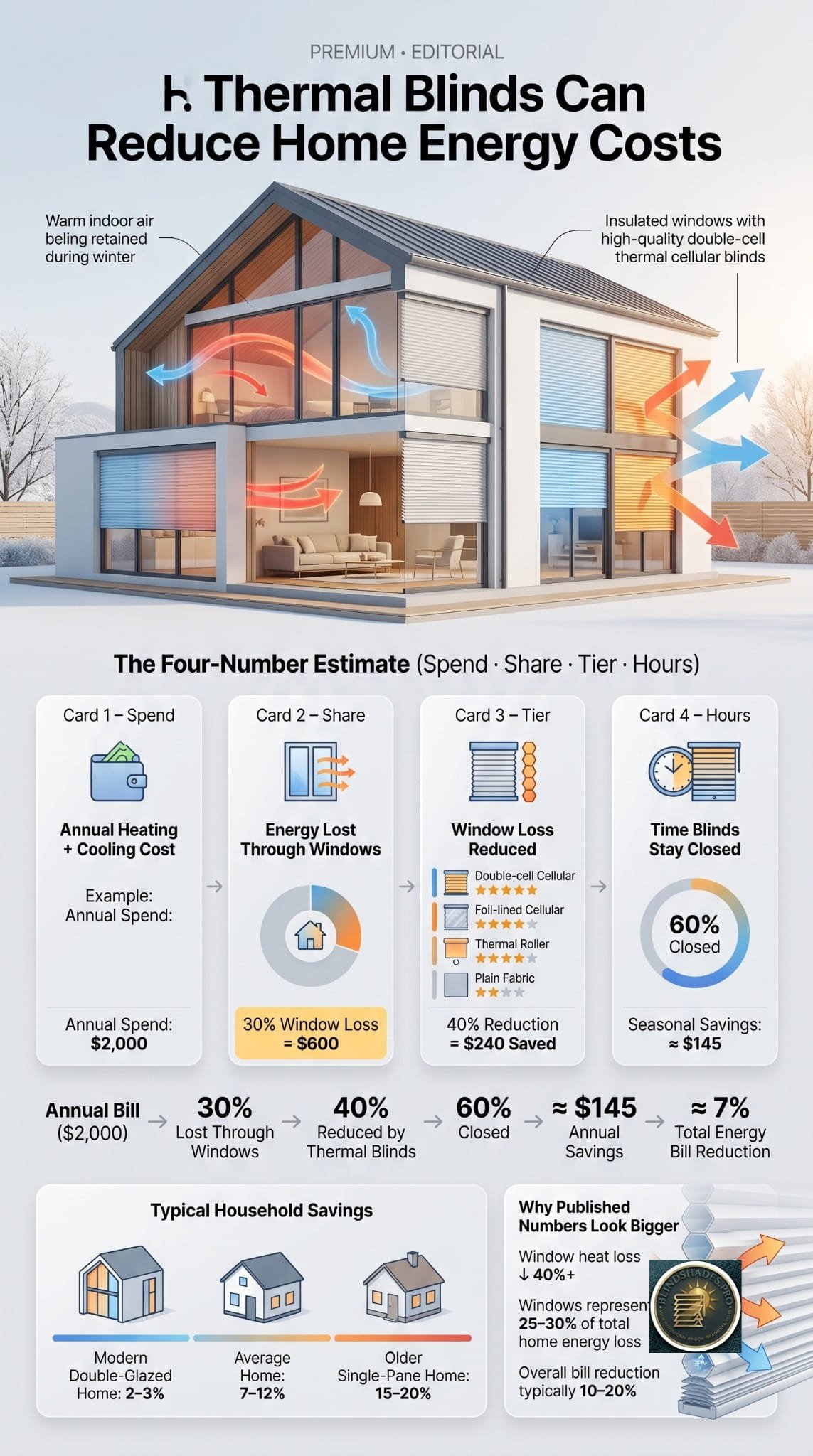
By Michael Turner — 30 years in window treatments
How much do thermal blinds save comes down to four numbers you can gather in ten minutes: your annual heating and cooling spend, your windows’ share of it, the tier of covering you fit, and the hours it is genuinely closed. Multiply those and you get a figure for your house rather than somebody else’s. Most published answers skip the fourth number, and many quietly swap a percentage of window heat loss for a percentage of your bill — which is how a bedroom shade ends up carrying a four-hundred-dollar promise.
Key Takeaways
- Four inputs decide your answer: spend, window share, covering tier, closed hours.
- Two different percentages circulate as one. Cutting window heat loss by forty percent is not cutting your bill by forty percent; the bill effect lands nearer ten to twenty.
- The measured research splits by scale. Per-window results are large, whole-house bill changes modest, and both are honest.
- A blind saves only while it is closed — the hours can halve any published figure.
- Payback is set by what you paid, not what you saved. The same shade repays in a winter or in five years depending on where you bought it.
⭐ Quick Answer — How Much Do Thermal Blinds Save?
How much do thermal blinds save comes down to four numbers — your spend, your windows’ share, your covering’s tier, and the hours it is closed — and for most homes the honest landing zone is ten to twenty percent off the combined bill:
- Two percentages circulate as one: the U.S. Department of Energy’s forty-percent figure is heat lost through the window, not your bill — the bill effect lands nearer ten to twenty percent.
- The measured research splits by scale: the peer-reviewed cellular-shade study on ScienceDirect found seventeen to thirty-six percent daily heating savings at the window and a far smaller whole-stock figure — both honest, and reconciled in-body.
- Hours are the input everybody skips: a blind saves only while it is closed, and the closed-hours divisor can halve any published figure — the routine that fixes it lives in when to open and close your blinds.
- Payback is set by the price, not the saving: the same shade repays in a winter from a stock size or a factory order and in five-plus years at full custom retail — Consumer Reports’ cooling figures carry the same fine print about fully closed operation.
- Run your own numbers: the worked estimate is below, the claims audit is in are thermal blinds worth it, and the tiers that earn the top of the range are in our Thermal & Insulated Blinds guide.
How Much Do Thermal Blinds Save?
The Four-Number Estimate (Spend · Share · Tier · Hours)
Take your annual heating and cooling spend, the share lost through your windows, the fraction of that loss your covering removes, and the fraction of the time it is closed. The answer falls out — for most homes, ten to twenty percent of the combined bill.
Published figures look larger because they measure the window, not the house. The U.S. Department of Energy credits insulated cellular shades with reducing heat loss through the window by forty percent or more. That is a sound figure, and it is not a bill figure. Windows account for roughly a quarter to a third of a home’s heating and cooling losses, so removing forty percent of a thirty percent problem removes about twelve percent of the total — where careful sellers land translating the same source into “about ten percent off heating.”
| Input | What it means | Typical range | Worked example |
|---|---|---|---|
| 1. Spend | Annual heating plus cooling cost | Whatever yours is | Two thousand dollars |
| 2. Share | Fraction lost through glass | 25–30%, more for large or single-pane windows | 30% → six hundred at the windows |
| 3. Tier | Share of window loss the covering removes | Foil-lined and double-cell cellular highest, roller mid, plain fabric lowest | 40% → two hundred and forty |
| 4. Hours | Share of the season it is genuinely closed | 40–70% typical, higher in bedrooms | 60% → about a hundred and forty-five |
A hundred and forty-five dollars against a two-thousand-dollar bill is a shade over seven percent. Push the same house to single glazing, a cold climate, and disciplined operation and it runs past fifteen; drop it to modern sealed units in a mild climate and it falls under three. That spread is why no single published figure was ever going to be right for you. The audit of who claims what, against which denominator, is in are thermal blinds worth it.
What Do the Measured Studies Actually Show?
The gap between the laboratory result and the bill result is the most useful thing on this subject, and almost nobody explains it.
The most rigorous work available is Kunwar’s 2022 study of the national energy savings potential of cellular shades in Energy and Buildings. Its experimental testing found daily heating energy savings of seventeen to thirty-six percent against the same window uncovered — and its national-scale estimate is far smaller, around nine percent. Both come from the same paper and they do not conflict: the large figure describes a treated window on a cold day, the small one an entire building stock, most of it neither fully covered nor consistently operated.
Household data agrees from the other end. The connected-thermostat company Tado has reported roughly fifteen to twenty percent less gas used in rooms fitted with lined thermal treatments — room-scoped, sitting between the two. Consumer NZ’s retention testing explains why tier matters: honeycomb blinds retained around sixty-three percent, heavy lined curtains around twenty-four, curtains merely labelled thermal around sixteen.
Per window on a cold night, dramatic. Across twelve months and every room, modest but real. Anyone quoting the first number as though it were the second is selling.
How Many Hours Are Your Blinds Actually Closed?
Every savings figure you have read assumes the covering is down, and a covering that is up is a piece of fabric near a window. The standard advice — open on sunny winter days for free solar gain, close at dusk to hold it — is correct, and it concedes the blind does nothing for much of the day. A shade closed twelve hours in twenty-four cannot deliver a result measured on a continuously covered window, however good it is.
Treat hours as a multiplier on everything else. A cheaper covering closed reliably beats a premium one that spends the winter rolled up. Bedrooms and unused rooms score highest; a south-facing living room scores lower but earns some back in daytime solar gain. Timers and motorisation exist largely to fix this number rather than the fabric. The routine behind it is in when to open and close your blinds.
What Would You Save?
Three variables decide the result: glazing, climate, and what you pay per unit of fuel.
| Household | Glazing and fuel | Bill effect | Verdict |
|---|---|---|---|
| Old house, cold winters | Single pane, electric resistance heat | Mid-to-high teens | The strongest case there is |
| Typical family home | Older double glazing, gas furnace | Around ten percent | Solid, unspectacular, worth doing |
| Hot-summer home | Older double glazing, central air | Real but summer-weighted | Exterior shading beats interior here |
| Recent build | Modern low-E or triple, heat pump | Low single digits | Buy for comfort; savings are a bonus |
| Airtight, heavily glazed | High-performance glass, heat pump | Close to nothing on heating | Overheating is the problem, not loss |
| Any home, poorly fitted | Any | A fraction of the above | Fix the fit before upgrading |
Fuel matters more than most sources admit: the same twelve percent is worth roughly twice as much where the marginal unit of heat is expensive electric resistance heating rather than cheap gas. The airtight row is no throwaway either — owners of tight, heavily glazed modern homes consistently report summer overheating rather than winter loss. Consumer Reports, citing Department of Energy figures, notes fully closed highly reflective blinds can cut heat gain by around forty-five percent, a cooling number belonging to keeping heat out.
How Long Until Thermal Blinds Pay for Themselves?
Payback is purchase price divided by annual saving — and since price varies far more than saving does, price decides the answer. One repeated claim puts payback at three to five years; elsewhere you will see a winter or two. Both are true, because the same honeycomb shade sells at wildly different prices depending on whether it came from a big-box stock size, a custom measure-and-install service, or a direct factory order — a spread of several times over, not several percent.
Run it: a hundred and forty-five dollars a year against four hundred spent covering the rooms that matter puts you ahead inside three years. Spend three times that across every window and you are in five-to-eight-year territory. For savings without the capital, the free and cheap rungs usually beat any blind on pure return — ranked in the cheapest ways to insulate windows — and where new glazing sits in the same sum is worked through in thermal blinds vs window replacement.
Avoid These Mistakes
- Multiplying the wrong percentage. Forty percent is window heat loss, not your bill; applied to total spend it overstates the result roughly threefold.
- Buying the tier without buying the fit. A snug mid-range shade beats a premium one with side gaps — warm air slides behind a loose blind, chills on the glass, and spills back out at the hem.
- Treating single-cell and double-cell as one product. Construction beats cell count: see single vs double cell shades and R-value.
- Ignoring the hours. The best covering in the house saves nothing between nine and five if nobody lowers it.
- Expecting winter figures in summer. Interior coverings intercept heat after it is through the glass; the big summer percentages belong to reflective and exterior strategies.
Who Should Expect Real Savings?
✔ Best for: older housing with single or early double glazing · cold or extreme climates · households on expensive electric heating · bedrooms and rooms closed for long stretches · anyone willing to operate them on a routine.
✖ Not ideal for: recent builds with modern sealed low-E units · mild climates with short heating seasons · homes on cheap gas, where the money saved is small in absolute terms · airtight, heavily glazed houses whose real problem is summer overheating · anyone unwilling to close them.
The Bottom Line
How much do thermal blinds save is a question with a real answer, and it is yours to calculate rather than look up: spend, share, tier, hours. For most homes the honest landing zone is ten to twenty percent off the combined bill — the top of that band for draughty glass, cold winters, and expensive fuel, the bottom for modern sealed units in a mild climate. The research supports both a striking per-window result and a modest whole-house one; the difference is scale, not honesty.
If the arithmetic works for your house, the ranked picks are in our complete Thermal & Insulated Blinds buying guide, and the construction that earns the top of the range is in which blinds insulate best.
FAQ
How much do thermal blinds save per year? The figure widely in circulation for an average detached home is roughly a hundred and fifty to four hundred dollars annually, or ten to twenty-five percent of combined heating and cooling costs. Treat it as a midpoint, not a promise: draughty single glazing on expensive electric heat lands above it, modern sealed units in a mild climate well below.
Do honeycomb shades really save money? Yes, more reliably than any other interior covering. The Department of Energy credits insulated cellular shades with cutting heat loss through the window by forty percent or more, and Consumer NZ’s testing put honeycomb retention near sixty-three percent against roughly twenty-four for heavy lined curtains. The saving is real, but it is a share of window losses, not your whole bill.
Which rooms benefit most from thermal blinds? Rooms with the worst glazing, the most glass, and the longest closed hours — usually bedrooms, north-facing rooms, and anything still on original single panes. Rooms you keep uncovered by day for solar gain or view score lower. Treating the three worst windows delivers most of the saving available.
Do thermal blinds still save energy with new windows? Some, but much less. Modern sealed low-E and triple-glazed units already do most of the work, so a covering removes a fraction of a much smaller loss — expect low single digits on the bill. Buy them for comfort, glare, and light control, and count the energy saving as a bonus.
Related Guides
- Best Thermal & Insulated Blinds — the complete buying guide
- Are Thermal Blinds Worth It? — every claim audited
- Which Blinds Insulate Best? — the material ladder
- Single vs Double Cell Shades and R-Value — construction beats cell count
- When to Open and Close Your Blinds — the hours multiplier
- Cheapest Ways to Insulate Windows — the low-cost rungs
- Thermal Blinds vs Window Replacement — where new glazing fits
