Venetian vs Vertical Blinds: Which Should You Choose?

Authored By Michael Turner -30 Years Home Improvement Expertise | Updated 2026 | BlindShades.pro
Updated on June 20, 2026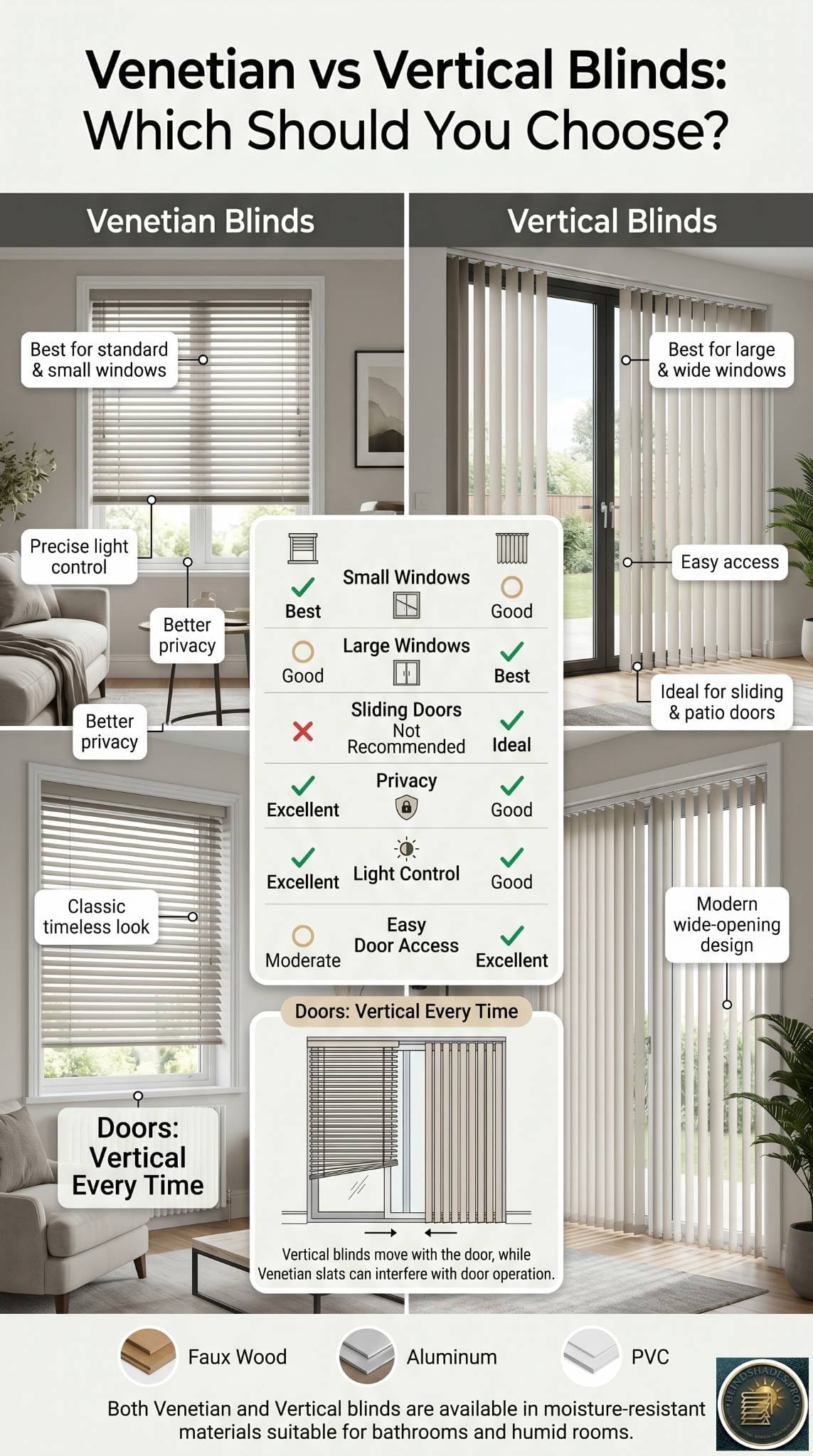
Authored by Michael Turner — 30 Years of Home Improvement Expertise | BlindShades.pro
Venetian and vertical blinds are not really rivals; they suit different windows. Choose Venetian blinds, with horizontal slats that tilt, for standard and small windows where you want precise light control, tight privacy, and a classic look. Choose vertical blinds, with louvres that hang from a track and draw to the side, for large or wide windows, floor-to-ceiling glass, and sliding or patio doors, where they slide out of the way for easy access. The deciding question is not which blind is better, but what your window is: its shape, and whether you walk through it.
Key Takeaways
- The window decides, not the blind. Venetian blinds suit standard and smaller windows; vertical blinds suit large, wide, and tall openings and anything you walk through. Work out your window’s shape and use first, and the choice usually makes itself.
- Vertical blinds win at sliding and patio doors, for a concrete reason. Horizontal Venetian slats get caught in sliding-door tracks or crushed when the door opens, while vertical louvres hang parallel to the door and slide aside with it. For any door you pass through, vertical is the clear answer.
- Venetian blinds give tighter privacy and more precise light control. The close horizontal overlap of Venetian slats blocks outside views well when closed, and small tilt adjustments fine-tune the light. Vertical blinds rotate to manage light across wide spans but can leave small gaps if misaligned.
- There is a design trick in the orientation. Horizontal Venetian lines make a room feel wider, while vertical louvre lines make it feel taller, so the right choice can subtly reshape how a room reads.
- Both come in moisture-proof materials. Venetian and vertical blinds are both available in faux wood, aluminum, or PVC, so either style can work in a bathroom or kitchen if you choose the right material.
⭐ Quick Answer
Venetian vs vertical blinds is not really about which is better — the two suit different windows, so the window decides.
- Choose Venetian (horizontal tilting slats) for standard and small windows, precise light control, tight privacy, and a classic look.
- Choose vertical (louvres on a track that draw aside) for large, wide, or floor-to-ceiling windows, as Blinds Direct notes for wide openings.
- Sliding and patio doors: vertical, every time. Venetian slats catch in the door tracks or get crushed, while vertical louvres slide parallel with the door, per Topjoy Blinds.
- Privacy and fine light control: Venetian has the edge; wide coverage and easy access: vertical wins. There is a design trick too — horizontal lines widen a room, vertical lines heighten it, as VelaBlinds explains.
- Both come moisture-proof in faux wood, aluminum, or PVC — see best Venetian blinds for bathrooms and compare materials in wood vs faux wood. For the full Venetian decision and picks, see our best Venetian blinds guide.
Venetian vs Vertical Blinds: The Full Comparison
Every deciding factor side by side.
| Factor | Venetian blinds | Vertical blinds |
|---|---|---|
| Slat orientation | Horizontal, tilt | Vertical, rotate and draw aside |
| Best window | Standard, small, narrow | Large, wide, tall, floor-to-ceiling |
| Sliding and patio doors | Poor (slats catch) | Excellent (slide with the door) |
| Light control | Precise small adjustments | Good across wide spans |
| Privacy when closed | Best (tight overlap) | Good (can gap if misaligned) |
| View when open | Stacks at top | Draws fully to the side |
| Style | Classic, versatile | Modern, practical |
| Cleaning | Dust magnet, slat by slat | Easier, wipe-clean louvres |
| Movement | Stable, compact | Can sway in a draft |
| Look on small windows | Neat | Can look bulky |
Read down the column that matches your window and priorities. The sections below explain the factors that decide most rooms.
What Are Venetian and Vertical Blinds?
Venetian blinds have horizontal slats that tilt; vertical blinds have louvres that hang from a track and draw to the side.
Venetian blinds are built from horizontal slats connected by cords or tapes. You tilt the slats to control light and privacy, and raise the whole blind to stack the slats at the top. They are the classic, versatile horizontal blind, available in wood, faux wood, and aluminum.
Vertical blinds are made from vertical louvres that hang from a track along the top. You rotate the louvres to control light, and draw the whole blind to one side to clear the window or door entirely. Modern verticals are mostly free-hanging and chain-free, doing away with the old bottom chains, and are commonly made from fabric or PVC.
That difference in orientation, horizontal versus vertical, is the root of every other difference, because it determines which windows and doors each one suits.
How Do You Decide — Window Shape and Doors?
Match the slat direction to the opening: horizontal slats for standard windows, vertical louvres for wide, tall, or walk-through openings.
The common advice is “vertical for big windows, Venetian for small,” but the sharper rule is about shape and use, not just size:
- Standard and smaller windows that are wider than they are tall, or roughly square, suit Venetian blinds, whose horizontal slats sit neatly and whose detailing is appreciated at that scale. A vertical blind can look bulky and out of place on a small window.
- Large, wide, and tall openings — picture windows, floor-to-ceiling glass, corner windows, wide expanses — suit vertical blinds, which cover the area smoothly, operate easily across the span, and draw cleanly aside.
- Anything you walk through — sliding doors, patio doors, French doors — calls for vertical blinds, for the mechanical reason in the next section.
So before comparing features, ask what your opening is: a standard window, a wide expanse, or a door. That answer settles most of the decision.
Which Is Better for Sliding and Patio Doors?
Vertical, decisively — Venetian slats jam in the track, while vertical louvres slide with the door.
This is the clearest win for either side, and it comes down to physical fit. Venetian blinds are designed for windows, and on a sliding or patio door their horizontal slats get caught in the door tracks or crushed when the door opens, and they struggle to cover the full height and width without looking awkward. Vertical blinds hang parallel to the door, so the louvres slide out of the way as the door opens and cover the full opening cleanly. For any sliding or patio door, vertical blinds are the practical answer every time, which is a big part of why they dominate large glazed openings and commercial spaces. If your project is mostly doors and wide glass, that points you toward verticals and our vertical blinds guide.
Which Gives Better Light Control?
Venetian for precise small adjustments; vertical for managing light across a wide span.
Both control light well, but differently. Venetian blinds excel at precise, incremental control: a small tilt of the horizontal slats lets you admit a sliver of soft, diffused light while keeping privacy, or angle the light up onto the ceiling. Vertical blinds rotate their louvres to manage light across a large window and are especially good at diffusing low, angled sun, as when the sun is low in the sky, without fully blocking the view. So for a small room where you want to fine-tune the light, Venetian wins; for a big, sunny window or door wall where you want even light management across the whole span, vertical is better suited.
Which Gives More Privacy?
Venetian, because its tight horizontal overlap blocks outside views more completely when closed.
Privacy is one of Venetian blinds’ strengths. When the horizontal slats are closed they overlap tightly, blocking almost all visibility from outside, which makes them a strong choice for bedrooms and street-level rooms. Vertical blinds are still private when closed, but lower-quality or misaligned louvres can leave small gaps that allow accidental visibility, so they need to be properly adjusted. The fix on the vertical side is blackout PVC louvres, which block light and visibility completely. As with any slatted blind, mind the nighttime silhouette with a light on inside, and close the slats fully after dark. For the material side of privacy, solid slats block more than thin ones, a point covered in aluminum vs wood Venetian blinds.
Which Looks Better — and the Line Trick?
It is classic versus modern, and the orientation itself can reshape how a room feels.
On pure style, Venetian blinds read as classic and versatile, suiting traditional and contemporary rooms alike, while vertical blinds read as modern and practical and have shaken off their dated reputation with cleaner, chain-free designs. There is also a genuine interior-design effect in the orientation worth knowing: horizontal lines make a room feel wider, which is what Venetian slats do, while vertical lines make it feel taller, which is what vertical louvres do. So beyond the window fit, you can use the blind’s direction to subtly correct a room’s proportions, widening a narrow room with Venetians or heightening a low one with verticals. On the view itself, vertical blinds draw fully to one side for an uninterrupted outlook, while Venetian blinds stack at the top and their slat lines break up the view when partly closed.
Which Is Easier to Clean?
Vertical — its smooth louvres wipe clean, while Venetian slats trap dust.
Maintenance favors vertical blinds. Their flat, vertical louvres, especially in PVC, do not collect dust in grooves the way horizontal slats do, and they wipe down quickly with a damp cloth. Venetian blinds, with their many horizontal slats, are genuine dust magnets that need regular slat-by-slat dusting. If low-maintenance is a priority, vertical has the edge; if you choose Venetian, the full method to keep it fast is in how to clean Venetian blinds.
Do Both Come in Moisture-Proof Materials?
Yes — both styles are available in faux wood, aluminum, or PVC, so either can suit a wet room.
The style choice and the material choice are separate decisions. Both Venetian and vertical blinds come in moisture-proof materials: faux wood, aluminum, and PVC all resist the humidity that would warp real wood, so either style works in a bathroom or kitchen if you pick the right material. For a wet room, that means you can choose the style that fits the window, a Venetian for a standard bathroom window or a vertical for a wide one or a patio door off the kitchen, and then specify it in a moisture-proof material. The material decisions are covered in wood vs faux wood blinds and best Venetian blinds for bathrooms.
Room-by-Room Verdict
Match the blind to the opening and the decision is clear.
| Window or room | Best choice |
|---|---|
| Standard or small windows | Venetian |
| Bedrooms, street-level rooms (privacy) | Venetian |
| Large, wide, or floor-to-ceiling windows | Vertical |
| Sliding doors, patio doors, French doors | Vertical |
| Offices, commercial, wide spans | Vertical |
| Narrow room you want to feel wider | Venetian (horizontal lines) |
| Low room you want to feel taller | Vertical (vertical lines) |
| Low-maintenance priority | Vertical |
| Bathrooms and kitchens | Either, in a moisture-proof material |
For the complete Venetian decision, materials, and our real-brand picks, see the best Venetian blinds guide. If your windows are mostly wide spans and doors, a vertical blind is likely the better fit.
Best Sources
- Blinds Direct — on vertical blinds suiting sliding doors, floor-to-ceiling and corner windows, and Venetians working better on individual panes and smaller sections.
- Topjoy Blinds — on Venetian slats getting stuck or crushed in sliding-door tracks while vertical louvres slide parallel with the door, and on blackout PVC vertical louvres for full privacy.
- VelaBlinds — on the horizontal-versus-vertical line design effect and Venetian blinds offering better privacy through tight slat overlap.
- Impress Blinds — on vertical louvres drawing aside for an uninterrupted view while Venetian stacks at the top, and verticals looking bulky on small windows.
Related Guides
- Best Venetian Blinds Buying Guide
- Best Venetian Blinds for Bathrooms
- Wood vs Faux Wood Blinds
- How to Measure for Venetian Blinds
Frequently Asked Questions
Are Venetian or vertical blinds better?
Neither is universally better; they suit different windows. Venetian blinds are better for standard and small windows where you want precise light control, tight privacy, and a classic look. Vertical blinds are better for large, wide, and tall windows and for sliding or patio doors, where they cover the span smoothly and slide aside for access. Decide by your window’s shape and whether it is a door.
Which is better for sliding doors, Venetian or vertical blinds?
Vertical blinds, every time. Venetian blinds have horizontal slats that get caught in sliding-door tracks or crushed when the door opens, and they struggle to cover the full opening neatly. Vertical louvres hang parallel to the door and slide out of the way as it opens, covering the full height and width cleanly, which makes them the practical choice for any door you walk through.
Which gives more privacy, Venetian or vertical blinds?
Venetian blinds have a slight edge. When their horizontal slats are closed they overlap tightly and block almost all visibility from outside. Vertical blinds are private too, but lower-quality or misaligned louvres can leave small gaps, so they must be adjusted properly. For full privacy with verticals, blackout PVC louvres block light and visibility completely.
Can you use Venetian or vertical blinds in a bathroom?
Both can work in a bathroom, as long as you choose a moisture-proof material. Faux wood, aluminum, and PVC versions of either style resist the humidity that would warp real wood. Pick the style that fits the window, a Venetian for a standard window or a vertical for a wide one or a patio door, then specify it in a moisture-resistant material.
Do vertical or Venetian blinds make a room look bigger?
Both can, through the orientation of their lines. Horizontal Venetian slats draw the eye sideways and make a room feel wider, which helps a narrow room. Vertical louvres draw the eye upward and make a room feel taller, which helps a low-ceilinged room. Choose the orientation that corrects the proportion you want to improve.
