What Are the Disadvantages of Solar Shades? The Honest List

Authored By Michael Turner -30 Years Home Improvement Expertise | Updated 2026 | BlindShades.pro
Updated on July 24, 2026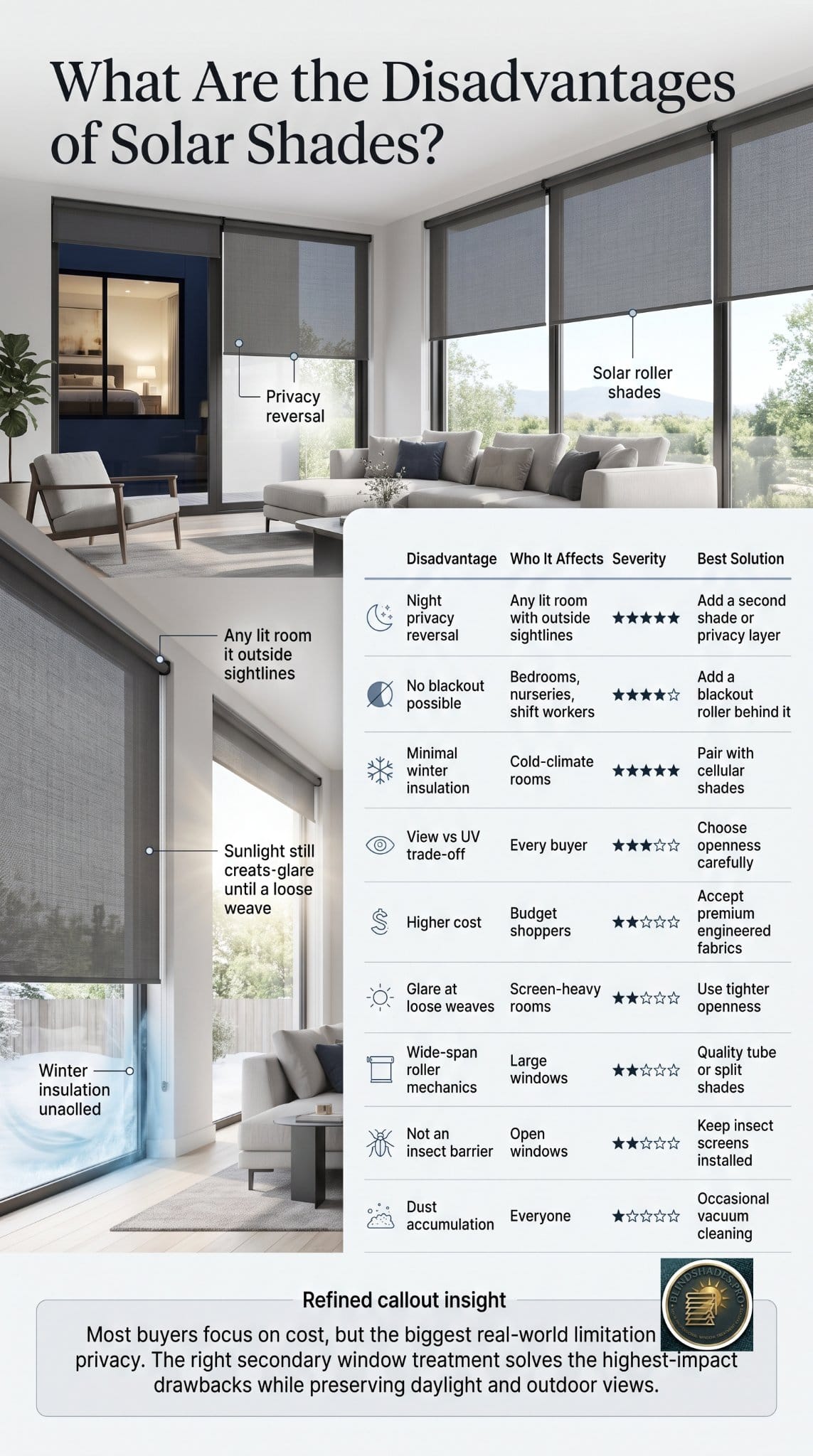
By Michael Turner — 30 years in window treatments
The disadvantages of solar shades are real, and the industry itself names the big three: no privacy at night once the lights come on, almost no winter insulation, and a permanent trade-off between view clarity and UV protection. But a list is not a decision. After three decades of installing these shades — and fielding the calls when they disappoint — every one of those cons is either a dealbreaker for a specific room, a problem with a known fix, or a quirk you accept. This guide runs the list through that test, separates real callbacks from paper cons, and adds the one disadvantage no published list mentions.
Key Takeaways
- The industry converges on three main disadvantages. velablinds (August 26, 2025) names them plainly: lack of nighttime privacy, poor insulation value in winter, and the view-versus-UV trade-off — the same trio that anchors nearly every honest treatment of the product.
- Two more cons deserve the list. SelectBlinds (August 1, 2025) adds the inability to create blackout conditions, and Made in the Shade Annapolis adds cost — solar fabrics run more expensive than basic rollers because of their engineered UV-blocking materials.
- No disadvantage is universal. Each one bites specific rooms: night privacy is fatal in a bathroom and irrelevant in a daytime office — which is why this page judges cons by room, fix, and severity rather than listing them.
- The complaints that generate real callbacks are three. Night-privacy shock, the still-freezing room, and aquarium-dim living rooms from over-tight weaves — the rest of the published cons almost never ring a phone.
- One disadvantage appears on no list at all. Wide windows introduce roller mechanics — sag, telescoping, tracking drift — and mesh is not an insect screen on windows you open. Both surprises live in the section nobody else wrote.
⭐ Quick Answer — What Are the Disadvantages of Solar Shades?
The honest disadvantages of solar shades are six — and every one is either room-dependent, fixable, or a quirk you accept:
- The big three the industry itself names: privacy reverses at night in any lit room (the full physics is in our night privacy guide), the open weave gives almost no winter insulation, and view trades against UV protection through the openness percentage — velablinds states the trio plainly.
- Two more worth listing: no weave produces blackout darkness, per SelectBlinds, and engineered fabrics cost more than basic rollers.
- The one nobody publishes: wide-span roller mechanics — sag, telescoping, tracking drift past door-width spans — plus the surprise that mesh is not an insect screen.
- The room decides the verdict: fatal in bathrooms and solo bedrooms, irrelevant in offices, sunrooms, and view windows — and the usual alternative carries its own ledger, per 3 Day Blinds on cellular durability and dust; the full matchup is solar shades vs cellular shades.
- Still worth buying? Yes — for daylight rooms, emphatically; the verified picks live in the complete solar shades guide.
What Are the Disadvantages of Solar Shades?
The complete list, ranked by how hard each one actually bites — with the fix or the honest “accept it” beside each:
| Disadvantage | Who it bites | Severity | Fix — or accept |
|---|---|---|---|
| Night privacy reversal | Any lit room with outside sightlines | ★★★★★ | Fix: second layer or dual shade — the full physics and fixes |
| No blackout possible | Bedrooms, nurseries, shift workers | ★★★★☆ | Fix: blackout layer or dual shade — the blackout guide |
| Minimal winter insulation | Cold-climate rooms | ★★★★☆ | Fix: cellular layer + the raise-for-sun routine — the winter answer |
| View vs UV trade-off | Every buyer, by degree | ★★★☆☆ | Manage: the openness decision — 5% vs 10% explained |
| Higher cost than basic rollers | Budget shoppers | ★★☆☆☆ | Accept — engineered PVC-coated polyester and fiberglass cost more; buy on the promo cycle |
| Glare persists at loose weaves | Screen-heavy rooms with 10% mesh | ★★☆☆☆ | Fix: tighter weave in that room |
| Wide-span roller mechanics | Windows past roughly door-width | ★★☆☆☆ | Manage: quality tube, split runs — the unlisted section below |
| Not an insect barrier | Opening windows in bug season | ★★☆☆☆ | Accept: mesh ≠ screen; keep the fly screen |
| Mesh collects dust | Everyone, mildly | ★☆☆☆☆ | Accept: occasional vacuuming, per Made in the Shade Annapolis |
Credit where due: Unique Perspective Window Coverings (February 11, 2025) leads its cons with limited night privacy, and The Shade Store (December 8, 2023) has documented the after-dark reversal for years. But where nearly every published list stops is exactly where useful judgment begins: which of these matters for your room?
Which Disadvantages Are Dealbreakers — and in Which Rooms?
The Dealbreaker Test (Room · Fix · Accept): no solar-shade disadvantage is universal — each is a dealbreaker for a specific room, a problem with a known fix, or a quirk you accept. Run the list through the test and it becomes a decision.
| Room | Dealbreaker cons here | The verdict |
|---|---|---|
| Bathroom | Night privacy — fatal | Wrong product solo; different treatment or a layered plan |
| Bedroom | Night privacy + no blackout + winter | Solar takes the day shift only; dual shade or skip |
| Street-facing living room | Night privacy | Fine WITH an evening layer closed at lamps-on |
| Home office (daytime) | None — glare is the enemy solar kills | Among the best rooms for the product |
| Sunroom / three-season room | None that matter | The product’s natural habitat |
| Upper floor, no sightlines | None | Buy for the view and the glare |
| Cold-climate all-purpose room | Winter insulation | Solar + cellular layering, or cellular alone — the matchup |
Read the matrix honestly and a pattern appears: the disadvantages cluster in rooms that are lit at night or cold in winter, and vanish in rooms that live by daylight. That is not spin — it is the same physics working both shifts, and it predicts exactly which complaints reach an installer’s phone.
What Problems Do Owners Actually Report?
Thirty years of callbacks sort the published cons into two very different piles — the ones that ring the phone, and the paper cons that never do:
| The complaint | Callback or paper con? | What is really happening |
|---|---|---|
| “You never told me the neighbors could see in” | ★ The #1 callback | Sold as “privacy” without the night caveat — the reversal, not the fabric, is the shock |
| “The room is still freezing” | ★ Callback #2 | A summer product asked to do winter work — insulation was never in the weave |
| “The living room feels like an aquarium” | ★ Callback #3 | Over-tight 1% weave specified where 5% belonged — dimness regret, not defect |
| “It’s dusty” | Paper con | Real, minor, solved by a vacuum brush — never a standalone call |
| “It clashed with the exterior look” | Paper con | Screenmobile (March 18, 2022) raises the aesthetic point for exterior units; interior mesh rarely draws it |
| “It cost more than blinds” | Paper con | True per Made in the Shade Annapolis — and accepted at purchase, not discovered later |
The pattern worth internalizing: every genuine callback is an expectations failure, not a product failure. The mesh never stops doing what it does — intercepting sun, passing air and view. Callbacks happen when a seller let a buyer expect privacy at night, warmth in January, or darkness at noon. Set those three expectations correctly and the disadvantage list collapses into quirks. Which leaves the one problem that genuinely is mechanical.
What’s the Disadvantage Nobody Lists?
Wide-span roller mechanics — after three decades, the quietest disappointment in the category. A solar shade is a roller shade, and rollers obey tube physics: past roughly door-width spans, economy tubes can bow slightly under fabric weight (a smile in the bottom bar), fabric can telescope — creeping sideways until one edge rubs — and a shade that tracked straight for a year can drift after seasons of temperature swings. None of this is exotic, and none of it appears in any pros-and-cons roundup I have found in circulation. The management is straightforward: on wide openings, specify a heavier tube grade, consider splitting one huge span into two coordinated shades on one headrail line, keep fabric edges clean of the frame, and treat a new telescoping habit as a re-rolling fix, not a replacement.
The second unlisted surprise is smaller but real: mesh is not an insect screen. Buyers with opening windows sometimes retire the fly screen because the shade “looks like one” — then meet the difference on the first summer evening. The weave hangs inside the glass line with open edges; bugs route around it effortlessly. Keep the insect screen; the solar shade was never applying for that job. Both of these are manage-and-accept items, not dealbreakers — but a disadvantages page that omits them is a list, not research. So how does the full ledger compare against the alternatives?
Do Other Shades Have Fewer Disadvantages?
No — they have different ones, and the honest cross-product view is the fastest cure for grass-is-greener shopping:
| Product | Its own disadvantage list | Verdict |
|---|---|---|
| Solar shades | The ledger above — night, winter, trade-off, cost | Unbeatable daytime glare-with-view; needs a night/winter partner |
| Cellular (honeycomb) | Per 3 Day Blinds (November 6, 2025): less durable in high-traffic and pet homes, cells collect dust and need regular cleaning — plus the view disappears when lowered | Wins insulation; loses the view — the full matchup |
| Blackout rollers | Total darkness means total view loss; daytime rooms turn cave-like | The night specialist, not a daytime product |
| Exterior solar screens | Per Tucson Rolling Shutters: no complete darkness and lower security than rolling units; permanent exterior look changes | A separate product family with its own ledger — covered separately |
| Skylight shades | Per Blinds Chalet (July 8, 2026): higher cost, complex installation, limited accessibility without motorization | Specialty-window rules apply |
Every window covering is a bundle of talents and taxes. The solar shade’s tax schedule is unusually predictable — it comes due at night and in January — which is precisely what makes it plannable: pair the mesh with one partner layer and the two biggest line items vanish.
Are Solar Shades Still Worth It?
Yes — for the rooms and jobs they were engineered for, emphatically. The disadvantages above are the price of a genuinely unique talent: no other treatment blocks most UV, kills glare, and keeps your view simultaneously — the reason offices, sunrooms, and view homes standardize on mesh, and the reason the commercial case pencils out on energy and comfort (the office ROI numbers make that argument with a straight face). The worth-it math fails only when the product is bought against its own ledger: as a privacy solution, an insulator, or a blackout. Buy it as what it is — the daytime specialist, with a partner layer where the room needs one — and the summer side of its résumé, covered in our heat-blocking guide, carries the price easily.
Who Should Buy Solar Shades Despite the Downsides?
✔ Buy them if: your rooms live by daylight — offices, sunrooms, view windows, upper floors; glare and UV are your actual enemies; you keep the view a priority; and you are willing to add a partner layer in any room that is lit at night or cold in winter. ✖ Skip them (or plan the layer from day one) if: the room is a bathroom or bedroom being sold “privacy”; you need darkness for sleep; winter insulation is the point of the purchase; or the budget cannot stretch past a basic roller — in which case a light-filtering roller does most of the daytime job at a lower price class. Undecided between the mesh and the honeycomb? Solar shades vs cellular shades settles it room by room, and the complete solar shades guide holds the verified picks.
Avoid These Mistakes
- Accepting a “privacy” pitch without the night caveat. The reversal is the industry’s most-documented con and the number-one callback — ask what happens at lamps-on before you sign.
- Buying mesh to warm a room. No weave insulates; the winter plan is choreography plus a trapped-air layer, never a tighter openness.
- Speccing 1% everywhere “to be safe.” Over-tight weaves in living rooms create the aquarium regret that fills callback pile three — match the percentage to the room’s job.
- Retiring the insect screen. Mesh is not a bug barrier on opening windows.
- Ordering one huge economy roller for a wide wall. Tube physics wins; upgrade the tube or split the span.
- Judging cost at list price. Solar fabrics run higher than basic rollers, but the category lives on deep promotional cycles — the per-year cost of a fade-resistant fabric is the honest comparison.
The Bottom Line
The disadvantages of solar shades are three big ones (night privacy, winter insulation, the view-UV trade-off), two medium ones (no blackout, cost), and a handful nobody publishes (wide-span mechanics, the insect-screen surprise). Run them through the Dealbreaker Test and the verdict writes itself: fatal in bathrooms and solo bedrooms, irrelevant in daylight rooms, and fixable everywhere else with one partner layer. Every real complaint in thirty years of callbacks traces to an expectation a seller failed to set — never to the mesh failing at its actual job. Set the expectations right and shop the talent: the verified picks, ratings shown with their review bases, live in the complete solar shades guide.
FAQ
Do solar shades fade over time? Rarely at a rate you will notice — the fade concern circulating in some cons lists is answered by the materials: PVC-coated polyester and fiberglass are engineered for daily sun exposure and resist UV degradation far better than ordinary fabrics. Fabric choice matters more than time; the color decision guide covers which shades hold their look longest.
Are solar shades expensive compared to other shades? Moderately — engineered mesh costs more than basic vinyl rollers and less than premium cellular or shutters, with ready-made entries at the low end and custom sizing commanding the premium. The honest comparison is cost per year on a fade-resistant fabric, and the category’s deep promotional cycles close most of the gap.
Can solar shades be blackout? No — an open weave cannot produce darkness, which is why “blackout solar shade” listings are really room-darkening solid fabrics on the same hardware. For genuine darkness, pair the mesh with a blackout layer or a dual-shade headrail; the blackout guide ranks the options that actually reach lights-out.
What are the drawbacks of cellular shades, the usual alternative? Cellular wins winter but carries its own ledger: the view disappears when lowered, cells collect dust and need regular cleaning, high-traffic and pet homes test the fabric’s durability, and internal cords cost more to repair. The solar-versus-cellular matchup weighs both lists room by room.
Are solar shades worth it despite the disadvantages? Yes — in the rooms they were built for. No other treatment delivers UV protection, glare control, and a kept view at once, which is why daylight-heavy rooms and commercial offices standardize on mesh. The math fails only when the product is bought as a privacy, insulation, or blackout solution — jobs it never claimed.
Do exterior solar screens have the same disadvantages? They share the no-darkness limit but swap the rest: exterior units trade renter-friendliness and easy install for stronger heat interception before the glass, plus their own list — weather exposure, exterior appearance changes, and lower security than solid rolling units. They are a separate product family, covered separately from interior mesh.
Related Guides
- Best Solar Shades — the complete guide
- Can You See Through Solar Shades at Night?
- Do Solar Shades Keep Cold Out?
- Solar Shades vs Cellular Shades
- 5% vs 10% Solar Shades
- Best Solar Shades for Blocking Heat
