Disadvantages of Thermal Blinds: The Honest List

Authored By Michael Turner -30 Years Home Improvement Expertise | Updated 2026 | BlindShades.pro
Updated on July 24, 2026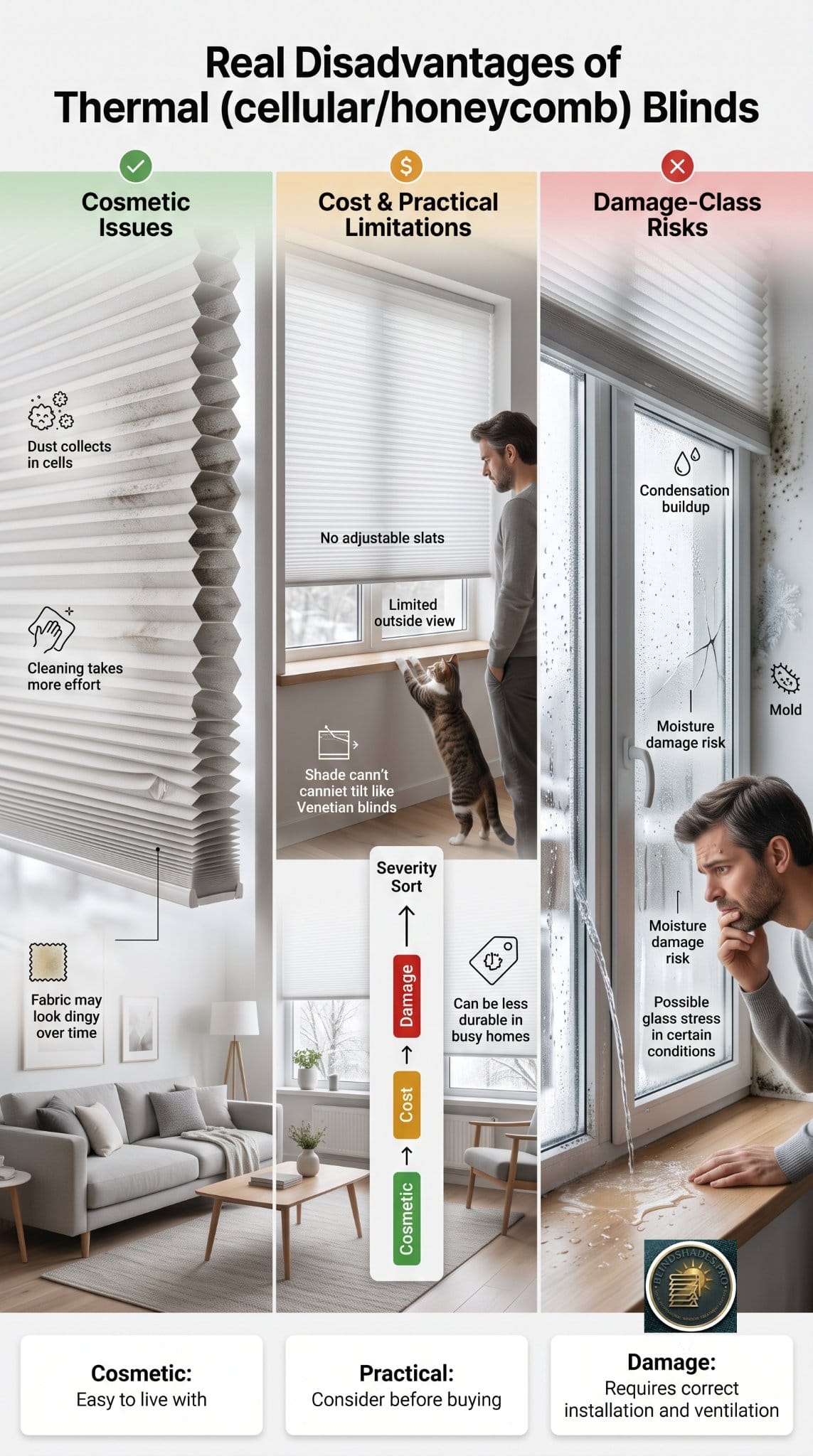
By Michael Turner — 30 years in window treatments
The disadvantages of thermal blinds sort into three tiers, and the published lists only cover the mildest one. Cosmetic cons — trapped dust, delicate fabric, a uniform look — are real and manageable. Cost cons are explainable. But the three disadvantages that can actually cost you money are damage-class, and no seller lists them: a tightly sealed blind over sun-blasted glass can crack a sealed double-glazed unit, trapped-pocket heat melts cheap slats, and the condensation that appears behind a new thermal blind sends hundreds of owners hunting for answers every winter. All three are documented, all three are preventable, and this page covers each with its case and its fix.
Key Takeaways
- The standard list is cosmetic: honeycomb pockets collect dust and the occasional insect, the fabric can’t take harsh chemicals or a dunk, cells tear more easily than wood or metal slats, linings fade over years of direct sun, and the look is uniform rather than decorative — all true, all manageable, none expensive.
- Three disadvantages are damage-class, and sellers skip them. Documented cases include a sealed double-glazed unit cracked by heat trapped behind a snug-fit blind, vinyl slats warped and melted in a west-window heat pocket, and the condensation surge behind new thermal blinds that filled a 269-answer discussion.
- Failure scales with product quality on hot glass. The better a blind seals, the hotter the trapped pocket runs — which is why frame-sealed systems publish a required distance from the glass that almost nobody reads.
- The honest other side is stronger than the cons: a peer-reviewed study found interior blinds significantly suppress night heat losses through double glazing, the U.S. Department of Energy credits insulated cellular shades with forty percent-plus reductions in window heat loss, and Consumer NZ’s testing puts honeycombs at 63 percent of heat retained — triple the best curtain tier.
- Most cons have a cheap neutralizer: a vacuum with a brush head, a hair dryer on cool for the cells, an air gap on sun-facing glass, and a humidity check before blaming the blind.
⭐ Quick Answer — Disadvantages of Thermal Blinds
The real disadvantages of thermal blinds sort into three tiers — and the published lists only cover the mildest:
- Cosmetic cons (real, manageable): honeycomb pockets trap dust, the fabric can’t take harsh cleaning, cells tear more easily than hard slats, linings fade in years of direct sun, and there’s no venetian-style tilt — the shade is up, down, or between.
- Cost cons (explainable): internal strings mean a mis-sized shade can’t be trimmed, so most are made to order at a premium — and fabric cells dislike steamy rooms.
- Damage cons (the ones sellers skip): a tightly sealed blind over sun-blasted glass has cracked a sealed double-glazed unit in a documented case, trapped-pocket heat melts cheap slats, and new thermal blinds often reveal a winter condensation problem that was already in the house.
- The other side is heavier: peer-reviewed research on ScienceDirect finds interior blinds significantly cut night heat losses, the U.S. Department of Energy credits insulated cellular shades with forty percent-plus savings on window heat loss, and Consumer NZ puts honeycombs at sixty-three percent of heat retained.
- Buy with the failure file in mind: the picks that survive this scrutiny are in our Thermal & Insulated Blinds guide, the summer gap rule in do thermal blinds keep heat out, and the harder-wearing alternatives in which blinds insulate best.
Disadvantages of Thermal Blinds: The Honest List
The Severity Sort (Cosmetic · Cost · Damage): most published cons are cosmetic, the ones that matter are damage-class — and the reason you haven’t read them is that sellers can’t write them.
Search this question and you’ll notice something odd: several top results don’t contain the word “disadvantages” at all, and the lists that exist agree on a gentle set — cleaning is fiddly, fabric is delicate, the look is plain. velablinds, the source behind most of the circulating list, adds the honest structural note that you can’t tilt cellular cells the way you tilt venetian slats; a honeycomb is up, down, or somewhere between, with no view-preserving louvre position. 3 Day Blinds contributes the most useful commercial caution on the field: cellular shades may be less durable in high-traffic areas or homes with pets. All fair. All minor.
What the field can’t say is where the real money is. A seller who writes “our best-fitting product can crack your glazing in the wrong window” has a marketing problem — so the documented failure cases live in owner forums instead. The community record on this question is blunter than any product page: alongside the cleaning gripes sits a homeowner who switched all their honeycombs out because they “started looking dingy after a few years,” a 63-answer thread weighing honeycomb experience for cold climates, and — ranking on this exact search — a 269-answer thread titled around the crazy amount of condensation that appeared after installing a thermal blind. The honest list has to include all of it. Here it is, sorted by severity.
What Are the Real Disadvantages, Sorted by Severity?
| Disadvantage | Severity | The reality | The neutralizer |
|---|---|---|---|
| Dust, bugs, and dirt in the cells | Cosmetic | Open pockets collect what flat blinds shed | Monthly vacuum with a brush head; hair dryer on cool blows out the cells |
| Spot-cleaning limits | Cosmetic | No harsh chemicals, no submersion — the fabric won’t survive it | Mild soap, barely damp cloth, blot not scrub |
| Fragile structure | Cosmetic | Paper-like cells tear more easily than wood or aluminum slats | Keep them away from pet claws and toddler grip zones; choose hard blinds there instead |
| Sun fading | Cosmetic | Years of direct sun fade linings and face fabrics | Light colors fade slower; rotate raised/lowered on the sunny side |
| The dinginess clock | Cosmetic | The documented owner complaint: cells looking dingy after a few years in busy rooms | Regular dusting delays it; treat cells as a wear item in kitchens and dens |
| Utilitarian look | Cosmetic | Uniform and structured next to drapery | Pair with side curtains — the layered setup wins on looks and warmth |
| No-tilt light control | Cosmetic | Up or down entirely; no louvre position with a view | Top-down/bottom-up models restore privacy-with-light; a real limitation otherwise |
| Made-to-order pricing | Cost | Internal strings mean a mis-sized shade can’t be trimmed — most are built to measure | Budget the premium for cold-side glass first; cheaper products elsewhere |
| Moisture rooms | Cost | Fabric cells dislike steamy kitchens and bathrooms | Wipeable rollers there — the comparison lives in cellular vs thermal roller blinds |
| Permanent-blackout light cost | Cost | One curtain seller warns prolonged blackout use can reduce daylight exposure enough to matter | Real only if coverings never open; daily open-close choreography solves it |
| Glass stress, melt, condensation | Damage | The three the product pages omit | The Failure File, next |
The Failure File: Three Disadvantages No Seller Lists
The blind is the fuse, the glazing is the breaker — melted slats are the early warning of the same trapped heat that cracks sealed units.
| Failure mode | The documented case | Who’s at risk | Prevention |
|---|---|---|---|
| Cracked sealed glazing | A UK homeowner’s expensive made-to-measure, frame-sealed blinds trapped so much heat the conservatory panes became too hot to touch — and one double-glazed unit cracked | Snug and perfect-fit blinds over strong sun; sealed double glazing specifically | Honor the manufacturer’s glass-to-blind distance spec; on hot days crack the window behind the covering, or shade outside |
| The melt | In one widely-shared account a west-facing room’s vinyl blinds softened and warped; in a second, blinds melted sandwiched between the window and an added blackout curtain — the upgrade built the oven | Cheap PVC slats on west and south glass; any layered stack sealed tight over hot panes | Aluminum or quality fabric on sun-blasted windows; vent between layers in summer |
| Winter condensation | The 269-answer thread: a wall of water droplets appearing on the glass behind a brand-new thermal blind | Cold climates, humid households, any well-sealed insulating covering | Usually not the blind’s fault — the diagnostic gate below |
The mechanism behind the first two deserves one careful paragraph, because the internet version is wrong. The glass doesn’t crack from simple expansion; a sealed double-glazed unit is a system — trapped gas between panes, a metal edge spacer, a frame — and when a tight covering cooks one side, those parts expand at different rates. The stress concentrates at the edges, and edge stress is what cracks sealed units. Single panes almost never crack this way. The unsettling corollary from the same case file: the risk scales with product quality. A loose, slatted, gappy blind vents its pocket; a beautifully sealed frame-clicked system doesn’t — which is exactly why the manufacturers of those systems publish a required distance between glass and blind, a spec almost nobody reads. One documented delayed case saw interior reflective film crack a unit over time; as a commenter put it, a simple sticker can crack glass in the correct circumstances. The against-interest capstone comes from a window-tinting business owner, writing against their own trade: do not put insulation, foil, or anything solid in or on dual-pane windows.
And the resolution in the crown case is the cheerful part: the owner moved a reflective bubble-foil layer outside the glass — about twenty pounds spent — and the panes went from scalding to room temperature within an hour, the room roughly ten degrees cooler. The full seal-in-winter, vent-in-summer rule lives in do thermal blinds keep heat out.
Is Condensation the Blind’s Fault?
Mostly no — and sometimes it’s evidence the blind is working. An insulating blind holds room heat away from the glass; the glass runs colder behind it; and cold glass sits below the dew point of humid indoor air, so moisture that used to evaporate invisibly now beads where you can see it. The problem — indoor humidity — usually existed before the blind made it visible. Where the water sits tells you everything:
| Where the moisture is | What it means | Whose problem |
|---|---|---|
| Inside face of the glass (room side) | Indoor humidity meeting cold glass — the common case | Yours, and fixable: ventilation, humidity control, blind choreography |
| Between the two panes | The sealed unit’s seal has failed and its insulating gas is gone | The window’s — no blind caused it, no blind fixes it |
| Outside surface | Ordinary dew on a cold morning | Nobody’s — it evaporates |
There’s even a reframe worth keeping from the community record: fresh condensation behind a new thermal blind is proof a still-air pocket formed — that’s how you know it’s working. Managing it is a ladder of its own — humidity targets, ventilation habits, blind timing — and it gets a dedicated guide. For this ledger: real phenomenon, rarely the blind’s fault, diagnosable in ten seconds by which surface is wet.
Who Should Reconsider — and Choose What Instead?
| Your situation | The honest call | The alternative |
|---|---|---|
| Pets, claws, high-traffic rooms | 3 Day Blinds’ caution is right — delicate cells suffer here | Faux wood or aluminum from which blinds insulate best‘s harder rungs |
| Steamy kitchen or bathroom | Fabric cells dislike the moisture | A wipeable thermal roller |
| Unvented, sun-hammered west glass | The one genuinely risky window for a snug fit | Exterior shading first, the gap rule inside |
| Floor-to-ceiling openings and sliders | Cell sizing gets awkward and pricey | Heavy sealed curtains — the case is made in blinds vs curtains for insulation |
| Style-first rooms | The utilitarian critique has teeth | Layer cells under drapery, or accept the trade |
| Cold bedroom, sound windows, no drama | The cons stay cosmetic here | Buy the honeycomb — the complete guide‘s home game |
Avoid These Mistakes
Sealing a perfect-fit blind hard against hot glass. The distance spec exists because the pocket is real. Sun-facing installs get the manufacturer’s gap, an opened window behind, or exterior shade.
Putting foil or solid insulation inside dual-pane windows. The tinting professional’s warning stands: nothing solid in or on sealed units. The safe reflective routes are exterior-grade layers or films rated for your specific glass.
Layering into an oven. The winter stack — blind plus blackout curtain — becomes a summer melt on hot glass. Un-stack the sunny side or leave the inner layer venting room.
Deep-cleaning delicate cells like hard slats. No solvents, no soaking, no scrubbing. Vacuum brush, cool-air blow-through, blot with mild soap. Anything harsher costs you the fabric.
Buying cells for the cat’s window. The claw problem has no neutralizer. Hard blinds exist for a reason.
Who Should Buy Which?
Thermal cellular blinds anyway ✔
- Cold-climate bedrooms and living rooms on sound windows — the cons stay cosmetic, the numbers stay large
- Anyone pairing them with curtains — the layered look answers the style critique
- Buyers who’ll respect the distance spec on sunny glass
Thermal cellular blinds — reconsider ✖
- Pet-heavy, high-traffic rooms and steam rooms
- Unvented west glass you won’t manage seasonally
- Style-first rooms where the uniform look grates
The Bottom Line
The disadvantages of thermal blinds are real: fiddly cleaning, delicate fabric, fading, a plain look, no tilt, a made-to-order price — and three damage risks that never make the product pages but sit documented in the owner record. Every one has a prevention, and the other side of the ledger is heavier: peer-reviewed night heat-loss suppression, the DOE’s forty-percent figure, Consumer NZ’s 63 percent retention crown. Buy with the failure file in mind — respect the distance spec, vent the summer pocket, check which surface the water sits on — and the cons shrink to chores. The ranked picks that survive this scrutiny are in our complete Thermal & Insulated Blinds guide, with the honeycomb-specific shortlist in the Cellular Shades guide.
FAQ
What do owners on Reddit say the disadvantages of thermal blinds are? The community record adds three things the seller lists omit: heat trapped behind snug blinds stressing glass on sunny windows, a wave of condensation appearing behind new blinds in cold weather — the subject of a 269-answer thread — and cells looking dingy after a few years in busy rooms. Alongside those sit the familiar cleaning and delicacy complaints, and plenty of owners who’d buy again for the winter savings.
Are cellular shades out of style? No — they’re a function-first product whose uniform look reads plain next to drapery, which is a different thing from dated. The current fashion answer is layering: cells at the glass for performance, curtains over them for softness. Top-down/bottom-up options also modernize the look while fixing the no-tilt privacy limitation.
What are cellular shades made of? Bonded polyester fabric, usually spun or non-woven, folded into rows of air-trapping cells — single, double, or triple — sometimes with a foil or blackout layer inside the window-facing cell. That construction is the whole story: it’s why they insulate, why they can’t be trimmed after manufacture, and why they’re more delicate than wood or metal slats.
What are the pros and cons of roller shades by comparison? Rollers flip the ledger: wipeable, tougher, cheaper, happier in wet rooms — but a flat single layer insulates far less, with no sound benefit. The full head-to-head, including where each wins by season, is in our cellular vs thermal roller comparison.
Is condensation behind a thermal blind a defect? Usually the opposite — it’s the still-air pocket doing its job, letting the glass run cold enough that indoor humidity condenses where you can finally see it. Check which surface is wet: room side is a humidity job, between the panes is a failed window seal, outside is harmless dew. Only the middle one is a defect, and it belongs to the window.
How do you clean thermal blinds without damaging them? Gently and often: a vacuum with a brush attachment along the cells monthly, a hair dryer on cool to blow debris out of the pockets, and a barely damp cloth with mild soap for spots — blotting, never scrubbing. No solvents, no immersion. The delicacy is the price of the fabric that does the insulating.
Related Guides
- The Best Thermal & Insulated Blinds — the complete guide
- Do Thermal Blinds Keep Heat Out? — the summer gap rule
- Are Thermal Blinds Worth It? — the numbers audit
- Which Blinds Insulate Best? — the material ladder
