Why Do Rich People Leave Their Windows Uncovered?

Authored By Michael Turner -30 Years Home Improvement Expertise | Updated 2026 | BlindShades.pro
Updated on July 24, 2026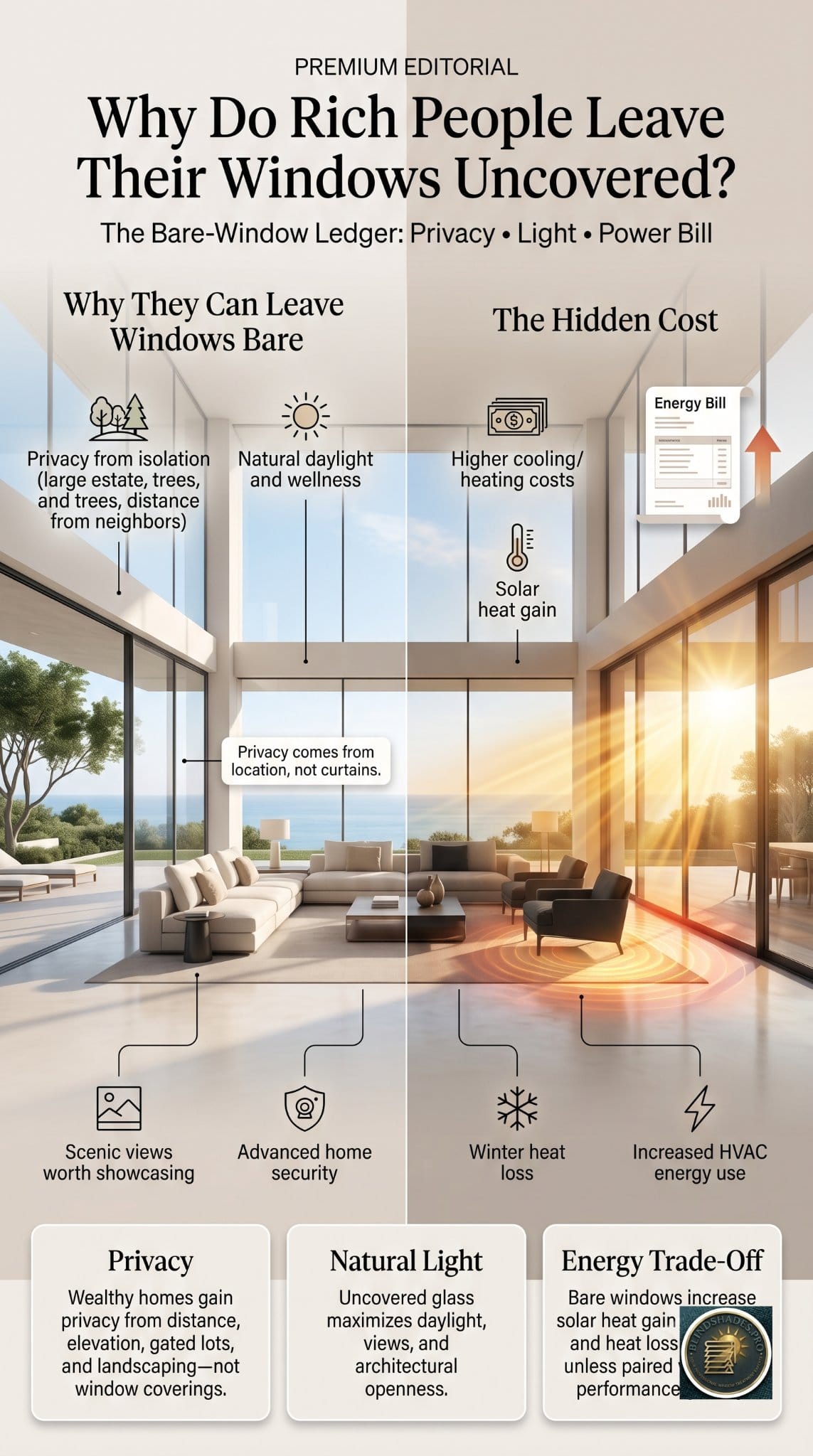
By Michael Turner — 30 years in window treatments
Rich people leave their windows uncovered because they can afford the three things bare glass actually costs: privacy, glare control, and energy. Set-back lots and penthouse elevation deliver privacy for free; architects design the light; and the energy pouring through unshaded glass is absorbed by budgets that don’t notice. What the trend pieces miss: most luxury “bare” windows aren’t bare at all — they’re wearing treatments engineered to disappear.
Key Takeaways
- The trend is real and measured: a Department of Energy survey, quoted across The Atlantic’s and The Guardian’s coverage, found top-bracket earners almost twice as likely to leave windows uncovered as households in the low twenty-thousands.
- Privacy is positional. A house set back behind landscaping, or a unit twenty floors up, gets free what dense streets must buy with coverings — most of why the wealthy skip drapes and everyone else can’t.
- The look has a running bill. Windows account for roughly 25 to 30 percent of residential heating and cooling energy use in Department of Energy estimates — bare glass leaks in both seasons, and the flex quietly includes not caring.
- “Uncovered” usually means invisibly covered. Recessed shades, ceiling-pocket motorized blinds, daytime sheers, and high-spec low-E glazing do the work visible treatments do elsewhere — the money went into coverings you can’t see.
- You can get the look without the bill: top-down shades, concealed mounts, and a good night routine deliver ninety percent of the bare-window feel at a fraction of the energy cost.
⭐ Quick Answer — Why Do Rich People Leave Their Windows Uncovered?
Asking why do rich people leave their windows uncovered has a three-part answer — privacy, light, and energy are already handled for them:
- Privacy comes with the lot: set-back homes, tall landscaping, and penthouse elevation deliver free what dense streets must buy with coverings — the positional logic behind The Atlantic’s trend-defining coverage.
- The number is real: a Department of Energy survey quoted across the coverage found top earners almost twice as likely to leave windows uncovered as the lowest bracket — the status reading Robb Report crowned the latest wealth flex.
- The look has a running bill: windows account for roughly 25 to 30 percent of home heating and cooling energy in U.S. Department of Energy estimates — bare glass leaks all year, and wealth simply absorbs it.
- “Uncovered” usually means invisibly covered: recessed cavity shades, ceiling-pocket motorized blinds, daytime sheers, and high-spec glazing do the work — the budget moved into treatments you can’t see, not zero.
- Get the look without the bill: the vanishing thermal layer lives in our Thermal & Insulated Blinds guide, the summer physics in do thermal blinds keep heat out, and the curtain seal rules in blinds vs curtains for insulation.
Why Do Rich People Leave Their Windows Uncovered?
The Bare-Window Ledger (Privacy · Light · Power Bill): the look is real, the reasons are structural — and the running cost is the part nobody prices.
The documentation is unusually good for a window topic. The Atlantic’s January 2024 piece framed it generously — ditching shades brings light, wellbeing, and a view, “regardless of who you are” — while Robb Report leaned into status: those who dare to leave windows open feel safer, with sophisticated security behind the confidence. NC Spin put the maximal version plainly: the rich eschew drapes, curtains, shades, sheers, blinds, and shutters — all of it. And the number holds up: the Department of Energy’s residential survey, quoted across the coverage, shows the more you earn, the less likely you cover your windows — the top bracket nearly doubles the bottom’s bare rate.
The community discussions add the texture the trend pieces skip. In the 63-post thread on why the rich skip curtains, the recurring answer is positional: nobody overlooks them. The fresh 742-post high-rise thread makes the point vertically — above a certain floor the only sightline is the skyline, so glass towers run bare by default. And the most-quoted ordinary-person line in the Atlantic’s own discussion maps the baseline: coverings exist to block sun when it’s not optimal and to block view when getting dressed — remove those needs and the coverings go too. Wealth doesn’t create a different taste; it removes the constraints. Better Homes & Gardens said it in one line: they show off their spaces without sacrificing privacy.
Which leaves what the coverage waves past. The aesthetic argument cuts against itself: the same articles note custom treatments are incredibly expensive — in high-end builds that budget didn’t vanish, it moved into treatments designed to disappear. And the energy ledger gets one throwaway clause — “a lack of concern for heating costs” — as if that were a personality trait rather than a bill.
What’s Really Behind Each Reason?
| The stated reason | What’s actually behind it | The honest cost |
|---|---|---|
| Privacy without drapes | Position — setbacks, landscaping, elevation; privacy bought with the lot, not fabric | None for them; a fishbowl copied on a dense street |
| Natural light and wellness | Architects design for daylight; bare glass maximizes it | Real benefit — and real summer glare and heat gain on west faces |
| Confidence and security | Gated neighborhoods and surveillance behind the calm | Not transferable by removing your curtains |
| Minimalist aesthetics | Designer preference for clean lines over heavy drapery | The look survives concealed treatments — bare and covered aren’t opposites |
| The expense inversion | Custom treatments cost a fortune, so skipping them reads as taste | In luxury builds the spend moved to invisible systems, not zero |
| The energy line nobody prices | Windows run 25–30 percent of heating and cooling energy per DOE estimates | Bare glass leaks all year; wealth absorbs the bill |
The last row is where this trend meets the rest of this site: the same Department of Energy that measured who goes bare also credits insulated cellular shades with cutting window heat loss by forty percent or more — the flex is, thermally, declining that saving in public.
Get the Look Without the Heating Bill
| What you want | The vanishing treatment | The move |
|---|---|---|
| Daytime bare-glass feel | Top-down shades or sheers | Glass reads open at eye level while the top handles sun; honeycomb versions in the Cellular Shades guide add the thermal layer |
| Fully invisible coverage | Concealed or recessed mounts, ceiling-pocket motorized shades | The luxury method itself, scaled down — hardware disappears, function stays |
| Night privacy on a normal street | A closing routine, not bare glass | Lit interiors behind bare glass are one-way theater after dark — close at dusk, open at dawn |
| Energy parity with their glazing | A snug cellular shade on cold-side glass | Does for ordinary glazing what low-E stacks do for theirs — ranked picks in our Thermal & Insulated Blinds guide |
| Big-window drama without drapery weight | Sheers, or sealed heavy curtains where cold demands | The seal rules are in blinds vs curtains for insulation |
| Sun-hammered west glass | Not bare — intercept it | The summer physics live in do thermal blinds keep heat out |
Avoid These Mistakes
Copying the look on a dense street. The rich version works because nobody can see in. At street level, bare windows plus evening lights equal a display case — the privacy was the lot’s, not the lifestyle’s.
Going bare on west-facing glass. Summer sun through unshaded west windows is heat gain, glare, and faded furniture. The uncovered look belongs on north light and shaded elevations; the hot sides need interception.
Pricing the curtains but not the energy. Skipping treatments saves the purchase and spends it back through the glass every season.
Assuming penthouse rules apply at ground level. The high-rise consensus — nobody can see you up here — inverts two floors from a sidewalk.
Confusing bare with untreated. The homes in the photographs mostly have shading you can’t see. Emulate the engineering, not just the emptiness.
Who Should Go Bare?
Bare windows ✔
- Genuinely private aspects: set-back lots, upper floors, tree-screened and north-facing glass
- Rooms where daylight is the point and summer sun never lands
- Anyone pairing bare daytime glass with a real dusk routine
Bare windows ✖
- Street-level rooms with sightlines and evening lighting
- West and south glass in cooling climates
- Cold-climate bedrooms where the glass is the biggest hole in the wall’s insulation
The Bottom Line
Why do rich people leave their windows uncovered? Because location buys their privacy, architects choreograph their light, and their budgets absorb what bare glass spends — while the treatments they do use are engineered out of sight. The habit is real, the number behind it is real, and so is the part the trend pieces skip: for everyone else, windows are the wall’s weakest thermal point, and dressing them well is the cheap version of what wealth does with glazing and concealed systems. Get the look with vanishing treatments and a dusk routine — the ranked picks live in our complete Thermal & Insulated Blinds guide, with the ladder logic in which blinds insulate best.
FAQ
Why don’t Americans close their curtains at night? Partly habit, partly the same positional logic — suburban setbacks make homes feel unobserved — and partly this trend filtering down as style. The practical rule: after dark, interior lights make bare glass one-way transparent, so any room with a sightline earns a dusk close.
Do uncovered windows actually waste energy? Yes, measurably. Windows run roughly 25 to 30 percent of residential heating and cooling energy in Department of Energy estimates — unshaded glass leaks heat out in winter and floods gain in come summer. Covering the worst offenders recovers most of it; the numbers are worked through in are thermal blinds worth it.
What about people who never open their blinds? The mirror habit — usually privacy, screen glare, shift sleep, or street-facing rooms — with its own cost in lost daylight and free winter solar gain. The healthy middle is choreography: open on the sun side in winter daytime, closed at dusk, adjusted by season rather than parked.
Is the no-curtains look still in style? Yes — minimalist bare glass remains a fixture of high-end interiors, and the coverage that made it famous keeps circulating. The maturing version of the trend is concealed rather than absent: recessed shades, motorized systems in ceiling pockets, and sheers that keep the clean lines while quietly doing the work.
Related Guides
- The Best Thermal & Insulated Blinds — the complete guide
- Blinds vs Curtains for Insulation — when fabric earns its place
- Do Thermal Blinds Keep Heat Out? — the summer physics
- The Best Cellular Shades — the vanishing thermal layer
