Cellular Shade R-Value: Single vs Double Cell

Authored By Michael Turner -30 Years Home Improvement Expertise | Updated 2026 | BlindShades.pro
Updated on July 24, 2026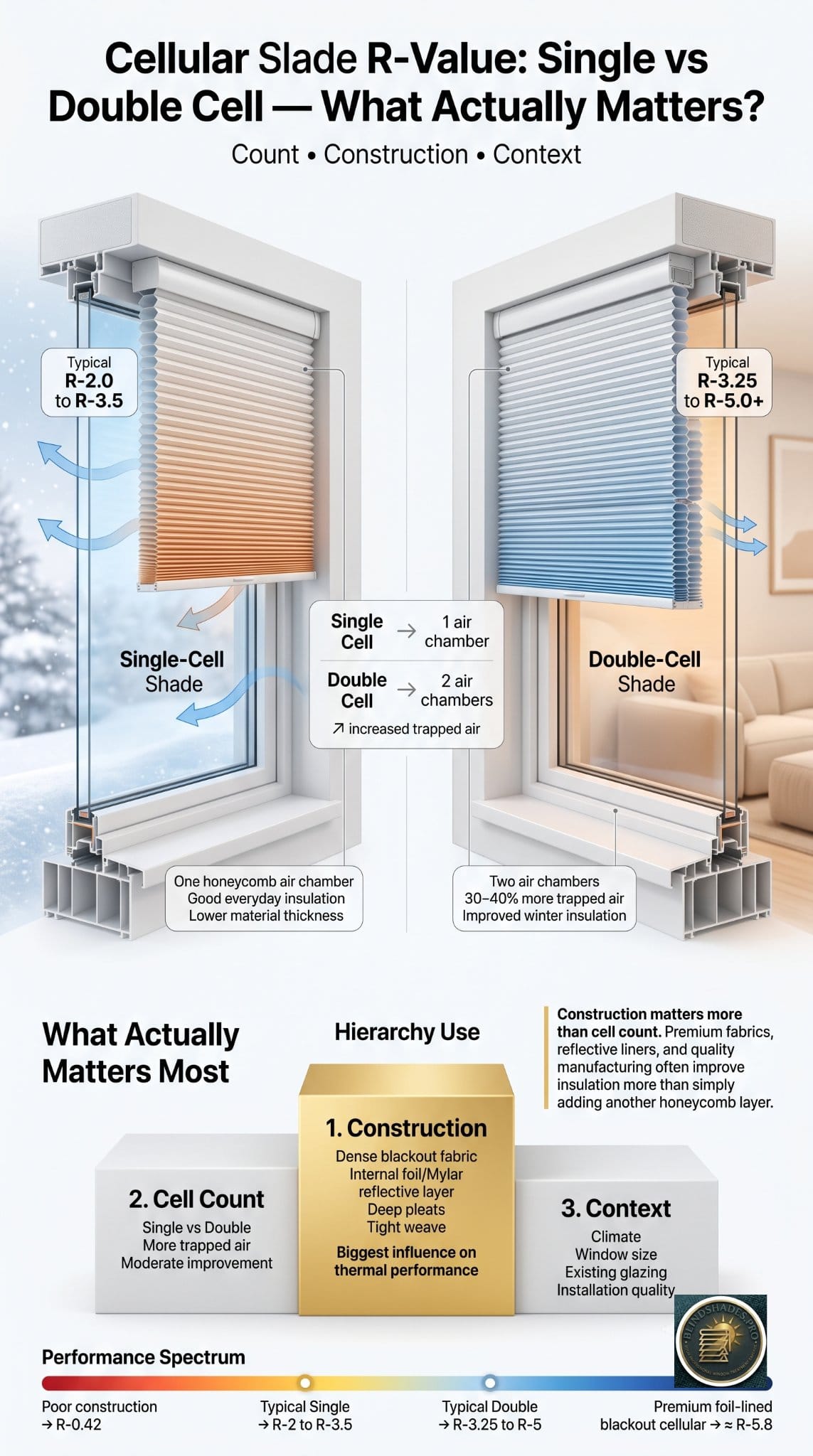
By Michael Turner — 30 years in window treatments
Cell count matters least, construction matters most, and your own window decides what’s worth paying for. Single-cell shades run roughly R-2.0 to 3.5 and doubles R-3.25 to 5.0-plus — but the ceiling of the whole category, around R-5.8, belongs to a foil-lined blackout construction, not to a third row of cells, and the densest fabrics lift both counts. Before you pay the double-cell premium, do the one piece of math no product page performs: add your shade’s R-value to your glass’s, because the same upgrade that transforms a single-pane window barely moves a modern double-glazed one.
Key Takeaways
- The honest ranges: singles typically R-2.0 to 3.5, doubles R-3.25 to 5.0-plus, with specialized foil-lined blackout versions reaching about R-5.8 — the ranges the field converges on, from Sense Blinds’ thermal-math piece to the fabric-by-fabric tables at cellularwindowshades.com.
- Construction beats count. Light-filtering fabric sets the low end of both ranges; dense blackout cells with internal Mylar or foil layers set the high end of both. A foil-lined single can out-insulate a plain double — the community’s foil-cell spec, corroborated by the category’s own ceiling number.
- The marginal-gain fight is a denominator fight. “Single to double is only R-4 to R-4.8 — not worth it” and “doubles block up to 50 percent more heat flow” are the same physics: the first measures your whole window assembly, the second the shade alone. Both are true; only one is your bill.
- Weight is the verdict nobody prints: in the definitive owner thread on a seventy-by-fifty-nine-inch window, the buyer who “did tons of research” chose singles to keep weight minimal — oversized doubles get heavy, and lighter shades get raised more often, which is its own efficiency.
- The premium has a mechanical explanation: cellular shades can’t be trimmed after manufacture — internal strings — so most are made to order, and doubles carry more material into that same premium.
⭐ Quick Answer — Cellular Shade R-Value: Single vs Double Cell
The cellular shade R-value question — single vs double cell — resolves in three words: count, construction, context:
- The honest ranges: singles typically run R-2.0 to 3.5 and doubles R-3.25 to 5.0-plus with roughly a third more trapped-air space — the figures the field converges on, fabric by fabric, in cellularwindowshades.com’s R-value tables.
- Construction beats count: the category’s ceiling — about R-5.8 — belongs to foil-lined blackout construction, not a third row of cells, and dense blackout fabrics with internal Mylar layers lift both counts. Ask whether the window-facing cell carries a foil layer; listings rarely say.
- Do the assembly math: a shade’s R only means something added to your glass — a single-pane window at roughly R-1 is transformed by any decent cell, while on modern double glazing the single-to-double upgrade moves the whole assembly a fraction. That’s how “not worth it” and Sense Blinds’ fifty-percent-more-heat-flow claim are both true — different denominators.
- The category itself is the win: honeycombs tower over every other interior covering — the U.S. Department of Energy credits insulated cellular shades with forty percent-plus less window heat loss — so the count decision is the last fork in the road, not the first.
- Buy by context: the ranked honeycombs live in our complete Cellular Shades guide, the wider field in the Thermal & Insulated Blinds guide, and the material ladder in which blinds insulate best.
Cellular Shade R-Value: Single vs Double Cell — What Actually Matters?
Count · Construction · Context: the cell count matters least, the construction matters most, and your glazing, window size, and climate decide what’s worth the premium.
Start with what the numbers agree on, because this field is unusually numerate. A single-cell shade — one row of honeycomb pockets — typically delivers R-2.0 to R-3.5. A double-cell — two stacked rows of smaller pockets — runs R-3.25 to R-5.0 and beyond, with roughly 30 to 40 percent more trapped-air space doing the work. Sense Blinds’ thermal-math framing pegs a typical single near R-2 and doubles at R-3 or higher; Blinds Chalet’s Q&A adds the structural reason — more air chambers — plus the detail sellers usually skip: deep pleats and tighter weaves also raise the number. So far, the count camp looks right.
Now the evidence that complicates it, drawn from the field’s own pages. The highest figure anywhere in this category — about R-5.8 — belongs to specialized foil-lined blackout variations, not to any count of plain cells. The fabric rule appears in the same breath: light-filtering materials set lower baselines, while denser blackout cells with internal Mylar or foil layers “maximize thermal performance in both types.” Read those two facts together and the hierarchy inverts: construction is the primary lever, count the secondary one. The community reached this verdict independently — the most useful spec in owner discussions is a window-facing cell with an internal foil layer, a construction almost no retail listing names, and real-world installs of quality honeycombs report around R-4 regardless of the count debate. At the other end of history sits the floor: teardown of a plantation-era honeycomb measured a dismal R-0.42, proof that a bad construction wastes any count. The full material ladder, rung by rung, lives in which blinds insulate best.
The R-Value Ledger
| Configuration | Typical R-value | The note that matters |
|---|---|---|
| Single cell, light-filtering | ~R-2.0–2.5 | The category’s entry point; the baseline both fights start from |
| Single cell, blackout / room-darkening | ~R-2.5–3.5 | Fabric density lifting a single toward double territory |
| Double cell, light-filtering | ~R-2.8–3.5 | cellularwindowshades.com’s fabric tables put double LF at 2.8 — light through, warmth kept |
| Double cell, blackout | ~R-3.5–5.0 | The workhorse premium configuration |
| Cell-in-cell (a cell nested inside a cell) | Upper-double territory in a slimmer stack | The compromise format the size decoder below covers |
| Foil-lined blackout construction | Up to ~R-5.8 | The category ceiling — and it’s a construction number, not a count number |
| Community real-install benchmark | ~R-4 | What owners of quality honeycombs actually report |
| The historical floor | R-0.42 | A plantation-era honeycomb teardown — construction done badly wastes everything |
Two readings: the ranges of single and double overlap — a well-built single beats a cheap double — and the ceiling belongs to a lining. Buying rule, stated once and plainly: in a mild climate, a plain single is genuinely fine; in a harsh climate or on hot west glass, pay for construction first — the foil cell, the blackout density — and for the second row of cells after that.
How Does Honeycomb Blinds’ R-Value Compare to Everything Else?
Worth thirty seconds of context, because the honeycomb shades R-value conversation happens inside a category that towers over its neighbors. Standard venetian blinds are rated ineffective against heat loss in Cornell’s extension research — air moves freely through tilted slats, and their honest R-contribution rounds toward nothing. A thermal-backed roller manages roughly R-0.9 to 1.5, a single flat layer doing single-flat-layer work. Curtains span from decoration to genuine mass, with Consumer NZ’s testing putting heavy-lined fabric at 24 percent heat retention. And then the honeycomb family starts at R-2 and runs to nearly R-6 — the same testing crowned honeycomb blinds at 63 percent retention, more than two and a half times the best curtain tier, which is why the U.S. Department of Energy’s forty-percent-plus heat-loss figure attaches to insulated cellular shades and to nothing else on the window.
Put plainly: the honeycomb blinds insulation value debate — single or double, half-inch or three-quarter — is an argument about which seat in first class. Any well-made, well-fitted honeycomb already out-insulates every other interior covering sold; the count and construction choices in this guide decide the margin above that, not whether you clear the bar. That’s also why this page’s parent guide exists — the ranked honeycomb picks in the complete Cellular Shades guide all start from the category’s inherent advantage, and the single-versus-double call is the last fork in the road, not the first. If you’re still deciding whether cells are the right category at all, start one level up with the material ladder, then come back for the count.
One caution keeps the comparison honest: the honeycomb blinds R-value story assumes the shade is mounted snug. The 63 percent, the R-4 installs, the assembly totals below — all of them presume an inside mount hugging the frame or side channels closing the edges. A gappy premium double posts worse real numbers than a sealed budget single, which is the fit rule this whole cluster keeps returning to.
The Assembly Math: Your Shade Plus Your Glass
Here is the calculation that referees the entire worth-it fight, using the assembly logic the field’s own R-value charts teach: a shade’s R-value only means something added to the glass it covers. Estimate bare glazing at roughly R-1 for single-pane, R-2 for double, R-3 for triple.
| Your glass | + Single cell (~R-2.5) | + Double blackout (~R-4) | What the upgrade buys |
|---|---|---|---|
| Single pane (~R-1) | ~R-3.5 total — the window’s resistance more than triples | ~R-5 total — five times bare glass | Enormous either way; even the single transforms the window |
| Double glazing (~R-2) | ~R-4.5 total | ~R-6 total | Real, but the single already captured most of the win |
| Triple glazing (~R-3) | ~R-5.5 total | ~R-7 total | Diminishing returns territory |
Now watch both camps be right. The skeptic’s math — “single to double only moves the assembly from about R-4 to R-4.8, not worth the extra cost” — measures the whole window on decent glazing, and it’s true. The seller’s math — Sense Blinds’ doubles “blocking up to 50 percent more heat flow” — measures the shade fabric alone, and it’s also true. Same physics, different denominators. Your heating bill runs on the assembly number. So: single-pane windows and drafty old glazing justify the best shade you can hang; modern double glazing makes the plain-single-plus-good-fit combination the value play, with the double reserved for the coldest bedroom, the north face, or the sound benefit. The DOE’s forty-percent-plus heat-loss reduction for insulated cellular shades and Consumer NZ’s 63 percent retention crown were both earned by the category, not by a cell count — context is what converts them into savings.
Cell Size and Count, Decoded
The size question hides inside the count question — three-quarter-inch singles against half-inch doubles against three-eighths cell-in-cell — and no article structure on this subject answers it, so here is the decoder.
| Format | Cell size | Character | Best for |
|---|---|---|---|
| Single cell | Three-quarter inch, one row of larger cells | Cleaner, larger pleat; slimmer stack when raised; lightest pull | Large windows, mild climates, minimalist looks |
| Double cell | Half inch, two rows of smaller cells | Denser honeycomb texture; taller raised stack; more weight | Cold climates, smaller windows, bedrooms wanting sound damping |
| Cell-in-cell | Three-eighths inch, a cell nested within a cell | Double-adjacent insulation in a single-adjacent profile | The have-both format where stack height and warmth both matter |
The practicality verdict from the definitive owner thread belongs here: fitting a window around seventy by fifty-nine inches, the buyer researched exhaustively and chose singles to keep weight minimal — at oversized dimensions, doubles get heavy, heavy shades get raised less willingly, and a shade you don’t operate loses its choreography value. Weight is a spec; treat it like one.
Which Should You Buy?
| Your situation | The pick | Why |
|---|---|---|
| Mild climate, decent windows | Plain single, snug fit | The assembly math says most of the win is already yours |
| Harsh winter, cold bedroom | Foil-lined or blackout double | Construction first, count second — this is where both earn keep |
| Hot west glass | Light-faced construction, foil cell window-side | Reflect the gain; the summer rules live in do thermal blinds keep heat out |
| Large or oversized windows | Single or cell-in-cell | The weight verdict; doubles get heavy at size |
| Bedroom needing dark and quiet | Blackout double or coated cell-in-cell | The two-spec answer from blackout vs thermal blinds |
| Single-pane or leaky glazing | The best shade the budget allows | Every added R multiplies here — see are thermal blinds worth it for the payback math |
Avoid These Mistakes
Paying the double premium on modern double glazing without the math. The assembly table is thirty seconds of arithmetic that saves the most commonly wasted money in this aisle.
Skipping the foil spec in a harsh climate. The category’s ceiling is a lining. Ask the retailer directly whether the window-facing cell carries an internal foil or Mylar layer; the listing rarely says.
Doubles on oversized windows without the weight check. The owner verdict exists for a reason — a heavy shade you stop raising costs you the daily solar gain a light one collects.
Buying light-filtering for a cold bedroom. The LF fabric that makes a kitchen glow sets the R-range’s floor. Cold rooms want density.
Confusing cell size with cell count. A three-quarter-inch single isn’t a lesser half-inch double — it’s a different format with its own wins. The decoder above is the map.
Who Should Buy Which?
Single cell ✔
- Mild climates, big windows, tight budgets, minimalist stacks
- Anyone on modern double glazing playing the value math
Single cell ✖
- The coldest rooms of a harsh-winter house
Double cell ✔
- Cold climates, small-to-medium windows, bedrooms wanting warmth plus quiet
- Single-pane and drafty glazing, where every point of R multiplies
Double cell ✖
- Oversized windows where weight kills the daily raise
The Bottom Line
Cellular shade R-value, single vs double cell: the ranges are real — roughly R-2 to 3.5 against R-3.25 to 5-plus — but the ceiling belongs to construction, the overlap means a good single beats a cheap double, and the assembly math decides whether the premium is savings or ceremony. Foil cell first, count second, weight checked, glass counted. The honeycombs that pass those tests are ranked in our complete Cellular Shades guide, with the wider insulation field in the Thermal & Insulated Blinds guide.
FAQ
Are double cell shades worth it? On single-pane or drafty glazing, cold climates, and small-to-medium bedroom windows — yes, clearly. On modern double glazing in a mild climate, the assembly math says a well-fitted single captures most of the benefit, and the premium buys a rounding difference. Worth it is a property of your window, not the shade.
What’s the difference between half-inch and three-quarter-inch cellular shades? Cell size, and everything downstream of it: three-quarter-inch cells usually come as singles with cleaner pleats, slimmer raised stacks, and less weight; half-inch cells usually come doubled, with denser texture and higher R at the cost of stack and heft. Cell-in-cell at three-eighths splits the difference.
What R-value do I need in a cellular shade? Match it to the glass: single-pane windows deserve the highest-R construction you can hang, because the assembly multiplies; double glazing is well served around R-3 to R-4 total assembly; and the practical ceiling — foil-lined blackout at roughly R-5.8 — is for harsh climates and the coldest rooms.
Which is more energy efficient, single or double cell? The double, on the shade alone — up to half again the resistance to heat flow. On the whole window, efficiency is the assembly number, and the gap narrows with better glazing. The most efficient shade in practice is the one snugly fitted and actually operated daily.
What about cellular shade cost, single vs double? In words, since pricing moves with sale cycles: singles use less material and cost less, as Blindsgalore’s comparison states; doubles carry the extra fabric into a higher made-to-order price; and the trim limitation — internal strings prevent cutting down a mis-sized shade — is why the whole category runs premium.
What does the community actually recommend? The recurring verdicts: quality honeycombs report around R-4 installed regardless of count; the foil-lined window-facing cell is the spec worth hunting; weight decides oversized windows — the exhaustively-researched large-window buyer chose singles; and bedroom owners with blackout cells and side trim report loving them.
Related Guides
- The Best Cellular Shades — the honeycomb shortlist this page feeds
- The Best Thermal & Insulated Blinds — the complete guide
- Which Blinds Insulate Best? — the material ladder
- Cellular vs Thermal Roller Blinds — the season test
