Can You Cut Cordless Blinds Down to Size?

Authored By Michael Turner -30 Years Home Improvement Expertise | Updated 2026 | BlindShades.pro
Updated on July 26, 2026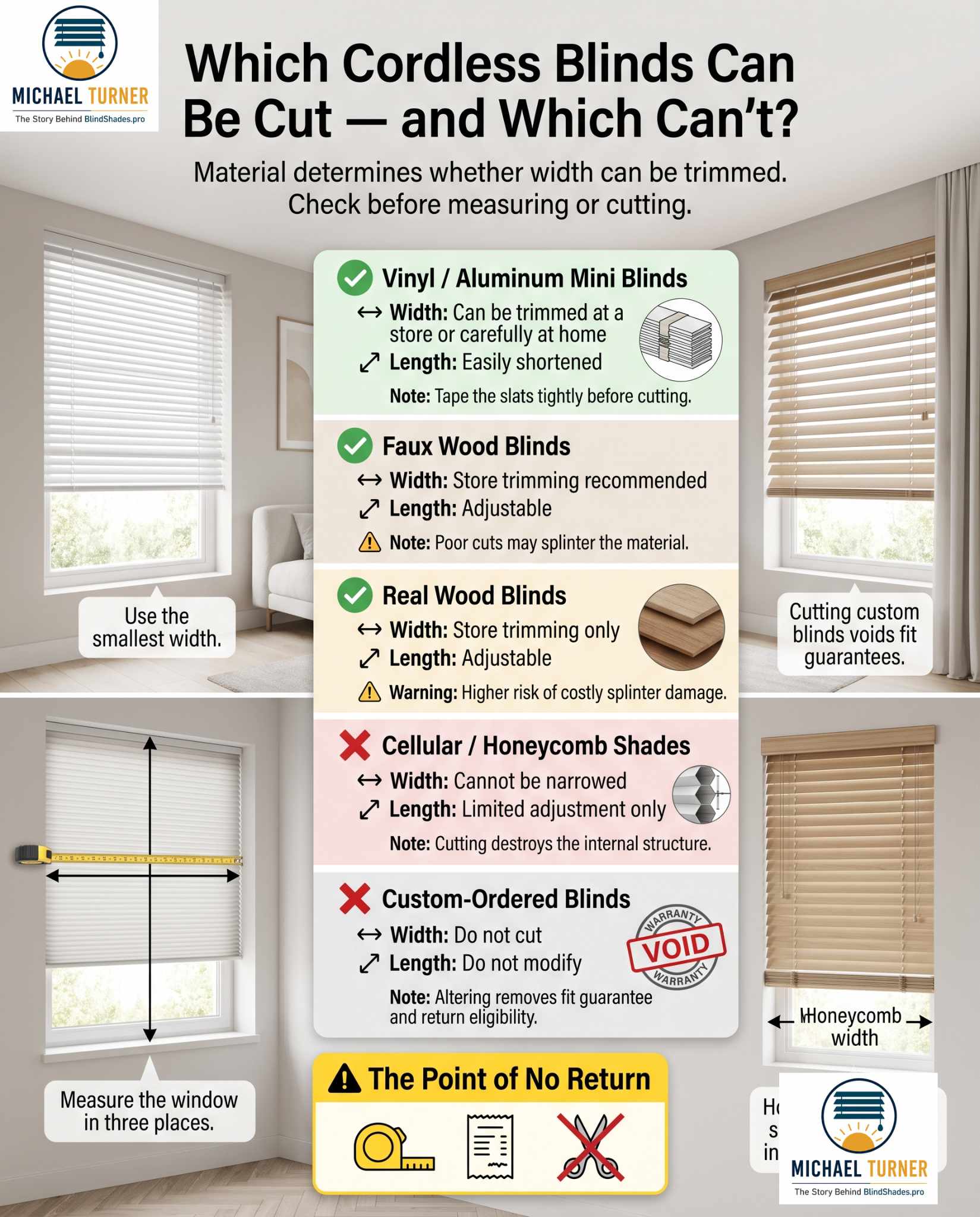
By Michael Turner — 30 years in window treatments
Yes, you can cut cordless blinds down to size — but width and length are two completely different jobs with opposite answers, and mixing them up is how people ruin a blind. Reducing the width means cutting the headrail, the bottom rail and every single slat, and the internal spring mechanism makes that a poor at-home project — it belongs at a store counter, where a commercial cutting machine does it free in minutes. Shortening the length is a genuine home job with basic tools. Two things almost nobody mentions before you pick up a saw: cellular and honeycomb shades cannot be narrowed at all, and the moment a blind is cut it stops being returnable.
Key Takeaways
- Width belongs at the counter, length belongs at home. That split answers most of this question.
- Big-box stores cut width free, usually while you wait — but they will not shorten the drop for you.
- Cellular and honeycomb shades cannot be cut narrower. The cells and internal cords do not survive it.
- Cutting ends your refund. A cut or custom blind is non-returnable at essentially every retailer.
- Most “too long” blinds need no cutting at all — rerouting or remounting usually solves it.
⭐ Quick Answer — Can You Cut Cordless Blinds Down to Size?
Yes, you can cut cordless blinds to size — but width and length are two different jobs with opposite answers, and knowing which one you need settles almost everything:
- Width belongs at the counter. Trimming width means cutting the headrail, bottom rail and every slat square, and Blindsgalore notes the internal spring mechanism makes that unsafe to attempt at home. Large retailers machine-cut stock blinds free, usually while you wait.
- Length belongs at home. Extend the blind flat, pull the bottom-rail plugs to release the lift cords, remove surplus slats, then re-knot and refit — a procedure documented step by step by iFixit.
- Check the material first. Vinyl and aluminium take both cuts, faux wood splinters if cut badly, and cellular or honeycomb shades cannot be narrowed at all — see cellular and honeycomb shades.
- Secure the wire before pulling plugs. Tape and a pencil hold the tensioned wire, or the spring fires it back into the headrail — and Levolor’s own instructions say to trim ladder cords only after the length is confirmed.
- The cut ends your refund. A cut or custom blind is non-returnable, so measure in three places and use the narrowest figure — the counter-versus-online decision is in where to buy cordless blinds, and the mini-blind walkthrough is in how to shorten mini blinds.
Can You Cut Cordless Blinds Down to Size?
The Two Cuts (Width at the Counter · Length at Home)
Two separate operations hide inside this question, and they do not belong in the same place. Deciding which you need takes ten seconds and prevents most mistakes in this category.
| The cut | Where it belongs | Tools | Reversible? |
|---|---|---|---|
| Width (too wide for the opening) | Store counter, commercial cutter | Industrial blind saw; at home, a fine-tooth hacksaw or mitre saw | No |
| Length (too long, stacks on the sill) | Home, on a flat surface | Screwdriver or pliers, scissors | Mostly — slats can be reinserted |
Width. Narrowing a blind means shortening the headrail, bottom rail and every slat by the same amount, keeping all three square. Industry guidance is blunt: Blindsgalore and other retailers note that internal cordless spring mechanisms make width-cutting very difficult to do safely at home, because the mechanism sits inside the rail you are cutting. That is why the store service exists — Home Depot, Lowe’s and most large retailers keep a purpose-built cutting machine at the blinds desk and trim stock blinds free, usually in minutes.
Length. Shortening the drop is straightforward. Extend the blind fully on a protected flat surface, pull the plugs from the underside of the bottom rail to release the internal lift cords, slide out or trim the surplus slats, then move the rail up to the new last slat, re-knot the cords and refit the plugs.
⭐ The rule the field never states plainly: the store will cut your width, but it will not shorten your length. Different services, different places — and knowing which you need decides whether this is an errand or an afternoon. The counter with the cutter is one of the strongest reasons to shop in person, compared in where to buy cordless blinds.
Which Cordless Blinds Can Be Cut — and Which Can’t?
Material decides this, and one whole category is excluded. Check yours before measuring anything.
| Material | Width | Length | Watch for |
|---|---|---|---|
| Vinyl / aluminium mini | ✔ At counter, or carefully at home | ✔ Easy | Tape the stack tight before any cut |
| Faux wood | ✔ At counter | ✔ | ⚠️ Splinters when cut badly — counter service only |
| Real wood | ✔ At counter | ✔ | Same splinter risk, worse cost of error |
| Cellular / honeycomb | ✖ Cannot be narrowed | Limited | Cell structure and internal cords do not survive it |
| Custom-ordered blinds | ✖ | ✖ | Cutting voids the fit guarantee entirely |
⭐ The point of no return. Here is the fact that ought to lead every guide on this subject and leads none of them: a cut blind is not returnable. Cut and custom coverings sit outside standard return policies because they have no resale value, and cutting a custom order also destroys the remake or fit guarantee that came with it. So measure the opening in three places and use the narrowest figure, because openings are rarely square — the refund mechanics are set out in where to buy cordless blinds.
If a stock size would have fitted with a store trim, buying custom and then cutting it is the most expensive route to the same window; the tier arithmetic is in what cordless blinds cost. Honeycomb owners should treat width as fixed and order correctly first time, which cellular and honeycomb shades covers in full.
How Do You Shorten Cordless Blinds at Home?
Work in order of reversibility — try what you can undo before what you cannot. That ordering is the difference between a tidy result and a bin.
| Step | What it does | Reversible? |
|---|---|---|
| 1. Reroute or re-knot only | Re-ties the lift cords higher without removing anything | ✔ Fully |
| 2. Remove surplus slats | Slides slats out from the bottom, rail moves up | ✔ Slats can go back |
| 3. Trim the ladder cords | Cuts the excess cord and eyelets once length is settled | ✖ |
| 4. Saw rails and slats | The width job — counter service strongly preferred | ✖ |
Blindsgalore’s own first rule: never cut cords unless absolutely necessary, because most shortening projects need rerouting rather than cutting. Start at step one and stop as soon as the blind fits.
Three specifics carry this job, from the people who wrote the instructions. Levolor’s own cordless wood blind shortening sheet, published through Lowe’s, has you cut the metal eyelets from the ladder cords and trim all ladder cords about four inches — after double-checking length, not before. Factory Direct Blinds recommends leaving two to three inches of slack rather than cutting flush. And one widely shared home-project video adds the move that prevents the worst surprise: secure the tensioned wire with tape and a pencil before you pull the plugs, or the spring fires it back into the headrail. If it escapes, why cordless blinds won’t go up or down has the diagnosis, because a released spring behaves like a broken one.
Mini blinds are the most commonly shortened product here and have their own step-by-step in how to shorten mini blinds; if slats are already bent, fix that first with our bent-slat repair guide.
How Do You Shorten Blinds Without Cutting Them?
Often you can, and it is usually the better answer. If the blind is only slightly too long, mount the brackets higher so the extra drop sits above the opening rather than pooling on the sill; on an outside mount, raising the headrail two inches can absorb the whole excess. On many cordless blinds the lift cords can be re-knotted higher inside the bottom rail, taking up length with no cut at all. And a small surplus that stacks neatly at the sill is cosmetic rather than a fault — ordering slightly long is the recommended way to buy, because a rail resting flat on the sill sits better than one hanging short of it. That matters most on wide openings, where weight and squareness already work against you; sizing those is covered in cordless blinds for large windows.
Avoid These Mistakes
- Cutting faux wood width at home. It splinters, and the counter does it free on a proper machine.
- Cutting before measuring three times. Use the narrowest of three measurements; openings are rarely square.
- Cutting a custom order. It voids the fit guarantee and the refund in one move.
- Pulling the bottom-rail plugs without securing the wire. Tape and a pencil first, or the spring takes the cord back inside.
- Trimming cords before length is confirmed. It is the one irreversible step in the length job — do it last.
- Assuming cellular shades work like slatted blinds. They cannot be narrowed — order the right width.
Who Should Cut, and Who Should Not?
Cut it yourself if: ✔ You need length removed only, on vinyl, aluminium or faux wood, with a flat protected surface to work on ✖ Not if the blind is cellular, honeycomb, or a custom order under guarantee
Use the store counter if: ✔ You need width removed, or the blind is faux wood or real wood ✖ Not if the blind was bought elsewhere and the retailer will not machine it
Do neither if: ✔ The blind is only slightly long — remount higher or re-knot the cords ✖ Not if the excess is enough to foul the mechanism
The Bottom Line
You can cut cordless blinds down to size, but treat it as two jobs: width at a store counter on a commercial machine, length at home with a screwdriver and scissors. Check the material first, because cellular and honeycomb cannot be narrowed and custom orders lose their guarantee the moment they are altered. Work in order of reversibility, secure the tensioned wire before pulling any plugs, and remember the cut is where your refund ends — measure three times and use the narrowest number.
Buying rather than modifying? Compare current options in our complete cordless blinds and shades guide, and see the best cordless mini blinds if stock sizes will do the job.
FAQ
Can you cut cordless blinds to width at home? You can on simple vinyl or aluminium blinds by taping the stack tightly, marking a cut line and using a fine-tooth hacksaw. It is not advisable on faux wood or any blind with a spring mechanism in the rail — to cut Levolor blinds to width, or any branded faux wood, use the store machine instead.
How do you shorten Levolor cordless blinds? Levolor’s own shortening instructions, published through Lowe’s, have you extend the blind, release the bottom rail, remove surplus slats, cut the metal eyelets from the ladder cords, then trim all ladder cords about four inches once length is double-checked. Confirm length before any cord is cut.
How do you cut blinds that are too wide? Take them to a blinds counter at a large hardware retailer, which trims headrail, bottom rail and slats together on a purpose-built machine, usually free and same-day on stock products. At home the job means cutting all three square, which is difficult with a spring mechanism inside the rail.
Can cellular or honeycomb shades be cut down? No, not in width. The honeycomb cell structure and the internal cords running through it do not survive being trimmed, and there is no rail-and-slat assembly to cut square. Order the correct width, or choose a slatted blind if you need the option to trim later.
Can you return blinds after they have been cut? Generally no. Cut and custom window coverings sit outside standard return policies because they have no resale value, and cutting a custom order also voids any fit guarantee that came with it. That makes the cut the point where your refund ends.

Related Guides
- Best Cordless Blinds & Shades — the complete buying guide
- Where to Buy Cordless Blinds — the counter with the cutter
- What Do Cordless Blinds Cost? — stock versus custom arithmetic
- How to Shorten Mini Blinds — the step-by-step for minis
- Best Cordless Mini Blinds — stock sizes worth buying
- Best Mini Blinds — the wider mini category
- Best Faux Wood Blinds — the material most often trimmed
- How Do Cordless Blinds Work? — the mechanism you are cutting around
