Blackout Blinds with Side Tracks: Do They Actually Seal?

Authored By Michael Turner -30 Years Home Improvement Expertise | Updated 2026 | BlindShades.pro
Updated on July 29, 2026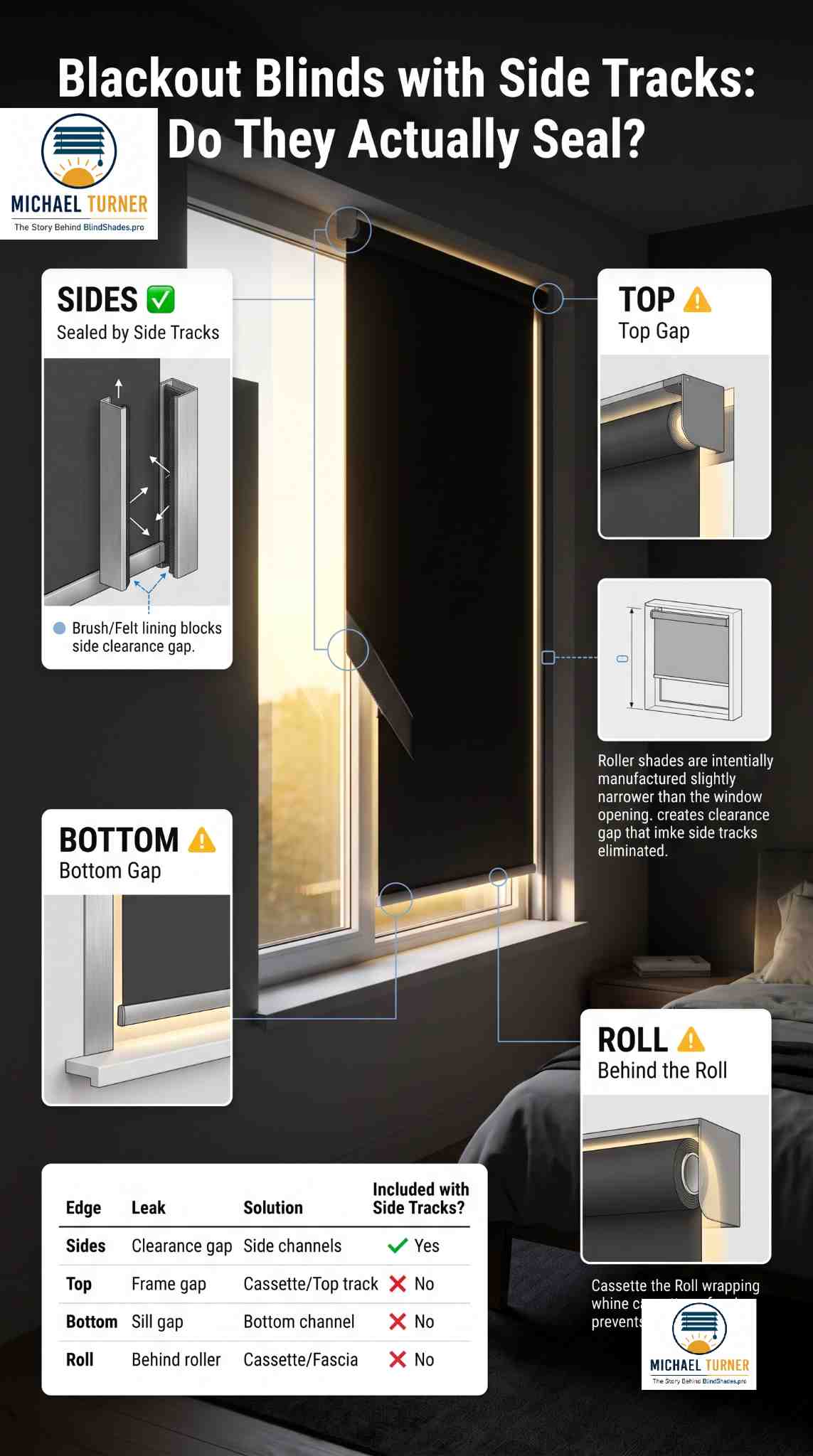
By Michael Turner — 30 years in window treatments
Blackout blinds with side tracks seal one of four leak paths extremely well, and the other three not at all. A window leaks at the sides, the top, the bottom and — on a roller — around the roll. Tracks are built for the sides and on that edge they work: the fabric runs inside a channel and the gap closes. A room that still glows afterwards has not been sold a bad product; it has been sold two of the four parts it needed. And there is a question nobody in this field raises: whether the window still opens.
Key Takeaways
- Four edges leak, tracks fix one. Channels solve the sides; the top, bottom and roller gap need separate parts.
- The gap exists on purpose. Shades are cut narrower than the opening so the fabric never rubs — the leak is a design decision, not a fault.
- Every performance figure in circulation is a seller’s own. No independent test of side tracks exists.
- Check the gap before you buy. Tracks need a specific clearance to fit; a shade already tight to the frame cannot take them.
- Tracks pin the shade to the frame — which matters on tilt-in windows, bedroom escape windows, and any shade you planned to take down and clean.
⭐ Quick Answer — Do Blackout Blinds with Side Tracks Actually Seal?
On the sides, yes — blackout blinds with side tracks close the biggest single leak in most rooms, but a window has four edges and channels address one:
- The fabric was never the problem. SleepyTime Tracks, which manufactures side channels, states it against its own category: blackout fabric stops around 99 percent of sunlight, and what fails is everything around it.
- The gap is deliberate. Shades are cut narrower than the opening so the fabric never drags, and Canisteo Blinds puts the bracket clearance at roughly three-quarters of an inch. That clearance is the light path a channel closes.
- ⚠ Sides are one edge of four. The head, the sill and the roll each need their own seal, and those parts are sold separately — the cassette side of it is in what a cassette headrail is.
- Measure before you order. Channels need a definite clearance to seat, so a tightly fitted shade may have no room for one — check it against measuring windows for blackout blinds.
- ⚠ Every figure in circulation belongs to a seller. Blinds Chalet supplies the field’s one honest line — no treatment guarantees complete blackout in every installation — and the ranked picks sit in our Blackout Blinds & Shades guide.
Do Blackout Blinds with Side Tracks Actually Seal?
The Four Edges (Sides · Top · Bottom · Roll)
Yes on the sides — and understanding why makes the rest of the purchase obvious.
Blackout fabric is not the weak point. SleepyTime Tracks, which manufactures side channels, states the case against its own category plainly: blackout blinds rarely fail because of the fabric, which typically stops around 99 percent of incoming sunlight; the problem is everything around it. That is why a heavier fabric never fixes a glowing room.
The gap is deliberate. Shades are cut narrower than the window opening so the fabric never drags on the frame during operation — a manufacturing decision that both The Color House and SmartWings state openly in their own product copy. Canisteo Blinds puts a number on it: mounting brackets typically hold the fabric about three-quarters of an inch clear of the casing. That clearance is the light path.
A channel closes it: the fabric edge runs inside a U or L profile lined with brushes or felt, leaving no straight line from glass to room. Canisteo notes the lining does a second job — it stops the fabric clattering against metal when the heating cycles.
So the sides are solved. The trouble is arithmetic.
| Edge | What leaks there | What actually fixes it | Sold with side tracks? |
|---|---|---|---|
| Sides | The clearance gap left so the fabric can move | Side channels, L or U profile, brush or felt lined | Yes — this is the product |
| Top | The space between the top of the fabric and the frame or bracket | A top track, or a cassette headbox enclosing the roll | No — sold separately |
| Bottom | The sill gap under the bottom rail | A sill channel, or ordering the shade long and letting it rest | No |
| Roll | Light passing behind the fabric as it wraps the tube | A cassette or fascia — see what a cassette headrail is | No |
Read that table and the honest answer appears. Side tracks seal the sides; total darkness needs the whole perimeter, and the perimeter is four parts. A photograph of a fully sealed window usually shows channels plus a cassette plus a sealed bottom rail — a complete assembly illustrated on a page selling one part of it.
What Kind of Side Track Do You Need?
Three profiles, and the mount decides which.
Choosing the wrong profile is the commonest reason tracks arrive and do not fit.
| Type | How it works | Best for | Watch for |
|---|---|---|---|
| L-track | An angle fixed inside the frame; the fabric rests against it | Inside mounts, and the renter-friendly option in removable magnetic form | Blocks light without enclosing the fabric — slightly less absolute than a channel |
| U-channel | Encloses the fabric edge on both faces | Roller shades, and the closest thing to a true seal | Needs the most clearance; hardest to retrofit to a tight shade |
| Top track | A strip sealing the gap above the shade | Any shade where light appears at the head | Sold as a separate part |
| Extension | Widens the reach of a channel | Wide gaps, shallow frames, outside mounts | Vendor-specific — check compatibility before ordering |
The Color House notes L-tracks come in permanent and removable forms, which makes them one of the few genuine blackout upgrades available to renters — see also no-drill blinds and temporary shades.
Fixing varies: SmartWings supplies powder-coated aluminium channels that mount with screws or adhesive, and most tracks ship over-length to be trimmed on site.
What Do the Blocking Claims Actually Mean?
Every number in circulation belongs to a company selling the product.
This is the one thing a buyer cannot easily see. Writing on this topic comes from retailers, track manufacturers and installer blogs — and nowhere else. There is no standards-body figure for side-track performance, no independent laboratory comparison, and no published test protocol. Every quantity below is a marketing claim, attributed as such.
| Claim | Who makes it | How to read it |
|---|---|---|
| Blocks up to 97 percent of light leaks | SleepyTime Tracks, a track manufacturer | “Up to”, against an unstated baseline and an unstated install |
| Fabric alone stops about 99 percent of sunlight | SleepyTime Tracks | Consistent with the category, and an argument for fixing the perimeter rather than the fabric |
| About three-quarters of an inch of bracket clearance | Canisteo Blinds, a retailer | The most useful number in the field — it is what you are closing |
| No treatment guarantees 100 percent blackout in every installation | Blinds Chalet, a retailer | ⚠️ The most honest line published by anyone selling these, and the one to trust |
Almost nobody writing about side tracks discloses that the industry’s most careful statement is a disclaimer. Where a figure is decisive to your purchase, read it as a seller’s specification — and note that a room called “pitch dark” by the person who fitted it has not been measured.
Will Side Tracks Even Fit Your Window?
Tracks need clearance to sit in, and a well-fitted shade may not have any.
This is the check the field skips, and the one that produces returns. A channel occupies space beside the fabric. If your shade was measured tightly — which is what a good installer does — that space may not exist.
The published requirements are specific. SleepyTime Tracks states that its channel profile needs only about three-sixteenths of an inch of side gap, and that inside-mount installations need roughly a pencil-width gap to work with. Read that in reverse: below that clearance, tracks do not fit, and the answer is a differently sized shade, not an accessory.
Three checks before ordering. Measure the gap at top, middle and bottom, because frames are rarely square and the tightest point governs. Identify your mount — most channels are built for inside mounts, and extensions exist because outside mounts are harder. Check frame depth, since a shallow reveal leaves nowhere for the profile to sit. If you are re-measuring anyway, measuring windows for blackout blinds covers the mount decision properly.
The Window Still Has to Work Afterwards
A side track pins the shade to the frame — and that has consequences nobody selling tracks will raise with you.
Everything above is available, in pieces, from companies with something to sell. What follows is not published anywhere in the field, and it decides whether tracks suit a specific window rather than windows in general.
Escape windows. A bedroom window may be your way out in a fire, and a shade fixed into channels down both sides is harder to clear in the dark and in a hurry than one you can shove aside. Removable magnetic L-tracks answer this where permanent channels do not — and anyone specifying blackout for a room that doubles as an exit should read window treatments for egress windows first.
Tilt-in windows. Many modern windows tilt inward for cleaning, and a fixed channel can obstruct the sash. The tell is in the industry’s own marketing: SleepyTime advertises channels that snap off in seconds to preserve access for cleaning and tilt-in windows — quietly conceding that fixed systems interfere with both.
Cleaning the shade. A shade held in channels is no longer a shade you lift out. Dust settles in the profile and the fabric can no longer be taken down and laid flat — which collides with blackout fabric’s own care needs, since the coating that makes it blackout is the layer ordinary cleaning destroys. The method is in how to clean blackout blinds.
Damp rooms. A channel screwed to a bathroom frame holds moisture against the joint — see preventing mould on bathroom blinds before adding hardware to a wet reveal.
None of this rules tracks out. It rules out permanent tracks on particular windows — a decision worth making deliberately rather than discovering afterwards.
Retrofit or Buy a Sealed System?
The answer turns on how much of the perimeter you need.
| Retrofit tracks | Integrated sealed system | |
|---|---|---|
| What you get | The side edges closed | Channels, cassette and bottom seal designed together |
| Cost | Far lower — an accessory, not a replacement | A complete shade, priced accordingly |
| Fit | Depends on existing clearance | Measured as one assembly |
| Best when | Sides are the visible leak and the shade is good | Light appears at head and sill too, or the room must be genuinely dark |
The test is where the glow is. Stand in the room with the shade down in daylight and find the light. Sides only, and tracks are an inexpensive fix to a good shade. Light at the head too, and you are patching a shade that was never built for the job — at which point true blackout from cellular shades is the better route.
Avoid These Mistakes
- Buying tracks before finding the leak. Diagnose first — why light comes through the sides of blackout blinds works through every leak path, and the answer is not always the sides.
- Assuming tracks cover the top. They do not. Head light needs a top track or a cassette, bought separately.
- Ordering without measuring the gap. Below the minimum clearance the channel will not seat — and a tightly measured shade has less room than a sloppy one.
- Fitting permanent channels to a tilt-in or escape window without deciding that consciously.
- Treating a vendor percentage as a specification. No independent test exists.
Who Should Fit Side Tracks — and Who Shouldn’t?
✔ Worth fitting if: the visible leak is down the sides and the shade is otherwise good · the room is a bedroom, nursery or media room where darkness has a job · you rent and need the removable magnetic version · your shade is inside-mounted with measurable clearance.
✖ Not worth it if: light comes from head and sill too, where a properly sealed shade costs less than three accessories · the window tilts in for cleaning · it is a bedroom escape route and you would fit permanent channels · the shade sits too tight for a channel to seat · the window is in a wet room.
The Bottom Line
Do blackout blinds with side tracks actually seal? On the sides, yes — convincingly, and cheaply on a shade otherwise doing its job. As a route to total darkness, only partly: a window leaks at four edges and channels address one. Find the light before you buy, measure the clearance you have, and decide honestly whether that window needs to open, tilt or come down for cleaning. Do those three things and you get the result you were promised. Order on the strength of a percentage and you get a darker room with a residual glow at the head.
If the leak turns out to be the shade rather than its edges, the ranked picks are in our complete Blackout Blinds & Shades buying guide — and blackout versus room-darkening settles which one you actually bought.
FAQ
Do blackout blinds with side tracks block all light? No, and the most careful sellers say so — Blinds Chalet states that no window treatment guarantees complete blackout in every installation. Channels close the side gaps, usually the largest leak, but the head, the sill and the roll each need their own seal.
How do you stop light coming through the side of roller blinds? Fit a channel that encloses the fabric edge, or an L-track the fabric rests against. Both close the clearance gap that lets the shade move freely. Measure that gap first: a tightly fitted shade may leave too little room for a profile to seat.
Can you add side tracks to blinds you already own? Usually yes, and that is the main appeal — it upgrades a working shade rather than replacing it. The limits are clearance and mount type. Most channels are built for inside mounts, and outside mounts generally need extension parts.
Do side tracks work with outside mount shades? Less easily. The field is built around inside mounts, and vendors sell extensions specifically because outside mounts are harder. Check compatibility before ordering rather than assuming — an extension made for one maker’s channel will not necessarily fit another’s.
Are side tracks worth it for a nursery? Often, because a nursery is exactly where residual light matters. Choose removable magnetic tracks over permanent channels: the window may serve as an escape route, and hardware that comes off in seconds keeps that option open.
Do side tracks make blinds harder to clean? Yes. A shade held in channels cannot be lifted out and laid flat, and dust collects in the profile. Snap-off designs exist for this reason. Decide how you will maintain the shade before fixing it permanently in place.
Related Guides
- Best Blackout Blinds & Shades — the complete buying guide
- Why Is Light Coming Through the Sides of My Blackout Blinds? — diagnose the leak first
- How to Get True Blackout from Cellular Shades — sealing a honeycomb shade
- Why Do My Cellular Shades Have a Gap at the Top? — the head-light problem
- What Is a Cassette Headrail? — the part that seals the roll
- How to Measure Windows for Blackout Blinds — inside mount vs outside mount
- Window Treatments for Egress Windows — when the window is also the exit
