How to Clean Blackout Blinds Without Wrecking the Coating

Authored By Michael Turner -30 Years Home Improvement Expertise | Updated 2026 | BlindShades.pro
Updated on August 1, 2026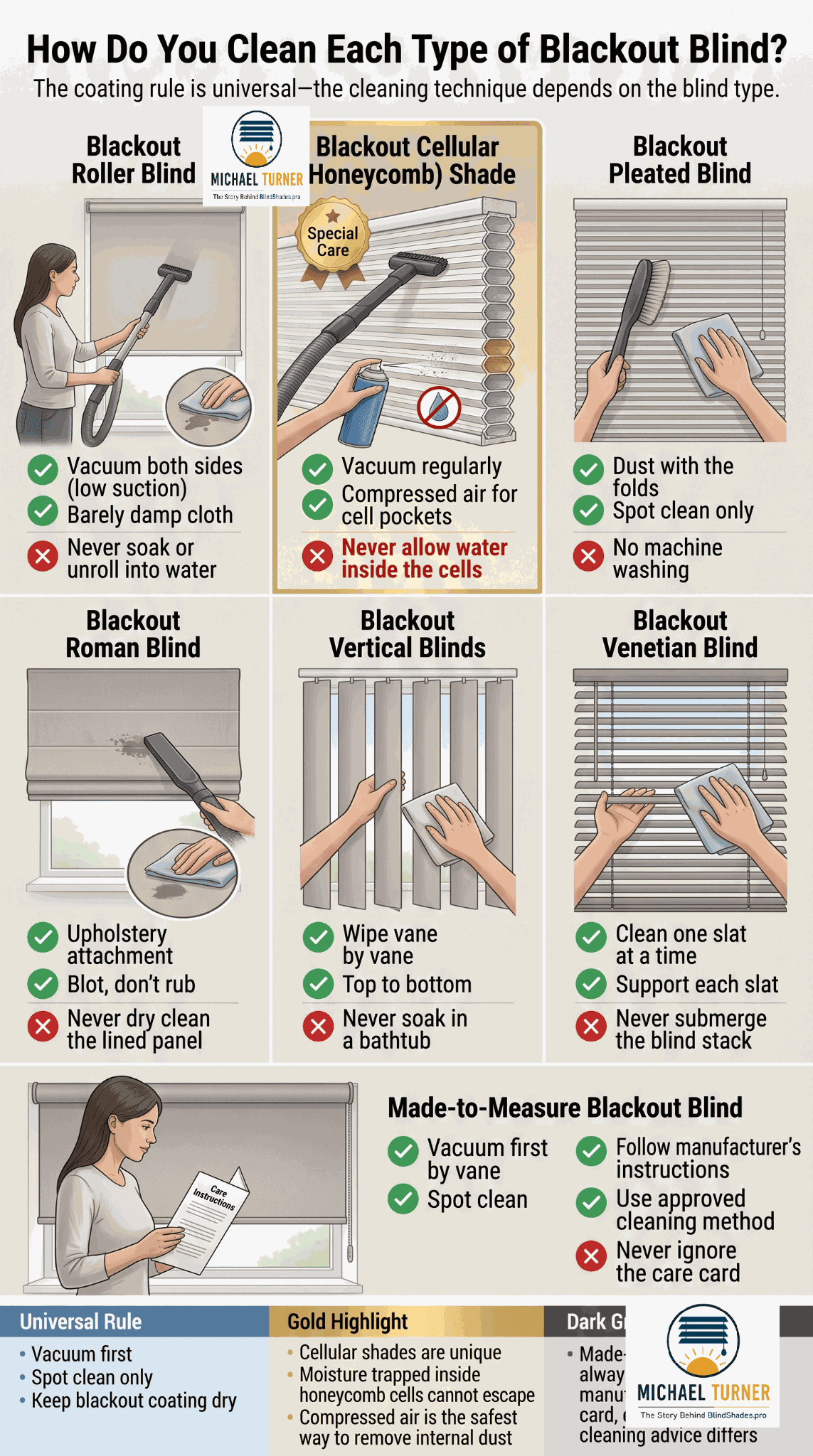
By Michael Turner — 30 years in window treatments
Dry first, damp only if you must, never wet — because what makes a blackout blind blackout is a coating on the back, and almost every popular cleaning method removes it. A vacuum and a dry cloth handle most of what these blinds need, and a barely damp cloth handles the rest. What ruins them is the advice people find first: soak it in the bath, scrub it with baking soda, wipe it with vinegar. All three are good methods for an ordinary blind, and all three attack the layer you paid for while leaving the fabric looking identical.

Key Takeaways
- The coating is the product. A blackout blind without its backing is a room-darkening blind that cost more.
- ⚠️ Never soak, never submerge. This is the single commonest way owners destroy a blackout blind, and it is also the most upvoted advice online.
- Vinegar and baking soda are both wrong here. One is an acid, the other an abrasive, and coatings survive neither.
- Damage is invisible until it is not. The fabric looks fine; you find out at the next bright morning.
- Dry it fully lowered. Rolling a damp blind traps moisture against the coating and grows mould inside the roll.
⭐ Quick Answer — How to Clean Blackout Blinds Without Wrecking the Coating
Dry first, damp only if you must, never wet — how to clean blackout blinds comes down to protecting the coating on the back:
- Vacuum both faces on low suction. The New York Times cleaning guidance is blunt about it: dusting every few weeks, or gently vacuuming with a brush attachment, is the best preventative there is.
- Spot-clean marks with barely damp cloth. Distinctive Window Treatment Plus gives the only blackout-specific method in circulation — lukewarm water, a little mild soap, air dry, and do not immerse.
- ⚠ Never soak it, whatever you read. The most upvoted advice online is to put blinds in the bath and scrub. That is correct for uncoated blinds and it destroys a blackout one.
- Vinegar and baking soda are both wrong here. One is an acid and one an abrasive. The Spruce recommends a vacuum and upholstery brush instead, which is the safe route.
- Dry it fully lowered before rolling up. Trapped moisture grows mould against the coating. If it is beyond spot cleaning it is beyond cleaning — see why blackout blinds fail, and the format guides for roller shades and pleated blinds.
✉ Ask Michael a Question — installation, buying advice or repair
Straight to Michael Turner — 30 years in window treatments.
How to Clean Blackout Blinds Without Damaging the Backing
DRY, DAMP, NEVER WET — three escalating levels and one hard stop. Almost everything goes wrong at the third.
Start with what you are cleaning. A blackout blind is ordinary fabric with a light-blocking layer bonded to the back — an acrylic or foam coating, or a laminated film. That layer stops the light, and it is mechanically and chemically far more fragile than the cloth carrying it. Every rule below follows from that.
| What people use | Why they reach for it | What it does to a blackout coating | Verdict |
|---|---|---|---|
| Vacuum, soft brush, low suction | Standard blind advice | Nothing — it lifts dust without touching the backing | ⭐ Always safe, do this first |
| Dry microfiber cloth | Standard blind advice | Nothing, provided you support the fabric | ⭐ Safe |
| One drop of mild soap, barely damp cloth | The recommended spot method | Minimal if the cloth is wrung out properly | Safe with care |
| ⚠️ Soaking or submerging | The most popular advice online | Water penetrates and lifts the coating from the cloth | ⛔ Never |
| ⚠️ Vinegar | Trusted household degreaser | Acetic acid attacks acrylic and foam backings | ⛔ Never |
| ⚠️ Baking soda | Trusted gentle scrub | An abrasive; it scours the coating and lodges in it | ⛔ Never |
| Steam cleaning | Seems gentler than scrubbing | Heat plus moisture is the worst combination for a bonded layer | ⛔ Never |
| Dry cleaning | Sounds professional and safe | Solvents dissolve exactly the polymers a coating is made from | ⛔ Never |
| Machine washing | It is only fabric, after all | Agitation plus water plus heat removes the backing entirely | ⛔ Never |
Read the bottom six rows together and a pattern appears that nobody states plainly: every method that feels thorough destroys the product, and every method that feels inadequate is the correct one. That is uncomfortable to hear when a blind is visibly grubby, which is why so many people ignore it.
The rest of the industry’s advice is sound as far as it goes: spot-clean with lukewarm water and a little mild soap, air dry, do not immerse. The most useful line in the field is blunter — dusting every few weeks, or gently vacuuming with a brush attachment when things look dingy, is the best preventative there is. Prevention does almost all the work.
Why Is the Most Popular Advice Also the Worst?
Because soaking a blind in the bath genuinely works on every other kind of blind, and it is the top answer wherever this gets asked.
The gap between what is recommended and what is correct is wider here than anywhere else in window treatments.
Ask a large cleaning community how to deal with grimy blinds and the most upvoted reply — on a thread running past two hundred answers — is to fill the bath with warm water and washing-up liquid and scrub gently. On a separate cleaning group the top answer is the same. Neither is careless: for aluminium venetians, vinyl verticals or a plastic roller, it is genuinely the fastest method there is.
It is also precisely what every manufacturer says never to do with a blackout blind, and the reason is not caution. Water works between the coating and the cloth and the bond fails from the inside; scrubbing accelerates it. What you get back looks completely normal, hangs perfectly and no longer blocks light — and because the damage is invisible until the next bright morning, most people never connect the two.
⚠️ So the practical rule is that generic blind-cleaning advice does not transfer. Almost everything written about cleaning blinds is written about uncoated ones, and the two most authoritative-looking sources on any results page will often be about fabric blinds or window coverings in general rather than blackout specifically. If a method does not mention the backing, it was not written for your blind.
How Do You Clean Each Type of Blackout Blind?
The coating rule is universal; the technique is not, and cellular is the format that genuinely needs something different.
| Format | Routine method | Spot method | ⛔ Never |
|---|---|---|---|
| Blackout roller | Lower fully, vacuum both faces on low suction | Barely damp cloth, blot downward | Unroll into water; see cleaning roller shades |
| Blackout cellular | ⭐ Vacuum, then compressed air into the cell pockets | Surface only; nothing enters a cell | Anything wet — water in a cell never leaves |
| Blackout pleated | Dust along the pleats, not across them | Barely damp, along the fold | Machine washing; see cleaning pleated blinds |
| Blackout roman | Vacuum with upholstery attachment | Blot only, never rub the lining | Dry cleaning the lined panel |
| Blackout vertical | Wipe vane by vane, supported | Barely damp cloth, top to bottom | Bath soaking, however tempting |
| Blackout venetian | Support each slat while wiping | Barely damp, one slat at a time | Submerging the stack |
| Made to measure | Follow the maker’s card first | As the instructions state | Ignoring the care card you were given |
Two rows deserve expanding. Cellular is the awkward one: you cannot reach inside a cell or flush it out. The community answer beats the industry’s here — light regular dusting and vacuuming keeps them clean, and compressed air clears the cell pockets when loose dust settles inside. It is the only route into a sealed cell that does not involve moisture.
Made to measure is the other, because the care card that came with it overrides everything here. Coatings differ by maker, and the one document written about your blind is the one people throw away.
What If It Is Already Marked, Mouldy or Creased?
Some of it comes back and some of it never does — and knowing which is which saves you from making it worse.
Most people arrive at this question after the fact, either because a blind is past the point where dusting helps or because a previous cleaning attempt has already done damage.
| What you are looking at | Can it be recovered? | What to do |
|---|---|---|
| Surface dust and general dinginess | Yes, easily | Vacuum both faces; this is nearly always all it needed |
| A specific mark or splash | Usually | Barely damp blot, downward, then plain water to lift residue |
| ⚠️ Mould spots on the fabric | On the face sometimes, never inside a cell | Treat the cause — see damp and mould |
| Kitchen grease film | Sometimes | Degreasing a coating is risky; the method is in kitchen blind grease |
| Permanent creases from scrubbing | No | Creases in a coated fabric are mechanical damage and will not release |
| Patchy light after a wash | ⛔ No | The coating has lifted; the blind is now room darkening |
| Crushed or creased cells | Rarely | See crushed cellular cells before attempting anything |
The mould row matters more than it looks. Mould on a blind is almost never a blind problem — it is condensation, and cleaning the fabric without fixing the moisture just schedules the next occurrence. In bathrooms the answer is ventilation rather than a cleaning routine, as set out in preventing mould on bathroom blinds.
⚠️ If you have already washed a blackout blind and the room is no longer dark, nothing here brings it back — you now own a room-darkening blind. Whether that matters depends on the room, and what blackout blinds cost covers replacing it.
Avoid These Mistakes
- ⛔ Soaking it in the bath. The most popular advice online, and the fastest way to strip a coating that will never be replaced.
- ⚠️ Reaching for vinegar or baking soda. Both are excellent on ordinary blinds. One is an acid and one is an abrasive, and coatings survive neither.
- Scrubbing a mark. Pressure creases a coated fabric permanently, and the crease shows as a light line afterwards.
- Rolling it up damp. Moisture trapped in a roll grows mould against the coating, which is why full drying while lowered matters.
- Cleaning a mouldy blind without fixing the damp. You are treating a symptom on a schedule.
- Ignoring the care card. For made-to-measure, the maker’s own instructions outrank every general rule here — made-to-measure care covers what those cards usually say.
What Should You Do Now?
| Your situation | Do this | Not this |
|---|---|---|
| Routine maintenance, looks fine | Vacuum both faces every few weeks | Nothing damper, ever |
| Visibly dusty, no marks | Vacuum, then a dry microfiber pass | Wet cloth |
| One or two marks | Barely damp blot, plain-water follow-up | Any cleaning agent beyond mild soap |
| Grease from a kitchen window | Careful degrease, small area first | Kitchen sprays on a coating |
| Mould visible | Fix the ventilation, then treat the surface | Bleach |
| Beyond spot cleaning | Replace it | Steam, soak or machine |
| Already washed and now leaking light | Accept it or replace | Any further attempt at repair |
✔ Clean it yourself if the problem is dust, a mark or general dinginess — almost every case, needing nothing beyond a vacuum and a barely damp cloth.
✔ Replace it if a wash has already lifted the coating, or the fabric is stained through rather than on the surface. Neither is recoverable.
✖ Do not attempt any wet method on a cellular shade. Water that gets into a cell does not come out, and the shade will grow mould from the inside.
✖ Do not treat this as a general blinds question. For uncoated formats the usual methods are fine — see venetian blinds, vertical blinds, mini blinds and panel track blinds, all of which tolerate far more than a blackout fabric will.
The Bottom Line
Cleaning a blackout blind is mostly a matter of not doing very much. Vacuum both faces on low suction every few weeks, blot the occasional mark with a barely damp cloth, dry it fully lowered, and it will outlast its mechanism. The failures come from thoroughness: soaking, scrubbing, steaming, vinegar and baking soda all work beautifully on ordinary blinds and all remove the coating. If a blind is genuinely past spot cleaning, replacement is the honest answer — every method capable of shifting that much dirt takes the backing with it.
If yours has already stopped darkening the room, work out whether cleaning caused it or something else did — why blackout blinds fail separates the two, and the full range of alternatives sits in our blackout blinds and shades guide.
FAQ
Can you clean blackout shades?
Yes, but only dry or barely damp. Vacuum both faces with a soft brush attachment, and spot-clean marks with a cloth wrung out in lukewarm water and one drop of mild soap. Never immerse, machine wash or steam them, because all three remove the light-blocking backing.
How do you clean really dirty blinds without taking them down?
Lower the blind fully so the fabric is flat and work in place. Vacuum on low suction first, then blot marks with a barely damp cloth, working downward in short sections. Taking a blackout blind down is what leads people to soak it, which is the thing to avoid.
Can blackout blinds be dry cleaned?
No. Dry-cleaning solvents dissolve the same polymers that blackout coatings are made from, so the fabric comes back clean and no longer blocks any light at all. No reputable maker recommends it, and no cleaner can reverse it once it has been done.
Can you wash blackout roller blinds?
No, and this is the commonest mistake in the category. Washing, soaking or scrubbing lifts the coating from the cloth, and the damage is invisible until daylight shows through. Vacuum and spot-clean instead, and treat a heavily soiled blind as a replacement.
How do you clean blackout blinds with vinegar?
You do not. Vinegar is acetic acid and it attacks the acrylic and foam backings blackout fabrics use, even diluted. The same applies to baking soda, which is an abrasive. Both are sound on uncoated blinds and both are wrong here.
How do you get mould off a blackout blind?
Fix the moisture first, or it returns. On the face, blot gently with a barely damp cloth and dry completely while lowered. Inside a cellular shade, mould cannot be reached or removed, and the shade needs replacing rather than cleaning.
Related Guides
- Best Blackout Blinds & Shades — the parent guide
- Why Blackout Blinds Fail — if it stopped darkening the room
- How to Clean Roller Shades — the roller method in full
- How to Clean Pleated Blinds — pleated-specific care
- Are Pleated Shades Machine Washable? — the short answer, and why
- How to Clean Made-to-Measure Blinds — following the care card
- Best Blackout Cellular Shades — the format that cannot be washed at all
- How to Clean Kitchen Blinds With Grease — the hardest cleaning case
- Damp and Mould in Blinds — fixing the cause, not the symptom
