Can You Put Plantation Shutters in a Bay Window?

Authored By Michael Turner -30 Years Home Improvement Expertise | Updated 2026 | BlindShades.pro
Updated on June 3, 2026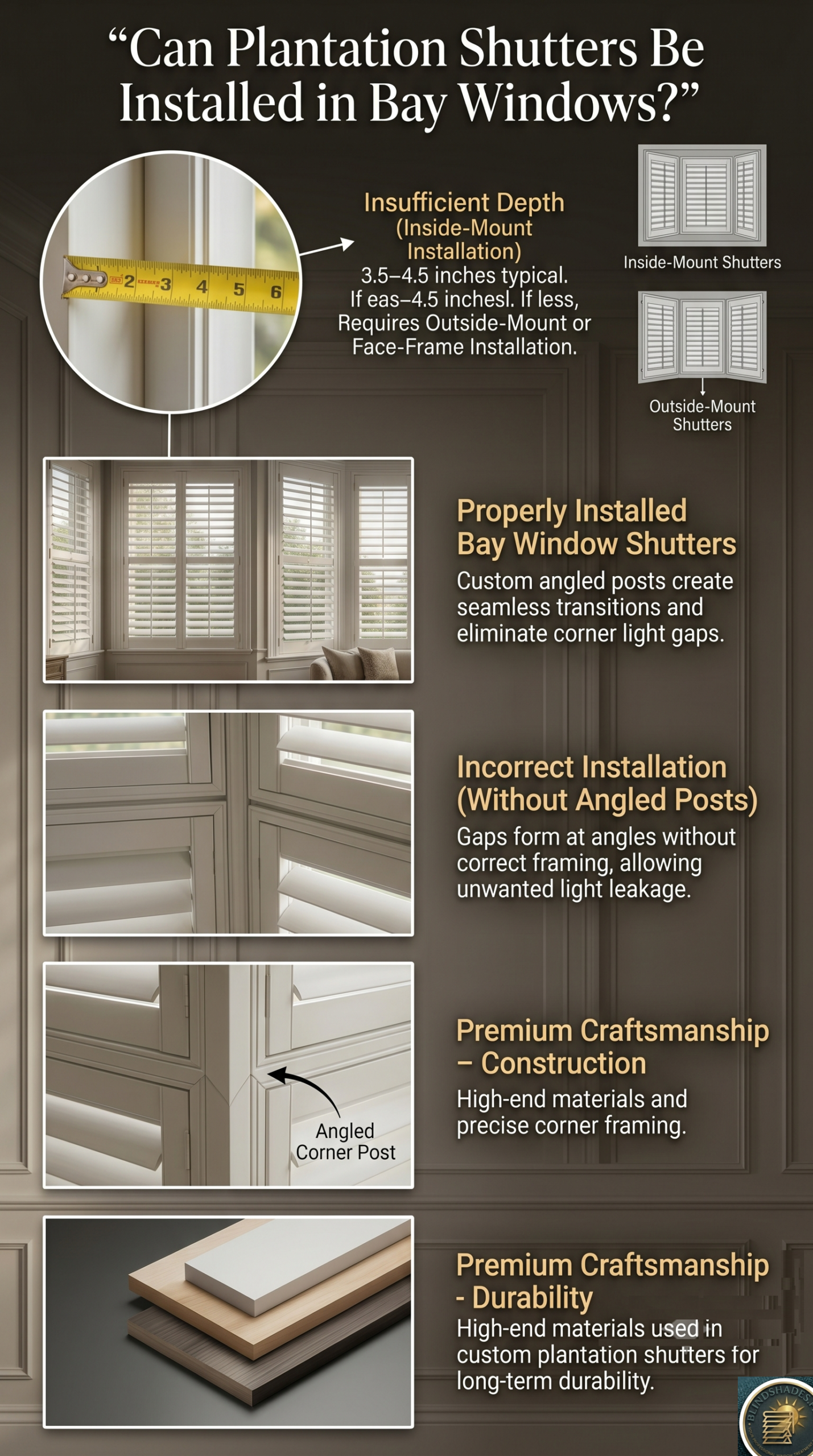
Key Takeaways:
- Before ordering plantation shutters for any bay window, measure the window recess depth; inside-mount plantation shutters require a minimum of 3.5 to 4.5 inches of recess depth; most residential bay window frames in American construction are only 2.5 to 3.5 inches deep; the majority of bay windows cannot accommodate inside-mount shutters and will require outside or face-frame mount instead
- A bay window plantation shutter set requires angled posts at the corner junctions where adjacent shutter frames meet; without angled posts, the two adjacent frames produce a visible triangular light gap at every bay corner; with angled posts beveled to the exact bay angle, the frames meet flush; this is the specification detail that distinguishes a professional bay window shutter installation from a poor-fitting one
- The per-year cost calculation changes the plantation shutter worth-it decision significantly: bay window shutters at $800 to $2,500 over a 50-year lifespan cost approximately $16 to $50 per year; three bay window cellular shades at $112 to $358 each over 7 to 10 years cost approximately $34 to $153 per year; plantation shutters can be the lower per-year cost option despite the 3 to 4 times higher upfront price
- For bay windows with built-in window seats, specify rear-tilt (up-tilt) louvers rather than the standard front-tilt configuration; front-tilt louvers in the standard position direct the louver gap toward the seat occupant from the exterior view; rear-tilt louvers direct the gap toward the ceiling, providing privacy for anyone seated in the window seat
- For bay windows with window seats, also specify hinges on the bay-side (inner edge) of each shutter panel so that the shutter swings outward into the bay alcove rather than inward into the room; standard inward-swinging shutters will contact the window seat before the panel is fully open, preventing complete access to the window
⭐ Quick Answer — Can You Put Plantation Shutters in a Bay Window?
- Measure Recess Depth First — Most Bays Cannot Inside-Mount: Plantation shutters for a bay window can be installed, but the window recess depth determines the mounting method. Inside-mount shutters require a minimum of 3.5 to 4.5 inches of recess depth to accommodate the shutter frame, hinge mechanism, and louver swing clearance without the louvers touching the glass. Most residential bay window frames in American construction are only 2.5 to 3.5 inches deep — at or below the minimum for inside mount. The implication: most bay windows CANNOT have inside-mount plantation shutters and require outside or face-frame mount instead. All four mounting options: (1) Inside mount (L-frame in recess; 3.5–4.5″ required). (2) Face-frame mount (L-frame on trim face; no depth required; any bay window). (3) Z-frame mount (bridges uneven reveals; no depth required; older construction). (4) Track system (large floor-to-ceiling bays; horizontal slide; no swing clearance required)
- Angled Posts Required at Corner Junctions — The Detail That Separates Custom from Cobbled: The most important manufacturing specification when ordering bay window plantation shutters: explicitly request angled posts at the interior corners where adjacent shutter frames meet. Without angled posts, the two square-cut posts from adjacent panels produce a visible triangular light gap of approximately 1 to 2 inches at every bay corner — even with louvers fully closed. With angled posts beveled to the exact bay angle (22.5 degrees each for a 45-degree bay; 15 degrees each for a 30-degree bay), the adjacent frames meet flush with no gap. Made in Shade Hilton Head confirms: “use wedge-shaped shutters designed specifically for angled window sides; the wedges adapt to the unique dimensions.” Not all manufacturers include angled posts by default — confirm this is specified at order
- The Per-Year Cost Comparison — Shutters Can Beat Cellular Shades Long-Term: Plantation shutters for bay windows cost $800 to $2,500 per bay window (Classic Roller Shutters). At a 30 to 50-year lifespan, the per-year cost is approximately $16 to $83 per year. Three bay window cellular shades at $112 to $358 each total $336 to $1,074 per replacement cycle at a 7 to 10-year lifespan: approximately $34 to $153 per year for three shades. Counter-intuitive finding: a $1,500 plantation shutter set at $37.50 per year over 40 years costs LESS per year than three $250 cellular shades at $75 per year needing replacement every 10 years. The break-even point is approximately 15 to 20 years. For homeowners staying 15 or more years: shutters are the economically rational choice. For homeowners moving within 5 years: cellular shades are the lower total expenditure
- Window Seat Bay Specifications — Louver Tilt Direction and Hinge Orientation: Two specifications are required for plantation shutters in a bay window with a built-in window seat. (1) Rear-tilt (up-tilt) louvers: standard front-tilt louvers direct the louver gap downward toward an exterior observer at street level whose sightline passes directly through the gap to the window seat occupant; rear-tilt louvers direct the gap upward toward the ceiling, blocking this sightline and providing privacy for seated occupants. Sunburst confirms louvers can be redirected “out of your eyes if you have a seat or table by the window.” (2) Bay-side hinge orientation: standard inward-swinging shutters contact the window seat cushion before reaching fully open; specifying hinges on the bay-side (inner edge) of each panel allows the shutter to swing outward into the bay alcove, achieving full open position without contacting the seat
- Material Selection by Bay Position and the Bi-Fold Option: Plantation shutters for bay windows in different positions need different materials. Hardwood: best for dry north-facing interior bays in formal living rooms; avoid kitchen bays, bathroom bays, and south/west-facing bays with direct UV (risk of warping and yellowing). Faux wood (solid composite): check that the formulation includes a UV inhibitor before specifying for south/west-facing bays; formulations without UV inhibitor will yellow and fade. Polywood (extruded polymer): the universal correct specification for window seat bays, dining bays, kitchen bays, bathroom bays, and any south or west-facing bay; Sunburst confirms Polywood “patented insulating system blocks most temperature transfer” and cleans easily near food or moisture. The bi-fold option: two adjacent bay panels (e.g., center + side panel) can be hinged together as a bi-fold; both sections open simultaneously in one motion; requires side wall clearance of approximately one full panel width (18 to 30 inches) for the folded stack
- Best Sources: Comprehensive bay window shutter measurement guide, cost range, and four bay types → Classic Roller Shutters bay window guide · Polywood insulating system for window seat bays and hinge placement → Sunburst Shutters bay window guide · Inside vs outside mount depth comparison → Blinds.com bay window coverings
⚠️ The Four Bay Window Types and Their Shutter Implications: Plantation shutters for bay windows are specified differently by bay type. Canted bay (most common): three panels with side panels at 30, 45, or 60 degrees; angled posts required at two interior corners; face-frame mount usually required (2.5 to 3.5-inch frames in most homes). Bow window: four to six equal curved sections forming a gentle curve; requires custom curved or graduated panel widths; more complex measurement with more corner joints; custom curved frames or graduated panels ordered per section. Box bay (90-degree): three panels with side panels perpendicular to center; deepest recess (inside mount may be viable in some box bays); 90-degree corner posts standard; no beveled angle required. Oriel bay (upper floor on brackets): typically three panels projecting from an upper floor with decorative brackets underneath; no floor connection; face-frame mount and professional installation recommended. The Classic Roller Shutters measurement protocol for all bay types: take three width measurements (top, middle, bottom) and three height measurements (left, middle, right) per section; record the smallest dimension for each to ensure the shutter fits without binding; measure the angle between sections for angled post specification; measure the recess depth at multiple points as bay corners can vary. For the per-year cost comparison with cellular shades, headrail depth chart, and the cardboard interference test protocol, see What Are the Best Blinds for Bay Windows. See the full depth and mounting guide below.
💡 The Z-Frame Mount and the Full Worth-It Decision Framework: The Z-frame (also called wrap frame or extension frame) is the correct mounting specification for plantation shutters in bay windows found in older construction where the window reveal is uneven or the opening is out-of-square. The Z-frame bridges the gap between the wall face and the window frame, compensating for irregular surfaces. mitsdenversouth confirms “Z-frames help cover imperfections in older windows, while L-frames provide a sleek, simple outline.” Victorian, Edwardian, and early 20th-century bay windows in particular benefit from Z-frame specification. The complete worth-it decision framework for bay window plantation shutters: Confirm window recess depth (3.5 to 4.5 inches required for inside mount; face-frame or Z-frame if shallower). Specify angled posts for all canted bay interior corners. Calculate per-year cost (shutter $16 to $83 per year vs three cellular shades $34 to $153 per year; break-even 15 to 20 years). For window seat bays: specify Polywood or faux wood with UV inhibitor; rear-tilt (up-tilt) louvers; bay-side hinges swinging outward into the alcove. For south and west-facing bays: specify Polywood or UV-inhibitor composite (hardwood warps; some faux wood formulations yellow). Bi-fold option available when both center and side sections are regularly opened together and side wall clearance permits the folded panel stack (18 to 30 inches per folded pair). For the sill-length and radiator clearance specifications that also apply to plantation shutters with window seats, see What Are the Best Curtains for a Bay Window. See the full per-year cost table below.
📖 Read the complete guide below for: the minimum inside-mount recess depth (3.5 to 4.5 inches required; most bay window frames are 2.5 to 3.5 inches; face-frame mount is standard for most bays), the four mounting options (inside mount with L-frame / face-frame mount on trim / Z-frame for uneven reveals / track system for large bays), the angled post specification at corner junctions (without = 1 to 2-inch triangular gap; 22.5 degrees bevel each for 45-degree bay), the per-year cost table ($16 to $83/yr for shutters vs $34 to $153/yr for three cellular shades; break-even 15 to 20 years), the four bay window types (canted / bow / box / oriel) and their shutter implications, window seat louver rear-tilt specification, bay-side hinge direction for window seat bays, material selection by position (hardwood / faux wood UV inhibitor / Polywood by exposure), and the bi-fold configuration option with side wall clearance requirement.
Plantation Shutters for Bay Windows — The Depth Requirement First
The most important specification check before any other decision — absent from all competitor guides.
Every plantation shutter buying guide for bay windows leads with style recommendations and louver sizes. The correct starting point is the window recess depth.
Why depth determines everything: An inside-mount plantation shutter frame requires the window recess to be deep enough to accommodate: the shutter frame profile (typically 3/4 to 1 inch); the hinge mechanism (typically 1/2 to 3/4 inch); and the louver swing clearance (the louver must be able to rotate from fully open to fully closed without contacting the glass).
The minimum inside-mount depth requirement: Standard plantation shutters require a minimum recess depth of approximately 3.5 to 4.5 inches for a clean inside mount. This accommodates the frame and allows the louvers to operate without touching the glass.
The residential bay window reality: Most residential bay window frames in American construction have a recess depth of approximately 2.5 to 3.5 inches — at or below the minimum required for inside-mount plantation shutters. Classic Roller Shutters confirms inside mount requires at least 65mm (2.6 inches) for their specific product line, but US standard plantation shutters with full operational clearance typically need 3.5 to 4.5 inches.
The implication: Most bay windows in American homes cannot accommodate inside-mount plantation shutters. The outside or face-frame mount is the correct specification for the majority of bay windows.
The Four Mounting Options for Bay Window Plantation Shutters
The complete mounting guide absent from all competitor guides.
| Mounting Option | Minimum Depth | Appearance | Best For |
|---|---|---|---|
| Inside mount (L-frame in recess) | 3.5–4.5 inches | Most streamlined; built-in look | Deep-recess bay windows (older construction, custom homes) |
| Face-frame mount (L-frame on trim face) | None — any depth | Slightly projecting; clean | Most residential bay windows under 3.5 inches deep |
| Z-frame mount (bridges wall to frame) | None — any depth | Compensates for uneven reveals | Older construction with out-of-square openings |
| Track system (sliding, not hinged) | None | Horizontal slide; contemporary | Very large bay windows; floor-to-ceiling panels |
Inside Mount (L-Frame in Recess)
The shutter frame is inserted inside the window opening within the existing recess. The shutter sits flush with or slightly inside the window frame, creating the streamlined built-in appearance seen in most shutter marketing photos.
When viable: Bay windows in older construction (pre-1960s) with deep plaster reveals often have 4 to 6 inch recesses. Custom and luxury construction may also provide the required depth. Measure the recess depth at multiple points — bay windows can have varying depths at the corners vs the center.
Face-Frame Mount (L-Frame on Trim Face)
The shutter frame is mounted on the face of the window trim, surrounding the outside of the window opening. The shutter sits in front of the wall face and overlaps the window trim. This is the most versatile mounting option and works for any bay window recess depth.
The appearance consideration: A face-frame mounted shutter projects approximately 1 to 1.5 inches from the wall face. For most bay windows, this is the correct specification; the depth constraint makes inside mount impractical for most homes.
Z-Frame Mount
The Z-frame (also called a wrap frame or extension frame) bridges the gap between the wall face and the window frame on windows where the reveal is uneven or the opening is out-of-square. mitsdenversouth confirms: “Z-frames help cover imperfections in older windows.” Particularly appropriate for bay windows in Victorian, Edwardian, and early 20th-century homes where the bay frame is not flush with the wall face.
The Angled Post Specification
The manufacturing detail that determines whether bay window shutters look custom or cobbled together — absent from all competitor guides.
At each inner corner of a canted bay window, the shutter frame from the center panel and the shutter frame from the angled side panel must meet. If the shutter panels are built with standard square-cut vertical posts, the two adjacent frames cannot meet flush at the bay angle — they produce a visible triangular gap at every corner.
The standard post failure: Standard shutter posts are cut at 90 degrees (square). At a 45-degree bay corner, two square-cut posts meeting at the corner leave a triangular gap of approximately 1 to 2 inches at the widest point. This gap is both a light gap (light enters through the corner even with louvers closed) and a visual defect (visible as a dark notch between adjacent panels).
The angled post solution: An angled post is a custom vertical frame member that is beveled to the exact bay angle. At a 45-degree bay corner, the two adjacent angled posts are cut at 22.5 degrees each (half of the 45-degree angle); they meet at the corner with no gap.
The specification: When ordering plantation shutters for a canted bay window, explicitly specify angled posts (also called angle-cut posts or angle compensation posts) for the interior corners of the bay. Do not assume this is included — some manufacturers include angled posts by default for bay window sets; others require explicit specification.
Made in Shade Hilton Head confirms: “use wedge-shaped shutters designed specifically for angled window sides; the wedges adapt to the unique dimensions.”
The Per-Year Cost and the Worth-It Calculation
The calculation absent from all competitor guides — shutters may be the lower per-year cost option.
All guides compare the upfront costs. None compute the per-year cost over the product’s lifespan.
The plantation shutter per-year cost: Classic Roller Shutters confirms: $800 to $2,500 per bay window. At a 30 to 50-year lifespan:
- $800 shutter set ÷ 50 years = $16 per year
- $2,500 shutter set ÷ 30 years = $83 per year
The cellular shade per-year cost: Three bay window cellular shades at $112 to $358 each = $336 to $1,074 total per replacement cycle at 7 to 10 year lifespan:
- $336 ÷ 7 years = $48 per year (entry level, replaced every 7 years)
- $1,074 ÷ 10 years = $107 per year (premium, replaced every 10 years)
The counter-intuitive finding: A $1,500 bay window plantation shutter set at $1,500 ÷ 40 years = $37.50 per year — less expensive per year than three premium cellular shades at $107 per year.
The break-even point: A $1,500 plantation shutter set vs three $250 cellular shades (total $750 per replacement cycle at 10 years):
- After 10 years: cellular shades need replacement ($750 more); shutters need nothing
- After 20 years: cellular shades at $1,500 total; shutters still at $1,500 upfront
- After 20 years: shutters have the same total cost as two cellular shade replacement cycles — with 20+ years remaining
- Break-even: approximately 15 to 20 years into ownership
The verdict: For homeowners staying in the property 15 or more years: plantation shutters are the economically rational choice. For homeowners moving within 5 years: cellular shades are the lower total expenditure.
The Louver Tilt Direction for Window Seat Bays
The specification absent from all competitor guides — louver direction determines privacy for window seat occupants.
Most plantation shutter louvers are designed to tilt in two positions:
- Front-tilt (downward): Louvers tilt forward and down; when partially open, the louver gap faces downward and outward. Light enters at a downward angle.
- Rear-tilt (upward): Louvers tilt backward and up; when partially open, the louver gap faces upward and toward the ceiling. Light enters at an upward angle.
The window seat problem with front-tilt: In a bay window with a built-in window seat, an exterior observer looking toward the bay from street level has a sightline that passes through the front-tilted louver gap directly toward the seat. A person seated in the window seat under front-tilted louvers is visible from the street when the shutters are in the partially-open position.
The rear-tilt solution: Rear-tilt louvers direct the louver gap upward toward the ceiling. An exterior observer at street level cannot see through an upward-tilted louver gap when looking up toward the bay from the sidewalk distance. Window seat occupants have full privacy in the rear-tilt position.
Sunburst confirms: “you can work with your window treatment installer to decide where to put the shutter hinges so they open how you need. Their adjustable louvers give you filtered light you can redirect out of your eyes if you have a seat or table by the window.”
The Hinge Direction for Window Seat Bay Shutters
The opening direction specification absent from all guides.
Standard plantation shutters are hinged on the outer side of each panel — the panel swings inward toward the room when opened. For a standard bay window without a window seat, this is fine: the panel swings inward into open room space.
The window seat conflict: A standard inward-swinging shutter in a bay window with a built-in window seat will contact the seat cushion or the seat occupant before the panel reaches its fully-open position. If the seat is 18 inches from the window and the shutter panel is 30 inches tall, the lower edge of the inward-swinging panel may strike the seat at approximately 75% open.
The bay-side hinge specification: For bay windows with window seats, specify hinges on the bay-side (inner edge) of each shutter panel. The panel then swings outward into the bay alcove rather than inward toward the room. This provides full panel opening clearance without requiring the seat to be clear.
The Material Selection Guide for Bay Window Positions
The position-specific material guide absent from all competitor guides.
| Material | Best Bay Position | Avoid |
|---|---|---|
| Hardwood (natural wood) | North-facing; dry interior bays; formal living rooms away from moisture | Kitchen bay window adjacent to sink; bathroom bay; south/west bay with direct sun (UV degradation) |
| Faux wood (solid composite with UV inhibitor) | Most residential bay positions; check for UV inhibitor in formulation | South/west-facing if formulation lacks UV inhibitor (yellowing and fading over time) |
| Polywood (extruded polymer; Hunter Douglas) | Window seat bays; kitchen and dining bay; bathroom bay; any south or west-facing bay | No practical exclusions; universally suitable |
| PVC/vinyl | Bathroom bay windows; high-moisture bays | Large bay windows where visible flex in wider panels is a concern |
The Polywood recommendation for bay windows with window seats: Sunburst confirms: “Polywood shutters’ patented insulating system blocks most temperature transfer from windows, keeping your living space at the temperature you desire. They also clean up easily if your family eats next to your bay window.”
For any bay window adjacent to a kitchen table, dining area, or with a window seat used for activities: Polywood is the correct specification for its moisture resistance, easy cleaning, and thermal performance.
The Bi-Fold Configuration Option
The alternative opening configuration absent from all buying guides.
Standard bay window shutters: three independent panels (center + two side panels). Each panel opens and closes independently.
Bi-fold configuration: Two adjacent panels (e.g., the center panel and one side panel) are hinged together in a bi-fold arrangement. When opened, both panels fold together in one motion, revealing both sections simultaneously.
When bi-fold is useful:
- Bay windows that are regularly fully opened for air or access (e.g., a bay window adjacent to a table where the shutters are opened every morning and closed every evening)
- Where the simplicity of one operation to open two sections is preferred over operating each section separately
The limitation: When the bi-fold panels are opened, the folded stack of two panels occupies approximately twice the space of a single panel. This requires the side wall or the ceiling to have sufficient clearance for the folded panel stack — typically at least the width of one full panel (typically 18 to 30 inches) to one side.
The Bay Window Types and Their Shutter Implications
Four bay types — each requires different shutter specifications.
| Bay Type | Typical Configuration | Shutter Challenge | Solution |
|---|---|---|---|
| Canted bay (most common) | 3 panels; side panels at 30, 45, or 60 degrees | Angled posts at corners; face-frame mount usually required | Angled posts specified at order |
| Bow window | 4-6 equal curved sections | Curved or graduated panel widths; more corner joints | Custom curved frames or graduated panel widths; more complex measurement |
| Box bay (90-degree) | 3 panels; side panels perpendicular | Deepest recess; inside mount possible; 90-degree corner posts standard | Standard frame; inside mount may be viable; simpler corner joint |
| Oriel bay (upper floor) | Typically 3 panels; projects on brackets | No floor connection; access may be limited from above | Face-frame mount; professional installation recommended |
Where to Order
For comprehensive bay window shutter measurement and configuration guidance: Classic Roller Shutters at classicrollershutters.com.au/plantation-shutters/plantation-shutters-for-bay-windows — the most detailed published guide for bay window shutter measurement; four bay types with configuration implications; $800 to $2,500 cost range; three-measurement-per-section protocol.
For Polywood shutters with patented thermal insulation for bay windows with window seats: Sunburst Shutters at sunburstshutters.com/blog/the-best-window-treatments-for-bay-windows — Polywood insulating system for window seat bay windows; hinge placement guidance; louver direction options for seated occupants.
For inside vs outside mount comparison and minimum depth requirements: Blinds.com at blinds.com/windows/bay-window-coverings — inside mount vs outside frame mount for bay window shutters; depth constraint guidance; louver size comparison.
Frequently Asked Questions
Can you put plantation shutters in a bay window? Yes, plantation shutters can be installed in bay windows, but the window recess depth must be confirmed before ordering. Inside-mount shutters require a minimum of 3.5 to 4.5 inches of recess depth. Most residential bay window frames are only 2.5 to 3.5 inches deep, requiring outside or face-frame mount instead. The fit also requires angled posts at the corner junctions between adjacent panels to prevent visible triangular light gaps. Custom fabrication is required for each section of a bay window, with three measurements taken per section at the top, middle, and bottom for width and at the left, middle, and right for height.
How much do plantation shutters cost for a bay window? Plantation shutters for a bay window cost approximately $800 to $2,500 per bay window depending on size, material, and installation complexity. Hardwood shutters are the most expensive, vinyl is the cheapest, and faux wood composite is in between. Despite the higher upfront cost, the per-year cost over a 30 to 50-year lifespan is approximately $16 to $83 per year, which compares favorably to three bay window cellular shades costing $34 to $153 per year over a 7 to 10-year replacement cycle. For homeowners planning to stay 15 or more years, shutters are typically the lower per-year cost option.
What is an angled post for bay window plantation shutters? An angled post is a custom vertical frame member that is beveled to the exact bay angle so that adjacent shutter frames from the center and side panels meet flush at the bay corner with no gap. Standard square-cut shutter posts meeting at a 30 or 45-degree bay corner produce a visible triangular light gap at each corner. Angled posts beveled to the bay angle (22.5 degrees each for a 45-degree bay) eliminate this gap. When ordering plantation shutters for a canted bay window, explicitly specify angled posts for the interior corners.
What louver tilt direction is correct for a bay window with a window seat? Rear-tilt (upward) louvers are correct for a bay window with a built-in window seat. Standard front-tilt louvers direct the louver gap downward and outward toward an exterior observer at street level who has a direct sightline to the window seat occupant through the partially-open louvers. Rear-tilt louvers direct the gap upward toward the ceiling, preventing the exterior sightline from reaching the window seat and providing privacy for seated occupants.
Should plantation shutters in a bay window with a window seat swing inward or outward? Plantation shutters in a bay window with a window seat should swing outward into the bay alcove rather than inward toward the room. Standard inward-swinging shutters hit the window seat cushion or occupant before the panel is fully open. Specifying hinges on the bay-side (inner edge) of each panel allows the shutters to swing outward into the alcove space, achieving full open position without contacting the seat.
Related Guides on BlindShades.pro
- The Best Bay Window Blinds & Shades Buying Guide
- What Are the Best Blinds for Bay Windows
- How Do You Measure a Bay Window for Blinds
- Are Cellular Shades Good for Bay Windows
- How Do You Add Privacy to a Bay Window Without Blocking Light
By Michael Turner | 30 Years Home Improvement Expertise | Updated 2026 | BlindShades.pro
