Are Cellular Shades Good for Skylights?

Authored By Michael Turner -30 Years Home Improvement Expertise | Updated 2026 | BlindShades.pro
Updated on June 7, 2026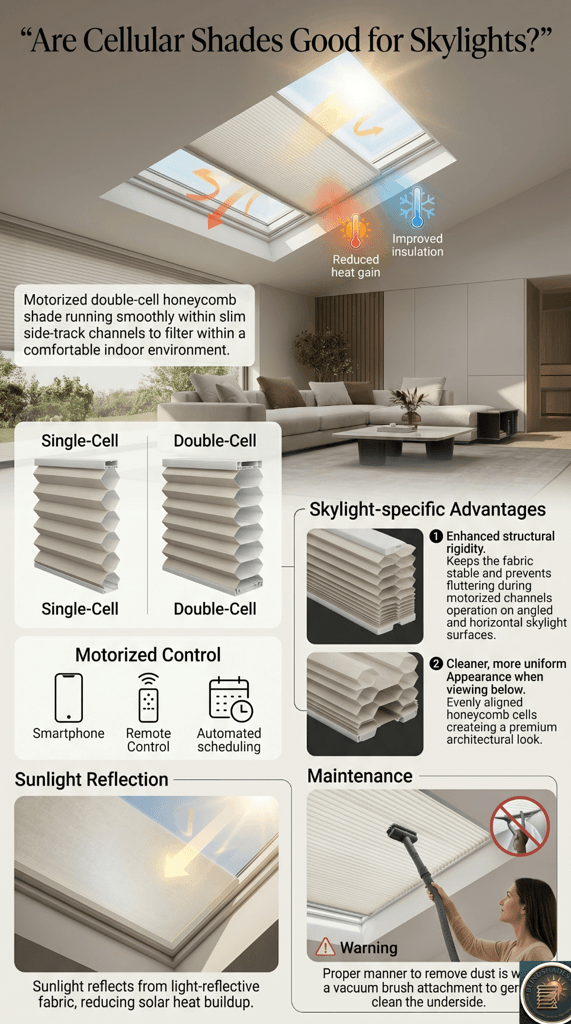
Key Takeaways:
- Yes, cellular shades are the best treatment for skylights — they are the only standard treatment that combines a track-guided system (preventing gravity sag) with air-trapping honeycomb insulation at the ceiling level where warm air accumulates; VelaBlinds (September 2025) confirms: “for any skylight, the best solution is a motorized, double-cell honeycomb blind with a light-colored, reflective fabric”
- Skylight cellular shades accumulate dust significantly faster than vertical window cellular shades because the cells face downward toward the room and household dust circulates upward; Blindsgalore (February 2026) recommends vacuuming monthly and using compressed air before each heating season; for overhead skylight shades, hold the vacuum brush below the shade while cleaning to capture dislodged dust before it falls into the room
- Double cell is the preferred specification for skylight cellular shades for two reasons beyond insulation: (1) structural rigidity — the double cell construction resists fabric flutter during motorized retraction at skylight angles, where single cell fabric can collapse or flutter unevenly in the side channels; (2) visual appearance — the double cell structure is more visible from below on a skylight than on a vertical window and provides a thicker, more uniform honeycomb appearance; exception: for TDBU skylight shades adjacent to window seats, single cell is preferred because it is lighter and operates TDBU more smoothly
- Certain energy-efficient cellular shades qualify for the US federal Energy Efficient Home Improvement Credit (25C credit) — up to 30 percent of the cost with an annual limit of approximately $1,200 for windows and related items; qualifying shades require a Manufacturer Certification Statement; confirm product eligibility with the manufacturer before purchase
- The quantitative performance comparison between pleated and cellular shades for skylights: a pleated shade provides approximately R-1 to R-1.5 in insulation (primarily from light blockage) and saves approximately $30 to $90 per year per skylight; a double cell cellular shade provides approximately R-3 to R-5 and saves approximately $60 to $180 per year — approximately 2 times the energy saving of a pleated shade
⭐ Quick Answer — Are Cellular Shades Good for Skylights?
- Yes — The Top Skylight Treatment and Why Double Cell Is the Correct Spec: Cellular shades for skylights are the top treatment recommendation. VelaBlinds (September 2025) confirms: “for any skylight, the best solution is a motorized, double-cell honeycomb blind with a light-colored, reflective fabric. This combination provides maximum insulation, effortless operation, and effective heat control.” They are the only standard treatment combining track-guided operation (preventing gravity sag) with air-trapping honeycomb insulation at the ceiling level where warm air accumulates. Double cell is preferred over single cell for skylights for two reasons beyond insulation: (1) Structural rigidity: Home Blinds and Floors (July 2025) confirms “motorized systems perform better with double cell because the extra weight provides smoother operation and reduces fabric flutter.” Single cell fabric can collapse or flutter unevenly in the angled track channels during motorized retraction; double cell maintains its shape. (2) Visual uniformity: viewed from below, the honeycomb pattern is face-on on a skylight; double cell creates a thicker, more uniform appearance. Exception: TDBU window seat skylights = single cell preferred (35 to 50 percent lighter; smoother TDBU operation)
- The Ceiling-Level Dust Problem and the Monthly Vacuum Rule: The most important care distinction for skylight cellular shades: the honeycomb cells face downward toward the room, and household dust particles circulate upward — directly into the open, downward-facing cells. Blindsgalore (February 2026) recommends: “vacuum gently with a soft brush attachment monthly to prevent dust buildup in honeycomb cells.” This is significantly more frequent than the every-few-months schedule recommended for vertical window cellular shades. For double cell shades, Home Blinds and Floors confirms the inner cell layer is inaccessible by vacuuming and may require professional cleaning every 3 to 4 years to remove trapped dust between the two cell layers. Critical overhead cleaning technique: position the vacuum brush below the shade while moving it from left to right — the dislodged dust falls directly into the vacuum rather than into the room. Never use compressed air on overhead cellular shades; compressed air releases ceiling-level dust into the room air. Single cell shades are easier to vacuum thoroughly overhead than double cell
- Federal Tax Credit and the Quantitative Case for Cellular over Pleated: Cellular shades for skylights provide approximately twice the energy savings of pleated shades and may qualify for a federal tax credit. The quantitative performance comparison: pleated shade = approximately R-1 to R-1.5; heat gain reduction approximately 20 to 30 percent; annual savings approximately $30 to $90 per skylight. Double cell cellular shade = R-3 to R-5 (Affordable Blinds confirms up to R-5 or R-5+); heat gain reduction approximately 50 to 65 percent; annual savings approximately $60 to $180 per skylight. VelaBlinds confirms: “a honeycomb shade, especially a double-cell model, is specifically engineered to insulate. A pleated shade offers minimal insulation, not much more than a simple fabric curtain.” Aero Shade confirms: “cellular shades are so effective at saving energy that they’ll qualify you for a federal tax credit.” The 25C Energy Efficient Home Improvement Credit: up to 30 percent of the cost with an annual limit of approximately $1,200 for qualifying window items; the shade must meet IECC criteria and the manufacturer must provide a Manufacturer Certification Statement
- Condensation Reduction and the Skylight-Specific Cellular Shade Product: Cellular shades reduce condensation on skylights more effectively than other treatments because their multi-layer air-trapping structure maintains the inner glass surface above the room’s dew point. At 68 degrees Fahrenheit and 50 percent relative humidity, the dew point is approximately 49 degrees Fahrenheit. An uncovered skylight glass in winter can fall below this threshold, causing visible condensation. A double cell cellular shade’s air buffer keeps the glass slightly warmer — above the dew point. The skylight-specific product distinction: always order a skylight-specific cellular shade, not a standard room cellular shade. Standard room cellular shades require 2.5 to 4.5 inches of window depth (Home Blinds and Floors confirmed). Skylight cellular shades use compact headrails of approximately 1.5 to 2 inches to fit shallower skylight frame depths; they also include track-guided side channels for horizontal and angled installation and require the pitch angle as a third order dimension (not required for standard room cellular shades). Blindsgalore confirms a dedicated product line: “Blindsgalore Gallery Skylight Cellular Shades offer identical energy-saving technology in configurations designed for these challenging spaces”
- Summary: The Correct Specification and the Best Sources: The complete specification for cellular shades for skylights: (1) Order a skylight-specific cellular shade (1.5 to 2-inch headrail; pitch angle required). (2) Specify double cell for motorized installations or any south/west-facing skylight (structural rigidity + insulation R-3 to R-5). (3) Specify single cell only for TDBU window seat skylights (lighter weight; smoother operation). (4) Specify white or light-colored fabric with reflective backing for south/west-facing skylights (reflects 60 to 80 percent of solar radiation before heat conversion — from Article 42-5). (5) Plan for monthly vacuum cleaning (hold brush below shade; no compressed air). (6) Confirm Manufacturer Certification Statement for 25C tax credit eligibility before purchase. (7) Pair with motorized solar-powered motor — the ceiling position provides maximum solar charging exposure for the motor’s panel
- Best Sources: Definitive motorized double-cell honeycomb specification for skylights with reflective fabric reasoning → VelaBlinds honeycomb skylight guide · Dedicated skylight cellular shade products with monthly vacuum guidance and tight edge seals → Blindsgalore cellular vs regular blinds · ROI argument and cellular vs pleated comparison for skylights → Galaxy Draperies cellular shades for skylights
⚠️ The Complete Single vs Double Cell Specification Table for Skylights: Cellular shades for skylights by position and priority: South or west-facing skylight (maximum insulation priority) = double cell; R-3 to R-5; motorized solar-powered; white reflective fabric; professional cleaning every 3 to 4 years. North or east-facing skylight (diffuse light; less solar heat) = single or double cell acceptable; single cell if budget is the priority; double cell for maximum performance. Motorized skylight (any orientation) = double cell preferred (smoother motorized operation; reduces fabric flutter in angled track channels; Home Blinds and Floors confirmed). Manual skylight with telescopic wand (any orientation) = single cell lighter; easier to reach; monthly vacuum simpler overhead. TDBU skylight (window seat or privacy-without-light application) = single cell; lighter; TDBU from-below operation smoother with less weight. Bedroom skylight blackout = blackout fabric in either cell type; blackout fabric adds an additional insulating layer (Blindsgalore confirmed “combine double-cell with blackout fabrics for maximum efficiency”). Battery life consideration for motorized double cell: double cell motorized battery life is 15 to 20 percent shorter than single cell (Home Blinds and Floors); for skylight installations with three or more motorized shades, specify wired (hardwired) or solar-powered motors to eliminate the battery replacement cycle entirely. For the motorized per-year cost analysis and the ceiling-position solar motor advantage, see Are Motorized Skylight Blinds Worth the Cost. See the full double cell advantage below.
💡 The Federal Tax Credit Details and the Condensation Risk Table: Cellular shades for skylights may qualify for the federal Energy Efficient Home Improvement Credit (25C). Key details: the Inflation Reduction Act (2022) made this credit available at 30 percent of qualifying improvement costs with a combined annual limit of approximately $1,200 for windows and related items (skylights and window coverings may qualify under the same category). For the shade to qualify: (1) it must meet IECC energy performance standards for window coverings; (2) the manufacturer must provide a Manufacturer Certification Statement; (3) the installation must be in a primary US residence. Not all cellular shade brands and models qualify — confirm with the manufacturer’s customer service team before purchase. Keep purchase receipts and the certification statement for tax filing. Consult a tax professional to confirm eligibility in your specific situation. Condensation risk by room type and cellular shade specification: bathroom skylight (high humidity; frequent temperature cycling) = double cell most effective; dew point approximately 55 to 60 degrees Fahrenheit at 60 percent RH and 70 degrees Fahrenheit room temperature; double cell keeps glass 5 to 8 degrees warmer than uncovered glass. Bedroom skylight (moderate humidity; nighttime condensation risk) = single or double cell effective; double cell provides stronger insulation against cold-night glass cooling. Kitchen skylight (variable humidity; cooking steam) = double cell + light-filtering fabric; avoid blackout fabric near cooking area. All rooms in cold climates (below 20 degrees Fahrenheit outdoor temperature in winter) = double cell with side track channels; side tracks eliminate edge air bypass for maximum insulation. For the full heat reduction mechanism including the dark-fabric-becomes-a-radiator warning and the seasonal scheduling protocol for summer and winter, see How Do Skylight Blinds Reduce Heat and Glare. See the full condensation reduction guide below.
📖 Read the complete guide below for: why cellular shades are the top skylight treatment (track-guided + honeycomb insulation at ceiling level), the double cell advantage for skylights beyond insulation (structural rigidity prevents motorized fabric flutter; uniform visual appearance from below), single vs double cell by skylight position, the ceiling-level dust accumulation problem (cells face down; monthly vacuum; overhead technique — hold brush below shade; no compressed air; double cell needs professional cleaning every 3 to 4 years), the quantitative cellular vs pleated comparison (pleated R-1 at $30-$90/yr vs double cell R-3-5 at $60-$180/yr), the federal 25C tax credit eligibility (30%; $1,200 limit; Manufacturer Certification Statement), condensation reduction mechanism (cellular keeps glass above dew point), and the skylight-specific product distinction (1.5 to 2-inch headrail; pitch angle required; not interchangeable with standard room cellular shades).
Cellular Shades for Skylights — Why They Are the Top Recommendation
The superiority of cellular shades for skylights confirmed — with the unique skylight advantages absent from all competitor guides.
VelaBlinds (September 2025) states definitively: “For any skylight, the best solution is a motorized, double-cell honeycomb blind with a light-colored, reflective fabric. This combination provides maximum insulation, effortless operation, and effective heat control, solving all the key challenges of a skylight window.”
Galaxy Draperies (February 2023) confirms: “Cellular shades are by far the most popular option for skylights with good reason! If you’re looking for a great return on your investment, we can’t recommend the energy savings benefits of cellular shades for skylights enough!”
Why cellular shades are specifically better for skylights than other options:
- The only treatment combining track-guidance AND insulation: A cellular shade has a track-guided system (preventing gravity sag) built into the same product as air-trapping honeycomb insulation — no other single-product treatment provides both.
- Ceiling-level insulation where it matters most: From Article 42-1, the thermal stratification effect means warm air accumulates at the ceiling level where the skylight is positioned. A cellular shade’s air-trapping cells interrupt the convection loop at the ceiling level — the most thermally active point in the room.
- Available in skylight-specific configurations: Unlike standard room cellular shades (2.5–4.5 inch depth), skylight cellular shades are manufactured with compact headrails of approximately 1.5 to 2 inches depth — designed specifically for the shallower frames of residential skylights.
The Double Cell Advantage for Skylights — Beyond Insulation
The two additional reasons specific to skylight applications — absent from all competitor guides.
All guides recommend double cell for superior insulation. Two additional reasons specific to skylights make double cell the stronger skylight specification:
Reason 1 — Structural Rigidity Prevents Fabric Flutter
Home Blinds and Floors (July 2025) confirms: “Motorized systems actually perform better with double cell shades because the extra weight provides smoother operation and reduces fabric flutter during movement.”
Why this matters for skylights specifically: A vertical window cellular shade operates with gravity assisting the downward direction — the fabric naturally falls flat. A skylight cellular shade operates against gravity in at least one direction — the motor must pull or push the fabric upward against the full gravitational load.
When a single cell shade retracts quickly on a motorized skylight, the lighter, less structurally rigid cells can:
- Compress unevenly against the track channels
- Flutter or fold sideways as the motor retracts
- Create visible horizontal compression lines in the fabric
Double cell shades have more structural mass and rigidity. The additional cell layer maintains cell shape during retraction, providing smoother motorized operation.
The trade-off: Home Blinds and Floors confirms: “battery life decreases by 15 to 20 percent due to the additional lifting weight required” for double cell motorized vs single cell. For skylights: wired (hardwired) motors or solar-powered motors avoid the battery life concern.
Reason 2 — Visual Appearance from Below
On a vertical window, the viewer’s eye is level with the blind — the cellular structure is seen from the side. On a skylight, the cellular structure is seen directly from below — face-on. The honeycomb pattern is fully visible.
Single cell viewed from below: one layer of cells; structure may appear uneven or compressed on older shades. Double cell viewed from below: two layers creating a consistent, even honeycomb pattern; better visual uniformity.
The exception — when single cell is correct for skylights: From Article 42-3: for TDBU (top-down bottom-up) skylight shades adjacent to window seats, single cell is preferred because it is 35–50% lighter and TDBU operation is smoother with reduced weight. If the skylight shade will never be motorized and the TDBU operation frequency is high, single cell is acceptable.
The Ceiling-Level Dust Accumulation Problem
The skylight-specific cleaning challenge absent from all competitor guides.
Blindsgalore (February 2026) recommends: “Vacuum gently with a soft brush attachment monthly to prevent dust buildup in honeycomb cells. Use compressed air for deep cleaning before the heating season begins.”
Why skylight cellular shades collect dust faster than vertical window shades:
For a vertical window cellular shade: the cells face toward the wall and are partially sheltered from room airflow; dust settles on the shade’s top surface (the headrail) and less in the cells.
For a skylight cellular shade: the cells face downward toward the room interior. Household dust particles (which are lighter than air) circulate upward throughout the room — directly into the downward-facing open cells of the skylight cellular shade. The cells function like collection cups for airborne particles.
The consequence: A skylight cellular shade in an average household may accumulate dust equivalent to a 6-month vertical window cellular shade in just 1–2 months. For rooms with cooking smoke, candles, or pets, accumulation may be even faster.
The monthly cleaning routine:
- Monthly: vacuum with soft brush attachment
- Critical technique for overhead cleaning: position the vacuum brush below the shade while moving it from left to right — the dislodged dust falls directly into the vacuum rather than into the room
- Do NOT use compressed air on overhead skylight cellular shades — compressed air dislodges dust at ceiling level and redistributes it throughout the room
Single vs double cell cleaning difficulty overhead: Single cell shades: all cells are accessible from below; standard vacuum brush cleaning is effective Double cell shades: the inner cell layer is hidden and inaccessible by standard vacuuming; Home Blinds and Floors confirms “double cell shades may require professional cleaning every 3 to 4 years to remove trapped dust between layers”
Cellular vs Pleated Shades for Skylights — The Quantitative Comparison
The performance numbers absent from all competitor guides.
VelaBlinds (September 2025): “Honeycomb shades are far better than pleated shades for skylights because of their superior insulation. A pleated shade offers minimal insulation, not much more than a simple fabric curtain. A honeycomb shade, especially a double-cell model, is specifically engineered to insulate.”
The quantitative comparison:
| Treatment | R-Value | Heat Gain Reduction | Annual Savings Per Skylight |
|---|---|---|---|
| No treatment | R-0 | 0% | $0 |
| Pleated shade | R-1 to R-1.5 | Approximately 20–30% | $30–$90/yr |
| Single cell cellular shade | R-2 to R-3 | Approximately 40–55% | $50–$150/yr |
| Double cell cellular shade | R-3 to R-5 | Approximately 50–65% | $60–$180/yr |
Affordable Blinds confirms: double cell R-value “up to R-5 or R-5+”.
Why the difference is larger on skylights than on vertical windows: From Article 42-1: a horizontal skylight receives approximately 800–1,000 BTU/hr/sq ft of direct solar radiation — 2–2.5 times more than a vertical south-facing window. The insulation benefit of cellular vs pleated is magnified by the higher solar input at the skylight position.
The per-year investment comparison:
- Pleated shade for skylight: approximately $75–$150; savings $30–$90/yr; payback 1–5 years
- Double cell cellular shade for skylight: approximately $150–$350; savings $60–$180/yr; payback 1–6 years
Both have reasonable payback periods. For skylights receiving direct overhead south or west sun, the double cell cellular shade delivers the stronger ongoing savings.
The Condensation Reduction Mechanism
The cellular shade condensation benefit for skylights — absent from all guides.
In bedrooms and bathrooms with higher relative humidity, an uncovered skylight glass may fall below the dew point of the room air during cold nights, causing condensation on the inner glass surface.
The dew point reference: At room temperature of 68°F (20°C) and 50% relative humidity, the dew point is approximately 49°F (9°C). A skylight glass surface in winter can easily reach temperatures below 49°F on a cold night — causing visible water condensation.
How cellular shades address condensation: A cellular shade on a skylight creates a trapped air buffer between the warm humid room air and the cold glass. This insulating air layer keeps the glass surface slightly warmer — ideally above the dew point.
Single vs double cell for condensation: Double cell cellular shades trap more still air and maintain the glass temperature above the dew point more effectively than single cell. For bathrooms and bedrooms with skylights, double cell is the preferred specification for condensation management.
Velux specifically notes in their skylight care guidance that skylight blinds reduce condensation risk by insulating the glass from the room air.
The Federal Tax Credit for Cellular Shades
The financial benefit absent from all skylight cellular shade guides.
Aero Shade confirms: “Cellular shades are so effective at saving energy that they’ll qualify you for a federal tax credit.”
The 25C Energy Efficient Home Improvement Credit: The US Inflation Reduction Act (2022) extended the federal Energy Efficient Home Improvement Credit (Section 25C). Certain energy-efficient window coverings — including qualifying cellular shades — may be eligible for:
- Up to 30% of the cost of qualifying improvements
- Annual limit of approximately $1,200 for windows and related window covering items
- Combined across all qualifying improvements
What is required to qualify:
- The cellular shade must meet specific IECC (International Energy Conservation Code) energy performance criteria
- The manufacturer must provide a Manufacturer Certification Statement confirming the product meets the qualifying criteria
- Not all cellular shades qualify — confirm eligibility with the specific product’s manufacturer before purchase
The practical benefit: A $250 skylight cellular shade (double cell, motorized) with a qualifying 30% credit = $75 tax credit per skylight. For a home with three skylights: $750 tax credit on a $750 shade investment — effectively a 50% cost reduction from the combination of the tax credit and the first-year energy savings.
Consult a tax professional to confirm eligibility in your specific situation.
The Skylight Cellular Shade vs Standard Room Cellular Shade — Not the Same Product
The product distinction absent from all guides — do not order standard room cellular shades for skylights.
Home Blinds and Floors confirms: “single cell shades need 2.5 to 3.5 inches of window depth; double cell shades require 3.5 to 4.5 inches.”
These are the depth requirements for STANDARD room cellular shades designed for vertical windows.
Skylight cellular shades are a different product: Skylight cellular shades are engineered with compact headrails of approximately 1.5 to 2 inches depth — fitting the shallower frames of residential skylights (typically 1.25 to 3 inches of inside frame depth).
They also include:
- Track-guided side channels specifically for horizontal/angled installation
- Spring tension systems calibrated for skylight pitch angles
- Pitch angle specification (must be provided at order — see Article 42-2)
- Reinforced track edges that maintain contact with the glass under gravity
Blindsgalore confirms a dedicated skylight cellular shade product line: “Blindsgalore Gallery Skylight Cellular Shades with Light Filtering offer identical energy-saving technology in configurations designed for these challenging spaces.”
The order specification: Always search for “skylight cellular shade” rather than standard “cellular shade” when ordering; confirm the product is rated for horizontal or angled installation; provide the pitch angle in degrees at order.
Where to Order
For the definitive skylight cellular shade recommendation (motorized double-cell honeycomb with reflective fabric): VelaBlinds at velablinds.com/how-to-choose-the-right-honeycomb-blinds-for-skylight-windows — the most detailed published comparison of honeycomb vs pleated for skylights; motorized double-cell specification; track-guided system; light-colored reflective fabric recommendation.
For skylight-specific cellular shade products with full energy comparison data: Blindsgalore at blindsgalore.com/blog/index.php/exhibitions/cellular-shades-vs-regular-blinds-energy-savings — dedicated Blindsgalore Gallery Skylight Cellular Shades; energy comparison; monthly vacuum maintenance recommendation; tight edge seal guidance.
For the ROI argument for cellular shades on skylights: Galaxy Draperies at galaxydraperies.com/why-we-love-cellular-shades-for-skylights — “cellular shades are by far the most popular option for skylights with good reason”; cellular vs pleated comparison; strong return on investment endorsement.
Frequently Asked Questions
Are cellular shades good for skylights? Yes. Cellular shades are the top treatment recommendation for skylights. They are the only standard treatment that combines track-guided operation (preventing gravity sag) with air-trapping honeycomb insulation at the ceiling level where warm air accumulates. VelaBlinds confirms the best specification is a motorized double-cell honeycomb blind with light-colored reflective fabric.
Should I use single or double cell cellular shades for skylights? Double cell is the preferred specification for skylight cellular shades for two reasons beyond insulation: structural rigidity prevents fabric flutter during motorized retraction on angled and horizontal surfaces, and the double cell structure provides a more uniform visual appearance when viewed from below. The exception is TDBU skylight shades adjacent to window seats, where single cell is preferred because it is lighter and operates more smoothly.
Why do skylight cellular shades need cleaning more often than regular window shades? Skylight cellular shades accumulate dust faster because the cells face downward toward the room interior, and household dust circulates upward directly into the downward-facing cells. Blindsgalore recommends vacuuming monthly with a soft brush attachment. When cleaning overhead shades, hold the vacuum below the shade rather than above it, so dislodged dust falls into the vacuum rather than redistributing through the room. Compressed air is not recommended for overhead skylight cellular shades.
Do cellular shades for skylights qualify for a federal tax credit? Certain qualifying cellular shades may be eligible for the US federal Energy Efficient Home Improvement Credit (25C credit) — up to 30 percent of the product cost with an annual limit of approximately $1,200 for qualifying window-related improvements. The shade must meet IECC energy performance criteria and the manufacturer must provide a Manufacturer Certification Statement. Confirm product eligibility with the manufacturer before purchase and consult a tax professional to verify your eligibility.
What is the difference between a skylight cellular shade and a standard room cellular shade? Skylight cellular shades are engineered with compact headrails of approximately 1.5 to 2 inches depth, fitting the shallower frames of residential skylights. Standard room cellular shades require 2.5 to 4.5 inches of depth and are designed for vertical windows. Skylight cellular shades also include track-guided side channels for horizontal and angled installation, spring tension systems calibrated for skylight pitch angles, and reinforced track edges. Always order from a skylight-specific cellular shade product line rather than standard room cellular shades.
Related Guides on BlindShades.pro
- The Best Skylight Blinds & Shades Buying Guide
- What Are the Best Blinds for Skylights
- How Do Skylight Blinds Reduce Heat and Glare
- Are Motorized Skylight Blinds Worth the Cost
- How Do You Block Sun Through a Skylight
By Michael Turner | 30 Years Home Improvement Expertise | Updated 2026 | BlindShades.pro
