Thermal Blinds for Sliding Glass Doors

Authored By Michael Turner -30 Years Home Improvement Expertise | Updated 2026 | BlindShades.pro
Updated on July 24, 2026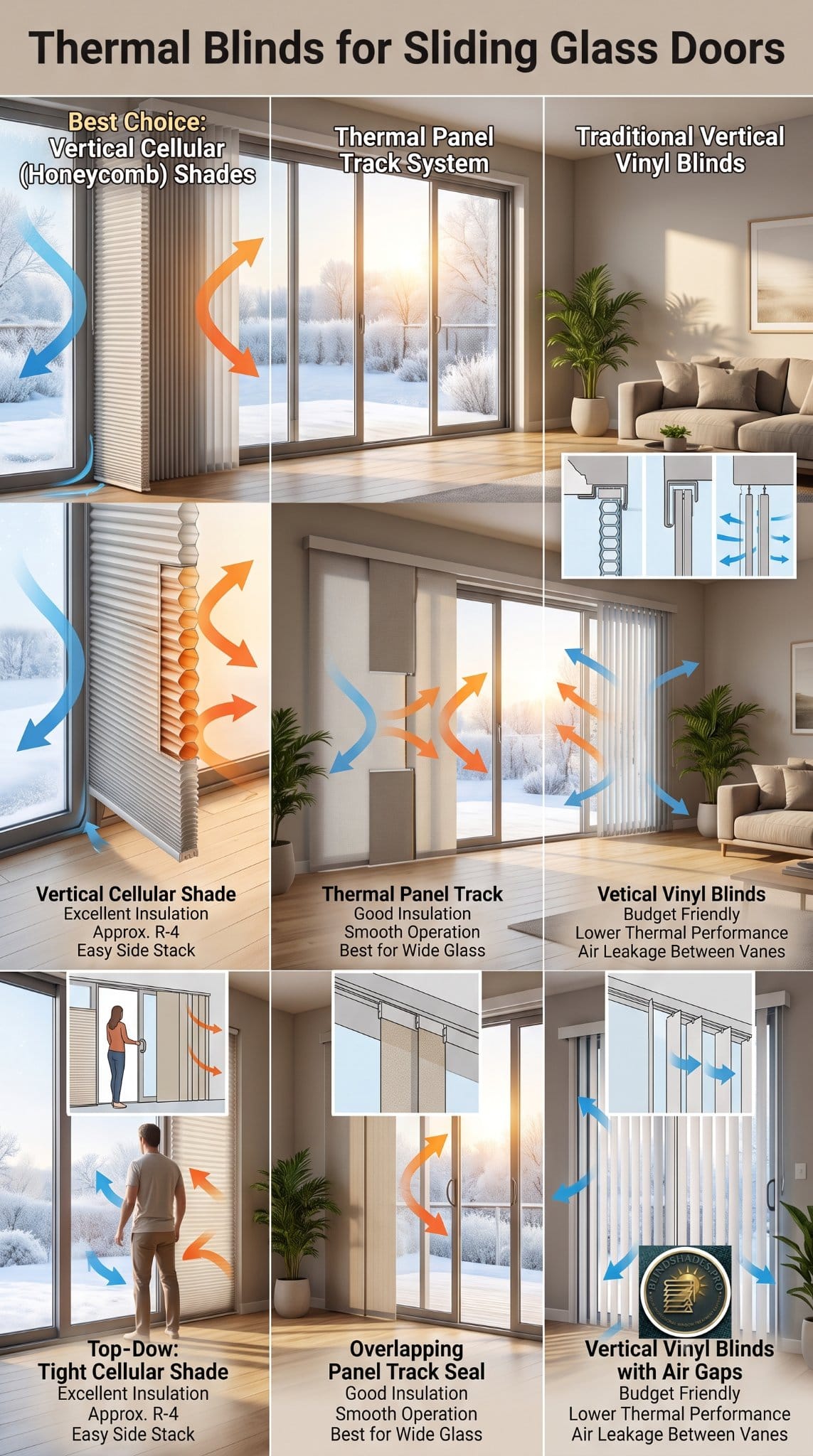
By Michael Turner — 30 years in window treatments
A sliding glass door is the biggest, leakiest pane in most homes — and the only one people walk through. That second fact is the one every product page forgets: the right thermal blinds for sliding glass doors are chosen by the traffic test first — where the covering stacks, how fast it clears, what daily use does to it — and by R-value second. Vertical honeycomb shades and thermal panel tracks pass both tests; heavy drapes pass with one rod trick; and the vinyl verticals filling the shopping results pass the traffic test while failing the thermal one.
Key Takeaways
- The winning formats are the ones the field converges on: vertical honeycomb (cellular) shades and thermal panel track blinds — trapped-air constructions reaching R-values up to around R-4, with vertical cells folding cleanly to the side and panels gliding on a track.
- The four-word rule from the best community thread on this subject: “blinds that fit in the frame.” A snug fit turns any covering into a still-air pocket; a gappy one turns R-value into decoration — the same fit doctrine that governs every window in this cluster.
- The drape route works with one rule attached: a rod extending well past the frame, so the fabric pulls completely clear of the glass when the door is in use. Skip that and you fight your own curtains daily.
- The vertical-blind rebellion is half right. The 330-comment thread’s asker declared “definitely not doing vertical,” and thermally the instinct is sound — slatted vinyl verticals clatter, leak air between vanes, and insulate least. But they’re cheap, traffic-proof, and fine where heat isn’t the job.
- The two-rod seasonal play is the sleeper: leave panel blinds up year-round and hang a second rod of removable thermal curtains for winter — a forum-buried method that layers insulation without sacrificing the door.
⭐ Quick Answer — Thermal Blinds for Sliding Glass Doors
The best thermal blinds for sliding glass doors pass two tests in order — traffic first, thermal second:
- Vertical cellular shades win both: honeycomb insulation turned sideways — trapped-air construction reaching around R-4 — folding cleanly off the glass in a second, with Hunter Douglas’ Duette as the format’s flagship.
- Thermal panel tracks are the style pick: wide overlapping panels in thick thermal-backed weaves gliding on a rail — the best look on big glass, with the honest note that stacked panels cover more glass than a cellular’s side-fold. For never-touch-it households, ODL’s enclosed between-glass blinds sidestep traffic entirely.
- Drapes pass with one rule: a rod extending well past the frame so fabric pulls completely clear when the door is in use — then floor-length, wall-hugging seal geometry does the rest.
- The community’s four-word verdict governs everything: “blinds that fit in the frame.” A snug fit makes the still-air pocket; edge gaps on door-sized glass are a chimney. And the vinyl verticals filling the shopping grids are traffic-proof but thermally last — buy them for budgets, not warmth, per the trapped-air logic in the U.S. Department of Energy’s covering guidance.
- Go deeper: the honeycomb math (sideways included) lives in our cellular R-value guide, the drape seal rules in blinds vs curtains for insulation, and the ranked picks in the Thermal & Insulated Blinds guide.
Thermal Blinds for Sliding Glass Doors: What Actually Works?
Pass the Traffic Test: a door covering is judged by what happens when someone uses the door — where it stacks, how fast it clears, what daily cycles do to it — and then by R-value.
Start with why sliders are the hardest thermal case in the house: the glass area is huge — often the building’s single largest pane — the frame is interrupted by a moving panel with its own seals, and unlike every window, the covering must get out of a human’s way several times a day. Formats that win on windows can lose here, and the community’s best single line — blinds that fit in the frame — matters doubly: at this size, edge gaps aren’t trim details, they’re a chimney. The fit-is-the-multiplier logic runs through this cluster, from which blinds insulate best‘s sealed-single-beats-gappy-double doctrine down.
The two formats the field crowns both pass the traffic test by design. Vertical honeycomb shades run the cellular construction sideways — the same trapped-air pockets that earn the family its numbers, real-world builds reaching around R-4 — and fold cleanly to one side; Hunter Douglas’s Duette is the field’s flagged example, and the cell math from our R-value guide applies sideways too. Thermal panel tracks glide wide overlapping fabric panels along a rail — the best-looking option on big glass in thick thermal-backed weaves, with the honest note that stacked panels occupy more glass than a cellular’s side-fold. And the drape route works on one condition the field states exactly once: the rod extends well past the frame so fabric pulls fully clear when the door is in use — at which point blinds vs curtains for insulation‘s seal geometry applies, floor-length, wall-hugging, capped.
Now the rebellion. In the 330-comment thread on what suits a sliding patio door for heat and cold, the asker’s opening position — definitely not doing vertical — is the community’s verdict on the covering America defaulted to for decades. Thermally the instinct is right: slatted vinyl verticals leak air between vanes and sit at the ladder’s bottom. Practically they survive: cheap, traffic-proof, vane-replaceable. Their honest place is the budget row below, not the thermal one.
The Format Ledger, Traffic-Tested
| Format | Insulation | The traffic test | Cost, in words |
|---|---|---|---|
| Vertical honeycomb (cellular) shades | The champion — trapped air sideways, up to ~R-4 real-world | Folds cleanly to the side; clears fast; cells need gentle handling | The premium pick; made-to-order |
| Thermal panel track blinds | Strong with thick thermal-backed weaves | Glides easily; wide panels stack over more glass | Mid-to-premium; the style buy |
| Thermal drapes (extended rod) | Heavy lined fabric done right — seal geometry applies | Passes only with the rod-past-frame rule; fabric takes daily handling well | Budget to custom |
| Vinyl or fabric vertical blinds | Honest last — vanes leak air between themselves | Traffic-proof, vane-replaceable, clatter included | The budget row |
| Integral (between-glass) blinds and window film | Film blocks gain; integral blinds never touch traffic | Zero traffic conflict by design; film route in the budget ladder | Film cheap; integral = a door purchase |
Which Fits Your Door?
| Your situation | The pick | Why |
|---|---|---|
| Cold bedroom slider, rental | Thermal drapes on a tension or damage-free rod + the film route | The fresh apartment-thread case: reversible, layered, deposit-safe |
| Freezing kitchen slider | Vertical cellular, snug in the frame | The four-word rule at the house’s leakiest door |
| West-facing patio door, summer | Light-faced or reflective-backed panels — with an air path | Intercept the sun; the gap rule from do thermal blinds keep heat out applies to doors too |
| Heavy daily traffic, kids and pets | Panel track or verticals | Durability beats the last point of R |
| Style-first, “definitely not vertical” | Panel track in a thermal weave | The rebellion’s happy ending |
| Maximum warmth, owner, staying put | Vertical cellular + the two-rod winter drape layer | The layered maximum — blind at the glass, mass over it |
Avoid These Mistakes
Hanging drapes on a short rod. Fabric that can’t clear the glass gets shoved behind the handle daily. The rod extends well past the frame — the rule the drape route lives or dies on.
Sealing tight over a west-sun slider. Doors trap heat pockets exactly like windows — the covering needs an air path on blazing glass, or the trapped pocket warps vanes and stresses sealed units.
Buying verticals for warmth. They pass the traffic test and fail the thermal one. If the vanes are the budget, spend the difference on the frame fit and the winter drape layer.
Skipping the two-rod play. Panels up all year plus removable thermal curtains for winter is the cheapest big upgrade on this page, and it lives in a forgotten forum post instead of any product listing.
Measuring the glass instead of the traffic path. The covering’s stacked width, its clearance past the handle, and which side the door opens from decide daily life. Measure the walk-through first.
Who Should Buy Which?
Vertical cellular shades ✔
- Cold climates, energy-first households, doors that deserve the premium
- Anyone wanting window-grade honeycomb numbers on door-sized glass
Vertical cellular shades ✖
- Claw-happy pets at floor level; rough daily traffic
Panel tracks ✔
- Big glass where looks matter; modern rooms; blackout-weave sleepers
Thermal drapes ✔
- Renters, budget layers, and the two-rod winter play
Vinyl verticals ✔ / ✖
- ✔ Budgets and rentals where heat isn’t the job · ✖ anyone buying them for insulation
The Bottom Line
Thermal blinds for sliding glass doors come down to two tests in order: traffic, then thermal. Vertical cellular shades win both — honeycomb numbers, clean side-fold; panel tracks win the style vote; drapes win the budget with the rod rule honored; and the vinyl verticals filling the shopping grids are a traffic tool, not a thermal one. Fit whatever you choose in the frame, give west sun an air path, and add the second-rod drape layer when winter bites. The honeycomb family’s ranked picks live in our complete Thermal & Insulated Blinds guide, with the light-plus-warmth combination spec in blackout vs thermal blinds.
FAQ
What type of blind is best for sliding doors? Vertical cellular shades for insulation — honeycomb construction that folds cleanly aside — with thermal panel tracks as the style-first runner-up. The deciding questions are traffic ones: which side should the stack land on, how wide is it, and does it clear the handle. Verticals in vinyl are the budget answer where warmth isn’t the goal.
How do you keep heat inside a sliding glass door? Layer it: a snug insulating covering at the glass (vertical cellular or thermal panels), the frame’s seals weatherstripped like any door, heavy floor-length drapes over everything on the coldest nights, and the two-rod method so the winter layer comes down in spring. The draft-hunting half lives in how to stop cold air coming through windows.
Are vertical thermal blinds any good? The cellular kind, genuinely — trapped-air construction turned sideways, with the family’s real numbers behind it. The slatted vinyl kind, thermally no: air moves freely between vanes, which is why the community’s “definitely not vertical” instinct is right for heat. Same word, two products — buy the cells.
What do thermal blinds for sliding glass doors cost? In words, since pricing moves with sale cycles: vinyl verticals are the budget floor; panel tracks run mid-range into premium fabrics; vertical cellulars carry the made-to-order honeycomb premium at door scale; thermal drapes span budget to custom. The two-rod layer adds winter performance at the price of curtains.
Related Guides
- The Best Thermal & Insulated Blinds — the complete guide
- Cellular Shade R-Value: Single vs Double Cell — the honeycomb math, sideways included
- Blinds vs Curtains for Insulation — the drape seal geometry
- Do Thermal Blinds Keep Heat Out? — the summer gap rule
