Best No Drill Blinds 2026: The Complete Buying Guide

Authored By Michael Turner -30 Years Home Improvement Expertise | Updated 2026 | BlindShades.pro
Updated on July 17, 2026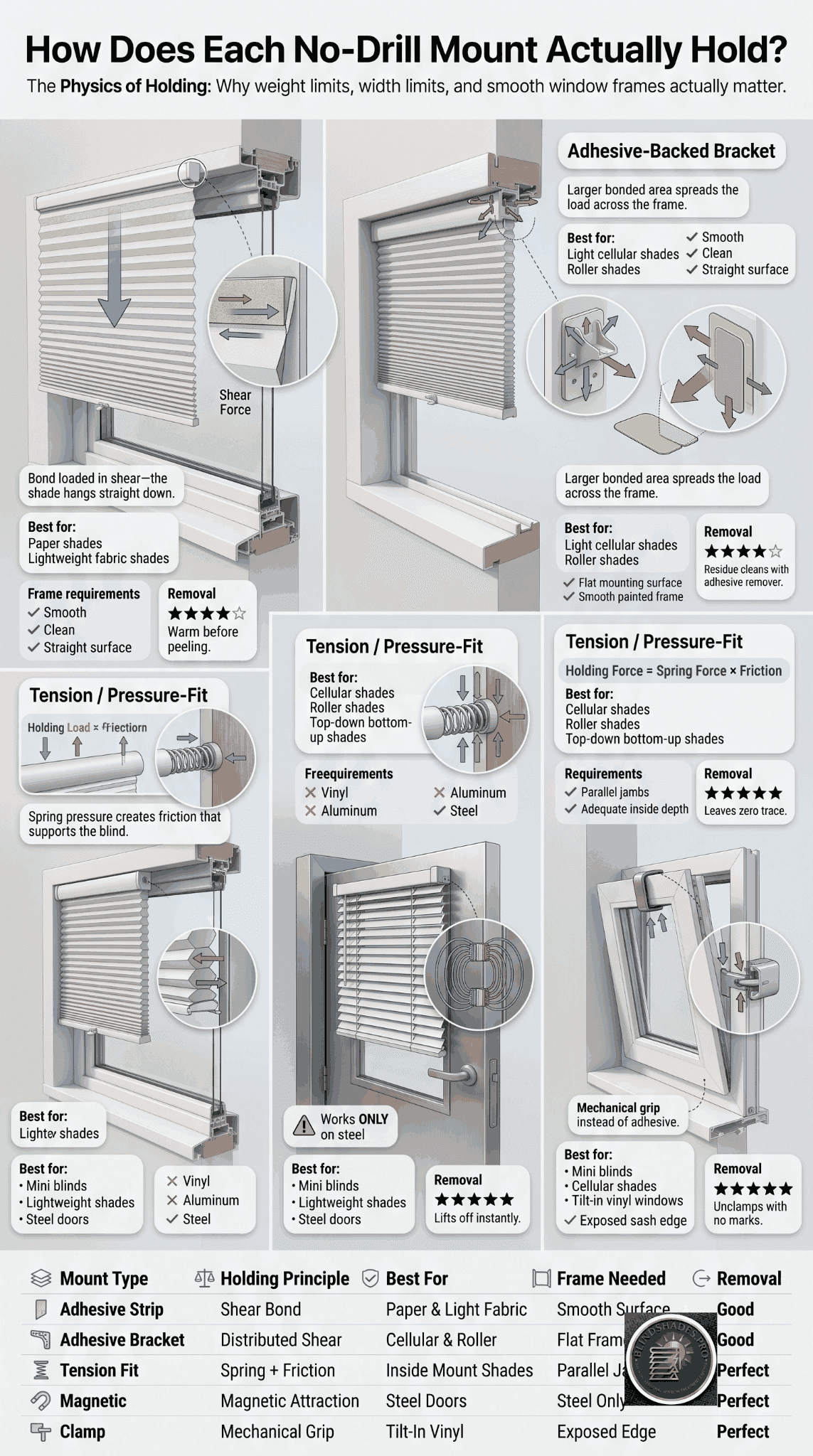
By Michael Turner, 30 years in the window treatment industry
No drill blinds mount without a single screw — by adhesive strip, spring tension, magnet, or clamp — which makes them the renter’s best friend and the fastest install in the industry. But every listing whispers the same three warnings: weight limits, a seventy-two-inch width ceiling, and “requires straight, smooth frames” — and no ranked page explains why. This guide does: the physics of each mounting system, the frame-compatibility check that takes thirty seconds and prevents every failed install, the branded-system decoder (Click2Fit vs Stick2Fit vs Twist2Fit, translated), the renter’s deposit math, and picks anchored to the biggest review bases in the category — including a two-thousand-review no-tools cellular from around twenty-one dollars.
Key Takeaways
- Read your frame before any brand. Adhesives need smooth, clean surfaces; tension needs frame depth; magnets need actual steel — the thirty-second frame check below decides your mount before shopping begins.
- The limits are physics, not fine print. Adhesives fail in peel (not shear), tension holds by friction that sag destroys past about seventy-two inches, and every system has a weight ceiling — the limits table turns each into a pass/fail check.
- The category’s king is a real shade, not a compromise. Blindster’s no-tools cordless TDBU cellular carries four point eight across twenty-one hundred reviews from around twenty-one dollars — the premium look the market consensus itself crowns.
- Zero damage is a protocol, not a promise. Warm adhesive strips before peeling, keep tension moderate, and the deposit-protection case closes clean — the removal section makes it repeatable.
- Yes, no-drill smart shades exist. The community keeps asking about motorized no-drill options; the answer is in print below.
⭐ Quick Answer — The Best No Drill Blinds
The best no drill blinds are chosen at three gates — Stick (adhesive: smooth clean frames only), Spring (tension: friction against the jamb, zero trace), and Snap (magnets need steel; clamps own tilt-in PVC) — after one pre-gate: read your frame’s material, depth, and width first:
- Best overall: the No Tools cordless TDBU cellulars — four point eight across twenty-one hundred reviews from around twenty-one dollars — at Blindster, with the tension-mounted zero-trace lane at Blindsgalore.
- The renter classic: Redi Shade’s peel-and-stick blackout paper — around seven dollars, up in five minutes, cut with a kitchen knife — and the branded Click2Fit, Stick2Fit and Twist2Fit systems at SelectBlinds, decoded in the systems table below.
- The limits are physics: adhesives fail in peel (not shear), tension dies past about seventy-two inches, and magnets need real steel — the frame-compatibility table turns all three into a thirty-second check.
- The flagship’s mechanism: light above, privacy below — the top-down bottom-up idea behind the category’s best product is explained in the TDBU guide.
- The dorm-and-staging lane: paper and disposable options live in the temporary blinds guide.
- The wet-room case: humidity-proof no-drill mounting is part of the complete bathroom blinds guide.
Quick Specification Reference
| Specification | The Short Answer |
|---|---|
| Best overall | Blindster No Tools Cordless TDBU Cellular — from around twenty-one dollars at 24×36, four point eight across twenty-one hundred reviews |
| Best renter/temporary | Redi Shade No Tools Blackout Paper — around seven dollars at Home Depot, four point two across fourteen hundred fifty-two |
| Best tension system | Blindsgalore No-Drill line — fifty-one to one sixty-six, four point seven store across forty-six hundred |
| Best magnetic | Cordless Room Darkening Magnetic Eco Mini — around thirty-six, four point eight across sixty-nine (steel frames only) |
| The four mounts | Adhesive (Stick) · Tension (Spring) · Magnetic + Clamp (Snap) |
| The three limits | Weight ceilings · the seventy-two-inch width rule · straight, smooth frames |
| The pre-gate | Read your frame: material, depth, and width decide the mount before the brand |
| The home turf | Rentals, dorms, bathrooms, kitchens, metal doors, and any wall you can’t repair |
Read the complete guide below for: the six Diamond picks across every mounting lane, the Stick-Spring-Snap Test, the mount-mechanism taxonomy this market never explains, the frame-compatibility and limits tables, the branded-system decoder, room verdicts, the renter’s deposit math with the zero-damage removal protocol, and the where-to-buy table that answers the Home Depot, Walmart, and Keego questions people actually search.
What Are the Best No Drill Blinds? Our Picks
Six picks, one per mounting lane — the market consensus verified against the biggest review bases, thin listings flagged.
The best no drill blinds for most windows is a no-tools cellular on adhesive-or-pressure brackets — and the market runs six honest lanes:
Best Overall — Blindster No Tools Cordless Top-Down Bottom-Up Cellular. The consensus premium pick, and the numbers agree: from around twenty-one dollars at 24×36 with four point eight across twenty-one hundred reviews, the light-filtering 22×36 at around sixty-three (four point seven across twenty-three hundred), and the blackout line to around two thirty at 35×59 (four point six across forty-two hundred) — high-strength pressure-fit or adhesive-backed brackets, honest thermal insulation from the cellular structure, and the market’s own verdict attributed: something long-lasting that doesn’t look like a temporary fix. The store behind it holds four point six across six thousand six hundred, ninety-eight-to-two-fifty-seven, sixty-day returns. The TDBU mechanism itself — light above, privacy below — is the same one argued in the top-down bottom-up guide.
Best Renter / Temporary — Redi Shade No Tools Blackout Paper. Around seven dollars at Home Depot, four point two across fourteen hundred fifty-two — the peel-and-stick classic the consensus crowns for renters: up in under five minutes, cut to size with a standard kitchen knife, zero damage on removal. For the whole disposable-and-temporary lane — paper shades, dorm-year solutions, staging — the deep dive is the temporary blinds guide.
Best Tension System — Blindsgalore No-Drill Line. Fifty-one to one sixty-six on innovative tension-mounting hardware that locks into place — no screws, no brackets, no adhesive — behind a four point seven store rating across forty-six hundred. The zero-trace champion; the cellular light-filtering entry at around fifty-one shows five stars across three reviews — thin base, flagged.
Best Magnetic — Cordless Room Darkening Magnetic Eco Mini. Around thirty-six via Home Depot, four point eight across sixty-nine — and the pick carries its own physics lesson: magnets hold to steel, which is why this lane owns metal entry doors, steel-framed mobile homes, and RV doors, and why it cannot own a vinyl window. VEVOR’s cordless minis (around thirty) run the budget end of the same aisle.
Best System Shopping — SelectBlinds Click2Fit, Stick2Fit, and Twist2Fit. The branded trio the community’s own Facebook thread lands on (“we bought ours from Select Blinds”) — three names, three mounts, decoded in full in the systems table below so you buy the mechanism, not the trademark.
Best Smart — Allesin No-Drill Smart Shades. The printed answer to the question a live community thread keeps asking — which brand for the no-drill motorized option? — no-drill smart shades in both inside and outside mounts, quick to install and secure to fit, per their own framing; the protocol-and-power decision runs through the motorized guide. The bathroom-first alternative is Persilux’s No-Drill Headrail (seventy-one to ninety-nine — no screws, no drills, and no adhesives, their claim), whose custom roller listing at around seventy-three shows five stars across one review — thin base, flagged — and Joydeco’s adhesive-and-tension-clip zebra and roller lines hold the consensus light-control slot.
| Pick | Product | Approx. Price (as listed) | Rating / Reviews | Wins the gate for |
|---|---|---|---|---|
| Best Overall | Blindster no-tools cordless TDBU cellular | From around twenty-one | 4.8 / 2,100 | The premium look, volume-proven |
| Best Renter | Redi Shade blackout paper | Around seven | 4.2 / 1,452 | Five minutes, a kitchen knife, zero damage |
| Best Tension | Blindsgalore no-drill line | Fifty-one to one sixty-six | 4.7 store / 4.6K | Zero-trace friction mounting |
| Best Magnetic | Magnetic Eco mini (Home Depot) | Around thirty-six | 4.8 / 69 | Steel doors and mobile homes |
| Best Systems | SelectBlinds Click2Fit / Stick2Fit / Twist2Fit | Varies by line | The community’s answer | Three mounts, decoded below |
| Best Smart | Allesin no-drill smart · Persilux headrail | — · seventy-one to ninety-nine | Thin bases flagged | The motorized question, answered |
How Do You Choose? The Stick-Spring-Snap Test
One pre-gate and three lanes: read your frame, then match the mount.
The pre-gate — read your frame. Thirty seconds at the window beats every review: What is the frame made of (wood, vinyl, aluminum, steel)? How deep is the inside jamb (tension needs contact area)? Is the surface straight and smooth (adhesive’s non-negotiable)? How wide is the span (the seventy-two-inch ceiling looms)? The compatibility table below turns the answers into a mount.
Gate 1 — Stick. Adhesive systems: peel-and-stick strips (the Redi Shade lane) and adhesive-backed brackets (the EZ-stick cellular class, around sixty-eight to ninety-two at Wayfair, with the no-drill TDBU cellular there at around sixty-seven holding four point six across sixty-one). Strongest for light-to-medium shades on smooth, clean, straight frames; the physics section explains the peel-vs-shear rule that governs everything.
Gate 2 — Spring. Tension systems: pressure-fit brackets and twist-lock rods holding by friction against the jamb. Zero adhesive, zero residue, zero trace — the purest deposit-protection play — but friction is proportional to frame contact, so shallow frames and wide spans are its enemies.
Gate 3 — Snap. The magnetic and clamp lanes: magnets for steel surfaces (doors, mobile homes), twist-and-clamp systems for tilt-in PVC frames where the sash edge gives a clamp something to grip. Small lanes, but where they fit, nothing fits better.
| Gate | The question | Pass looks like | Fail routes to |
|---|---|---|---|
| Pre-gate: Frame | Material, depth, width, surface? | A clear answer to all four | Guessing → returns |
| Stick | Smooth, clean, straight frame? | Vinyl/painted wood in good condition | Textured, peeling, or dusty frames |
| Spring | Enough jamb depth and under-72 width? | Standard double-hung inside mounts | Shallow trim, wide spans |
| Snap | Steel surface or tilt-in PVC edge? | Metal doors; clamp-friendly sashes | Everything else → Stick or Spring |
How Does Each No-Drill Mount Actually Hold? The Physics of Holding
The section this entire market skips — why the weight limits, the width ceiling, and the smooth-frame rule exist.
A naming note first, because this category wears many labels: no drill blinds, no-drill blinds, no tools blinds, no drill no tools blinds for windows, no tools no drill shades, no drill shades, screwless blinds, tension blinds (no drilling), peel and stick blinds, no drill mini blinds, and magnetic blinds all describe one promise — mounting without screws — delivered by four different machines. Here is how each one actually works:
| Mount | How it holds | What it holds best | Frames it needs | Removal grade |
|---|---|---|---|---|
| Adhesive strip (peel-and-stick) | Bond loaded in shear — the shade hangs straight down | Paper and light fabric shades | Smooth, clean, straight; cured paint | Good — warm before peeling |
| Adhesive-backed bracket | Same shear rule, spread across bracket area | Light-to-mid cellulars and rollers | Same, plus flat bracket seats | Good — residue solvent finishes |
| Tension / pressure-fit | Friction = spring force × jamb contact | Cellulars, rollers, TDBU inside-mounts | Depth for contact; parallel jambs | Perfect — zero trace |
| Magnetic | Magnet-to-steel attraction | Minis and light shades on doors | Ferrous STEEL only — never vinyl | Perfect — lifts off |
| Clamp / twist systems | Mechanical grip on the sash edge | Minis, cellulars on tilt-in PVC | Tilt-in vinyl with exposed edge | Perfect — unclamps |
Now the three warnings every listing carries, explained. Weight limits exist because adhesives are strong in shear (the straight-down hang) and weak in peel — any force that curls the bond edge away from the frame unzips it like tape; a heavy shade bouncing on operation generates exactly that peel force, which is why every adhesive system caps its load and why a failing adhesive blind always fails a few days after install, not immediately (the bond creeps). The seventy-two-inch rule — the consensus’s own number — is span physics: a wide headrail sags in the middle, and sag rotates the mounting points, converting clean shear into peel at the brackets and breaking a tension rod’s parallel contact; past roughly six feet, no spring or strip fights geometry. The smooth-frame requirement is contact area: adhesive bonds and friction pads both work through surface contact, and textured vinyl, flaking paint, or dust cuts real contact to a fraction of the rated value. The thirty-second frame check defeats all three warnings before they cost you a return.
And the honest escalation: past seventy-two inches, on crumbling frames, or under heavy motorized hardware, the answer is a drilled bracket — or the disposable temporary paper lane while you negotiate with the landlord. A no-drill guide that never says “sometimes, drill” isn’t being honest with you.
Which Frames Take Which Mounts?
The thirty-second check, tabled.
| Your frame | Stick (adhesive) | Spring (tension) | Snap (magnet) | Snap (clamp) |
|---|---|---|---|---|
| Smooth vinyl window | ✓ best | ✓ if jamb is deep | ✗ | Tilt-in only |
| Painted wood (good condition) | ✓ | ✓ | ✗ | ✗ |
| Painted wood (old/flaking) | ✗ — bond fails | ✓ carefully | ✗ | ✗ |
| Aluminum frame | ✓ clean first | ✓ | ✗ (aluminum isn’t ferrous) | ✗ |
| Steel entry/French door | ✓ | ✗ no jamb | ✓ the home turf | ✗ |
| Tilt-in PVC sash | ✓ | ✓ | ✗ | ✓ the clamp lane |
| Textured or damaged anything | ✗ | Depth permitting | Steel only | Edge permitting |
Steel doors deserve their sentence: a magnetic mini on a metal French or entry door is the cleanest install in this entire guide — the door-glass specifics live in the french door blinds guide.
What Are the Limits? Weight, Width, and Depth
Every system’s ceilings in one honest table.
| Limit | The rule | Why | The workaround |
|---|---|---|---|
| Weight | Every adhesive/tension listing caps load — respect it | Peel-force physics above | Split wide windows into two shades; choose cellular (lightest real shade per square foot) |
| Width | About seventy-two inches is the category ceiling | Span sag converts shear to peel, breaks tension contact | Two shades on one window; or drill |
| Frame depth | Tension needs real jamb contact | Friction is proportional to contact area | Outside-mount adhesive systems; clamp on tilt-ins |
| Surface | Straight, smooth, clean — non-negotiable for Stick | Contact area is the bond | Isopropyl wipe, cured paint, or switch to Spring |
The cellular point matters doubly: honeycomb fabric is the lightest true shade per square foot — which is exactly why the no-drill category’s flagship products are cellulars, and why they carry real insulation as a bonus (the energy case is argued in the thermal insulated blinds guide; cordless operation, the category’s default, is covered in the cordless guide).
The Branded Systems, Decoded
Click2Fit vs Stick2Fit vs Twist2Fit — and the other trademarks — translated into the taxonomy.
| Branded system | What it actually is | The lane |
|---|---|---|
| SelectBlinds Click2Fit | Pressure-click brackets — Spring | Tension, inside-mount |
| SelectBlinds Stick2Fit | Adhesive-backed brackets — Stick | Adhesive, smooth frames |
| SelectBlinds Twist2Fit | Twist-lock tension — Spring | Tension, rod-style |
| Persilux No-Drill Headrail | Bracket system with no screws, drills, or adhesives (their claim) — clamp-class | Snap, tilt-in and clean jambs |
| Blindsgalore tension hardware | Lock-into-place friction mounts | Spring, the zero-trace spine |
| Redi Shade peel-and-stick | The original adhesive strip | Stick, the renter classic |
| EZ-Stick cellular class | Adhesive brackets on real cellulars | Stick, mid-weight |
| Magnetic Eco minis | Steel-surface magnets | Snap, doors and mobile homes |
One decoded rule: when two systems from one brand differ only in mount, buy the mount your frame passed in the compatibility table — the shade fabric above the brackets is usually identical.
Which Rooms and Homes Suit No Drill Blinds?
Rentals are the home turf — with the wet rooms the ranked pages themselves lead with.
| Setting | Verdict | The rule |
|---|---|---|
| Rental / apartment | The home turf | The deposit math below is the whole case |
| Bathroom | Strong — the category pages lead with it | Tension or headrail systems shrug off humidity; adhesives want ventilation; the room’s full playbook is the bathroom hub |
| Kitchen | Strong | Wipeable no-drill aluminum venetians are the editorial pick for kitchens — water-resistant and tough, per the one ranked blog (the slat family lives in the venetian guide); placement rules in the kitchen hub |
| Dorm | Perfect | Redi Shade’s five-minute lane |
| Metal doors / mobile homes / RVs | The magnetic lane’s kingdom | Steel is the requirement — and steel is what these have |
| Nursery | Good — cordless is the category default anyway | Blackout no-drill cellulars run the whole lane |
| Owned home, large windows | Honest routing | Past seventy-two inches, drill — the shade will thank you |
The Renter’s Deposit Math
The economics nobody writes down — and the removal protocol that keeps zero-damage honest.
Here is the case in numbers stated as words. A drilled install puts four to eight screw holes per window into frame or wall; patched badly — and tenant patches usually read badly — that is the classic deduction line-item, and across a multi-window apartment the exposure typically runs well past the modest premium no-drill hardware commands. Meanwhile the no-drill premium over equivalent drilled hardware is often nothing at all: the category’s flagship cellular starts around twenty-one dollars, and its seven-dollar paper floor is the cheapest functioning window treatment sold anywhere. The deposit case closes itself — if removal actually leaves zero trace.
The removal protocol, from three decades of installs and take-downs: warm adhesive strips for thirty seconds with a hair dryer before peeling — heat softens the bond so it releases instead of tearing paint; peel low and slow, back against the surface, never straight out (that’s the peel force working for you at last); finish residue with isopropyl or a citrus solvent, never a scraper. Tension systems: back the pressure off before removal and check the contact pads — over-tensioned rods can dent soft vinyl over a summer, so moderate tension plus periodic checks is the rule. Magnets and clamps: lift off, done. Follow the protocol and the promise the consensus makes — zero damage upon removal — is simply true.
Two honest closers. The community’s premium tier is real: for design-conscious renters, the ranked threads name Blinds2Go and IKEA’s Tretur line as clean-looking no-drill options — attributed and seconded here for what they are. And the quiet truth: many landlords will happily approve a drilled install if asked, sometimes even reimburse it — no-drill is for when asking is worse than paying, which, for deposits, dorms, and short leases, it usually is.
Where Should You Buy No Drill Blinds?
The retailer questions people search — Home Depot, Walmart, Keego — answered by name.
| Retailer / Route | What’s there (as listed) | The note |
|---|---|---|
| Blindster (4.6 store / 6.6K) | The no-tools flagship family: twenty-one to two-thirty, bases of 2.1K–4.2K | The category king’s home; sixty-day returns |
| Home Depot | Redi Shade paper (~seven, 4.2/1,452) + the Magnetic Eco minis (~thirty-six, 4.8/69) — the “no drill blinds Home Depot” answer | Walk-in returns; the renter aisle |
| Blindsgalore | Tension line, fifty-one to one sixty-six (4.7/4.6K) | The zero-trace spine |
| SelectBlinds | The Click2Fit / Stick2Fit / Twist2Fit trio | Buy the mount, not the trademark |
| Walmart | Grandekor no-drill blackout rollers (~eighty-two), Checory budget listings (around five) — the “Walmart no drill blinds” answer | Thin-to-no review bases — inspect on arrival |
| Keego (via Walmart) | The searched-by-name budget brand | Same rule: check the listing’s base |
| Wayfair | EZ-Stick cellular class (sixty-seven to ninety-two, 4.6/61) | Adhesive-bracket mid-market |
| American Blinds / Persilux / Allesin / Joydeco | Sixty-eight to four-oh-one (4.8 store/680) · headrail systems · smart shades · zebra/roller clips | The specialist lanes |
| Amazon | The community’s top answer: all kinds — check the reviews | The advice stands; volume is the filter |
Related Buying Guides
- Best Temporary Blinds & Shades — the paper-and-disposable sibling lane
- Best Top-Down Bottom-Up Blinds & Shades — the mechanism behind the category’s flagship
- Best Bathroom Window Blinds & Shades — the wet-room lane the category pages lead with
- Best Kitchen Window Blinds & Shades — wipeable no-drill placement done right
- Best French Door Blinds & Shades — where the magnetic lane meets door glass
Complete No-Drill Guide Library
- Best Temporary Blinds & Shades — dorms, staging, and the paper lane
- Best Top-Down Bottom-Up Blinds & Shades — the flagship’s mechanism
- Best Bathroom Window Blinds & Shades — humidity-proof mounting
- Best Kitchen Window Blinds & Shades — the wipe-down rooms
- Best French Door Blinds & Shades — steel doors and the magnet case
- Best Venetian Blinds — the no-drill aluminum kitchen pick’s family
- Best Cordless Blinds & Shades — the category’s default lift
- Best Thermal Insulated Blinds — why the cellular flagship insulates too
Frequently Asked Questions
What are the best no drill blinds? The best no drill blinds overall are Blindster’s No Tools Cordless TDBU Cellulars — from around twenty-one dollars with four point eight across twenty-one hundred reviews — with Redi Shade’s seven-dollar blackout paper as the renter classic (four point two across fourteen hundred fifty-two), Blindsgalore’s tension line as the zero-trace pick, and the Magnetic Eco minis owning steel doors at around thirty-six dollars.
How do no drill blinds stay up? Four ways: adhesive strips or brackets (bonded to the frame, load carried straight down in shear), spring tension (friction between pressure-fit hardware and the window jamb), magnets (attraction to steel surfaces — doors and mobile-home frames), and clamp systems (mechanical grip on tilt-in PVC sash edges). Each mount has frame requirements — material, depth, and smoothness decide which one your window can hold.
Do no drill blinds fall down? Properly matched to the frame, no — failures trace to three causes: adhesive on textured, dusty, or flaking surfaces (the bond needs full contact), overweight shades generating peel force at the bond edge, and spans past about seventy-two inches where sag breaks both adhesive geometry and tension contact. Pass the frame check, respect the listed weight limit, and the mount holds for years.
Are no drill blinds good for renters? They are the renter’s category: no wall damage, no deposit deductions, and installs measured in minutes — from seven-dollar paper shades to twenty-one-dollar cellular flagships. The one discipline is removal: warm adhesive strips before peeling, back the tension off before pulling rods, and the zero-damage promise holds. For short stays and dorms, the temporary paper lane is even simpler.
Do magnetic blinds work on any window? No — magnets need ferrous steel, which vinyl and aluminum window frames are not. The magnetic lane’s kingdom is metal entry doors, steel French doors, mobile homes, and RVs, where a magnetic mini is the cleanest install in the whole no-drill world. On standard windows, adhesive or tension systems do the work instead.
Can you get motorized or smart no drill blinds? Yes — the question communities keep asking has a real answer: no-drill smart shades exist in both inside and outside mounts (Allesin’s line is the ranked example), pairing app-controlled motors with screwless mounting. Mind the weight limit — motors add mass, so these lean on robust bracket systems rather than light adhesive strips — and choose the control protocol the way any motorized shade demands.
