Are Cordless Blackout Blinds the Right Pick for Bedrooms?

Authored By Michael Turner -30 Years Home Improvement Expertise | Updated 2026 | BlindShades.pro
Updated on July 26, 2026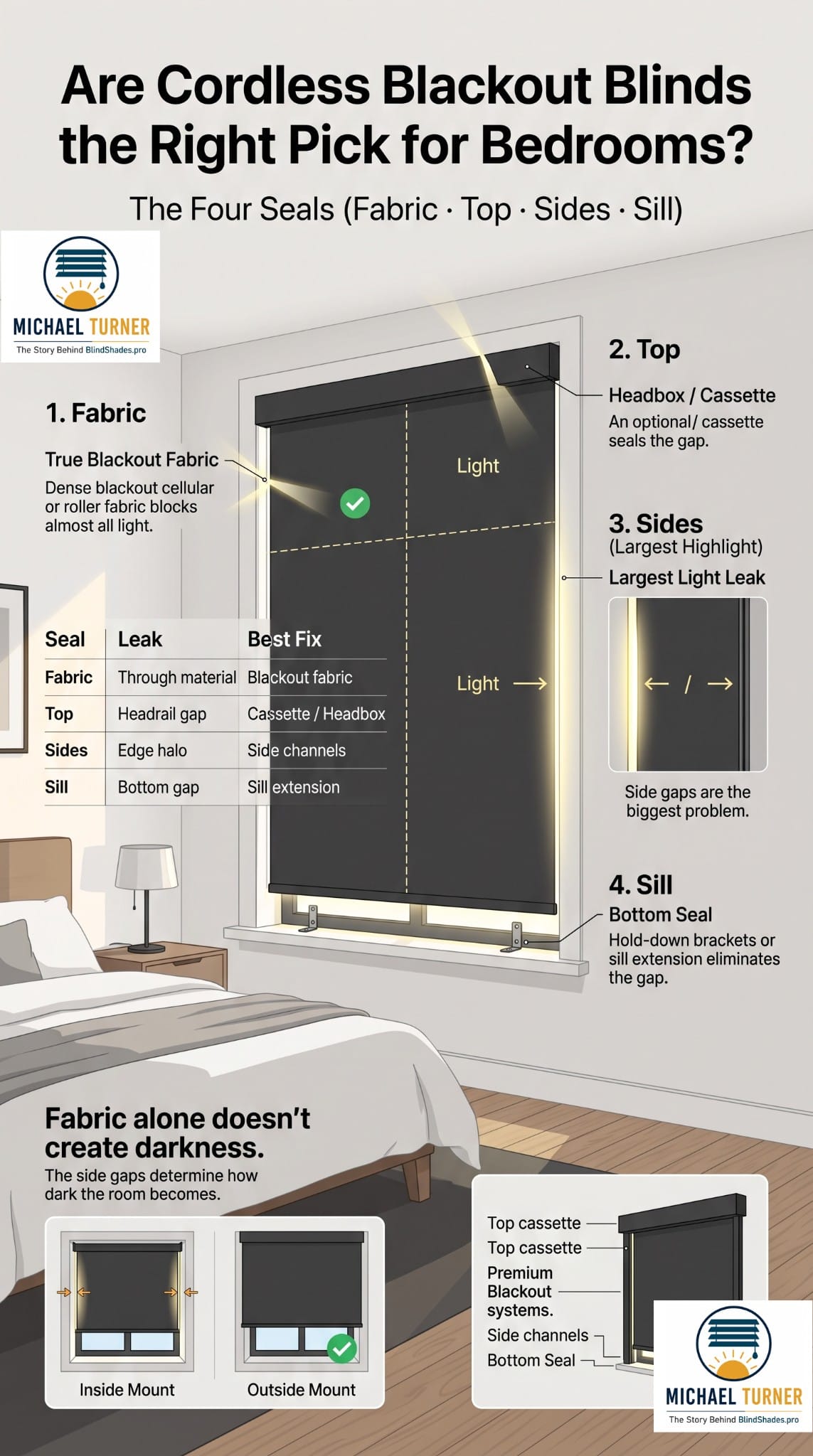
By Michael Turner — 30 years in window treatments
Yes, for most bedrooms — but the fabric is only one of four seals, and it is the only one the sales copy talks about. Norman, a manufacturer of these products, states the position more bluntly than any retailer will: a wholly blackout fabric is not possible, because light seeps through the top and the sides of the shade. Total darkness comes from sealing the assembly — a light-blocking top treatment and side channels — not from buying a darker fabric. So the honest answer is that cordless blackout blinds are the right pick when you understand what you are actually buying, and a disappointment when you buy the adjective on the label. Cordless also adds five specific complications in a dark room that almost nobody writes about.

Key Takeaways
- Light enters at four places, and fabric only blocks one of them. The sides are where you notice it.
- “Blackout” is not a regulated term. One retailer’s room-darkening percentage is another’s blackout.
- The seal is buyable. Side channels and cassette headboxes exist as ordering options, not improvisations.
- No-drill undercuts the blackout claim, because no-drill means inside mount and inside mount is what leaks.
- Cordless has a dark-room problem nobody mentions: you have to find the bottom rail by touch.
⭐ Quick Answer — Are Cordless Blackout Blinds Right for Bedrooms?
Yes for most bedrooms — but cordless blackout blinds only deliver darkness when you seal the assembly, because the fabric is just one of four places light gets in:
- A manufacturer says fabric alone cannot do it. Norman states that a wholly blackout fabric is not possible, since light seeps through the top and sides — total darkness needs a light-blocking top treatment plus side channels.
- The sides are what you actually notice. Blindster calls it the halo: a sliver of light around the outer edges that no shade removes on its own. The diagnosis is in why light comes through the sides.
- “Blackout” is not a regulated word. Published bands overlap so badly that one seller’s room-darkening shade outperforms another’s blackout — read the figure for the specific fabric, not the adjective.
- Cordless adds a dark-room catch. You have to find the bottom rail by touch, so leave the shade a hand’s width down — and never split a wide blackout bedroom window, because the meeting rail becomes a light line.
- Cheapest real fix: mount outside the opening with overlap. Wirecutter names a cordless blackout cellular shade among its picks; compare the category in our blackout blinds guide and the cordless blinds and shades guide.
Are Cordless Blackout Blinds the Right Pick for Bedrooms?
The Four Seals (Fabric · Top · Sides · Sill)
They are, once you stop treating this as a fabric decision. A blackout shade has four places light can get in, and buying a better fabric improves exactly one of them.
| Seal | What leaks | The fix | What it costs |
|---|---|---|---|
| Fabric | Light through the material itself | A true blackout fabric — cellular or roller | Included in the product |
| Top | The gap above the headrail | A cassette or headbox, or mount outside the opening | Small upcharge |
| Sides | The halo down both edges — the one you notice | Side channels, or outside mount with generous overlap | The largest upgrade |
| Sill | Light under the bottom rail | Sill channel, hold-down brackets, or order length past the sill | Cheap or free |
The sides are the whole game. The trade calls it the side gap or light gap, and Blindster describes the result plainly: even with blackout shades, a little halo of light still sneaks through around the outer edges, and no shade makes a room pitch black on its own. That halo is what makes people conclude blackout blinds “don’t work,” when the fabric is doing its job and the mounting is not.
The fix is a product, not a workaround. Norman sells LightGuard 360, which adds a light-blocking top treatment plus side and bottom channels around the shade’s edges. Hunter Douglas offers LightLock on its Duette honeycomb shades, using side channels to seal incoming light. Independent installers describe the same upgrade generically — slim tracks along the sides of the frame that hold the fabric and close the gap. If you have already met this problem, the diagnosis is in why light comes through the sides of blackout blinds.
The cheapest version of the same result is an outside mount with real overlap — the shade wider and longer than the opening, so the leak paths simply are not there. It looks less tailored and it works. Measuring for that is a different exercise from measuring for an inside mount, covered in measuring windows for blackout blinds.
What Does “Blackout” Actually Mean on a Label?
Less than you would hope, because no standard defines it. Compare what different sellers publish and the two categories overlap so heavily that the words stop sorting products.
| Seller | “Room darkening” | “Blackout” |
|---|---|---|
| UBlockout | 70–85% | 85–100% |
| SelectBlinds | around 70–99% | nearly all light |
| Blindster | 95–99% | 100% |
| Factory Direct Blinds | 95–99% | almost all light |
| EcoSmart Shades | softens light | up to 99% |
Read that column pairing again: one seller’s room-darkening shade blocks 95 to 99 percent, while another’s blackout shade starts at 85. A product labelled room-darkening by one company can outperform a product labelled blackout by another. This is the same pattern that sits behind the word “thermal” — a marketing adjective with no regulator behind it.
Two practical consequences. Ignore the adjective and read the actual figure the seller publishes for the specific fabric. And treat any percentage as a fabric rating measured through the material, never a promise about your room — the full comparison of the two terms is in blackout versus room darkening shades.
One more honesty note. The sleep case for darkness is real and well established in general terms, but the specific light-threshold numbers circulating in this category come from companies selling the solution, so this guide does not repeat them. If sleep is the whole reason you are shopping, are blackout blinds worth it for sleep takes that question on its own terms.
What Does Cordless Add — and Cost — in a Dark Bedroom?
Cordless is the right operation for a bedroom, particularly a child’s, because there is nothing hanging to reach. It also creates five complications that only show up in a room you have deliberately made dark.
| Complication | Why cordless causes it | The fix |
|---|---|---|
| Finding the rail in the dark | No cord hanging at a fixed height — you must locate the bottom rail | Leave the shade a hand’s width down, or fit the clear rail handle |
| Marking the fabric | You grip the rail, and on cellular your fingers meet fabric | Use the handle; clean per the fabric’s own rules |
| A light line across the middle | A wide opening split into two panels leaves a meeting rail | ⭐ Never split a blackout bedroom window |
| No second chance on width | Cellular and honeycomb cannot be narrowed after the fact | Measure three times, order once |
| The rail sits below the sill | Blackout length should overshoot the sill to kill the bottom leak | Accept it, or fit hold-down brackets |
The third one is worth dwelling on, because it is a trap set by good advice. On a very wide window the correct engineering answer is usually to divide the span across two or three panels on one headrail — that is how the industry prevents sag, and it is explained in cordless blinds for large windows. In a living room that split is invisible. In a blackout bedroom it introduces a vertical light line exactly where you least want one. If your bedroom window is wide enough to need splitting, either accept the line, seal it with an outside mount that spans the whole opening, or motorise a single panel instead.
The fourth is the one that costs money. Because a blackout cellular shade cannot be trimmed narrower after it arrives, the order has to be right first time — the rules are in can you cut cordless blinds to size.
⭐ And the elegant answer to the dark-room grab is a different configuration entirely. A top-down bottom-up shade lets you drop the top rail for daylight while the bottom stays sealed, which means you rarely need to hunt for the bottom rail at all. It is the configuration that suits blackout bedrooms best and the one least often recommended for them — see cordless top-down bottom-up shades.
Which Configuration Suits Your Sleep?
The right specification depends on how light-sensitive you are and when you sleep, not on the room’s name. Community discussion of bedroom shades keeps landing on the same qualifier: blackout matters most if you are a light-sensitive sleeper or you nap during the day.
| Sleeper | What matters most | Configuration |
|---|---|---|
| Ordinary sleeper, curtains too | Fabric only | Inside-mount blackout cellular; curtains cover the halo |
| Light-sensitive, early sun | Side seal | Blackout cellular plus side channels, or outside mount |
| Daytime sleeper / shift worker | All four seals | Outside mount, cassette, side and sill channels |
| Nursery | Seal plus safety | Cordless blackout cellular, nothing reachable, sealed edges |
Shift workers are the hardest case in the category, because they need darkness at the brightest part of the day — that scenario has its own guide in blackout blinds for shift workers. For nurseries, the darkness question and the safety question are separate: cordless answers the safety half, and blinds for a nursery covers the room, while the safety claim itself is examined in are cordless blinds child-safe.
On material, cellular and roller both work. Cellular adds insulation and noise damping and is the type most often recommended for bedrooms; roller is flatter, cheaper and easier to pair with channels. The trade-offs are drawn in blackout roller versus cellular shades for bedrooms and in our cellular and honeycomb shades guide.
Do You Need No-Drill Blackout Blinds?
If you rent, no-drill is often the only option — but understand the trade you are making, because the standard recommendation contradicts itself. No-drill and tension-mounted shades are widely promoted as the best blackout choice for rentals, and they are genuinely the best damage-free choice. They are also, necessarily, inside mounts — and inside mounting is precisely the configuration that produces the side halo. A no-drill blackout shade is a blackout fabric with the leakiest possible seal.
That is not a reason to avoid them; it is a reason to expect the halo and plan around it. Pair a no-drill shade with a curtain or a removable side channel, choose the darkest fabric available since fabric is the only seal you control, and treat the result as a very dark room rather than a dark one. If a damage-free install is the constraint, our complete cordless blinds and shades guide and the blackout blinds and shades guide both cover no-drill options.
Avoid These Mistakes
- Buying the adjective. “Blackout” is unregulated; read the published figure for the specific fabric.
- Expecting a fabric to darken a room. A manufacturer says a wholly blackout fabric is not possible — seal the top, sides and sill too.
- Inside-mounting when you needed darkness. The tailored look costs you the side seal; outside mount with overlap is the cheap fix.
- Splitting a wide blackout bedroom window. The meeting rail becomes a light line across the middle.
- Ordering blackout cellular before measuring three times. It cannot be narrowed later.
- Stopping the shade at the sill. Overshoot it, or fit hold-downs, or accept the bottom glow.
Who Should Choose Cordless Blackout?
Choose cordless blackout if: ✔ The room is a bedroom or nursery, and safety and a clean look both matter ✔ You will seal the sides with channels or an outside mount, not just trust the fabric ✖ Not if you want one unbroken shade across a very wide bedroom window
Add full channels if: ✔ You sleep in daylight, or wake to direct morning sun on that window ✖ Not if a curtain over the top is already solving it
Consider motorised instead if: ✔ The window is out of reach, or you want a single sealed panel across a wide span ✖ Not for an ordinary reachable bedroom window, where cordless costs less and does the job
The Bottom Line
Cordless blackout blinds are the right pick for bedrooms, with one correction to how the category is sold: darkness is a property of the whole assembly, not the fabric. Get the fabric right, then seal the top, the sides and the sill — because the halo down the edges is what people actually complain about. Ignore the words on the label and read the published figures, expect a no-drill shade to leak at the sides, never split a wide blackout bedroom window, and remember that a blackout cellular cannot be trimmed after it arrives. Cordless is the safest operation for a child’s room; leave the shade a hand’s width down so you can find it in the dark.
Ready to specify one? Start with our complete cordless blinds and shades guide, or compare the whole category in the best blackout blinds and shades guide.
FAQ
Do cordless blackout blinds block all light? Not on their own. Blackout fabrics block nearly all light through the material, but light still enters around the top, sides and bottom of an inside-mounted shade — a manufacturer states that a wholly blackout fabric is not possible. Side channels, a cassette headbox or an outside mount with overlap close those paths.
What is the difference between blackout and room darkening? Less than the words imply, because neither term is regulated. Published ranges overlap heavily: one seller lists room darkening at 95 to 99 percent while another starts blackout at 85. Read the specific figure for the fabric you are ordering rather than the category name on the page.
How do you stop light coming through the sides of blackout blinds? Three ways, in order of cost. Mount outside the opening with generous overlap so there is no side gap. Add side channels — slim tracks that hold the fabric edges, sold as options such as LightGuard or LightLock. Or hang a curtain over the shade, which covers the halo without changing the blind.
Are cordless blackout blinds safe for a nursery? Cordless removes the reachable hanging cord, which is the specific hazard safety standards target, so it is the right operation for a nursery. Darkness and safety are separate questions though — seal the edges for darkness, and keep any cord, chain or tension device out of reach entirely.
Are cordless blackout blinds good for shift workers? They can be, but daytime sleeping is the hardest case in this category and fabric alone will not do it. Expect to need all four seals — an outside mount or cassette at the top, side channels down both edges and a sill channel or overshoot at the bottom.
Are no-drill blackout blinds any good for bedrooms? For renters they are often the only option and they install without damage, but they are inside mounts by design, so they leak at the sides more than a mounted shade does. Choose the darkest fabric available, since fabric is the one seal you control, and pair it with a curtain.

Related Guides
- Best Cordless Blinds & Shades — the complete buying guide
- Best Blackout Blinds & Shades — the whole blackout category
- Why Is Light Coming Through the Sides of Blackout Blinds? — the halo, diagnosed
- Blackout vs Room Darkening Shades — what the labels mean
- Cordless Top-Down Bottom-Up Shades — the best blackout-bedroom configuration
- Cordless Blinds for Large Windows — why not to split a bedroom span
- Blackout Blinds for Shift Workers — sleeping in daylight
- Best Blinds for a Nursery — darkness and safety together
- Blackout Roller vs Cellular Shades for Bedrooms — the material call
- Are Blackout Blinds Worth It for Sleep? — the sleep case
