The Best Blackout Cellular Shades

Authored By Michael Turner -30 Years Home Improvement Expertise | Updated 2026 | BlindShades.pro
Updated on July 30, 2026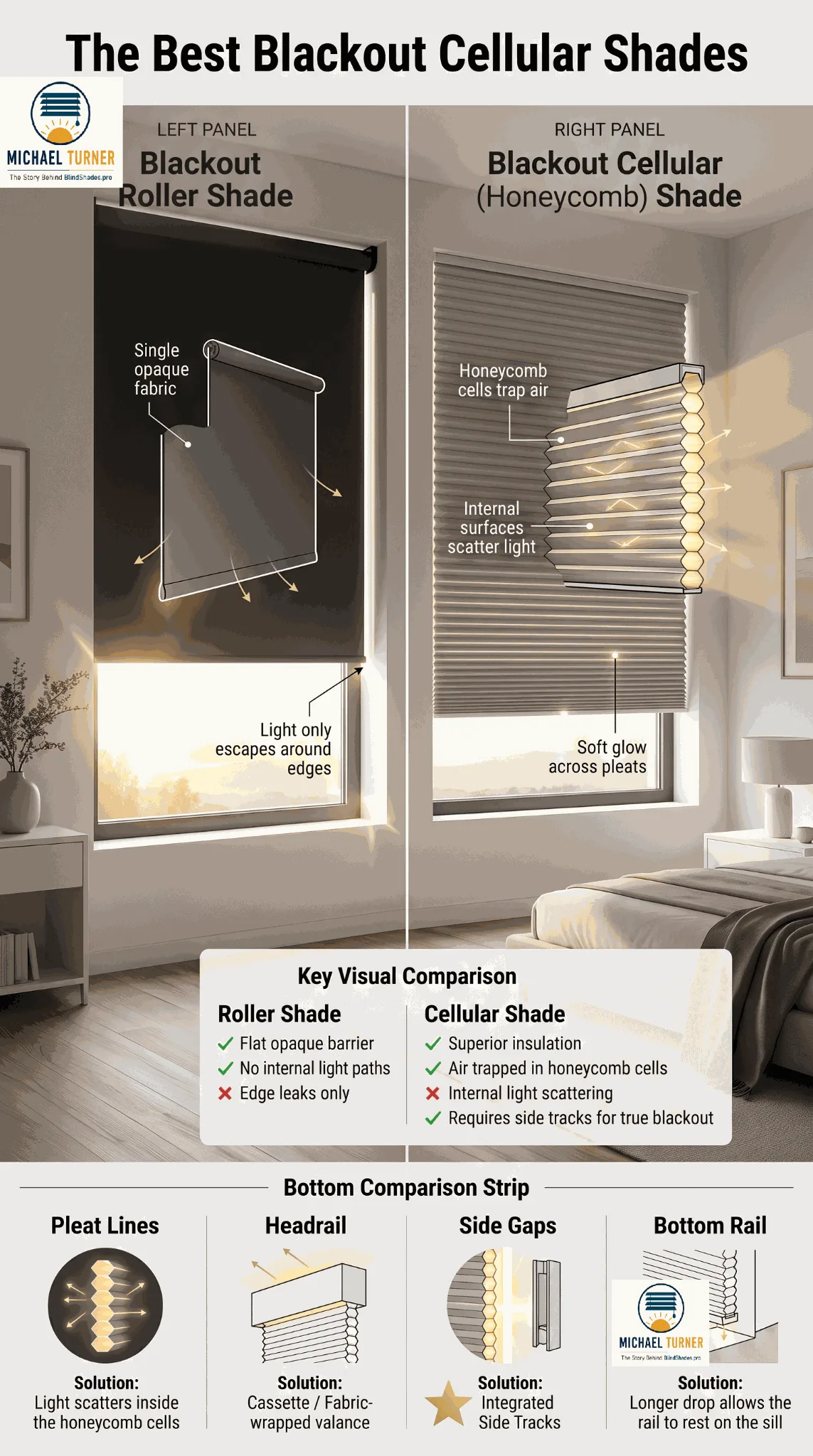
By Michael Turner — 30 years in window treatments
The best blackout cellular shades are the ones with tracked sides and a review base big enough to trust — and the category’s most-promoted products are not its best-evidenced ones. Cellular is the only blackout format that insulates properly, which is why it belongs on cold or overheating windows. But the honeycomb that traps air also gives light somewhere to travel, so a cellular shade needs its sides closed more than a roller does. And what the independent testers chose barely overlaps with what carries thousands of verified reviews.

Key Takeaways
- Cellular earns its place on thermal grounds, not light-blocking grounds. Nothing else in the blackout category insulates comparably.
- The cells are the weakness too. Light travels inside the honeycomb and glows along pleat lines and the top rail, so tracked sides matter more here.
- ⚠️ Two of the biggest test houses pick a roller, not a cellular, as their best blackout shade overall — worth knowing before you pay a cellular premium.
- Check the review base, not the star rating. In this category ratings sit on anything from eight reviews to nearly five thousand.
- The list price is largely fiction. Half-off is the standing state, not an event, so never buy on a discount claim.
⭐ Quick Answer — The Best Blackout Cellular Shades
Buy cellular for insulation and buy it with tracks — the best blackout cellular shades are judged on three things, not on the star rating:
- Who actually tested it. Bob Vila runs the only cellular-specific test programme in circulation and named the Windowsandgarden cordless honeycomb its overall pick.
- ⚠ Two big test houses chose a roller instead. The Spruce and Better Homes & Gardens both named the same blackout roller best overall, filing cellular only as most insulating.
- How many reviews sit behind the rating. One listing shows 4.8 stars on eight reviews beside another at 4.4 on roughly 4,800. Read the count first.
- Whether the sides are closed. The honeycomb scatters light along the pleats and at the head, so genuine darkness needs integrated side tracks — see how to get true blackout from a cellular shade.
- Cellular earns its premium on heat, not darkness. UBlockout scored one cordless blackout cellular shade at 90 to 95 percent — good, not total. Compare the whole format in our cellular & honeycomb shades guide.
✉ Ask Michael a Question — installation, buying advice or repair
Straight to Michael Turner — 30 years in window treatments.
What Are the Best Blackout Cellular Shades to Buy?
SCORE, BASE, TRACK — judge any blackout cellular shade on who actually tested it, how many verified reviews sit behind the rating, and whether the sides are closed.
Every product below is one we have seen listed with a real published rating or a named test-house endorsement. Prices move constantly in this category, so treat the figures as the order of magnitude they were at the time of writing rather than a quote.
| Category | Product | Where it sells | Verified rating and base |
|---|---|---|---|
| Best on verified volume | Home Decorators Collection Blackout Cordless Cellular Shade | Home Depot, around thirty dollars | 4.4 stars on roughly 4,800 reviews — the largest base in view |
| Best budget | Blindster Cordless Blackout Cellular, Tussah | Blindster, around twenty-seven dollars | 4.5 stars on roughly 844 reviews |
| Best top-down bottom-up | Cordless Blackout Top-Down Bottom-Up Cellular, French Roast | Blindster, around forty-five dollars | 4.5 stars on roughly 565 reviews |
| Best for true darkness | SelectBlinds Click2Fit Cordless Total Blackout Cellular | SelectBlinds, roughly ninety to one hundred seventy-five dollars | ⭐ Three-eighths-inch cells with integrated side and bottom tracks; no public base in view |
| Best insulating | IKEA Trippevals Blackout Cellular Blind | IKEA, around sixty-five dollars | The Spruce’s Most Insulating pick after its testing programme |
| Best tester-scored | Select Blinds Essential Cordless Blackout Cellular | Select Blinds, from around one hundred seventeen dollars | ⭐ UBlockout scored it 90 to 95 percent for blackout |
⚠️ One listing to treat carefully: a Blindsgalore Harmony blackout cellular shade shows 4.8 stars — the highest rating on the page — on eight reviews. That is not a bad product, and it may well be excellent. It is simply a number that cannot carry weight next to 4.4 on nearly five thousand. Ratings and review bases are different pieces of information, and the category prints them at the same size.
For motorised, the premium answer in circulation is Serena by Lutron, endorsed for smart-home integration with the caveat that setup is more involved. If motorisation is the priority rather than blackout, the motorised and smart blinds guide is the better start.
What Did the Independent Testers Actually Pick?
Both of the biggest test houses on this subject chose a roller shade, not a cellular one — and almost nobody writing about blackout cellular shades mentions it.
This is the most useful thing in the field and it is buried. When you read the published testing rather than the retailer copy, the pattern is consistent: cellular wins on insulation and loses on best-overall.
| Test house | Published | Named best overall | Was it a cellular shade? |
|---|---|---|---|
| Better Homes & Gardens | March 2026 | ChrisDowa blackout roller shade | No — a roller |
| The Spruce | April 2026 | ChrisDowa blackout roller shade | No — a roller; its cellular pick is filed as Most Insulating |
| Bob Vila | Cellular-specific test | Windowsandgarden Cordless Honeycomb | Yes |
| Wirecutter | July 2026 | Names a blackout cellular shade for fabric range and the easiest manual lift-and-lower in its group | Yes, but for handling rather than darkness |
Read down that last column and the conclusion appears on its own. Asked which blackout shade is best, a test house reaches for a roller; asked specifically about cellular, cellular wins — because the question changed. Two publishers converging on one roller model is a real signal, and it means the reason to buy cellular must be something other than raw light blocking. That reason is thermal, and it is a good one: nothing else here holds an insulating air pocket against the glass. The cell-count decision sits in cellular shade R-value by cell count and the cold-climate case in cellular shades for cold climates.
Wirecutter’s finding is easy to misread. Its praise for the cellular shade is about fabric choice and ease of raising and lowering by hand — a usability verdict, not a darkness verdict. Real advantage if you operate the shade daily; not evidence that cellular blocks more light.
Why Does a Cellular Shade Leak Light Where a Roller Does Not?
Because the honeycomb that traps air is also a channel light can travel along, so cellular needs its sides closed more than any other blackout format.
A roller shade is a single flat sheet. Coat it or laminate it and the only way light gets past is around the edges. A cellular shade is a folded structure of sealed cells, and that structure does two things at once: it holds still air, which is why it insulates, and it presents dozens of internal surfaces that scatter light rather than absorbing it. At low sun angles you can see the result as a faint line along each pleat, or a soft glow across the whole face, even with the shade fully down and a genuinely opaque fabric specified.
| Where light gets in | Why the cell structure causes it | What actually closes it |
|---|---|---|
| Along the pleat lines | Light entering a cell scatters between its internal faces instead of stopping | A denser fabric, or accepting the glow and adding a second layer |
| At the top rail | The cells terminate at the headrail, leaving a path above the stack | A cassette or a fabric-wrapped valance |
| Down both sides | The stack must run narrower than the recess to travel freely | ⭐ Integrated side tracks — the only complete fix |
| At the sill | The bottom rail rests but rarely seals against an uneven sill | Ordering the drop long, so the rail sits on the sill |
This is why the premium end of the category is defined by hardware, not fabric: the dearest blackout cellular products are the ones with tracks built in, not the ones with the darkest cloth. The mechanics of getting a cellular shade genuinely dark are in how to get true blackout from cellular shades, the headrail complaint in the gap at the top, and an honest assessment of the hardware in whether blackout side tracks seal.
What Do the Ratings and the Discounts Actually Tell You?
Very little as printed — because the review bases behind the stars differ by a factor of six hundred, and the crossed-out price is close to fictional.
Set the listings side by side and the pattern is impossible to miss. One blackout cellular shade carries 4.8 stars on eight reviews. Another carries 4.4 on roughly 4,800. A third sits at 4.2 on around 957, a fourth at 4.5 on 844, a fifth at 4.4 on 242. Sorted by star rating, the eight-review product wins the page. Sorted by how much evidence sits behind the number, it is the least informative listing on it.
The pricing tells the same story in a different currency. Across the products visible at the time of writing, three carried struck-through list prices roughly double what they were selling for — one at about one hundred fifty-three from three hundred six, one at about sixty-one from one hundred twenty-two, one at about ninety-eight from one hundred fifty-one — alongside a standing half-off badge. ⭐ When half-off is the permanent state of a category, it is not a discount, it is the price. The list figure exists to make the selling figure look like a decision you should hurry.
Two rules follow. Read the review count before the star rating, and treat anything under about a hundred reviews as an opinion rather than a signal. And never let a countdown or a crossed-out number set your timing — know the size and specification you want, then check two or three sellers.
Avoid These Mistakes
- Buying cellular for darkness alone. A roller does that more cheaply. Cellular is worth the premium when insulation matters too.
- Skipping the tracks and hoping. If the room has to be genuinely dark, the sides need closing. Budget for it at the outset.
- Sorting by star rating. An eight-review 4.8 sits above a 4,800-review 4.4 and tells you far less.
- Ordering the drop to the exact sill height. The bottom rail should rest on the sill, not stop above it.
- Washing the shade. Cellular cannot be submerged; water wicks into the cells and destroys both the coating and the pleat memory.
- Assuming a blackout label means darkness. Published blocking percentages disagree across the industry and nobody certifies them — the competing claims are set out in blackout blinds versus blackout curtains.
Who Should Choose Which?
| Your situation | Choose | Why |
|---|---|---|
| Cold room, single glazing | Double-cell blackout cellular | The air pocket is the point; darkness comes along with it |
| Genuine darkness required | Cellular with integrated tracks | Nothing else in the format closes the sides |
| Budget bedroom, one window | Budget cordless blackout cellular | Hundreds of verified reviews at low cost |
| Want daylight and privacy | Top-down bottom-up blackout cellular | Lower half closed, light over the top |
| Darkness only, tight budget | A blackout roller instead | Two test houses named a roller best overall |
| Nursery or child’s room | Cordless cellular, no loose cords | Safety first, cords never |
| Smart-home setup | Motorised cellular | Convenience is the purchase, not the blackout |
✔ Choose blackout cellular if the window loses or gains heat, the room needs both insulation and darkness, or you want the top-down bottom-up option — which the top-down bottom-up guide covers in full.
✔ Choose the tracked version if darkness is a requirement rather than a preference. Compare with the pleated alternative in blackout pleated versus blackout cellular.
✖ Do not choose cellular if you only want the room dark and the window is not a thermal problem — see blackout roller versus cellular for a bedroom.
✖ Do not choose cellular for a bathroom or anywhere humid. Moisture in the cells is the one failure this format cannot recover from.
The Bottom Line
The best blackout cellular shades are the tracked ones, and cellular is worth choosing when the window has a thermal problem as well as a light problem. If it does not, a blackout roller will darken the room for less. Buy on review base rather than star rating, treat the crossed-out price as marketing, and budget for side tracks from the start rather than discovering you need them after the first bright morning.
Compare cellular against every other blackout format in our blackout blinds and shades guide, or start from the format itself in the cellular and honeycomb shades guide. Check current prices across two or three retailers before ordering — in this category the same shade moves substantially week to week.
FAQ
What are the advantages of blackout cellular shades?
Insulation, chiefly. The honeycomb holds still air against the glass, so the shade slows heat loss and heat gain in a way no other blackout format matches. You also get cordless and top-down bottom-up options widely, and a soft appearance that suits living spaces better than a flat roller.
Do cellular shades offer complete blackout at the sides?
Not on their own. The stack has to run narrower than the recess to travel freely, so two lines of light sit down the edges. Only integrated side tracks close them, which is why the premium blackout cellular products are defined by their hardware rather than their fabric.
Are blackout cellular shades better than blackout roller shades?
For insulation, clearly. For darkness alone, no — two major test houses named a roller as their best blackout shade overall. Choose cellular when the window is a thermal problem as well as a light problem, and a roller when you simply want the room dark.
Are single or double cell blackout shades better?
Double cell insulates more and costs more; single cell is slimmer and stacks tighter. For a cold window or a hot south elevation, double earns its price. For a mild climate where darkness is the goal, single is usually enough. The R-value comparison sets out the difference properly.
Can you wash blackout cellular shades?
No. Water wicks into the cells, lifts the blackout coating and destroys the pleat memory, and the shade will look acceptable while no longer performing. Vacuum with a brush attachment and spot-clean sparingly. This is the most common way owners ruin an expensive shade.
How much do blackout cellular shades cost?
At the time of writing, ready-made cordless versions ran from roughly twenty-five to sixty dollars, custom and tracked versions from about ninety to one hundred seventy-five, and motorised considerably above that. Prices move constantly and half-off is close to permanent, so check two or three sellers.
Related Guides
- Best Blackout Blinds & Shades — the parent guide
- Cellular & Honeycomb Shades — the format guide
- True Blackout From Cellular Shades — closing the gaps
- Cellular Shade R-Value by Cell Count — insulation numbers
- Single vs Double Cell Shades — practical differences
- Are Triple Cell Shades Worth It? — diminishing returns
- Hunter Douglas Duette vs Levolor — premium vs mid-market
- Cellular Shade Gap at the Top — the headrail problem
- Cordless Cellular Shade Won’t Stay Up — mechanism faults
- Cellular Shades for Basement Windows — damp and cold
