Best Woven Wood & Bamboo Shades 2026: The Complete Buying Guide

Authored By Michael Turner -30 Years Home Improvement Expertise | Updated 2026 | BlindShades.pro
Updated on July 18, 2026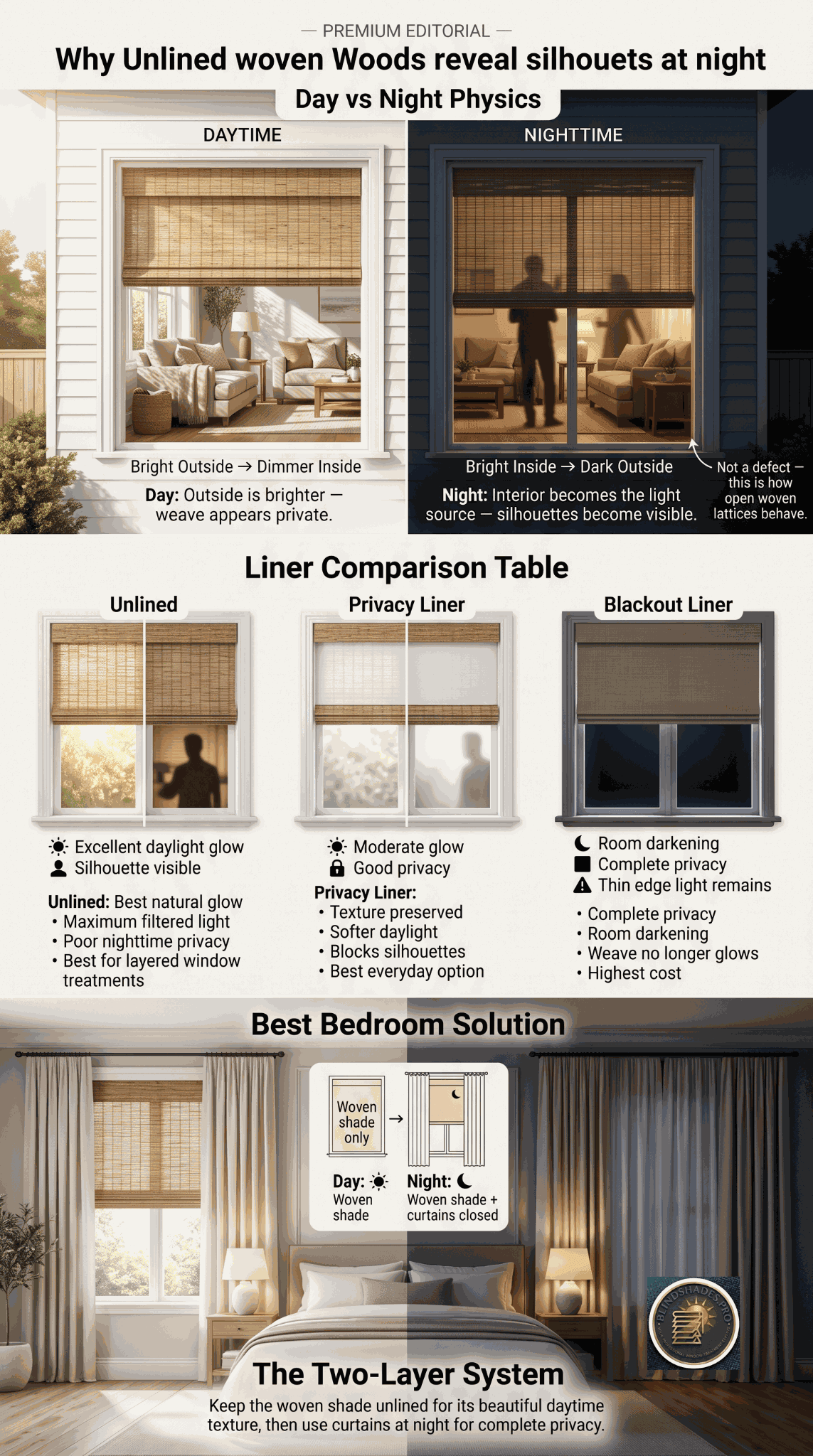
By Michael Turner, 30 years in the window treatment industry
A woven wood shade is a Roman shade woven from nature — bamboo slats, reeds, grasses, and jute folding up in soft horizontal pleats and throwing the dappled, organic light that no fabric can fake. That light is why people buy them. What nobody ranked on this topic will tell you is the category’s two governing truths: first, “bamboo shade” is not one product but a material family whose weave decides everything from price to privacy; and second, an unlined woven wood is beautiful by day and see-through by night — the liner, not the fabric, is the spec that decides whether these shades belong in your bedroom. This guide covers the picks, the weaves, the liner decision the stores bury in fine print, and the honest boundaries against faux wood, fabric Romans, and sheers.
Key Takeaways
- The liner is the real decision. Unlined woven woods glow by day and silhouette you by night — privacy liners are the living-space default, blackout liners convert the shade into a fabric-backed Roman (and roughly double the price), and unlined belongs in texture-first rooms or layered setups.
- Buy the weave, not the word. Bamboo slats, reeds, grasses, and jute weave, filter, and price differently — which is why the same product name runs from seventeen dollars to four hundred on this market.
- These are Romans at heart. Woven woods raise in the same flat, standard, and hobbled folds as fabric Romans and share their mechanics — the fold style changes the whole look.
- The volume verdict is decisive. Blindster’s Super Value cordless bamboo line carries a four point eight across eleven hundred fifty reviews on its own page — the category’s proven core, from seventeen dollars at the narrowest widths.
- The dappled light is the product. Filtered, warm, moving light is the entire case for this category — a feature in living rooms and sunrooms, a bug in media rooms and street-facing bedrooms without the right liner.
⭐ Quick Answer — The Best Woven Wood & Bamboo Shades
The best woven wood shades are chosen at three gates — Weave (bamboo slats, reeds, grasses or jute; density decides price and privacy), Liner (unlined weaves are see-through at night — privacy liners are the default, blackout liners for bedrooms), and Light (dappled filtering is the point):
- The volume verdict: Blindster’s Super Value cordless bamboo holds four point eight across eleven hundred fifty reviews from around seventeen dollars at narrow widths, and the honest category spine — natural bamboo and grasses with optional liners — is at Blindsgalore.
- The premium reference: the Designer Series grass and jute weaves two ranking bloggers independently cite live at Hunter Douglas, with a styling tip worth stealing — these shades can live half-raised — from the guide at The Turquoise Home.
- The mechanics: woven woods are Romans woven from grass — the fold decision (flat, standard or cascading) is mapped in flat vs relaxed vs hobbled Roman shades, and the fabric half of the family lives in the complete Roman shades guide.
- The night-privacy fix without a liner: keep the weave unlined for daytime glow and add a curtain layer after dark — the architecture in roller shades layered with curtains applies verbatim.
- The honest quirk: width-band pricing — the same shade runs from the twenties at eighteen inches to the eighties and beyond at wide windows, so compare per-window quotes, not headlines.
Quick Specification Reference
| Specification | The Short Answer |
|---|---|
| Best overall | Blindster Super Value Cordless Bamboo — from around seventeen dollars at forty-five percent off, four point eight across one thousand one hundred fifty product-page reviews |
| Best budget | Blindsgalore Cordless Woven Wood — around thirty-one at half off, four point eight across forty-six |
| Best custom | Blinds.com Custom Woven Wood, cordless lift — around forty-three to seventy-one, four point five across four hundred thirty-five |
| Best premium | Hunter Douglas Designer Series woven woods — dealer-quoted; West Elm custom bamboo blackout Roman around four hundred nine at the designer-retail ceiling |
| Typical cost range | Thirty-one to three fifty-seven per Blindsgalore; seventeen to about two hundred by width per Blindster; width-band pricing from the twenties to the eighties per A Storied Style (April 2026) |
| The material family | Bamboo slats, reeds, grasses, jute — weave density predicts price and privacy |
| The hidden spec | The liner: none, privacy, or blackout — decides night privacy and room fit |
| The mechanics | Roman-shade folds and lifts — flat, standard, or hobbled; cordless is the modern default |
Read the complete guide below for: the six Diamond picks anchored to the category’s biggest review bases, the Weave-Liner-Light Test, the material-family taxonomy no ranked page draws, the liner decision the stores bury in fine print, fold styles and room verdicts, the honest boundaries against faux wood and fabric Romans, and where to buy — with the width-band price truth and one lamp-shade warning.
What Are the Best Woven Wood & Bamboo Shades? Our Picks
Six picks, one per job — volume-anchored, blogger verdicts attributed, and the liner fine print stated inside the picks.
The best woven wood shades for most rooms is a reed-or-bamboo cordless shade with a privacy liner — but the market runs six honest lanes.
Best Overall — Blindster Super Value Cordless Bamboo Woven Wood. The category’s volume king: from around seventeen dollars at forty-five percent off at the narrowest sizes to about two hundred at the widest, with a four point eight rating across one thousand one hundred fifty reviews on the product page itself (the marketplace listings for the same family hold four point five across seventeen hundred). Real bamboo slats and reeds, bleached whites to dark browns, sixty-day returns — and liner options at order time, which is where the real decision lives.
Best Budget — Blindsgalore Cordless Woven Wood. Around thirty-one dollars at half off, four point eight across forty-six early reviews, from the store whose category page is the most honest spine on this market: natural bamboo and grasses, optional liners, cordless lifts, thirty-one to three fifty-seven. BlindsOnline’s cordless woven wood (around thirty-six, four point seven across twenty) is the wholesale-priced backup.
Best Custom — Blinds.com Custom Woven Wood with Cordless Lift. Around forty-three dollars in starter sizes to seventy-one in standard customs, four point five across four hundred thirty-five (the smaller-size listing holds four point four across three hundred eight). The continuous-cord-loop variant (around eighty-two, four point zero across two hundred forty-five) exists for tall drops — but cordless is the family default for good reason.
Best Big-Brand — Bali Natural Woven Wood. Around one hundred sixteen dollars at forty percent off via Blindsgalore, four point six across seventy-eight — the national-brand fabric library with woven-wood texture, and the bridge pick for buyers who want a name over a price.
Best Blogger-Proven — Arlo Cordless Rustique Bamboo Roman, with Chicology Belmon as the retail twin. Angela Marie Made’s February 2022 review still ranks for a reason: she calls the Arlo cordless rustique her favorite cheap bamboo shade, with the honest pros-and-cons (looks and quality outrunning the price) attached. The walk-in-retail twin is Chicology’s Belmon natural cordless bamboo Roman via Target — around fifty-two dollars, four point four across five hundred seven — from a brand whose own bamboo range runs forty-five to one thirty.
Best Premium — Hunter Douglas Designer Series Woven Woods. The reference standard two ranking bloggers independently point to — Danielle Moss’s woven woods and The Turquoise Home’s Designer Series jute — dealer-quoted, with the deepest grass-and-jute library in the category. The designer-retail ceiling is West Elm’s custom bamboo blackout Roman at around four hundred nine dollars — and note what that name admits: the blackout is a liner sewn behind the bamboo, which is exactly the framework’s point. You are always buying weave plus liner; premium just bundles them beautifully.
| Pick | Product | Approx. Price (as listed) | Rating / Reviews | Wins the gate for |
|---|---|---|---|---|
| Best Overall | Blindster Super Value cordless bamboo | Seventeen to two hundred by width | 4.8 / 1,150 | Volume-proven value, liner options |
| Best Budget | Blindsgalore cordless woven wood | Around thirty-one (half off) | 4.8 / 46 | The honest category spine, cheap |
| Best Custom | Blinds.com custom woven wood | Forty-three to seventy-one | 4.5 / 435 | Made-to-measure with cordless lift |
| Best Big-Brand | Bali natural woven wood | Around one sixteen (40% off) | 4.6 / 78 | National-brand fabric library |
| Best Blogger-Proven | Arlo rustique · Chicology Belmon | Budget class · around fifty-two | Attributed review · 4.4 / 507 | The four-year favorite + retail twin |
| Best Premium | HD Designer Series · West Elm blackout bamboo | Dealer-quoted · around four-oh-nine | Twice blogger-cited · designer retail | Grass/jute depth; the liner truth priced |
How Do You Choose? The Weave-Liner-Light Test
Three gates, in order: which natural material and how tightly it’s woven, which liner (if any) backs it, and whether the room wants the light these shades make.
Gate 1 — Weave. “Bamboo shade” is a family name. Flat bamboo slats, round reeds, fine grasses, and knotted jute all weave into shades — at different densities, different prices, and critically different levels of see-through. The taxonomy gets its own section below, because it is the section this entire market skips.
Gate 2 — Liner. The stores whisper it in spec sheets — Blindsgalore’s category page says “optional liners” and moves on — but the liner is the whole ballgame for privacy and room fit. Unlined, privacy, or blackout: the decision is covered in full two sections down.
Gate 3 — Light. The reason this category exists is what the weave does to sunlight: it breaks it into warm, moving, dappled texture. That is a feature in living rooms — the number-one room people search this category for — and in sunrooms, dining rooms, and kitchens. It is a bug in home theaters, glare-sensitive offices, and any bedroom that expects darkness from an unlined weave.
| Gate | The question | Pass looks like | Fail routes to |
|---|---|---|---|
| Weave | Which material, how dense? | Reeds/bamboo for the classic look; grasses/jute for designer softness | Ultra-open weaves where privacy matters |
| Liner | Who sees in at night? | Privacy liner as the living-space default; blackout for bedrooms | Unlined shades on street-facing glass |
| Light | Does the room want dappled light? | Living rooms, sunrooms, kitchens | Media rooms; sleep spaces without liners |
Related guides: woven texture is the design community’s failproof bay pick — with one transparency warning worth reading first in the bay and bow window shades guide.
What Are Woven Wood Shades Actually Made Of? Reading the Weave
Slats, reeds, grasses, and jute — the taxonomy that predicts price, privacy, and the look on your wall.
No ranked page on this market draws the map, so here it is. When Blindster’s product copy says real bamboo slats and reeds it is naming two of four distinct materials that all get sold under one label:
| Material | What it looks like | Weave & light behavior | Price band | Choose it for |
|---|---|---|---|---|
| Bamboo slats | Flat, uniform strips — venetian-adjacent when closed | Tighter, more regular; least see-through of the family | The budget core (Blindster’s seventeen-dollar class) | Clean lines, modern-rustic rooms |
| Reeds | Round profiles, visible weft cords — the classic “bamboo shade” | Medium density; the signature dappled light | Mid-market | The look most ID threads are chasing |
| Grasses | Fine, irregular, soft — reads as woven cloth from across the room | Variable density; the most texture per glance | Upper-mid to premium | Designer rooms, layered schemes |
| Jute / mixed naturals | Knotted, chunky, deliberately imperfect | Open and organic; most see-through unlined | Premium (HD Designer Series class) | Statement windows, coastal and organic-modern styles |
Three notes the taxonomy earns. First, weave density — not material name — predicts both price and privacy: a tight bamboo-slat weave outprivates a loose premium jute every time, which is why the liner gate exists. Second, finishes span bleached whites through tortoise and dark browns — the color range Blindster’s page states plainly — so the “too dark for my room” objection died years ago. Third, the sustainability case is real as the industry states it: bamboo and grasses are rapid-renewal crops, and eco-framing is now the category’s standard pitch from Blindsgalore to TWOPAGES — take it as a genuine bonus, and ask for chain-of-custody documentation if certification specifically matters to you.
And the identification demand deserves its answer. Two live community threads — twenty-plus and thirty-plus comments, one only five months old — ask where can I find these exact bamboo shades? The honest reply: the look in nearly every inspiration photo is unlined reed weave, outside-mounted, in a natural mid-tone. Name that spec and every custom shop on this page can build it; the top-voted answers (Amazon cordless finds, Smith and Noble’s selection, JC Penney) are all selling variations of the same three words.
The Liner Decision: Why Unlined Woven Woods Are See-Through at Night
The category’s buried mandatory question — beautiful by day, silhouette theater after dark.
Here is the physics every store’s “optional liner” dropdown is politely not explaining. An unlined woven wood is an open lattice. By day, light outside exceeds light inside, so the weave reads as glowing texture from within and near-opaque from without. After sunset the equation flips: your lit room becomes the bright side, and an unlined weave becomes a scrim — shapes, movement, and silhouettes read clearly from the street. This is not a defect; it is how lattices work. It is also the single most common regret purchase in the category.
| Liner choice | Day look | Night privacy | Light filtering | The honest cost |
|---|---|---|---|---|
| Unlined | The full dappled glow — the category at its best | Poor — silhouettes visible | Maximum filtered light | Cheapest; texture-first rooms and layered setups only |
| Privacy liner | Texture preserved, glow softened | Solid — shapes no longer read | Moderate | The living-space default; modest upcharge |
| Blackout liner | Texture by reflection only — the weave stops glowing | Complete | Room-darkening | Converts the shade into a fabric-backed Roman; can roughly double the price (West Elm’s four-hundred-dollar blackout bamboo is the ceiling case) |
Two riders. Blackout liners inherit the universal blackout caveat — the fabric blacks out, the edges still glow, and the side-gap physics is covered in why light comes through the sides of blackout blinds with the whole-room playbook in the complete blackout guide. And the layered alternative is often better than the blackout liner: keep the shade unlined for daytime glory and hang a curtain layer for night — the architecture argued in roller shades layered with curtains applies to woven woods verbatim, and it is the bedroom system our bedroom blinds guide calls the Two-Layer System.
Which Fold Style Should You Choose?
The best woven wood shades are Romans at heart — the fold sets the personality.
| Fold style | The look | Best with | Trade |
|---|---|---|---|
| Flat fold | Clean single plane when lowered; crisp stack | Bamboo slats, modern rooms | Least “romantic” drape |
| Standard Roman fold | Soft overlapping pleats — the classic | Reeds and grasses | The default for a reason |
| Hobbled (waterfall) | Permanent cascading folds even when lowered | Grasses, jute, traditional rooms | More fabric depth, more cost, slightly less light |
The full fold decision — with photos-worth-of-difference detail — is in flat vs relaxed vs hobbled Roman shades, and the fabric-Roman side of the family lives in the complete Roman shades guide — a woven wood is, structurally, a Roman woven from grass, and everything Romans know about lifts and folds applies here. One community-sourced tip worth its own sentence, from The Turquoise Home’s April 2024 guide: these shades can be pulled halfway down and left there — the half-raised stack is a legitimate permanent look, softening the window top while keeping the view. (For light-from-the-top with privacy below as an engineered feature rather than a styling trick, that is the top-down bottom-up family — the TDBU guide covers bamboo TDBU options too.)
Which Rooms Suit Woven Wood & Bamboo Shades?
Living rooms lead the demand for the best woven wood shades — with liner rules deciding the rest.
| Room | Verdict | The rule |
|---|---|---|
| Living room | The home turf — the top room term attached to this category | Privacy liner for street-facing glass; unlined for private aspects |
| Sunroom / dining | Yes, gloriously | Unlined earns its keep here |
| Kitchen | Yes, away from the splash zone | Natural texture over the sink is the look — Roman shades in the kitchen covers placement and cleaning |
| Bedroom | Only with the liner decision made | Blackout liner or the two-layer system — never unlined on street-facing sleep |
| Bathroom | Caveat — humidity and natural fiber disagree | Ventilated half-baths fine; steam rooms route to faux wood |
| Office | Glare check first | Dappled light on screens divides opinion — test before committing a Zoom wall |
Bamboo vs Faux Wood, Real Wood, Fabric Romans, and Sheers: Where’s the Line?
The 11-year-old Houzz question — bamboo shades or faux wood blinds — answered, plus the rest of the family tree.
| Contender | What it is | Choose it over woven wood when | The woven wood counter |
|---|---|---|---|
| Faux wood blinds | PVC/composite slat blinds | Bathrooms, tilt-control rooms, wipe-clean priorities | No slat blind makes dappled light; texture wins living spaces |
| Real wood blinds | Stained basswood slat blinds | You want furniture-grade millwork and tilt | Woven woods read organic and soft where wood blinds read tailored |
| Fabric Roman shades | The same folds in cloth | Pattern, color, true blackout without a conversion | Naturals bring texture no print matches |
| Window sheers | Soft light-filtering fabric | Maximum diffused brightness, curtain softness | Sheers glow evenly; weaves dapple — different poetry |
| Whether Romans at all are worth it | The family-level question | — | Argued honestly in are Roman shades worth it |
The Houzz debate’s honest resolution: it was never a fair fight. Faux wood is a function purchase (wet rooms, tilt, durability); bamboo is a light-and-texture purchase. Buyers torn between them usually have one wet-room window and one living-room window — and should buy one of each.
Where Should You Buy Woven Wood & Bamboo Shades?
The best woven wood shades follow width-band pricing — the category’s honest quirk — and one ranked shopping result is a lamp.
The freshest ranked editorial (A Storied Style, April 17, 2026) prices its affordable finds from the twenties at eighteen-inch widths to the eighties at the widest — and that width-band structure holds across the market: the same shade can triple in price as the window widens, so compare per-window quotes, not headline prices.
| Retailer / Route | Listed range (as published) | Rating shown | Watch-out |
|---|---|---|---|
| Blindster (value core) | Seventeen to about two hundred by width | 4.8 / 1,150 product page | Sixty-day returns; liner options at order |
| Blindsgalore (custom) | Thirty-one to three fifty-seven | 4.7 store / 4,600 | The honest liner-and-materials spine |
| Blinds.com / JustBlinds | Forty-three to eighty-two · around sixty-five | 4.5 / 435 · 4.3 / 255 | Cord-loop variant rates lower (4.0 / 245) |
| SelectBlinds | Fifty-five to eighty-four lines | 4.5 / 136 · 4.6 / 171 · 4.7 / 15 | Elevated Coastal line is new — thin base |
| Chicology (Target retail) | Forty-five to one thirty | 4.4 / 507 (Belmon) | The Home Depot Natural Woven listing sits at 3.5 / 4 — same brand, fragmented listings; sort by review count |
| TWOPAGES (curtain house) | Thirteen to one sixty-four | 4.5 store / 4.1K | Free delivery threshold is high |
| West Elm / HD dealers | Around four-oh-nine · dealer-quoted | Designer retail · reference brand | You are paying for the liner bundle and the label |
| Amazon / big-box PASF lanes | Arlo class, budget finds | Blogger-attributed | The community’s top-voted source for cordless budget finds |
And the deadpan warning this keyword earned: mid-results sits the IKEA GOTTORP — four point six across one hundred twenty-seven reviews, around forty dollars, and a pendant lamp shade. “Shade” is doing two jobs in this language; if the product hangs from the ceiling, you are one aisle over.
Related Buying Guides
- Best Roman Shades — the fabric half of the fold family
- Best Faux Wood Blinds — the wet-room and tilt-control lane
- Best Real Wood Blinds — stained millwork instead of woven texture
- Best Window Sheers — even glow instead of dapple
- Best Top-Down Bottom-Up Blinds & Shades — engineered light-from-the-top, bamboo included
Complete Woven Wood Guide Library
- Best Roman Shades — folds, lifts, and fabric-Roman picks
- Flat vs Relaxed vs Hobbled Roman Shades — the fold decision in depth
- Are Roman Shades Worth It? — the family-level value verdict
- Roller Shades Layered with Curtains — the layered-liner alternative
- Roman Shades in the Kitchen — natural texture near the sink, done right
- Best Faux Wood Blinds — the Houzz question’s other half
- Best Window Sheers — the soft-light neighbor
- Best Top-Down Bottom-Up Blinds & Shades — the “top down bamboo” answer
Frequently Asked Questions
What are the best woven wood bamboo shades? The best woven wood shades on the current market are Blindster’s Super Value cordless bamboo line — four point eight across eleven hundred fifty product-page reviews, from around seventeen dollars at narrow widths — with Blindsgalore and Blinds.com owning the custom lanes, Bali the national-brand lane, Chicology’s Belmon the walk-in-retail lane at Target, and Hunter Douglas’s Designer Series the premium grass-and-jute reference. Whichever you choose, the liner option at checkout matters more than the brand.
Are bamboo shades see-through at night? Unlined ones, yes — an unlined weave is an open lattice, and after dark your lit room becomes the bright side, so silhouettes read clearly from outside. A privacy liner solves it for living spaces; a blackout liner solves it for bedrooms (and converts the shade into a fabric-backed Roman); or keep the shade unlined for daytime beauty and layer a curtain for night.
What’s the difference between bamboo, reed, grass, and jute shades? They are one family sold under one name. Flat bamboo slats weave tightest and cheapest; round reeds make the classic dappled look most inspiration photos show; fine grasses read soft and designer; knotted jute is the premium, most open, most organic end. Weave density — not the material’s name — predicts both the price and how much you can see through it.
Do woven wood shades block light? Not by themselves — filtering light is their job, and the warm dappled glow is the reason to buy them. For room-darkening, add a blackout liner (expect the price to climb toward fabric-Roman territory) and remember the edges still glow like any blackout treatment; for true sleep-room darkness, the layered shade-plus-curtain system beats a liner alone.
Are bamboo shades good for bathrooms and kitchens? Kitchens, yes — away from the splash-and-splatter zone, natural texture over a sink window is one of the category’s signature looks. Bathrooms, carefully — natural fiber and daily steam disagree, so ventilated half-baths are fine and full steam rooms route to faux wood. Living rooms, sunrooms and dining rooms remain the home turf.
What do woven wood shades cost? Width decides more than brand: the market’s honest structure runs from the twenties at eighteen-inch widths to the eighties and beyond at wide windows (per the freshest ranked editorial), with Blindster’s value line from seventeen dollars, customs typically forty to one twenty, national brands like Bali around one sixteen on sale, and designer blackout-lined pieces reaching four hundred plus.
