Best Solar Shades for Blocking Heat: Do They Cool a House?

Authored By Michael Turner -30 Years Home Improvement Expertise | Updated 2026 | BlindShades.pro
Updated on July 22, 2026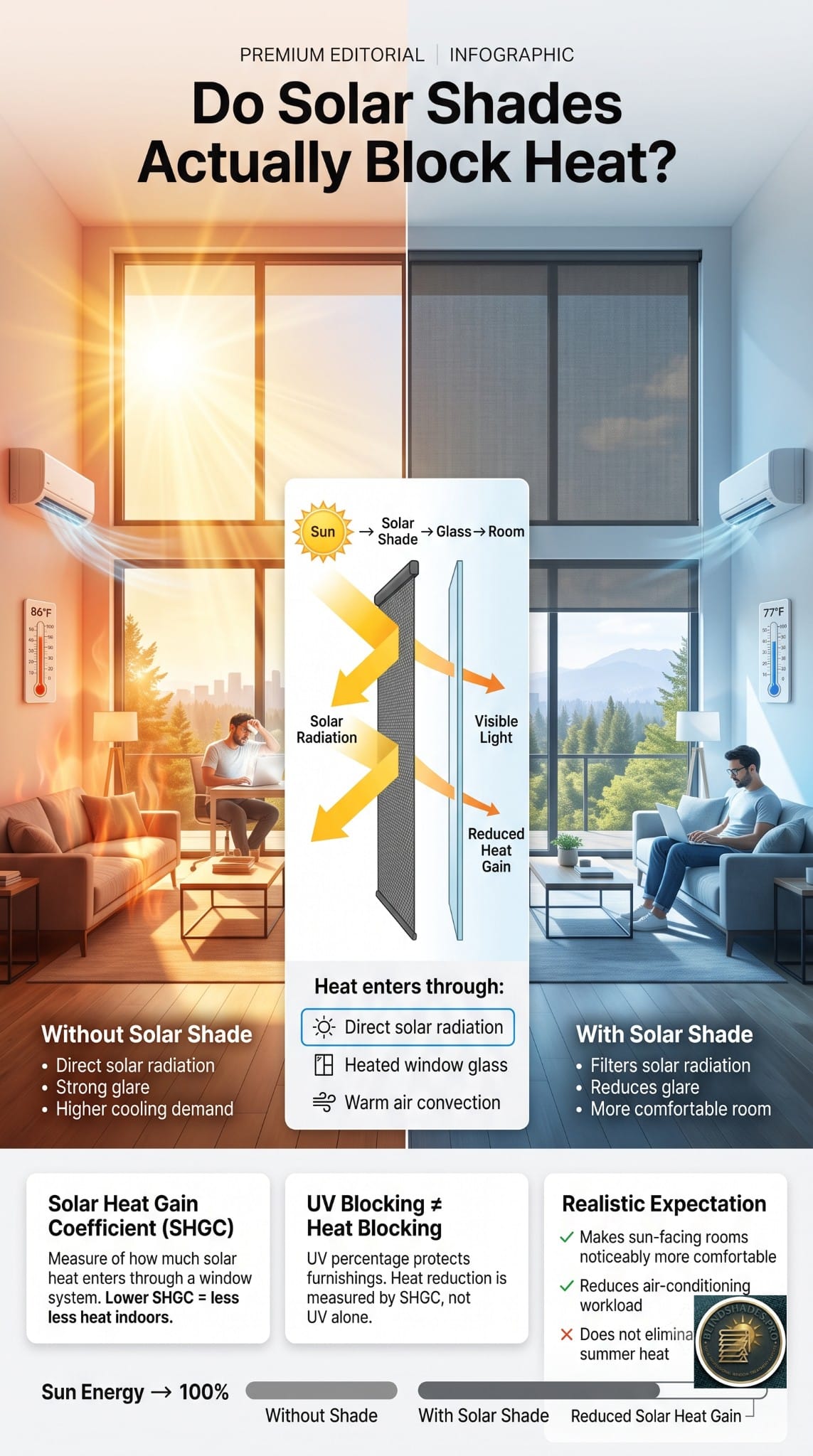
By Michael Turner — 30 years in window treatments
Yes — solar shades meaningfully cool a room, and the best solar shades for blocking heat are the ones matched to where the heat should be stopped: outside the glass, at the glass, or inside it. Stopped outside, most gain never enters; stopped inside, a well-chosen mesh still cuts glare-hour heat noticeably — while a dark tight weave in the wrong spot quietly re-radiates warmth into the room it should be cooling. This guide maps the three gates, corrects the color mistake, turns an 80-comment Phoenix thread into an escalation standard, and ends with verified picks and the exact max-heat spec.
Key Takeaways
- Where you stop heat matters more than brand. Industry guides such as Persilux Home credit exterior screens with blocking up to 90% of solar heat gain before the glass — earlier interception always beats later.
- Interior mesh is the value play, per the fabric maker itself. Phifer — supplier of the industry’s Sheerweave and Suntex fabrics — calls interior roller shades in high-performance fabrics the most efficient and cost-effective covering for reducing solar heat.
- The color paradox is real. Dark mesh sees better and absorbs more; light or metallized backings bounce energy back out — for pure heat rejection, the room-facing story is light.
- Cellular is the trap-the-air alternative. Blinds & More E. TN (August 28, 2023) puts double- and triple-cell honeycombs at the category’s highest R-value and shade coefficient — the fork our cellular matchup covers.
- The desert already ran this experiment. In an 80-plus-comment r/AskPhoenix thread, the 25-vote top answer is ceramic tint — “lets light in but blocks 90% of the heat” — with exterior shades at 14 votes; this guide formalizes that ladder.
⭐ Quick Answer — Best Solar Shades for Blocking Heat
The best solar shades for blocking heat follow the Three Gates rule — stop the sun outside the glass, at the glass, or inside it, and earlier always wins:
- Gate 1, outside: exterior screens intercept up to ninety percent of solar gain before the glass per industry guides — the desert-class answer, with Southwest Blinds serving exactly that market.
- Gate 3, inside: interior mesh is the value play — Phifer, the fabric maker itself, calls high-performance interior roller fabrics the most cost-effective route to cutting solar heat.
- The spec most buyers get backwards: tight AND light — a one-to-three percent weave in a light or reflective-backed fabric, generously mounted; dark mesh absorbs and re-radiates, and the openness math lives in our 5% vs 10% guide.
- Need insulation too? Honeycomb’s trapped air holds the category’s highest R-values — the fork is solar shades vs cellular shades.
- Ready to buy: verified picks with retail ratings — from Blindsgalore screen fabrics to big-box exterior rollers — are ranked in the complete solar shades guide, and every listing runs on deep promo cycles, so never buy at list.
Do Solar Shades Actually Block Heat?
Yes — solar shades are engineered for exactly this job, and the industry says so plainly: the Blind Guy of Missoula (May 29, 2026) describes them as designed specifically to reduce solar heat gain while maintaining visibility, and Southwest Blinds in Phoenix credits them with letting light in while greatly reducing a home’s solar heat. The honest part is what “block heat” means. A window heats a room by direct radiation, by the glass warming and re-radiating, and by convection; solar mesh — PVC-coated polyester or fiberglass — intercepts the radiation share, which is why a sun-facing room feels calmer within minutes of dropping the shade.
What no seller page explains is the measurement behind the promise: heat performance is the SHGC concept — solar heat gain coefficient, how much of the sun’s energy ends up inside — a different number from the UV percentages quoted everywhere (our openness guide untangles the conflation). Expectations, honestly set: good interior mesh turns a punishing afternoon room comfortable and eases the air-conditioning load; it does not make August feel like October. How close you get depends on which gate you stop the heat at — the decision that actually ranks the products.
Where Should the Heat Be Stopped? The Three Gates
The Three Gates (Outside · Glass · Inside): heat can be stopped before the glass, at the glass, or inside the glass — and earlier always beats later, because energy that never enters cannot warm the room.
The conventional hierarchy is correct as far as it goes — exterior first, interior next, honeycomb for insulation — but it is usually presented as a list where a model belongs. Every option slots into a gate. Gate 1, outside: exterior screens intercept before the glass — Persilux Home puts the figure at up to 90% blocked, and Solar Screen Outlet advises 90%-class screens when heat is the main concern. Gate 2, at the glass: film and ceramic tint, the Phoenix forum’s favorite — invisible and permanent, at the price of treating the glass. Gate 3, inside: mesh reflects and intercepts radiation (best with light or metallized room-facing surfaces) while honeycomb traps air, the physics behind Blinds & More’s R-value figures and the reason cellular also wins winter (the cold-weather question is its own guide).
| Option | Gate | Mechanism | Keeps the view? | Renter-friendly? |
|---|---|---|---|---|
| Exterior solar screen/shade | 1 — Outside | Intercepts before the glass (up to ~90% per Persilux Home) | Yes — mesh view out | Rarely — mounted outside |
| Ceramic tint / window film | 2 — Glass | Rejects gain at the pane (25-vote Phoenix favorite) | Yes — clearest of all | No — permanent |
| Interior solar mesh | 3 — Inside | Reflects/intercepts radiation; openness + color set the math | Yes — the signature talent | Yes |
| Cellular (honeycomb) | 3 — Inside | Traps air; highest R-value + shade coefficient per Blinds & More | No when lowered | Yes |
| Blackout solar / room-darkening | 3 — Inside | Blocks light and radiation wholesale | No | Yes |
Which Openness and Color Block the Most Heat?
Tight and light — the max-heat interior recipe, and it contradicts what most buyers order. On openness the sources align: industry guidance converges on a 1–3% weave for high-heat areas, and Bringnox (March 11, 2026) ranks 1% best for heat blocking. On color, the paradox: dark mesh sees best and kills glare best, but — as even the sellers concede — lighter colors bounce solar energy back out the window while dark fabrics absorb and re-radiate it indoors. A dark 1% shade in a baking window becomes a warm radiator panel: better than bare glass, worse than its light twin.
| Interior configuration | Heat rejection | The catch |
|---|---|---|
| Light or metallized 1–3% mesh | The interior benchmark ★★★★★ | Softest view; “clinical” brightness |
| Dual-sided (dark out / reflective in) 1–3% | Near-benchmark ★★★★☆ | Premium price class |
| Dark 1–3% mesh | Absorbs, then re-radiates ★★★☆☆ | Best view + glare — worst of the tight weaves for heat |
| Light 5–10% mesh | Partial ★★★☆☆ | Buys view and daylight instead |
| Cellular light-filtering | Trapped-air insulation ★★★★☆ | View gone when lowered; wins winter too |
The honest spec: 1–3% openness · light or metallized room-facing fabric · generous outside-mount, lowered before the sun arrives, not after. The mount rule matters more than buyers expect — radiation slipping past an undersized inside mount still lands in the room, so a frame-shadowing outside mount beats a prettier recessed fit. If the view is why you resist light fabric, split the difference per our color guide — dark where scenery leads, light where the sun punishes. And when even the perfect spec is not enough, the desert has written the escalation path.
What Do Phoenix Homeowners Actually Use?
They escalate past interior shades — and their vote counts are the strongest real-world evidence anywhere on this subject. In the r/AskPhoenix “death rays” thread (80-plus comments), the top answer at 25 votes is ceramic tint — it lets light in but blocks 90% of the heat, in the commenter’s words — with exterior sun shades at 14 votes and internet-connected motorized shades at 8. Facebook runs the same conversation: a 70-plus-comment Home Design and Decor thread asks what best blocks afternoon sun and glare.
I formalize the pattern as the Phoenix Standard: when the exposure is desert-class — west-facing, low-angle, hours of direct load — start at Gate 1 or 2 and let interior mesh be the comfort layer, not the defense. Then scale it back honestly: most homes are not Phoenix, and for an ordinary hot-summer exposure a correctly specced Gate 3 mesh earns its keep on comfort and air-conditioning load alone. Bogleheads reaches the same layered conclusion from the frugal side — tint, trees, and removable bamboo roll-ups stored off-season — which also answers the “removable” searches: seasonal exterior layers exist, and the temporary blinds guide covers interior no-drill routes. (Car-window sun blockers are a different product family, not covered here.) With the standard set, the shades themselves.
Which Are the Best Solar Shades for Blocking Heat?
The best solar shades for blocking heat, verified against current retail listings — ratings shown with their review bases, never our own scores; prices stated in classes because promo cycles move them constantly:
| Pick | Product (rating / reviews) | Gate + why it wins | Price class |
|---|---|---|---|
| Best exterior overall | Coolaroo Exterior Roller Shade — 4.6 / 7.1K (Home Depot) | Gate 1 at massive review scale; intercepts before the glass | Mid |
| Best fade-resistant exterior | Coolaroo Cordless 95% UV Block Exterior — 4.7 / 286 | Gate 1; the listing’s 95%-UV fabric claim, cordless lift | Mid |
| Best custom exterior | Blindster Custom Exterior Solar — 4.6 / 724 | Gate 1 in made-to-measure sizes for odd openings | Premium |
| Best interior mesh | Bali Solar Roller Shade — 4.4 / 1.3K (Home Depot) | Gate 3 workhorse; order it in the tight-and-light spec above | Entry–mid |
| Best premium screen fabric | Blindsgalore Solar Screen Shade — 4.9 / 161 | Gate 3; the highest-rated solar fabric we found at meaningful volume | Mid |
| Best budget dark-room | Blindster Blackout Solar, Misty Grey — 4.1 / 1.5K | Gate 3; wholesale light-and-heat block for bedrooms — more in the blackout guide | Entry |
Two flags: Select Blinds shows a perfect 5.0 from only 3 reviews — too thin to rank; and every listing above showed 20–50% promo pricing at capture, so check the current price on each pick and buy on the cycle, never at list. The retail lanes (Home Depot, Amazon, the custom houses) carry the same fabric families — the complete solar shades guide holds the full Diamond table and per-lane advice.
Which Setup Fits Your Situation?
| Your situation | The heat verdict | Spec |
|---|---|---|
| West-facing bedroom, hot summers | Gate 3 done right | 1–3% light/metallized mesh, outside-mount, lowered by noon — dual shade if darkness also matters |
| Sunroom / wall of glass | Gate 3 layered | Mesh on the glass for glare hours + cellular over it for trapped-air insulation — the full matchup |
| Phoenix-class exposure | Gate 1 or 2 first | Exterior screen or ceramic tint per the Phoenix Standard; interior mesh becomes the comfort layer |
| Renter, no drilling, no permanence | Gate 3 removable | Tension/no-drill interior routes or seasonal roll-ups; skip exterior hardware |
| View window you refuse to veil | Gate 2 or light 5% mesh | Tint keeps the view clearest; light-fabric 5% is the compromise — night behavior still reverses |
| Office / commercial glazing | Gate 3 at scale | Mesh’s daylighting-with-comfort case — the ROI numbers live in the commercial guide |
Fit Check
✔ Interior solar mesh fits you if: your problem is glare-hour heat and brightness, you want the view kept, you rent or avoid exterior work, and comfort plus a lighter air-conditioning load is the win you are buying. ✖ Mesh alone is wrong if: the exposure is desert-class (escalate per the Phoenix Standard), you need winter insulation too (cellular’s trapped air wins — see the matchup), or you expect a dark room (that is the blackout-solar row, not a weave choice).
Common Mistakes
- Buying dark 1% “for maximum heat blocking.” Dark absorbs and re-radiates; the max-heat interior spec is tight and light — dark earns its place for view and glare, not heat.
- Judging heat by UV percentages. The quoted 90s are UV figures; heat is the SHGC concept — related, not identical.
- Undersized inside mounts. Side-gap leakage quietly undoes a good fabric; outside-mount generously on hot windows.
- Lowering the shade after the room is hot. Interception beats recovery — drop it before the sun arrives.
- Fighting a Phoenix wall with a better mesh. Desert-class exposure is a Gate 1/2 problem; escalate instead of upgrading.
- Paying list price. Every pick above was on 20–50% promo at capture — this category runs on cycles.
The Bottom Line
Do solar shades cool a house? Meaningfully, yes — when the gate matches the exposure. Ordinary hot windows: interior mesh in the tight-and-light spec, generously mounted, lowered early. Glass walls and winter-cold climates: add cellular’s trapped air. Desert-class walls: escalate to exterior screens or tint per the Phoenix Standard, with mesh as the comfort layer. And on any path, buy on the promo cycle. The best solar shades for blocking heat are in the picks table above; for the full brand field, verified ratings, and per-retailer lanes, start at the complete solar shades guide — and check today’s price on each pick before you order.
FAQ
Do solar shades block heat? Yes — solar mesh intercepts solar radiation before it lands in the room, which is why sellers describe the products as built to reduce solar heat gain while keeping the view. Expect a noticeably calmer room during glare hours and a lighter air-conditioning load, not an air-conditioned feel on a desert-class wall.
Do solar shades keep a house warm in winter too? Barely — an open mesh cannot trap air, so its winter contribution is minimal. Insulation is the honeycomb family’s talent: trapped-air cells with the category’s highest R-values. Our cold-weather guide covers what mesh does and does not do between October and March, and when a cellular layer earns its place.
Should heat-blocking solar shades be dark or light? Light — for pure heat rejection, lighter and metallized surfaces bounce energy back out while dark fabric absorbs and re-radiates it indoors. Dark still wins view clarity and glare kill, which is why dual-sided fabrics exist. Our color guide maps the trade-off window by window.
Are exterior solar screens better than interior shades for heat? For raw heat rejection, yes — stopping radiation before the glass beats intercepting it inside, which is why desert homeowners escalate outward. Interior mesh wins on cost, renter-friendliness, and daily livability. The fabric maker’s own position is that interior high-performance fabrics are the most cost-effective route.
Do solar shades block UV as well as heat? Yes — UV interception is the weave’s strongest suit, roughly one hundred minus the openness percentage, which protects floors and furniture from fading. But UV numbers are not heat numbers: a shade can post a high UV figure while admitting real warmth. This page’s spec optimizes both together.
Are removable sun shades worth it for heat? Seasonally, yes — frugal forum consensus favors removable exterior layers like roll-up shades stored off-season, and interior no-drill routes serve renters. They trade durability and fit precision for flexibility; if the window bakes year-round, permanent Gate 1 or Gate 3 hardware repays itself.
Related Guides
- Best Solar Shades — the complete guide
- 5% vs 10% Solar Shades
- Solar Shades vs Cellular Shades
- Do Solar Shades Keep Cold Out?
- How to Choose Solar Shade Color
- Are Solar Shades Worth It for a Commercial Office?
