Why Blackout Blinds Fail in the First Year

Authored By Michael Turner -30 Years Home Improvement Expertise | Updated 2026 | BlindShades.pro
Updated on July 31, 2026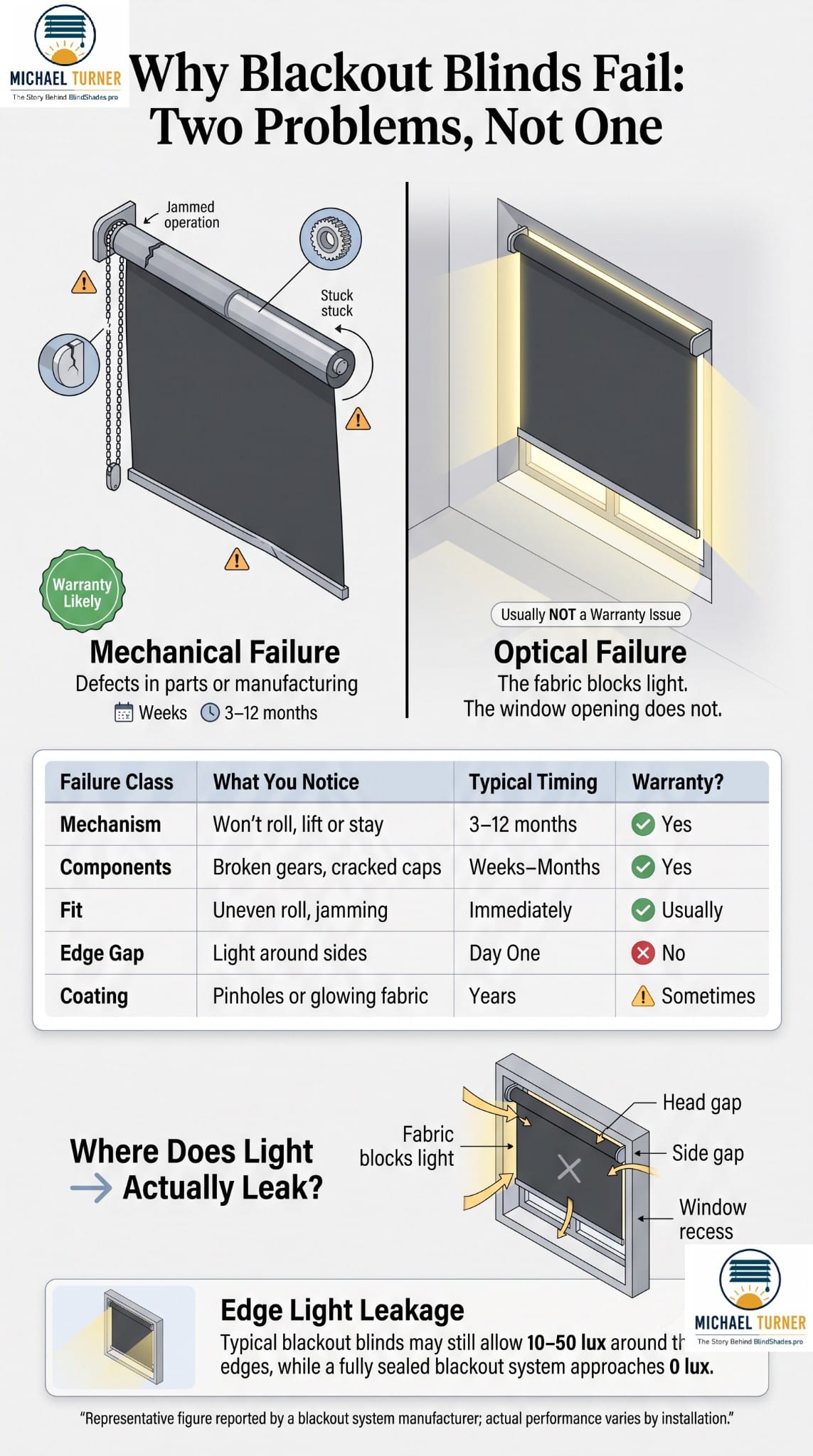
By Michael Turner — 30 years in window treatments
Two entirely different things go wrong, on different clocks, and only one is a defect you can claim for. If the blind has stopped rolling, lifting or holding position, that is mechanical, it is almost certainly covered, and there is usually a repair. If it still works but light gets past it, that is optical — and in most cases not a fault at all, but the product doing what it was always going to do. Almost everything written about this treats the two as one problem, which is why people spend money fixing the wrong thing.

Key Takeaways
- Mechanical failure is a warranty event. Springs, cords, brackets and headrails that give out inside a year are defects. Claim.
- ⚠️ Optical failure usually is not. Light down the sides was there on day one; you noticed it on the first bright morning.
- Failures cluster in the first summer, not across the first year. Adhesives and heat-sensitive parts give out when the window cavity gets hot.
- Check the backing before you complain. Fabric that is not white or silver thermally coated is probably room darkening, not blackout.
- Hold it to the sun. If no light passes through the cloth, the fabric is fine and the problem is at the edges.
⭐ Quick Answer — Why Blackout Blinds Fail in the First Year
Two different things go wrong, and understanding why blackout blinds fail starts with sorting yours into one of two boxes:
- Mechanical failure is a defect. Claim it. Cracked end caps, stripped gears, cords that saw through weak locks, and tension springs that stop a cordless shade retracting are all faults, and most fall inside a first-year warranty.
- ⚠ Light at the edges is not a defect. An inside-mounted blind must run narrower than the recess to travel, so the gap was there on day one — see where the light actually gets in.
- Check the backing first. Weffort Shades puts it simply: if the reverse is not white or silver thermally coated, you have room darkening rather than blackout and nothing has failed.
- Then hold the cloth to the sun. Canisteo Blinds notes that when a blackout setup disappoints at dawn the fabric is rarely the cause — if no light passes through it, everything is arriving around it.
- Failures bunch in the first hot spell. Adhesives on tracks and hems peel when the window cavity heats, so a blind fitted in autumn fails in summer. UBlockout puts typical edge leakage at ten to fifty lux — and the commonest mechanical fault of all has a fix in roller blinds that will not stay up.
Why Blackout Blinds Fail: Two Problems, Not One
TWO FAILURES, NOT ONE — mechanical and optical. They have different causes, different timelines, and only one of them gets your money back.
The industry writes about first-year failure as one subject, usually a list running from thin plastics to light gaps in a single breath. That is why the advice is unsatisfying: half concerns manufacturing quality and half concerns physics, and the reader cannot tell which half applies.
| Failure class | What you see | When it shows | Is it a warranty claim? |
|---|---|---|---|
| Mechanical — mechanism | Will not roll, lift, tilt or hold position | Three to twelve months | ⭐ Yes. A mechanism that fails inside a year is a defect |
| Mechanical — components | Cracked end caps, stripped gears, snapped cord | Weeks to months | ⭐ Yes, and usually a parts replacement rather than a whole blind |
| Mechanical — fit | Uneven rolling, jamming, headrail twist | First weeks after fitting | ⭐ Yes if cut to size for you; the cut is the fault |
| Optical — edge gap | Light down the sides and over the head | ⚠️ Day one, noticed later | ⚠️ No. The blind is narrower than the recess by design |
| Optical — coating | Pinholes, patchy glow across the face | Years, not months | Sometimes, if premature — but rarely inside a year |
The fourth row holds most of the disappointment and is the row least likely to be resolved by complaining. Retailers call it the halo effect: flat fabric cannot seal a three-dimensional opening, so light arrives around the blind rather than through it. Where it gets in and what closes each gap is set out in why light comes through the sides — that page is the diagnostic, this one is about which class you have.
One published figure is worth carrying. UBlockout, which sells sealed systems, puts the leak around the edges of most products sold as blackout at ten to fifty lux, against zero for genuine darkness. Treat it as a seller’s own figure rather than a measured standard — but it is a more useful unit than the blocking percentages the category quotes, because it describes the installed result rather than the cloth.
When Does Each Failure Actually Happen?
Not evenly across twelve months — they bunch, and the biggest cluster is the first summer.
Nobody sequences this, and the sequence explains a great deal. A blind fitted in October appears perfect for months and then goes wrong in July, which feels sudden and is nothing of the kind.
| Period | What typically goes wrong | Why then | Where to take it |
|---|---|---|---|
| Week one | The halo is noticed | First bright morning; nothing changed but the season | Not a failure — see the light-gap guide |
| Weeks two to eight | Uneven rolling, jamming, twist | Cut-to-size tolerance shows once the blind is used daily | Warranty claim on the cut |
| Months two to six | Cracked end caps, stripped gears, cord wear | Daily operation finds the weakest moulded part | Parts claim; often replaceable |
| ⚠️ The first hot spell | Adhesive on tracks, hems and thermal layers peels | Window cavities run far hotter than the room | Warranty, and re-specify the fixing |
| Months three to twelve | Cordless shade stops retracting | Tension springs lose strength under repeated cycling | ⭐ Warranty, and a common repair |
| Year two onward | Pinholing and patchy light through the face | Ultraviolet degrades the coating over years | Replacement, not repair |
Two things follow. Most of what is called first-year failure is either a fitting fault that showed up late or a heat event that waited for the weather — neither random, both claimable. And the one entry that is not claimable, the halo, is the one that arrives first and annoys people most.
A benchmark sits at the other end: one retailer puts the normal replacement horizon for blinds at roughly five to ten years. Against that, anything mechanical giving out inside twelve months is a specification problem rather than bad luck — and the trade is blunt about why, since cheap mechanisms often fail within a year when materials, hardware and cut-to-fit construction are designed to cut cost.
Is It the Fabric, or Is It the Fit?
Two checks settle it in about two minutes, and both come from the trade rather than from us.
Before assuming a blind has failed, establish whether it is the product you think you bought. A good deal of reported blackout failure is a labelling problem.
Check one: look at the backing. Turn the fabric over. If the reverse is not white or silver and thermally coated, you almost certainly have room-darkening fabric rather than blackout. Room darkening is a legitimate specification sold at similar prices, but it never claimed to stop all light. The distinction is in blackout versus room-darkening shades — and if that is what you have, nothing has failed.
Check two: hold the cloth to the sun. Lift the fabric to a bright window and look through it. If not a single point of light passes through the material itself, the fabric is doing its job perfectly and every bit of light in your room is arriving around it. One retailer makes exactly this point about motorised setups that disappoint at six in the morning: the problem is rarely the fabric, and holding it to the sun proves it in seconds.
If both checks pass — coated backing, no light through the cloth — the failure is optical and at the perimeter, not a product fault. That is a hardware problem, and do blackout side tracks actually seal covers what closes it. If either check fails, you have grounds to go back to the retailer.
Which Mechanical Faults Are Actually Fixable?
Most of them — and by blind type the fault is usually well known enough to have a standard remedy.
Mechanical failure feels terminal and rarely is. The same faults recur by format: if yours matches the pattern, the repair is documented and the part often sold separately.
| Blind type | The common first-year fault | Fixable? | Where the fix is |
|---|---|---|---|
| Roller | Will not stay up; spring loses tension | Usually | Roller blind spring fix, and rolling crooked |
| Cellular | Cordless shade stops retracting; crushed cells | Often | Cordless cellular that will not stay up and crushed or creased cells |
| Pleated | Loses position, sags at one side | Usually | Pleated blinds that will not stay up |
| Roman | Uneven folds; cord lock slips | Usually | Uneven roman folds and roman shades that will not stay up |
| Vertical | Vanes will not rotate or traverse | Often | Will not open or close, will not turn, damaged vanes |
| Venetian | Cord jams; slats will not close flat | Often | Will not go up or down, slats will not close, bent slats |
| Panel track | Panels stick or drop off carriers | Usually | Panel track will not slide |
| Made to measure | Fit faults from the original order | Claim first | Made-to-measure troubleshooting |
⚠️ One caution. If the blind is under warranty, attempting a repair can void it. Decide whether you are claiming or fixing before taking anything apart — and if the fault appeared within weeks of fitting, claim.
Avoid These Mistakes
- Replacing the blind when the fabric was fine. If no light passes through the cloth, a new blind of the same specification will do exactly the same thing.
- ⚠️ Complaining about the halo as a defect. It is geometry, not a fault, and the retailer will say so. Ask about side tracks instead.
- Washing a blackout blind. Water strips the coating while the fabric still looks perfect — the commonest self-inflicted failure, covered in how to clean blackout blinds.
- Pulling a cord at an angle. Thin internal cords saw through weak locks when they are drawn sideways rather than straight down.
- Cutting a stock blind down yourself. Trimming stresses the headrail and is the usual cause of uneven rolling and jamming afterwards.
- Letting the warranty window pass. A mechanism fault at ten months is claimable; the same fault at fourteen is yours.
What Should You Do Now?
| What is happening | What it is | Do this |
|---|---|---|
| Will not roll, lift or hold | Mechanical defect | Claim under warranty before attempting a repair |
| Cracked plastic parts | Component defect | Ask for parts, not a whole replacement |
| Rolls crooked or jams | Fit or cut fault | Claim if it was cut to size for you |
| Adhesive lifting in hot weather | Heat failure | Claim, then re-specify a mechanical fixing |
| Light down the sides only | ⚠️ Not a defect | Fit side tracks or add a second layer |
| Light through the whole face | Wrong specification | Check the backing — likely room darkening |
| Patchy pinholes after years | Coating age | Replacement; nothing repairs a degraded coating |
✔ Claim if the blind stops working, a part breaks, or a cut-to-size order rolls unevenly. All three are defects and all three are usually inside a first-year warranty.
✔ Fix the hardware if the blind works perfectly and the light is arriving at the perimeter — that is what side tracks and layering are for.
✖ Do not buy a replacement blind until you know which class you are in. A same-specification replacement fixes optical failure not at all.
✖ Do not assume expensive means durable. Price buys materials and fit; the mechanism is often the same part across several price points, which is why what blackout blinds cost is a poor proxy for how long they last.
The Bottom Line
Blackout blinds fail in the first year for two unrelated reasons, and telling them apart is worth more than the repair. Mechanisms giving out inside twelve months are defects: claim them, because a blind should last five to ten years and the trade itself says cheap mechanisms often fail within one. Light at the edges is not a defect, however disappointing — it was there from day one and it closes with hardware, not a replacement. Run the two checks first, and if the backing is coated and no light passes through the cloth, look at the perimeter rather than the blind.
Compare specifications across the category in our blackout blinds and shades guide, and if you are replacing rather than repairing, a blackout cellular shade with tracked sides addresses both failure classes at once.
FAQ
Why are blackout blinds bad?
They are not, but they are frequently oversold. A blackout blind stops light through its fabric and never could stop light around it, so a room fitted with one alone is dim rather than dark. That gap between expectation and physics is what most complaints describe.
Why do blinds break easily?
Because the parts that move are the parts that are cheapest to make badly. Moulded gears, end caps and cord locks are where manufacturers cut cost, and cut-to-fit construction adds tolerance problems on top. The trade description is blunt: designed to cut costs rather than withstand normal use.
Do blackout curtains lose effectiveness?
The coating does degrade, but over years rather than months. Prolonged ultraviolet exposure eventually produces pinholes and a patchy glow across the face. If darkness worsened suddenly rather than gradually, suspect a shifted bracket or a changed fitting rather than the fabric itself.
When were blackout blinds invented?
The idea long predates the modern product. Heavy blackout fabric became a household requirement during wartime blackout rules, but today’s coated and laminated blackout textiles, and the tracked systems built around them, are recent consumer products rather than anything historic.
How long should blackout blinds last?
One retailer puts the general replacement horizon for blinds at roughly five to ten years, and coated blackout fabrics sit at the shorter end because the coating is what ages. Any mechanical failure inside the first twelve months is a specification problem, not normal wear.
Is light down the sides a manufacturing fault?
Almost never. An inside-mounted blind must be narrower than the recess to travel freely, so two vertical gaps are designed in. It becomes a fault only if the blind was made to the wrong size, or if brackets have shifted and the shade now hangs off-centre.
Related Guides
- Best Blackout Blinds & Shades — the parent guide
- Why Is Light Coming Through the Sides? — the light-gap diagnostic
- Do Blackout Side Tracks Actually Seal? — closing the perimeter
- Blackout vs Room-Darkening Shades — the specification check
- Roller Blind Won’t Stay Up — the commonest mechanical fault
- Cellular Shade Gap at the Top — head light on a cellular stack
- Made-to-Measure Troubleshooting — fit faults from the order
- What Do Blackout Blinds Cost? — why price is a poor durability guide
- Best Blackout Cellular Shades — if you are replacing rather than repairing
