Best Pleated Blinds 2026: Complete Buying Guide

Authored By Michael Turner -30 Years Home Improvement Expertise | Updated 2026 | BlindShades.pro
Updated on June 29, 2026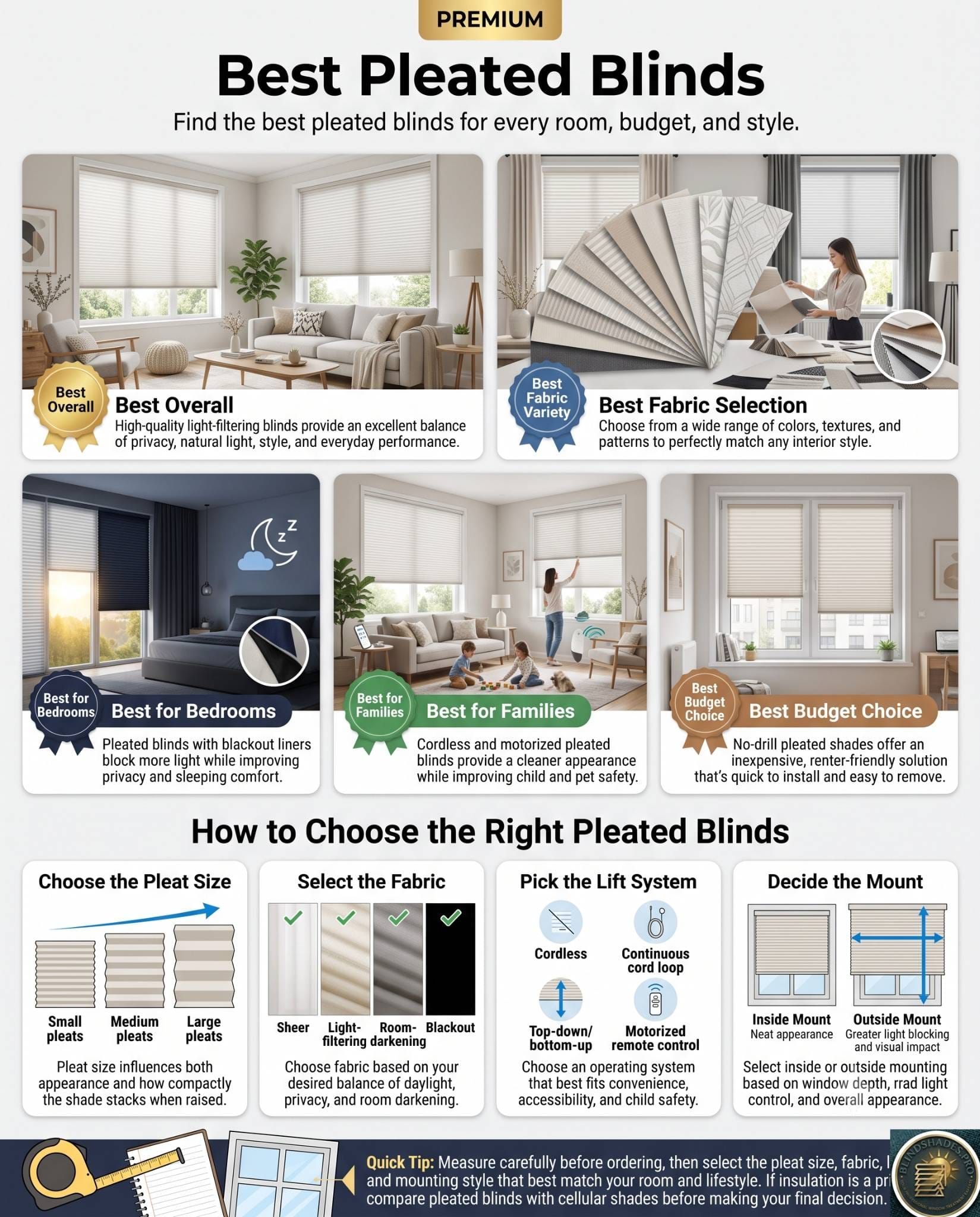
Authored by Michael Turner — 30 Years of Home Improvement Expertise | BlindShades.pro
The best pleated blinds use a single layer of crisply folded fabric to cover a window with a clean, modern look, soft filtered light, and an affordable price. Also called pleated shades, they suit almost any room: light-filtering fabric gives daytime privacy with a glow, a blackout liner darkens a bedroom, and the slim stack tucks neatly out of the way when raised. For most homes, a quality brand such as Hunter Douglas, Graber, or Bali in a light-filtering fabric is the best all-round choice; for rentals there are no-drill adhesive options, and for true room darkening you add a blackout liner, though a cellular shade still insulates and blocks light better. The right pick comes down to four decisions: the pleat size, the fabric, the lift, and the mount. This guide walks through all four, names real-brand picks by category, and links to everything you need to measure, install, clean, and repair them.
Key Takeaways
- Pleated blinds are affordable and stylish. A single layer of pleated fabric gives a clean, modern look with soft filtered light, at a lower price than most cellular or Roman shades.
- Fabric and liner set the light level. Light-filtering fabric gives daytime privacy; adding a blackout liner darkens a room, though it will not match a cellular blackout shade.
- Choose cordless for safety. Cordless and motorized lifts remove accessible cords, making pleated blinds a child- and pet-safe choice; look for the Certified Best for Kids label.
- They are not cellular shades. Pleated blinds have one fabric layer and little insulation; cellular shades add a honeycomb air pocket for energy efficiency, the main reason to choose cellular instead.
- Pleat retention matters. Over years of daily use, basic pleated fabric can soften; better fabrics and back-stiffener construction hold their crisp pleats longer.
⭐ Quick Answer
The best pleated blinds use a single layer of crisply folded fabric for a clean, modern look and soft filtered light at a low price. Choosing the right set comes down to four decisions.
- Best overall: a quality light-filtering pleated blind from a trusted brand like Hunter Douglas, Graber, or Bali.
- Best fabric range and value: Graber for the widest fabrics, or Bali for dependable value.
- Best blackout: add a blackout liner for a darker bedroom, though it will not fully match a cellular blackout shade.
- Best cordless or budget: a cordless, Certified Best for Kids blind for safety, or no-drill adhesive shades for renters.
- Four decisions: pleat, fabric, lift, and mount. Measure first with how to measure for pleated blinds, compare pleated blinds vs cellular shades, or see best blackout pleated blinds.
Quick Specification Reference
The essentials at a glance.
| Specification | Typical range |
|---|---|
| Also called | Pleated shades, accordion shades |
| Construction | Single layer of pleated fabric |
| Pleat sizes | 1 inch or 2 inch |
| Opacity options | Sheer, light filtering, room darkening, blackout liner |
| Insulation | Minimal (cellular shades insulate better) |
| Lift options | Corded, cordless, continuous loop, top-down/bottom-up, motorized |
| Mount | Inside or outside |
| Best for | Living rooms, bedrooms, offices, rentals, specialty shapes |
| Relative cost | Lower than cellular, Roman, or woven wood |
| Child safety | Cordless and motorized options available |
Read the Complete Guide Below For:
A clear explanation of what pleated blinds are and how they differ from cellular shades; the four-step Pleated Buying Path that gets you the right set; how to choose your pleat size, pick the fabric and opacity, select the lift system, and confirm the mount; our category picks from real, widely available brands; a quick pleated blinds vs cellular shades comparison; an honest look at pleat retention and sagging; a For Offices and Specifiers section; and links to everything you need to measure, install, clean, restring, and repair them, plus whether they are worth it.
What Are Pleated Blinds?
A single layer of folded fabric that raises into a slim stack.
Pleated blinds, also called pleated shades or accordion shades, are window treatments made from a single layer of fabric folded into crisp, even pleats that stack neatly at the top when raised. Invented in the 1960s, they were one of the first fabric shades to replace bulky drapery with a clean, compact, modern look. The fabric runs from a headrail to a bottom rail, lifted by cords, a cordless mechanism, or a motor, with thin lift strings threaded through the pleats.
The key thing to understand is how they differ from cellular shades. From the front, the two look almost identical, crisp horizontal pleats, but from the side, a pleated blind is a single flat layer of fabric, while a cellular shade is two layers joined into honeycomb-shaped air pockets. That single difference is everything: cellular shades insulate and block light better, while pleated blinds are simpler, more affordable, and offer a wider range of decorative fabrics. We cover the choice in full in pleated blinds vs cellular shades.
The Pleated Buying Path
Four decisions, in order, get you the right set: Pleat, Fabric, Lift, Mount.
Choosing pleated blinds is simple once you take it in order. First, choose your pleat size, which sets the look and scale. Second, pick the fabric and opacity, which set the light and privacy. Third, choose the lift system, which sets how you operate them and how safe they are. Fourth, confirm the mount. Work through these four in sequence and the right configuration becomes clear. The sections below walk through each step.
Step 1: Choose Your Pleat Size
One-inch for most windows, two-inch for larger ones.
| Pleat size | Best for |
|---|---|
| 1 inch | Standard and smaller windows, a finer, more detailed look |
| 2 inch | Larger and taller windows, a bolder look, fewer folds |
Pleated blinds come in two standard pleat sizes, one inch and two inch, and the choice is mostly aesthetic. One-inch pleats give a finer, more delicate appearance and suit standard or smaller windows; two-inch pleats create a bolder, more pronounced fold and work well on larger or taller windows where a finer pleat would look busy. Larger pleats also stack a little more compactly relative to the window. Either way, the pleats compress into a slim bundle at the top when the blind is raised.
Step 2: Pick the Fabric and Opacity
With pleated blinds, the fabric sets the light and privacy.
| Opacity | Light control | Best for |
|---|---|---|
| Sheer | Soft, diffused light, little privacy | Living rooms wanting a view and glow |
| Light filtering | Daytime privacy with a soft glow | Living rooms, dining rooms, offices |
| Room darkening | Blocks most light | Media rooms, naps |
| Blackout liner | Blocks nearly all light | Bedrooms, nurseries (on a budget) |
Because pleated blinds are a single fabric layer, the fabric you choose determines the light and privacy. This is the most important decision. Sheer fabrics let light glow through with minimal privacy; light-filtering fabrics give soft daytime privacy and are the most popular choice; and for darkness you add a blackout liner behind the fabric. An honest note: a pleated blind with a blackout liner darkens a room well, but it will not match the light blocking of a cellular blackout shade, whose continuous structure leaves fewer gaps. Pleated blinds also offer one of the widest ranges of colors, patterns, and textures of any shade, which is a big part of their appeal. For a dedicated dark-bedroom setup, see best blackout pleated blinds.
Step 3: Choose the Lift System
How you raise them, and how safe they are.
| Lift system | How it works | Best for |
|---|---|---|
| Corded | Pull a cord, lock at height | Budget, simplest mechanism |
| Cordless | Push or pull the rail, no cords | Child and pet safety, clean look |
| Continuous loop | Tensioned looped cord | Larger or heavier shades |
| Top-down / bottom-up | Open from top or bottom | Privacy with daylight |
| Motorized | Remote, app, or voice | Hard-to-reach or smart homes |
The lift system sets both convenience and safety. Corded is the cheapest but leaves accessible cords; cordless removes them for a cleaner look and is the safest choice for homes with children or pets; a continuous loop helps with larger shades; top-down/bottom-up lets you lower from the top for privacy while keeping daylight; and motorization suits high or hard-to-reach windows. For child safety, choose cordless or motorized and look for the Certified Best for Kids label from the Window Coverings Manufacturers Association. If a cordless lift stops holding position, the spring usually just needs resetting, covered in pleated blinds won’t stay up.
Step 4: Mount and Fit
Inside mount for a clean look, outside mount for coverage.
| Mount | Notes |
|---|---|
| Inside mount | Sits inside the frame for a clean, built-in look; needs adequate depth |
| Outside mount | Mounts above and wider than the opening; blocks more light, hides a shallow frame |
Pleated blinds can mount inside the window frame for a clean, recessed look, or outside it, above and wider than the opening, to block more light and cover a shallow or unattractive frame. Inside mount needs enough frame depth for the headrail; outside mount is the better choice for darkening a bedroom, since it reduces the light gaps at the edges. Accurate measuring is essential either way, the difference between a crisp fit and a gappy one, so follow the full method in how to measure for pleated blinds before ordering, and how to install pleated blinds when they arrive.
Best Pleated Blinds: Our Picks
Real, widely available options chosen by category — not lab-tested by us.
These are real products chosen for how well each suits its purpose, how widely available it is, and its verified reputation. We have not run independent lab tests; confirm current pricing, sizes, fabrics, and the cordless or motorized option before buying.
| Category | Pick | Why it fits |
|---|---|---|
| Best Overall | Hunter Douglas Applause | Strong pleat retention, broad options |
| Best Fabric Range | Graber Pleated Shades | Huge color, pattern, and texture range |
| Best Value | Bali Pleated Shades | Trusted brand, wide fabric range, fair price |
| Best Blackout | Pleated blind with blackout liner | Darker bedroom on a budget |
| Best Cordless / Child-Safe | Any Certified Best for Kids cordless pleated blind | No accessible cords |
| Best Budget / Renter | Redi Shade or Changshade | No-drill, trim-to-fit, temporary |
- Best Overall — Hunter Douglas Applause. A premium pleated, or honeycomb-adjacent, line known for strong pleat retention and a broad range of fabrics, opacities, and cordless and motorized lifts.
- Best Fabric Range — Graber Pleated Shades. One of the widest selections of colors, patterns, and textures, making Graber the pick when the look of the fabric matters most.
- Best Value — Bali Pleated Shades. A trusted, widely available brand with a broad fabric range and dependable construction at a fair price.
- Best Blackout — Pleated blind with a blackout liner. Adding a blackout liner to a quality pleated blind darkens a bedroom affordably; for the darkest result, mount outside the frame. Note it will not match a cellular blackout shade.
- Best Cordless / Child-Safe — any Certified Best for Kids cordless pleated blind. Cordless operation removes accessible cords; the Best for Kids label is independent confirmation, ideal near children and pets.
- Best Budget / Renter — Redi Shade or Changshade. No-drill, self-adhesive paper or fabric shades that trim to width with scissors and install without tools, ideal for rentals, move-ins, and temporary coverage.
Disclosure: this section contains affiliate links. Prices are indicative tiers, not quotes, and vary by size, fabric, and retailer. We never publish fabricated prices, specifications, or testing claims.
Pleated Blinds vs Cellular Shades
They look alike; the difference is the air pocket.
The most common cross-shop is cellular shades, since the two look nearly identical from the front. Here is the short version:
| Factor | Pleated Blinds | Cellular Shades |
|---|---|---|
| Construction | Single fabric layer | Honeycomb air pockets |
| Insulation | Minimal | Strong (the main reason to choose cellular) |
| Light blocking | Good with a liner | Best, especially blackout |
| Fabric variety | Very wide | Wide |
| Cost | Lower | Higher |
| Look | Crisp pleats | Crisp pleats (honeycomb in profile) |
In short, choose pleated blinds for a wider fabric range and a lower price, and cellular shades when insulation and maximum light blocking matter most. The full breakdown is in pleated blinds vs cellular shades, and for the roller comparison see pleated blinds vs roller blinds. If neither is quite right, see alternatives to pleated blinds.
Will Pleated Blinds Sag? Pleat Retention Explained
Better fabric and construction hold their pleats longer.
A fair question before buying is whether pleated blinds keep their crisp folds. Over years of regular raising and lowering, the pleats on basic, lower-quality fabric can soften and lose some of their sharpness, especially on wide or frequently used windows. The good news is that fabric quality and construction make a real difference: better pleated lines use stiffer, more resilient fabric and back-stiffener or pleat-retention construction, such as Hunter Douglas’s NeatPleat, designed specifically to hold the folds crisp over time. Wide shades also hold their shape better with enough mounting brackets to prevent sagging in the middle.
| Common issue | Cause | Fix |
|---|---|---|
| Pleats softening over time | Lower-quality fabric, heavy use | Choose pleat-retention construction |
| Shade sagging in the middle | Too few brackets on a wide shade | Add a center support bracket |
| Won’t stay raised | Cord lock or spring needs attention | See the won’t-stay-up guide |
| Lift string broken | Worn or frayed string | Restring the shade |
When buying, ask specifically about pleat-retention or back-stiffener construction for any window you use daily. If problems do appear, most are easy fixes: a sagging wide shade needs another bracket, a shade that won’t hold position is covered in pleated blinds won’t stay up, and a broken lift string is covered in how to restring pleated blinds.
For Offices and Specifiers
Pleated blinds suit commercial spaces on honest, confirmable specs.
Beyond the home, pleated blinds work well in offices, meeting rooms, and other commercial spaces where a clean, affordable fabric shade is wanted across many windows. For commercial projects, window treatments fall under CSI MasterFormat Division 12 (Furnishings), and specifiers should confirm the relevant certifications on each product’s documentation rather than assume them. The ones that commonly matter for fabric shades are NFPA 701 flame resistance for contract fabrics, ANSI/WCMA A100.1 for window-covering cord safety, and GREENGUARD certification for low chemical emissions in occupied spaces; cordless and motorized controls satisfy cord-safety requirements by removing accessible cords. Honest note: exact flame ratings and emissions figures vary by fabric and finish, so request the manufacturer’s cut sheet for project-exact values rather than relying on category generalizations. Where insulation or stricter light control is required, cellular shades are often the better specified choice.
Installation, Care, and Repair
Easy to fit, easy to keep, easy to fix.
Pleated blinds are among the most low-maintenance window treatments. Installation is a DIY-friendly job of mounting the brackets and clipping in the headrail, walked through in how to install pleated blinds. Cleaning is simple, mostly dusting and gentle spot-cleaning, with the full method, including which fabrics can and cannot be spot-cleaned, in how to clean pleated blinds. The two most common repairs are a shade that will not stay raised, covered in pleated blinds won’t stay up, and a broken lift string, covered in how to restring pleated blinds, both of which you can usually fix yourself.
Are Pleated Blinds Worth It?
Worth it for affordable style; less so when insulation is the priority.
Pleated blinds are well worth it when you want a clean, modern fabric shade with a wide choice of colors at a lower price than most alternatives, which makes them a strong everyday choice for living rooms, offices, and rentals. They are less ideal when energy efficiency or maximum room darkening is the priority, since a cellular shade insulates and blocks light better for not much more. We weigh the full case in are pleated blinds worth it, so you can match the decision to your room and budget.
Related Buying Guides
- Best Cellular Shades Buying Guide
- Best Roller Shades Buying Guide
- Best Roller Blinds Buying Guide
- Best Vertical Blinds Buying Guide
Best Sources
- Graber — on the difference between pleated and cellular shades, single-layer versus honeycomb construction, pleat sizes, and the range of fabrics and liners for light control.
- Bali — on pleated shades as the decorative, fabric-rich single-layer option, opacity selection, and cordless, top-down/bottom-up, and motorized lifts.
- Hunter Douglas — on premium pleated and honeycomb lines, pleat-retention construction, room-darkening liners, and cordless and motorized operating systems.
- The Shade Store — on pleated and cellular shade construction, inside versus outside mount, and light-filtering versus blackout material options.
- Factory Direct Blinds — on pleated versus cellular shades, where each fits, and the insulation and cost trade-offs between them.
- Blinds.com — on 1-inch and 2-inch pleats, consistent re-pleating, cordless and continuous-loop controls, and adding liners for more light control.
- Fix My Blinds — on common pleated shade repairs, restringing broken lift strings, replacing brackets, and resetting cordless mechanisms.
Complete Pleated Blinds Guide: All 10 Articles
Everything in this cluster, in one place.
Fix and install:
- How to Measure for Pleated Blinds — the buy-bridge: inside and outside mount measuring.
- How to Install Pleated Blinds — mounting the brackets and clipping in the headrail.
- How to Clean Pleated Blinds — dusting, spot cleaning, and what not to do.
- How to Restring Pleated Blinds — replacing a broken or frayed lift string.
- Pleated Blinds Won’t Stay Up — fixing a shade that droops or will not hold.
Compare and learn:
- Best Blackout Pleated Blinds — the darkest pleated setups for bedrooms.
- Pleated Blinds vs Cellular Shades — the key comparison, insulation and cost.
- Pleated Blinds vs Roller Blinds — folded fabric versus a smooth roll.
- Alternatives to Pleated Blinds — better options by priority and room.
- Are Pleated Blinds Worth It? — an honest verdict on value.
Frequently Asked Questions
What are the best pleated blinds?
For most homes, a quality light-filtering pleated blind from a trusted brand such as Hunter Douglas, Graber, or Bali is the best all-round choice, balancing look, fabric range, and value. Graber stands out for the widest fabric, color, and texture selection; Bali offers strong value; and Hunter Douglas’s Applause line is known for pleat retention. For a darker bedroom, add a blackout liner; for child safety, choose a cordless or Certified Best for Kids option; and for rentals, no-drill adhesive shades like Redi Shade or Changshade install without tools. The best pick depends on your fabric, lift, and budget priorities.
What is the difference between pleated blinds and cellular shades?
Pleated blinds and cellular shades look almost identical from the front, but differ in construction. A pleated blind is a single layer of folded fabric, while a cellular shade is two layers joined into honeycomb-shaped air pockets. That air pocket gives cellular shades much better insulation and light blocking, which is the main reason to choose them. Pleated blinds, in turn, are simpler, more affordable, and offer a wider range of decorative fabrics. Choose pleated blinds for style and value, and cellular shades when energy efficiency or maximum room darkening matters most.
Do pleated blinds provide good privacy and light control?
Yes, with the right fabric. Because pleated blinds are a single fabric layer, the opacity you choose sets the privacy and light: sheer fabrics glow with little privacy, light-filtering fabrics give soft daytime privacy, and a blackout liner darkens a room for sleep. For a bedroom, choose a room-darkening fabric or blackout liner and mount outside the frame to reduce light gaps at the edges. Note that a pleated blackout blind darkens a room well but will not fully match a cellular blackout shade, whose continuous structure blocks light more completely.
Are pleated blinds child safe?
They can be, and should be, in homes with children or pets. Choose a cordless or motorized lift, both of which remove the accessible pull cords that make corded blinds a hazard, and look for the Certified Best for Kids label from the Window Coverings Manufacturers Association as independent confirmation. Cordless pleated blinds operate by simply pushing or pulling the rail, so going cord-free costs nothing in convenience while making the window safer. Corded lifts are cheaper but are best avoided where young children are present.
Do pleated blinds sag or lose their pleats over time?
Basic, lower-quality pleated fabric can soften and lose some pleat sharpness over years of daily use, especially on wide or frequently operated windows. Better pleated lines use stiffer, more resilient fabric and back-stiffener or pleat-retention construction, such as Hunter Douglas’s NeatPleat, designed to hold the folds crisp longer. Wide shades also keep their shape better with an extra center support bracket to prevent sagging in the middle. When buying for a daily-use window, ask specifically about pleat-retention construction, and choose a reputable brand for the best long-term crispness.
Are pleated blinds cheaper than cellular shades?
Yes, pleated blinds are generally cheaper than cellular shades, both because of their simpler single-layer construction and their wide availability. That lower price is a major reason they remain popular for living rooms, offices, rentals, and whole-home projects on a budget. Cellular shades cost more but add honeycomb insulation and better light blocking, so the extra spend buys energy efficiency. For style and value, pleated blinds win; for insulation and maximum darkness, cellular shades justify their higher price.
