The Best Ceiling Track Systems Buying Guide (2026)

Authored By Michael Turner -30 Years Home Improvement Expertise | Updated 2026 | BlindShades.pro
Updated on July 20, 2026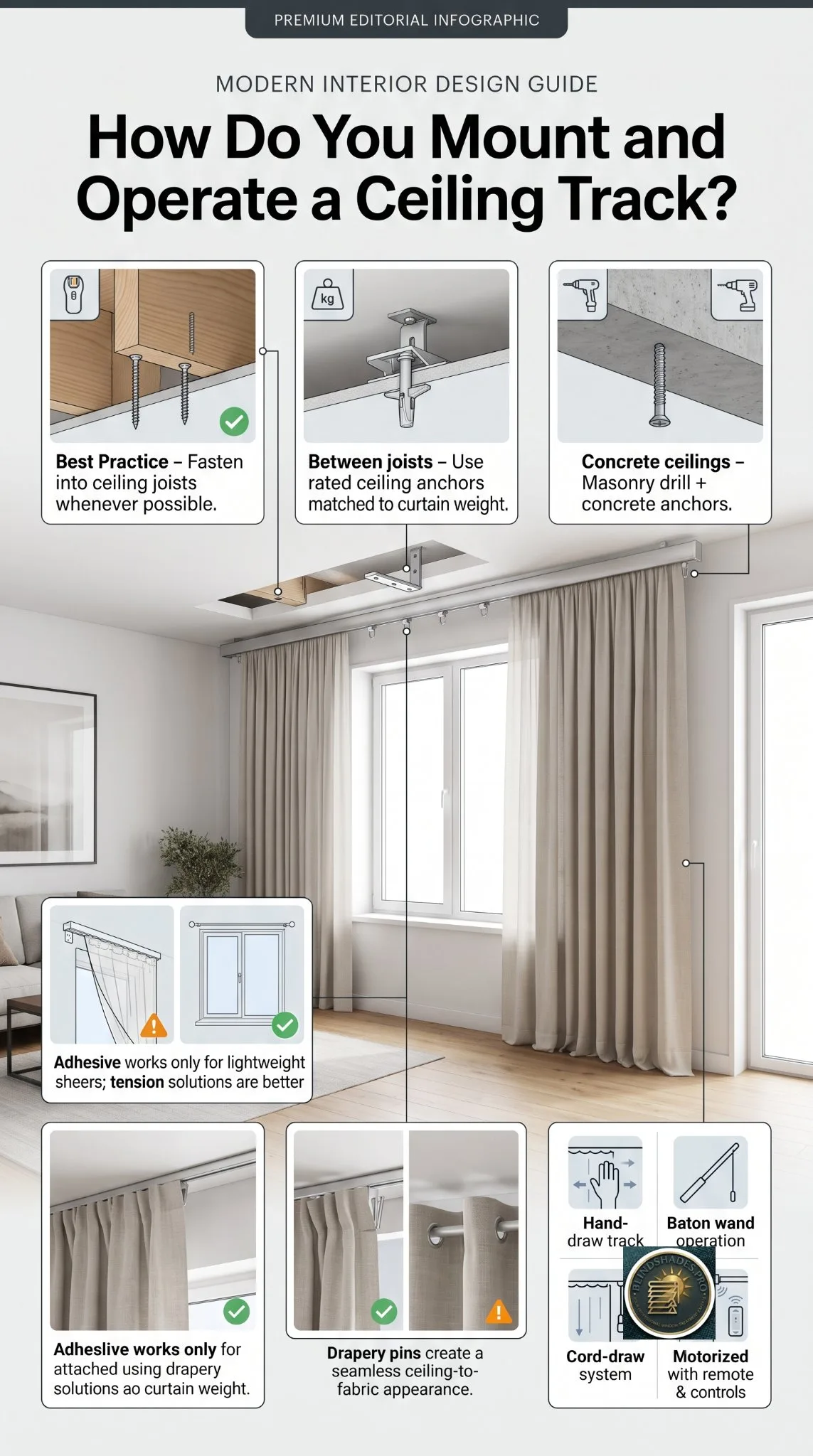
By Michael Turner — 30 years in the window treatment industry
“Ceiling track” is five different products wearing one name — curtain tracks, track lighting, garage storage rails, art-hanging systems, and drop-ceiling grids — and Google’s own results mix all five, so this guide begins by sorting them and then owns the one the searches actually mean: ceiling-mounted CURTAIN track systems, the hardware that hangs fabric from above and quietly outclasses the curtain rod at almost everything. The market’s consensus triad is sound — budget DIY systems for layered sheers and blackouts, commercial aluminum with ball-bearing gliders for heavy floor-to-ceiling drapes, and custom-cut or bendable tracks for curves and bays — and around it this guide adds what no seller prints: the Overhead Test (Load, Layout, Lift), the double-track layering recipe the forums keep asking for, the drapery-pin method for the seamless look, and the honest answer to the no-drill question. Hotel-window elegance, room dividers, and bay-window curves, all from the fifth wall.
Key Takeaways
- Sort the five products first: curtain tracks (this guide), track lighting, garage storage racks, art-hanging rails, and drop-ceiling grids all rank for this phrase — the disambiguation table below saves you from three wrong aisles.
- Load picks the track class: light sheers ride budget channel tracks; heavy floor-to-ceiling drapes want commercial aluminum with ball-bearing gliders that don’t bind — the market’s own dividing line.
- The double-track recipe is the category’s best trick: blackout on the inner run, sheer on the outer — the layered hotel look the forums keep asking for, formalized here with the triple-track option behind it.
- The seamless method is two small parts: rod-pocket curtains paired with drapery pins close the curtain-to-track gap — the detail the design press’s ceiling-hanging love letter got exactly right.
- Ceilings are structural, and honesty about that matters: joists and proper anchors carry real drapes; adhesive no-drill tracks carry sheers at best — the answer the no-drill search deserves straight.
⭐ Quick Answer — The Best Ceiling Track Systems
The best ceiling track systems for curtains pass the Overhead Test — Load (fabric weight picks the track class), Layout (straight, joined, bent for bays, or room-divider), Lift (hand, baton, cord, or motor):
- Best budget system: the VIDGA-class single, double, and triple tracks at IKEA — about ten to one-oh-five, wall and ceiling, room dividers included — with the honest catch that gliders and hooks are often sold separately.
- Best-rated true track: the Rebrilliant ceiling curtain track set at four point seven across twenty-four, about forty-two — the thin-base hardware norm, hedged by return windows.
- Best custom-cut and curves: seven-to-twelve-foot lengths in plastic or aluminum from about seven at Curtain-Tracks.com, and the bendable tier near one twenty-nine for bay and corner sweeps.
- The seamless method: rod-pocket curtains on drapery pins — the gap-closing trick from the ceiling-hanging essay at The New York Times — with wave S-fold carriers for the architectural ribbon look on the window sheers guide’s fabrics.
- The layered wall: sheer on the inner run, blackout on the outer — the double-track recipe, with the night layer’s science in the blackout blinds guide and the powered version in the motorized and smart blinds guide.
Quick Specification Reference
| Specification | Ceiling curtain track reality (2026) |
|---|---|
| What this guide covers | Ceiling-mounted CURTAIN tracks — not lighting, storage, art, or grid systems (routed below) |
| The class ladder | Budget channel systems → mid silent-roller sets → commercial ball-bearing aluminum |
| The run options | Single, double, and triple tracks — the layering architecture |
| The length game | Stock four-to-twelve-foot sections, joinable; custom-cut to the inch in the specialist lane |
| The curve answer | Bendable tracks (vinyl and formable aluminum) for bays, bows, and corners |
| The lift options | Hand-draw, baton wand, cord-draw, and motorized carriers |
| The mounting truth | Joists and rated anchors for drapes; adhesive tracks are sheer-weight only |
| The price band | About seven (custom-cut entry) to two sixty-four (commercial kits); most winners under one thirty |
| The seamless detail | Rod-pocket headers on drapery pins — minimal gap, maximal glide, two-dollar upgrade |
Read the complete guide below for: the six picks across every class, the Overhead Test, the five-products disambiguation, the track-type taxonomy, the double-track layering recipe, every layout from bay curves to room dividers with the molding rule included, mounting and lift honesty, and the warning table.
What Are the Best Ceiling Track Systems in 2026? — Our Picks
Review volumes are stated exactly as the market shows them — and in this hardware category they are thin across the board, so class reputation and return windows carry more weight than usual, and the table says so.
| Pick | Product | Rating / reviews | Price (words) | The lane |
|---|---|---|---|---|
| Best Budget System | The IKEA VIDGA-class track system | Store-rated 4.0 across ~1,700 | About ten to one-oh-five across the line | Single/double/triple runs, wall and ceiling, room dividers — gliders and hooks often sold separately, budget accordingly |
| Best-Rated Track Set | Rebrilliant Ceiling Curtain Track Set | 4.7 across 24 | About forty-two | The category’s best true-track score |
| Best Heavy-Drape Class | Rod Desyne Commercial Ceiling Track | Class-reputation tier | Kit-priced | Aluminum with ball-bearing gliders that don’t bind — the floor-to-ceiling, hotel-style standard |
| Best Custom-Cut | Curtain-Tracks.com ceiling lane | Specialist — seven-to-twelve-foot lengths, plastic or aluminum | About seven to sixty-nine; forty-five-day returns | Cut to your exact inch |
| Best for Curves & Bays | The bendable track tier (ATS bend class) | Specialist | About one twenty-nine | The corner-turner — vinyl and formable aluminum |
| Best Layering Kit | TWOPAGES Leo Double Wall & Ceiling Track | Maker fleet | About one thirty (single about fifty) | The blockout-plus-sheer recipe in one box |
The honesty paragraph this category needs: thin review bases are the hardware norm here — twenty-four reviews leads the true-track field, a two-sixty-four commercial kit shows four point oh across ONE, and the silent-roller and budget tiers run on handfuls. The compensating evidence is real, though: the budget system’s store base runs seventeen hundred deep, the specialist lanes publish forty-five-day return windows, and the community record is unusually specific — the renovation forum’s top answer names joinable aluminum S-fold track as the budget double-run solution, which is exactly the class this guide’s recipe section builds on. And one buying axis the listings undersell entirely: noise. A curtain drawn at midnight across a cheap channel announces itself; the difference lives in three parts — wheeled carriers over sliding gliders (the “silent roller” tier’s whole pitch), aluminum track over vinyl for straight runs (vinyl flexes and chatters under weight), and a clean channel (a twice-a-year vacuum pass along the run plus a dry silicone wipe keeps the glide showroom-quiet; never oil a curtain track — oil holds dust and builds the very grit it was meant to cure). If the track serves a bedroom or a shared wall, spend one tier up on carriers before spending anywhere else.
The Overhead Test: Load · Layout · Lift
Three questions in order — what the fabric weighs, what shape the run takes, and what moves it — and the first one prevents the binding glider that ruins the whole idea.
| Overhead Test step | The question | The failure it prevents |
|---|---|---|
| Load | Sheer, standard, or floor-to-ceiling heavy? | Velvet drapes grinding to a halt on a budget channel |
| Layout | Straight, joined, bent, wall-to-wall, or divider? | The bay corner a straight track can’t turn |
| Lift | Hand, baton, cord, or motor? | The twelve-foot span nobody can reach the middle of |
Which “Ceiling Track” Do You Mean? Five Products, One Name
Google mixes all five on page one — here is the thirty-second sort that saves three wrong aisles.
| You want | The product | The tell | Where it lives |
|---|---|---|---|
| Curtains hung from above | Ceiling curtain track systems | Carriers, gliders, fabric | THIS guide |
| Adjustable spotlights on a rail | Track lighting | Wattage in the title (the linear-track listings in this very SERP) | The lighting aisle |
| Bikes and bins overhead | Garage storage rails | The garage-racks filter chip Google itself shows | The storage aisle |
| Pictures on movable hangers | Art-hanging track | Gallery cables and hooks | The framing world |
| A suspended tile ceiling | Drop-ceiling grid track | The surface-mount grid kits ranking mid-page | The ceilings aisle |
| (The wry sixth) | Workshop lifting rails | The 2012 forum thread about moving heavy projects | Not curtains, but we admire the ambition |
Sorted. From here, everything is the curtain track — and the naming sweep for the search bar’s own habits: curtain track ceiling and ceiling curtain track are the same query in two word orders, the best ceiling track for curtains is what this whole guide chooses, and the curtain track ceiling ikea searches land in the budget-system row below. Now the taxonomy proper:
Which Curtain Track Type? The Taxonomy
Fixed or traverse, channel or rail, wave or plain — the type table that the class ladder rides on.
| Type | The construction | The verdict |
|---|---|---|
| Fixed track | A plain run; curtains slide by hand | Simple, low-cost, very durable — the every-room baseline in this market’s own words |
| Traverse track | Cord or wand draws the carriers | The wide-window and formal-drape lane |
| Enclosed U-channel | Gliders ride hidden inside the channel | The cleanest visible line; light-to-medium loads |
| I-beam rail | Carriers ride the rail’s outside | The heavy-duty pattern the commercial class uses |
| S-fold / ripple-fold carriers | Spaced carriers form even architectural waves | The look that revived the category — demands roughly double flat fabric width, so order fullness accordingly |
| Bendable track | Vinyl or formable aluminum | The curve specialist — bays, bows, corners |
How Do You Layer Tracks? The Double-Track Recipe
The forums keep asking for the blockout-plus-sheer ceiling setup — here is the recipe, formalized.
| Run | What hangs there | The rule |
|---|---|---|
| Inner track (window side) | The sheer | Daylight privacy lives closest to the glass — the whole physics is in our window sheers guide |
| Outer track (room side) | The blackout or drape | The night layer draws over the sheer — the darkness science is our blackout blinds guide’s |
| Triple run (optional) | Sheer · drape · a valance or second decorative | The full hotel wall |
| The spacing | Runs sit roughly two to three inches apart | Fabrics glide past each other without kissing |
| The order note | Buy both runs from ONE system family | Mixed-brand carriers bind at the overlaps |
| The alternative | One dual-fabric shade instead of two tracks | The cassette version of the same trade — our day-night blinds guide |
Which Curtains Work on a Ceiling Track?
The track is only half the purchase — the header on the curtain decides whether the glide is silk or sandpaper.
The header hierarchy, from best glide down: pleat-tape headers with hooks are the track’s native partner — sewn-in tape takes standard drapery hooks, the hooks drop into the carriers, and pleats form themselves; rod-pocket curtains paired with drapery pins are the budget path to nearly the same result (the seamless method from the mounting table — pin through the pocket’s back, hang the pin in the carrier, and the pocket never touches the track); wave and S-fold headings are made-for-track constructions that need the matching spaced carriers, nothing else; and back-tab curtains adapt with pins in a pinch. The one header to avoid is the one most ready-made curtains ship with: grommets — the rings want a rod through them, they interfere with carriers, and threading a track through grommets defeats the glide entirely. Loops and tab-tops share the problem in softer form. The fullness math rides the header too: plain and pinned headers look right at one-and-a-half to two times the track length in fabric width; wave and S-fold demand the full double and reward it with those even architectural ribbons. And one practical note for the double track recipe: the sheer run tolerates lighter, cheaper headers than the drape run — spend the pleat tape on the room-side fabric where the eye lands and the weight lives, and let the sheer ride simple carriers behind it. If your curtains are already bought, the header question runs backward: rod-pocket and back-tab convert with a box of pins for a few dollars; grommet panels want a rod — or a re-header at a tailor, which usually costs more than better curtains.
What Layouts Can Ceiling Tracks Do? The Shape Table
The rod hangs straight or not at all; the track’s whole argument is that it doesn’t care — bays, corners, dividers, and whole walls, mapped.
| Layout | The method | The note |
|---|---|---|
| Straight window run | Stock length, cut or joined | The baseline — track length equals the coverage width, not the window |
| Wall-to-wall / floor-to-ceiling | Join sections across the full span | The hotel look; curtains stack at the ends, so add stacking room |
| The bay and the bow | Bendable vinyl or formable aluminum, one continuous sweep | The corner-turner the market’s own guidance names for curved and bay windows — panel-by-panel alternatives live in our bay window blinds guide |
| The room divider | Ceiling track mid-room, sheer or drape | The budget system’s own headline use — studios, shared kids’ rooms, the loft’s instant wall |
| The patio-door wall | A track sweep over sliders | Wave sheers over moving glass — the door logic is our sliding glass door blinds guide’s |
| The molding rule | Where crown molding is beautiful, hang INSIDE the columns just under it | The community’s top answer, promoted: never cover good molding with fabric — the track’s low profile is exactly what makes this possible |
The room-divider layout earns its own paragraph, because it is the track’s second career and the budget system’s own headline: a mid-room ceiling run with a sheer makes a studio into a bedroom-and-parlor without a permit, a drape on the same run makes it private, and the whole wall stacks flat against the side wall by day. The three divider rules: mount into joists without exception (a divider curtain gets touched, tugged, and leaned into in ways a window curtain never does), run the fabric floor-to-ceiling at double fullness so it reads as architecture instead of laundry, and pick a double-sided fabric or add a plain liner — a divider has no “back of the curtain” to hide. Renters running dividers get the honest note from the mounting table doubled: this is the one layout where the no-drill compromise genuinely can’t carry the job.
How Do You Mount and Operate a Ceiling Track?
Ceilings are structural, and the honest mounting section is the difference between a decade of silent glide and a Saturday of drywall repair — plus the lift lanes, including the motorized answer.
| Question | The answer | The note |
|---|---|---|
| Into what? | Joists first — locate and screw into framing wherever the run allows | The quiet, forever mount |
| Between joists? | Rated hollow-wall ceiling anchors, one per bracket, weight-matched | Drapes are heavier than they look wet-cleaned or humid |
| Concrete ceilings? | The masonry drill-and-anchor discipline | Same rules as every masonry mount on this site |
| Ceiling curtain track no drill? | The straight answer: adhesive tracks hold SHEERS at best, and warm ceilings weaken adhesive over time | For rented windows, the tension-and-clamp toolbox at the window itself is the better road — our no drill blinds guide |
| The seamless look | Rod-pocket headers hung on drapery pins — the little pins reduce the gap between curtain and track, in the design press’s own words; grommets and loops can interfere with carriers | The two-dollar upgrade that makes ceiling curtains read custom |
| Hand, baton, cord? | Hand-draw for reachable runs; baton wands for tall; cord-draw for wide | The classic ladder |
| Motorized ceiling curtain track? | Motorized carrier kits and retrofit motors exist across the class ladder | The remote-and-app logic, quiet-motor questions, and smart-home lanes live in our motorized and smart blinds guide |
Where Should You Buy — and the Warning Table
The measuring walkthrough before any order, because tracks are bought by the inch: decide coverage first (the window plus stacking room on each side for a window run; wall-to-wall means literally that, minus a half-inch per end for end-stops); measure the ceiling run with a steel tape at the ceiling itself, not the floor (old houses disagree between the two by more than you’d think); for bends, measure each straight leg and each corner’s angle separately and give the specialist all of it; count carriers at roughly one per four inches of fabric width for plain headers and per the carrier-set spec for wave; and mark your joists BEFORE ordering bracket counts, because a bracket that lands between joists needs an anchor rated for the load and a bracket that lands ON one needs only a screw. Write the total, add the carrier and end-stop hardware to the cart (the gliders-sold-separately catch), and the order arrives installable.
The lanes: the budget system’s own aisles (ten-to-one-oh-five, in-store returns, seventeen-hundred-deep store base — and the curtain track system IKEA searches land here for good reason), the specialist cut-to-length shops with forty-five-day windows, the maker fleets for double-track kits, the big-box aisles for the silent-roller mid-tier, and the commercial class through the drapery-hardware channel. The best ceiling track systems for living room duty are usually the double-run recipe above in the mid tier; the “nearby” searches deserve one honest sentence — this is a measure-and-order category more than a walk-in one, and the custom-cut lane ships to the inch.
| Warning | The listing | The rule |
|---|---|---|
| The contaminant aisles | Track lighting, storage racks, and grid kits ranking beside curtain tracks | The five-products table is the decoder — check for carriers and gliders before carting |
| The one-review commercial kit | 4.0 across 1 at about two sixty-four | Class money on anecdote evidence — buy the class through reputations and returns instead |
| Thin bases everywhere | 4.7/24 leads the field; 4.4/19 · 4.1/35 follow | The hardware norm — return windows are the real warranty |
| Gliders sold separately | The budget system’s known catch | Price the carriers, hooks, and end-stops INTO the quote |
| Discount theater | Twenty-four to fifty percent “off” | The recurring sale price is the real price |
Related Buying Guides
- Best Window Sheers — the fabric the inner run carries
- Best Blackout Blinds & Shades — the outer run’s night science
- Best Motorized & Smart Blinds — the powered carrier’s wider world
- Best No Drill Blinds — when the ceiling can’t be drilled
- Best Bay Window Blinds & Shades — the bend tier’s favorite assignment
- Best Sliding Glass Door Blinds — track sweeps over moving glass
- Best Day-Night Blinds — the cassette version of the layering trade
- Best Panel Track Blinds — the track that carries panels instead of curtains
- Best Roman Curtains & Roll-Up Curtains — the soft-rise family a track wall frames
- Best Made to Measure Blinds — the cut-to-the-inch discipline
FAQ
What are the best ceiling track systems for curtains? By the Overhead Test: the budget VIDGA-class systems (about ten to one-oh-five, single-to-triple runs) for light and layered duty, the best-rated track set at four point seven across twenty-four for standard windows, commercial ball-bearing aluminum for heavy floor-to-ceiling drapes, custom-cut lanes from about seven, and bendable tracks near one twenty-nine for bays and curves.
Can you hang curtains from the ceiling without drilling? Honestly: adhesive ceiling tracks hold sheers at best, and warm ceilings weaken adhesive over time. For real drapes the ceiling wants joists or rated anchors — and for rented homes, the better road is usually no-drill hardware at the window itself rather than the ceiling.
How do you make ceiling curtains look seamless? Rod-pocket headers hung on drapery pins — the small pins close the gap between curtain and track while keeping the glide free, where grommets and loops can interfere with the carriers. Add S-fold or ripple-fold carriers and roughly double fullness for the even architectural wave.
Can ceiling tracks turn corners for bay windows? Yes — that is the track’s signature advantage: bendable vinyl and formable aluminum tracks curve through bays, bows, and corners in one continuous sweep, the layout no straight rod can attempt. Measure the angles, order the bend class, and form on install.
How do you hang blackout and sheer curtains together? The double-track recipe: sheer on the inner run (window side) for daytime privacy, blackout or drape on the outer run for night, runs spaced two to three inches so the fabrics glide past each other — both runs from one system family so the carriers match.
How much weight can a ceiling curtain track hold? The class ladder answers it: budget channel systems carry sheers and standard panels; commercial aluminum with ball-bearing gliders carries heavy floor-to-ceiling drapes without binding. The mount matters as much as the track — joists and rated anchors, one per bracket, weight-matched.
The Bottom Line
Sort the five products, then run the three questions. Load: match the fabric to the class, and let ball bearings carry anything heavy enough to bind. Layout: straight is the beginning, not the limit — join for the wall, bend for the bay, split the room when a wall is needed by Friday, and never cover good molding when hanging just beneath it is right there. Lift: hands for the reachable, batons for the tall, motors for the wall of glass. Then the two small finishing moves that make the whole category sing — drapery pins under rod pockets for the seamless glide, and the double-run recipe for the hotel wall — and the fifth wall becomes the best curtain rod the house never knew it had.
