Can You Add Blackout to Blinds You Already Own?

Authored By Michael Turner -30 Years Home Improvement Expertise | Updated 2026 | BlindShades.pro
Updated on July 30, 2026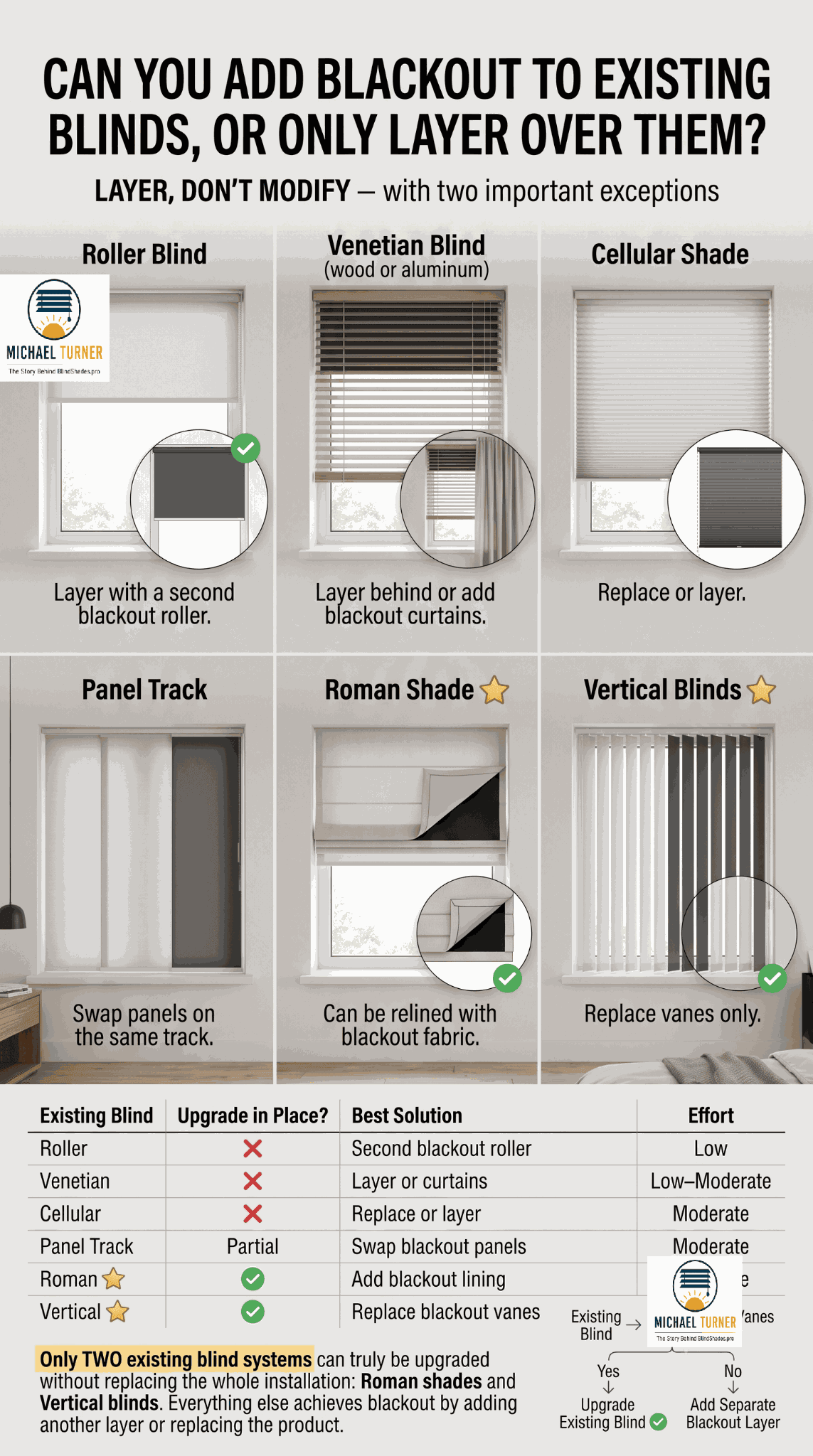
By Michael Turner — 30 years in window treatments
Almost always yes, but by adding a second layer rather than changing the blind — and the two things that decide how are what type of blind you own and whether you can drill. Roller, venetian and cellular blinds cannot be re-fabricked at all; the mechanism will not take it. Roman shades and vertical blinds are the exceptions, and for those two you can genuinely upgrade what you already have rather than hanging something in front of it. Almost everyone writing about this gives one answer for every window, which is why so many people end up taping fabric to a blind that then refuses to roll.

Key Takeaways
- Layer, do not modify. Adding fabric to a working blind usually breaks the mechanism before it darkens the room.
- ⚠️ Roller blinds are the worst candidate. Extra fabric thickens the roll, and a thicker roll will not sit in its brackets or hold its position.
- Two types are genuinely upgradeable. A roman shade can be relined, and vertical vanes can be swapped for blackout ones with the headrail left alone.
- The new layer goes closest to the glass, not in front of the existing blind — that is where fabric performs best.
- Blackout film works and is permanent. It gives total darkness and a look most people regret in a living room.
⭐ Quick Answer — Can You Add Blackout to Blinds You Already Own?
Yes, but you add blackout to existing blinds by fitting a second layer, not by altering the blind — and what you own decides how:
- ⚠ Never glue or tape fabric to a roller. Extra thickness stops the roll seating in its brackets and unbalances the spring, so the blind creeps down or refuses to hold.
- Put the new layer nearest the glass. Canisteo Blinds makes the point plainly: the blackout shade should be the first layer, behind whatever you already have.
- Roman shades can be relined. A blackout lining goes behind the face fabric as ordinary workroom practice — see roman shades.
- Vertical vanes just unhook. They are sold individually by width, so you swap fabric and keep the headrail — see vertical blinds.
- Everything else gets layered. AIM Your Home and Beyond Shades both confirm a blackout shade works behind existing blinds, with the old blind left in front as the decorative layer — the mechanics are in layering shades with curtains.
✉ Ask Michael a Question — installation, buying advice or repair
Straight to Michael Turner — 30 years in window treatments.
Can You Add Blackout to Existing Blinds, or Only Layer Over Them?
LAYER, DON’T MODIFY — with two exceptions. Three questions decide it: what you own, where the new layer goes, and what the change costs the mechanism.
The generic advice is to put a blackout shade behind whatever you have, and for most windows that is right. But nobody asks this in the abstract. People arrive with a specific blind in a specific room, and the honest answer changes completely depending on which one.
| What you own | Can it be upgraded in place? | The realistic route | Effort and cost |
|---|---|---|---|
| Roller | No | A second slim blackout roller nearer the glass | Low cost, two brackets |
| Venetian, wood or metal | No — slats cannot be lined | Blackout shade behind, or curtains in front | Low to moderate |
| Cellular | No — the cells are sealed | Replace with a blackout cellular, or layer | Moderate |
| Panel track | Partly — panels are swappable | Order blackout panels for the same track | Moderate, no new hardware |
| ⭐ Roman | Yes — it can be relined | Blackout lining added behind the face fabric | Moderate, a sewing job |
| ⭐ Vertical | Yes — vanes are replaceable | Buy blackout vanes for the existing headrail | Low, no tools |
Two rows say yes, and they are the two the field never separates out. If you own a roman shade or vertical blinds, skip the layering advice and go to the upgrade section below — you are in a better position than you think.
What Happens If You Just Add Fabric to the Blind You Have?
You change the mechanism before you change the darkness, and on a roller blind that happens immediately.
This is the part that gets left out. Sticking blackout fabric to a blind feels like the obvious fix, and it fails for mechanical rather than aesthetic reasons. A roller blind is a balanced system: a tube of known diameter, a spring or clutch calibrated to the weight on it, and brackets sized to the tube. Add a second layer and all three assumptions change at once.
| Mechanism | What extra fabric does to it | What you actually see |
|---|---|---|
| Roller tube and brackets | Increases the rolled diameter | The roll fouls the cassette or will not seat in its brackets |
| Spring or clutch | Adds weight the tension was balanced for | The blind creeps down, or will not stay up |
| Roll geometry | Uneven thickness across the width | ⚠️ The fabric telescopes sideways and tracks off-square |
| Venetian tilt and ladder tapes | Adds weight to every slat | Slats sag, the tilt stiffens, cords wear at the drums |
| Cellular stack | Anything adhered to a cell face stops it folding | The stack collapses unevenly and creases permanently |
The most upvoted answer on this question in the DIY communities says the same thing in one line: adding a layer makes the roll thicker, which interferes with normal function. That is not a warning about doing it badly. It is a description of what happens when you do it correctly.
Blackout film is the exception that proves the point, because it goes on the glass rather than the blind. It works and delivers total darkness. Retailers selling both are honest about the trade: it is permanent, and reads as a temporary-accommodation look in a room you live in. Worth it for a shift worker’s bedroom, rarely anywhere else.
Which Blinds Can Actually Be Upgraded in Place?
Roman shades and vertical blinds — and in both cases you keep the hardware and change only the fabric.
A roman shade is not a mechanism with fabric attached; it is fabric with a mechanism attached. The panel is already a made-up assembly of face fabric, lining and sometimes an interlining, held by rings and cords. A blackout lining goes into that assembly the same way any other lining does, sitting behind the face fabric so the room-side appearance is unchanged. Curtain makers describe this as adding the blackout layer between the existing lining and interlining, and it is ordinary workroom practice rather than a modification. If you are having it done, the cost is labour rather than materials. If the shade was cheap, a new blackout roman is often the better buy — the comparison sits in blackout versus light-filtering roman shades.
Vertical blinds are easier still, and almost nobody mentions it. The vanes are consumable parts. They hang from carriers on the headrail, they are sold individually by width, and swapping them takes no tools and no fixings — you unhook each vane and hook on the replacement. Buy blackout vanes in the correct width and drop, and you have converted the blind without touching the track. If some carriers are broken or the vanes will not sit straight, fix that first: how to fix vertical blind vanes covers the usual faults, and it is worth doing before spending money on new fabric.
⚠️ One honest caveat for both. Neither upgrade closes the gaps at the sides. A relined roman still hangs inside the recess with light down each edge, and vertical vanes overlap but never seal. If you are chasing genuine darkness rather than a much darker room, the edges are a separate problem — why light comes through the sides of blackout blinds explains where it gets in.
Where Should the New Layer Go?
Closest to the glass, and behind whatever you already have — the nearer blackout fabric sits to the window, the better it performs.
This is the single most useful rule in the subject and very few of the people selling these products state it. A blackout layer against the glass intercepts light before it enters the room and before it bounces around the reveal. The same shade hung in front of your existing blind still darkens the room, but leaves a lit gap between the layers that glows at the edges.
| Route | Where it mounts | How dark it gets | Fixings needed |
|---|---|---|---|
| Slim blackout roller behind the blind | Inside the recess, nearest the glass | ⭐ Best of the four; still leaks at the sides | Two small brackets |
| Tension rod and blackout panel | Sprung across the reveal | Good, and the panel is easy to remove | None at all |
| Cut blackout panel on magnets or hook-and-loop | Around the inner frame edges | Very good where the frame suits it | Magnetic strips or adhesive |
| Blackout curtains over the whole opening | Wall or trim above the window | Good, and it covers the edges by overlapping | Pole and brackets, or trim clamps |
| Blackout film | On the glass itself | Total, and permanent | None, but it does not come off |
Two of those routes belong to other guides and this one only points at them. The magnetic route works properly on a steel frame and becomes an adhesive product on anything else, which is set out honestly in are magnetic blackout blinds any good. The curtain route is a comparison in its own right and is covered in blackout blinds versus blackout curtains, with the mechanics of running fabric alongside an existing shade in roller shades layered with curtains.
If you are renting, the choice narrows sharply and the deciding factor becomes what the fixing does to the wall rather than how dark the room goes — blackout blinds for renters covers that layer of the problem, including which fittings threaten a deposit and which do not.
Avoid These Mistakes
- Gluing or taping fabric to a roller blind. The roll thickens, the brackets stop taking it, and you have ruined a working blind to get a slightly darker room.
- Hanging the new layer in front of the old one. Put it nearest the glass. In front, it glows at the edges and looks like an afterthought.
- Spray-painting or dyeing an existing shade. It stiffens the fabric, blocks far less light than expected, and is irreversible.
- ⚠️ Adding weight to venetian slats. The tilt mechanism and ladder tapes are sized for the slats alone and will wear through.
- Buying blackout film for a living room. It delivers total darkness and a look you will want to remove within a year.
- Assuming the upgrade fixes the edges. A relined roman or a new set of vanes is darker, not dark. The sides are a separate job.
Who Should Choose Which?
| What you have and want | Do this | Why |
|---|---|---|
| Roller blind, want it darker | Second slim roller nearest the glass | The existing roll cannot take fabric |
| Venetian, bedroom | Blackout shade behind, or curtains | Slats cannot be lined at any price |
| Roman shade you like | Have it relined | Keeps the shade, changes only the lining |
| Vertical blinds | Replace the vanes | No tools, no hardware, no waste |
| Panel track | Order blackout panels for the track | The system is designed to be re-panelled |
| Renting, no fixings allowed | Tension rod and panel | Nothing touches the wall |
| Shift worker, total darkness | Film, or a shade plus side tracks | Only these two reach genuine darkness |
✔ Layer if you own a roller, venetian or cellular blind. There is no honest way to convert those in place, and a second shade nearest the glass is both cheaper and reversible.
✔ Upgrade in place if you own a roman shade or vertical blinds — you keep the hardware and change only the fabric, and in the vertical case it takes no tools at all.
✖ Do not modify a working mechanism. Every method that involves attaching something to a moving part trades a functioning blind for a marginal gain in darkness.
✖ Do not expect any of this to give total blackout. The fabric is only half the problem; see do blackout side tracks actually seal for the other half.
The Bottom Line
You can add blackout to existing blinds, and for most people that means fitting a separate slim blackout shade between the blind and the glass rather than altering anything. Roller, venetian and cellular blinds cannot be converted; the mechanism gives out before the darkness arrives. Roman shades and vertical blinds are the two genuine exceptions, and both let you keep the hardware you already paid for. Whatever route you take, the edges remain a separate problem and no amount of added fabric solves them.
Compare every format in our blackout blinds and shades guide before buying a second layer — a purpose-made blackout cellular shade often costs less than the shade plus the workaround, and fits properly first time.
FAQ
Can you add blackout to existing blinds?
Yes, by fitting a separate blackout layer rather than altering the blind. A slim roller mounted nearer the glass, a tension rod with a blackout panel, or a cut panel held by magnets all work. Roman shades and vertical blinds are the exceptions and can be upgraded directly.
Can you put blackout shades behind blinds?
Yes, and it is the standard answer for a reason. The blackout shade sits nearest the glass and the existing blind stays in front as the decorative layer. You need enough depth in the recess for both, which is the only real constraint on this route.
Is there a blackout liner for roller blinds?
Not one that attaches to the existing roll. Adding fabric increases the rolled diameter, which stops the tube seating in its brackets and unbalances the spring or clutch. The practical equivalent is a second slim blackout roller fitted behind the one you have.
Can you make normal blinds blackout?
Not by treating the fabric. Painting, dyeing or spraying an existing blind stiffens it, blocks far less light than expected and cannot be undone. The only conversions that genuinely work are relining a roman shade or replacing vertical vanes with blackout ones.
Does blackout film work over blinds?
Yes, and it gives total darkness because it goes on the glass rather than the blind. The trade is that it is permanent and unmistakably utilitarian to look at. It suits a shift worker’s bedroom and rarely suits a room you entertain in.
How do I install blackout shades behind blinds?
Measure the recess depth first, since you need clearance for both layers. Fit the blackout shade as far back as the brackets allow, ideally against the glass, then rehang the existing blind in front. Inside-mount brackets on the reveal keep both layers independent.
Related Guides
- Best Blackout Blinds & Shades — the parent guide
- Do Blackout Side Tracks Actually Seal? — the edges the layer will not fix
- Are Magnetic Blackout Blinds Any Good? — the magnetic insert route
- Blackout Blinds vs Blackout Curtains — choosing the second layer
- Roller Shades Layered With Curtains — layering mechanics in full
- Blackout Blinds for Renters — when the fixing decides
- Can Pleated Shades Be Blackout? — the same question for pleated
- How to Get True Blackout From Cellular Shades — the same question for cellular
About the author: Michael Turner has spent thirty years in window treatments,
