The Best Solar Screens: Face, Factor, and Frame Before Brand

Authored By Michael Turner -30 Years Home Improvement Expertise | Updated 2026 | BlindShades.pro
Updated on July 16, 2026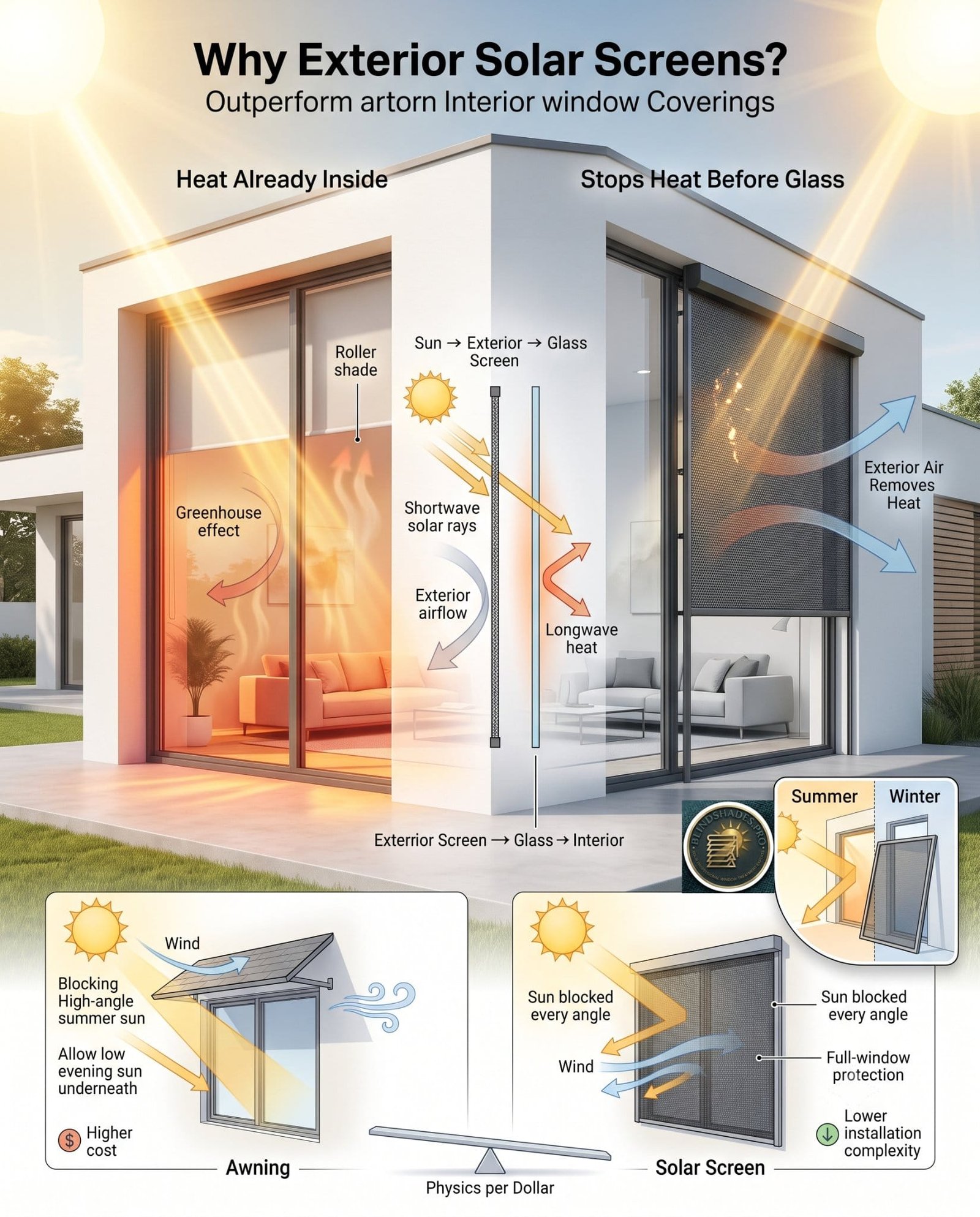
Authored by Michael Turner — 30 Years of Home Improvement Expertise | BlindShades.pro | Complete Buying Guide, Updated for 2026
The best solar screens are chosen by three decisions that come before any brand name: which face of the house takes the sun, which shading factor and color that face needs, and which frame route — DIY kit, bulk roll, custom-made, or local installer — fits your hands and budget. Solar screens are exterior mesh panels that intercept solar radiation before it reaches the glass, which is why they reject heat instead of merely managing it, and why the hot-climate forums keep calling them a huge difference. The mesh market is unusually settled: Phifer’s SunTex line is the industry standard, Phifer Super Solar Screening+ is the view-through premium with an insect-screen bonus, and Twitchell’s Textilene is the professional’s heavy-duty choice — so the real decisions are the ninety-versus-eighty question, the color question, and the buy-route. One warning before anything else: this category shares a name with interior solar shades, and their percentage numbers mean opposite things — a mix-up this guide untangles early, because half the pages ranking for this search are quietly selling the other product.
⭐ Quick Answer — The Best Solar Screens
The best solar screens are chosen at three gates — Face (which glass takes the sun), Factor (shading percentage plus color), and Frame (DIY kit, bulk roll, custom, or installer):
- The mesh market is settled: Phifer SunTex is the industry standard (blocking roughly eighty to ninety percent of solar heat and UV), Phifer Super Solar Screening+ adds view-through and a ten-year guarantee, and Twitchell Textilene is the professional’s coastal and big-pet pick.
- Ninety vs eighty is a compass call: ninety-percent mesh for hot-climate west and south glass, eighty for north faces and mild climates — and charcoal or black gives the best outward view and glare control.
- Exterior position is the whole trick: screens reject heat before the glass instead of managing it after — per Efficient Window Coverings, cutting heat gain, UV, and glare while keeping view. The interior half of the family is mapped in the best solar shades guide.
- Know the number trap: a ninety-percent screen blocks ninety percent of heat, but a three-percent interior shade is three percent open — opposite conventions; night see-through rules are covered in can you see through solar shades from outside.
- Buy by route: DIY kits around twenty dollars per window, custom screens from around forty via houses like Solar Screen Outlet, or local install for second stories — and pair with thermal & insulated blinds for the winter half of the energy fight.
Key Takeaways
- Exterior position is the whole trick. Solar heat gain is a greenhouse problem — once sunlight passes the glass, the re-radiated heat is trapped inside — so an exterior screen that absorbs and sheds energy to outdoor air rejects heat in a way no interior treatment can match, which is why per Efficient Window Coverings the category cuts heat gain, UV damage, and glare while keeping view and daylight.
- The mesh market has three settled answers. Phifer SunTex (vinyl-coated polyester, blocking roughly eighty to ninety percent of solar heat and UV, pet-resistant) is the industry standard; Phifer Super Solar Screening+ (vinyl-coated fiberglass, up to ninety percent block with strong view-through, doubling as an insect screen, backed by a ten-year guarantee) is the premium; Twitchell Textilene (PVC-coated polyester) is the professional’s pick for coastal homes and big pets.
- Ninety or eighty is a compass question. West- and south-facing glass in hot climates needs ninety-percent mesh; north faces and milder climates keep more daylight with eighty — the single spec decision that determines whether your screens feel transformative or dim.
- Screens and shades use opposite numbers. A ninety-percent solar screen blocks ninety percent of solar heat; a three-percent solar shade is three percent open weave. High numbers mean maximum blocking on one product and maximum view on the other — and pages that blur the two are selling you the wrong side of the glass.
- The buy-route matters as much as the mesh. The same Phifer fabric arrives as a DIY kit around twenty dollars per window, a bulk roll for frame-builders, a custom-made screen from around forty dollars, or a local install — the Phoenix-area service market alone shows a 4.6 rating across roughly 1,587 reviews — so match the route to your skills before comparing prices.
Related guides: screens own summer’s radiation; winter’s conduction and convection belong to the complete guide to thermal insulated blinds.
Quick Specification Reference
| Spec | The short answer |
|---|---|
| What a solar screen is | Exterior-mounted mesh (in a frame or track) that intercepts solar radiation before the glass |
| The three gates | Face (which orientation and climate) → Factor (shading percentage + color) → Frame (kit, roll, custom, or installer) |
| Shading factors | Eighty percent for mild climates and north faces; ninety percent for hot-climate west and south glass |
| The mesh names | Phifer SunTex, Phifer Super Solar Screening+, Twitchell Textilene — plus standard insect fiberglass as the non-solar reference |
| Color rule | Dark (charcoal/black) absorbs: best view-through and glare control; light reflects: more privacy and brightness |
| What it fixes | Solar heat gain, UV fading, glare — while keeping daylight and outward view |
| What it is not | An interior solar shade — different product, opposite percentage convention, other side of the glass |
| Insects and pets | Several solar meshes double as heavy-duty insect screens; SunTex and Textilene are marketed pet-resistant |
| Price band | DIY kits around twenty dollars per window; custom-made from around forty dollars; pro install priced locally — stated in words throughout, per our no-fabricated-prices rule |
| Specifier layer | Shading/openness factor, fabric composition, and certifications live on manufacturer cut sheets — honest ranges below, exact values from Phifer and Twitchell documentation |
Read the complete guide below for: the Face–Factor–Frame Test that replaces brand-first shopping; five verified picks; the percentage decode that separates screens from shades; the outside-the-glass physics that answers “do they really work” and the awning objection; the ninety-versus-eighty decision; the color table; the mesh material matrix with the specifier block; the four buy-routes from twenty-dollar kits to local installers; and the cost-and-worth-it verdict by climate.
What Are the Best Solar Screens? Our Picks
Five verified picks — and an honest note: in this category the “brands” are mesh makers and buy-routes, not model numbers.
| Pick | Product | Gate it wins | The attributed case |
|---|---|---|---|
| Best Overall Mesh | Phifer SunTex (80 or 90) | Face + Factor | The industry standard per Google’s own AI answer: vinyl-coated polyester blocking roughly eighty to ninety percent of solar heat and UV, highly pet-resistant, rated for windows and patios alike |
| Best View-Through Premium | Phifer Super Solar Screening+ | Factor (view) | Vinyl-coated fiberglass blocking up to ninety percent of solar heat while keeping outward visibility, doubling as a heavy-duty insect screen, and backed by a ten-year guarantee per Phifer’s documentation |
| Best Heavy-Duty / Coastal | Twitchell Textilene (80 or 90) | Face (harsh exposure) | “The Professional’s Choice” per Quality Window Screen — PVC-coated polyester built for coastal environments and homes with large pets, with the ninety-percent weave designed to block up to ninety percent of solar heat |
| Best Custom Route | Solar Screen Outlet made-to-size screens | Frame (custom) | The category’s top-ranked custom house: six mesh colors, four roll widths, thirty-day returns, free delivery over a modest order threshold — with custom-sized exterior screens cited from around forty dollars |
| Best DIY Kit | Phifer-fabric window screen kits (Shade Screen Solutions; Home Depot kit route) | Frame (DIY) | Complete kits — mesh in your choice of eighty or ninety percent, frame stock, and mounting hardware — listed around twenty dollars per window with thirty-day returns; the route the hot-climate forums keep recommending |
Read the table by gates, not rows. Most houses land on SunTex in ninety percent for the west and south faces and eighty percent elsewhere; view-obsessed rooms upgrade to Super Solar Screening+; coastal and big-dog households step to Textilene; and the Frame gate — kit, custom, or installer — decides where you buy any of them. What the table honestly cannot do is rank installers: solar screens are a strong local-service market (a single Arizona metro shows a 4.6 average across roughly 1,587 reviews on Yelp), and the buy-route section below covers when paying for install beats the twenty-dollar kit.
How Do You Choose Solar Screens? The Face–Factor–Frame Test
Three gates in order: which glass takes the hit, which mesh spec that glass needs, and whose hands build the screen.
| Gate | The question | What the answer decides |
|---|---|---|
| Face | Which orientations are you treating — and is this windows or a patio? | West and south faces in hot climates are the payback case and demand ninety percent; north faces and mild climates keep daylight with eighty; patios route to heavier meshes and track or retractable systems rather than window frames |
| Factor | How much blocking, in which color? | The shading percentage sets heat and glare rejection; the color splits view-through (dark) against reflection and privacy (light) — the two specs together are the entire performance decision |
| Frame | Kit, bulk roll, custom-made, or local installer? | Same mesh, four price tiers: kits around twenty dollars per window for confident DIYers, rolls for frame-builders, custom-made from around forty dollars for exact fits, and local install where ladders, second stories, or volume argue for pros |
The test exists because this category’s regrets are gate-skips, not product failures. The hot-climate threads are full of them: ninety-percent mesh on a north kitchen window that now feels like dusk (a Face miss), a white mesh chosen for curb appeal that turned the picture window into a mirror from inside (a Factor miss), and a fifteen-window DIY weekend abandoned at window six (a Frame miss). Google’s AI answer for this exact search ends by asking three questions it cannot answer for you — windows or patio, retractable or fixed, which climate and sun direction — and those are the Face and Frame gates verbatim. Run the gates in order; the rest of this guide arms each one.
One scope note before the gates get their data, because it decides whether this is even the right guide: solar screens mount outside the glass; solar shades hang inside it. They share a name, split the physics, and use opposite numbers — which is exactly where we start.
Solar Screens vs Solar Shades: Why Do the Percentages Mean Opposite Things?
A ninety-percent screen and a three-percent shade are both “dark” — because the two products count in opposite directions.
Here is the decode no ranking page offers. Exterior solar screens are rated by shading factor — the share of solar energy blocked — so ninety percent means ninety percent of the sun’s heat stopped. Interior solar shades are rated by openness factor — the share of the weave that is open — so three percent means a tight, dark fabric and ten percent means an airy, view-friendly one. High numbers mean maximum blocking on screens and maximum openness on shades. The confusion is not hypothetical: interior shade catalogs rank on this exact search, quoting one-to-ten-percent openness to shoppers hunting eighty-and-ninety-percent screens, and a buyer who doesn’t know the conventions flipped can order precisely the wrong product with total confidence.
| Exterior solar screens | Interior solar shades | The practical difference | |
|---|---|---|---|
| Mounts | Outside the glass, in frames or tracks | Inside the room, on a roller | Which side of the glass the heat fight happens |
| Number convention | Shading factor — percent blocked | Openness factor — percent open | Opposite directions; ninety-percent screen ≈ very dark, ten-percent shade ≈ very open |
| Heat performance | Rejects heat before the glass — the strongest heat play | Manages heat and glare after the glass | Screens win hot climates; shades win view-and-interior control |
| Best at | West/south heat, UV fading, whole-window coverage | Glare control, daytime privacy, interior style, easy seasonal use | Different jobs, honestly complementary |
| Rules and rentals | HOA and landlord approval often required for exterior mounting | Almost always allowed | The most common reason to choose shades instead |
| Our coverage | This guide | The best solar shades buying guide | Two deliberate guides, one boundary |
The honest crossover cases run both directions. Choose interior shades when the building says no — rentals, HOAs that police exterior appearance, upper floors with no safe mounting, historic facades — or when the goal is glare and view management rather than raw heat rejection; the openness decision, fabric colors, and the classic “can people see in at night” question live on the shades side, including our full answer to whether you can see through solar shades from outside. Choose exterior screens when the enemy is heat itself. And plenty of hot-climate houses rightly run both: screens on the brutal west wall, shades managing glare and privacy everywhere else.
Do Solar Screens Really Work? The Outside-the-Glass Advantage
Yes — and the reason is the greenhouse effect, which also explains the one objection worth taking seriously.
Sunlight passes through glass as shortwave radiation; the surfaces it strikes inside re-emit it as longwave heat, and glass traps longwave — that is the greenhouse effect, and it is why a parked car cooks. Every interior treatment, however good, fights that battle after the radiation is already indoors: it can reflect some energy back out and manage the rest, but a share of the heat is already in the room. An exterior screen changes the venue. The mesh intercepts most of the radiation before the glass, absorbs it, and sheds that heat to outdoor air where moving air carries it away. The institutional summary from Efficient Window Coverings states the category’s case plainly: solar screens reduce solar heat gain, UV damage, and glare while still permitting significant view and light transmission. That is also why the hot-climate testimony is so consistent — a forty-seven-answer San Antonio thread’s top verdict is that they make a huge difference, a Phoenix poster’s ninety-percent install came with an outright “highly recommend,” and the fresh fifty-eight-answer Phoenix worth-it debate (March 2026) keeps landing on yes for sun-struck glass.
That fresh thread also contains the one ranked objection worth engaging rather than dismissing: an awning would work better, the argument goes, because anything attached to the window absorbs light and emits heat right at the glass. The physics half of that is fair — an awning shades from a distance and never warms the window zone, and for a single south-facing window it can outperform on paper. The practice half is where screens win: an awning only blocks high-angle sun (west-facing evening sun ducks straight under it), covers one geometry per window, fights wind for its whole life, needs structure and permits an HOA will notice, and costs multiples per opening. A screen covers the entire pane at every sun angle, survives weather as a taut mesh, mounts in minutes, and — because it sits in outdoor air with a small standoff from the glass — sheds most of its absorbed heat to the breeze rather than the window. The honest verdict: for one dramatic southern exposure with money to spend, price an awning too; for whole-house heat control, the screen route wins on physics-per-dollar. Winter deserves one honest sentence as well: the same interception works against free winter sun, which is why removable frames are popular in four-season climates — and why the indoor half of the insulation story belongs to the best thermal and insulated blinds guide.
What Is a 90 Percent Solar Screen — and When Do You Need It?
Ninety percent is a shading factor, not a marketing flourish — and it is a compass decision.
A ninety-percent solar screen uses a weave dense enough to block roughly ninety percent of incoming solar energy; an eighty-percent weave trades some blocking for meaningfully more daylight and view. Google’s own answer states the deployment rule the industry has settled on, and it matches everything the hot-climate forums report:
| Your situation | Eighty percent | Ninety percent |
|---|---|---|
| West or south glass, hot climate | Underpowered for the worst hours | The essential spec — maximum heat and glare rejection where the sun actually lands |
| North glass, any climate | The right call — keeps rooms bright | Overkill that buys dimness |
| East glass | A judgment call — morning sun is real but brief | Choose it for bedrooms where dawn glare ruins sleep |
| Mild or coastal-cool climates | The default | Reserve for specific glare problems |
| View-critical picture windows | The compromise spec | Pair with dark color to claw back view-through |
| Patios and outdoor rooms | Comfortable filtered light | The full-shade outdoor-room feel; heavier meshes and track systems live here |
Two notes the table compresses. First, mixing factors across one facade is not just allowed, it is the professional pattern — ninety on the west wall, eighty everywhere else — and nothing about the products prevents it. Second, the factor interacts with the next section’s color decision: a ninety-percent screen in charcoal preserves far more apparent view than the number suggests, which is the pairing behind most of the best solar screens installed in the Sun Belt. Skylights deserve their own footnote: glass overhead is the most brutal Face of all, and the roof-window version of this fight is covered in skylight blinds for heat reduction.
What Is the Best Color for Solar Screens?
Dark for view and glare, light for privacy and reflection — the physics is simple and the industry data agrees.
Color on a solar screen is not decoration; it decides how the blocked light behaves. Dark meshes — charcoal and black — absorb incoming light, which kills glare and, counterintuitively, gives the clearest outward view, because a dark mesh reads as transparent to the eye the way sunglasses do. Light meshes — white, beige, stone — reflect light, which bounces more energy away and reads brighter from the street, but the reflection also washes out the view from inside and turns the mesh slightly mirror-like. Hartley Window Coverings’ design guidance (May 1, 2026) lands where installers do: charcoal or black complements clean architectural lines and provides the best outward visibility and glare reduction, while lighter screens earn their keep on privacy-first and reflection-first jobs.
| Color family | View from inside | Glare control | Daytime privacy from outside | Curb appeal note |
|---|---|---|---|---|
| Charcoal / black | Best — reads transparent | Best | Good | The modern default; disappears against most windows |
| Brown / bronze | Very good | Very good | Good | Warms against brick and wood tones |
| Gray / stone | Good | Good | Better | The neutral compromise |
| White / light beige | Weakest — reflective wash | Moderate | Best | Brightest from the street; check HOA color rules |
The practical rule: choose dark unless a specific privacy or facade requirement argues otherwise, and order sample swatches — every serious supplier ships them — to view against your actual glass in afternoon light. Privacy itself deserves the honest caveat that applies to all mesh products: daytime privacy comes from the light imbalance, and after dark with interior lights on, any screen or shade becomes see-through from outside; night privacy is a job for the interior layer.
Which Mesh Material Should You Choose?
Three coated-fabric families do this job — and the differences are about claws, salt, and view, not marketing tiers.
| Mesh | Composition | Shading factors | Durability character | Extras on record | Tier |
|---|---|---|---|---|---|
| Phifer SunTex | Vinyl-coated polyester | Eighty and ninety percent | Heavy-duty; marketed highly pet-resistant | Rated for windows and patios; the volume standard | The default |
| Phifer Super Solar Screening+ | Vinyl-coated fiberglass | Up to ninety percent | Premium weave tuned for view-through | Doubles as heavy-duty insect screen; ten-year guarantee per Phifer | The view premium |
| Twitchell Textilene | PVC-coated polyester | Eighty and ninety percent | “Nearly indestructible” per its professional reputation; the coastal and big-pet answer | The Professional’s Choice per Quality Window Screen | The heavy-duty pick |
| Standard insect fiberglass (reference) | Uncoated fiberglass | Not a solar product | Light-duty | Keeps bugs out, does nothing meaningful for heat | The row that explains why your existing screens don’t count |
For Specifiers — the 777 block. Specifying solar screening for a commercial or multi-unit project runs on four data points, all of which live on manufacturer cut sheets rather than consumer pages: exact shading/openness coefficients per fabric and color, fabric composition and weight, fire-performance certification (verify NFPA 701 flame-propagation listings per fabric on the current cut sheet), and low-emissions certification where interior-adjacent (GREENGUARD listings vary by product line — confirm, never assume). Energy modeling for exterior attachments should lean on the Attachments Energy Rating Council ecosystem via efficientwindowcoverings.org rather than seller claims. This guide states honest category ranges only; Phifer and Twitchell publish the per-SKU numbers, and the office-side interior strategy — glare, screens, and conference glass — is covered in our office and commercial blinds guide with the worth-it math in are solar shades worth it for a commercial office. One specific office overlap worth its own link: exterior screens are also the cleanest fix for computer screen glare from office windows, because they kill the glare without the cave effect interior blackout creates.
Should You Buy a Kit, a Roll, Custom Screens, or a Local Installer?
Four routes to the same mesh — priced by whose hands do the work.
| Route | What arrives | Best for | Watch for |
|---|---|---|---|
| DIY kit | Mesh (your choice of eighty or ninety), frame stock, corners, spline, hardware — around twenty dollars per window, thirty-day returns per the ranking kit listings | Standard windows, patient hands, whole-house budgets | Measure twice; a weekend of spline-rolling is honest work — the forums’ Home Depot-kit veterans say exactly that |
| Bulk roll + frames | Mesh by the roll (multiple widths and colors) plus separately sourced frame stock | Frame-builders and repair-your-own households | The cheapest per window only if your time is free |
| Custom-made screens | Made-to-measure framed screens from around forty dollars each; the top custom house offers six colors, four widths, and thirty-day returns | Exact fits, odd sizes, no-tools buyers | Shipping thresholds; measure to the maker’s spec exactly |
| Local installer | Measured, built, and mounted — the route behind the strong metro service markets (a 4.6 average across roughly 1,587 reviews in one Arizona city) | Second stories, big windows, volume jobs, anyone allergic to ladders | Get the mesh brand and factor in writing; you are buying the same fabrics either way |
The route decision is where the best solar screens projects succeed or stall, because the mesh is identical across all four. The honest selector: count your windows, count your stories, and be truthful about ladder appetite. One-story houses with standard windows are kit territory and the savings are real; anything involving a second-story west wall — precisely the glass that most needs ninety percent — is where installer quotes earn their keep. Two adjacent products share this aisle and deserve their own guides: fixed screens on outdoor living spaces cross into the best patio shades and outdoor patio blinds territory, and the retractable-versus-fixed question Google’s answer raises has a modern third option — motorized exterior and interior systems — mapped in the motorized and smart blinds guide.
How Much Do Solar Screens Cost — and Are They Worth It?
Priced in routes, paid back in compass directions.
Stated in words, per our rules: the DIY kit route runs around twenty dollars per standard window; custom-made framed screens start around forty dollars and climb with size and mesh; bulk rolls price by the foot across multiple widths; and professional installation is quoted locally, typically landing as a multiple of the custom-screen price once labor and ladders enter. What drives the number is mechanical: square footage, the mesh family (Textilene and Super Solar+ over SunTex), the factor (ninety over eighty marginally), frame color matching, and access height.
| Situation | Worth-it verdict |
|---|---|
| Hot-climate west/south glass (the Phoenix question) | The strongest yes in window treatments — this is the exact case the fifty-eight-answer worth-it thread keeps affirming |
| Whole-house in cooling-dominated climates | Yes — kit-route economics make it one of the cheapest meaningful efficiency upgrades available |
| North faces, mild climates | Marginal — buy for glare or UV fading if at all, at eighty percent |
| Heating-dominated climates | Seasonal — removable frames in summer, open glass for free winter sun, interior insulation doing the cold-month work |
| Rentals, HOAs, upper floors with no mounting | Route the budget to interior solar shades instead — the boundary section above is your map |
The worth-it logic is the same greenhouse physics from earlier wearing a price tag: every unit of heat rejected before the glass is a unit your air conditioner never meets, so the payback scales with how hard your cooling runs and how directly your glass faces the sun. That is why the best solar screens conversation is really a Sun Belt conversation — and why the honest answer for a shaded Vermont bungalow is to spend the money indoors.
Other Buying Guides
- Are Solar Shades Worth It for a Commercial Office?
- Solar Shades for Bathroom Privacy
- Can You See Through Solar Shades from Outside?
- Skylight Blinds for Heat Reduction
- How to Reduce Computer Screen Glare from Office Windows
- Best Outdoor Patio Blinds
- Best Patio Shades
- Best Thermal & Insulated Blinds
Related Buying Guides
- The Best Solar Shades Buying Guide — the interior half of this category
- The Best Motorized & Smart Blinds Buying Guide
- The Best Thermal & Insulated Blinds Buying Guide
- The Best Office & Commercial Blinds & Shades Buying Guide
- The Best Outdoor Patio Blinds Buying Guide
Frequently Asked Questions
Do solar screens really work?
Yes — and the mechanism is the reason. Solar heat gain is a greenhouse problem: once sunlight passes the glass, the re-radiated heat is trapped indoors. An exterior solar screen intercepts most of that radiation before the glass, absorbs it, and sheds the heat to outdoor air, which is why it rejects heat rather than merely managing it. Per Efficient Window Coverings, the category reduces solar heat gain, UV damage, and glare while keeping significant view and daylight — and the hot-climate field reports agree, from a forty-seven-answer San Antonio thread’s “huge difference” verdict to the fresh Phoenix worth-it debate landing on yes for sun-struck glass.
What is the best color for solar screens?
Charcoal or black for most installs: dark mesh absorbs light, which kills glare and gives the clearest outward view — the same optics as sunglasses — and per Hartley Window Coverings’ 2026 guidance it complements clean architectural lines best. Light colors (white, beige, stone) reflect more energy and read brighter from the street, buying daytime privacy at the cost of a washed-out view from inside. Order swatches and check them against your own glass in afternoon light; and remember night privacy is an interior-layer job regardless of mesh color.
What is a 90 percent solar screen?
A screen whose mesh blocks roughly ninety percent of incoming solar energy — its shading factor. Ninety percent is the spec for west- and south-facing glass in hot climates, where maximum heat and glare rejection matters more than maximum daylight; eighty percent keeps rooms brighter on north faces and in milder climates. Do not confuse the convention with interior solar shades, which are rated by openness (a three-percent shade is three percent open weave) — the numbers run in opposite directions across the two products.
How much do solar screens cost?
By route rather than by product: DIY kits with Phifer mesh, frame stock, and hardware list around twenty dollars per standard window; custom-made framed screens start around forty dollars each and scale with size and mesh family; bulk rolls price by the foot for frame-builders; and professional installation is quoted locally, typically a multiple of the screen price once labor and access height enter. The payback logic is climate math — every unit of heat rejected before the glass is a unit the air conditioner never meets — which is why hot-climate west and south windows justify the spend fastest.
Are solar screens better than solar shades?
They are different products for different jobs, and the names hide it. Exterior solar screens mount outside the glass and win the heat fight outright; interior solar shades mount inside and win on glare management, daytime privacy, view control, and installability anywhere — including the rentals, HOAs, and upper floors where exterior mounting is off the table. Hot-climate houses frequently run both: screens on the punished west wall, shades everywhere the job is glare and style. Our solar shades guide covers the interior half in full.
Can you see through solar screens at night?
From inside out during the day, yes — especially with dark mesh. At night the imbalance flips: with interior lights on, any mesh product becomes see-through from outside, screens and shades alike. Daytime privacy is real; night privacy always belongs to an interior layer such as shades, blinds, or drapes behind the glass.
By Michael Turner | 30 Years Home Improvement Expertise | Updated 2026 | BlindShades.pro
