How to Reach Blinds on Tall Windows: The Height Ladder

Authored By Michael Turner -30 Years Home Improvement Expertise | Updated 2026 | BlindShades.pro
Updated on July 26, 2026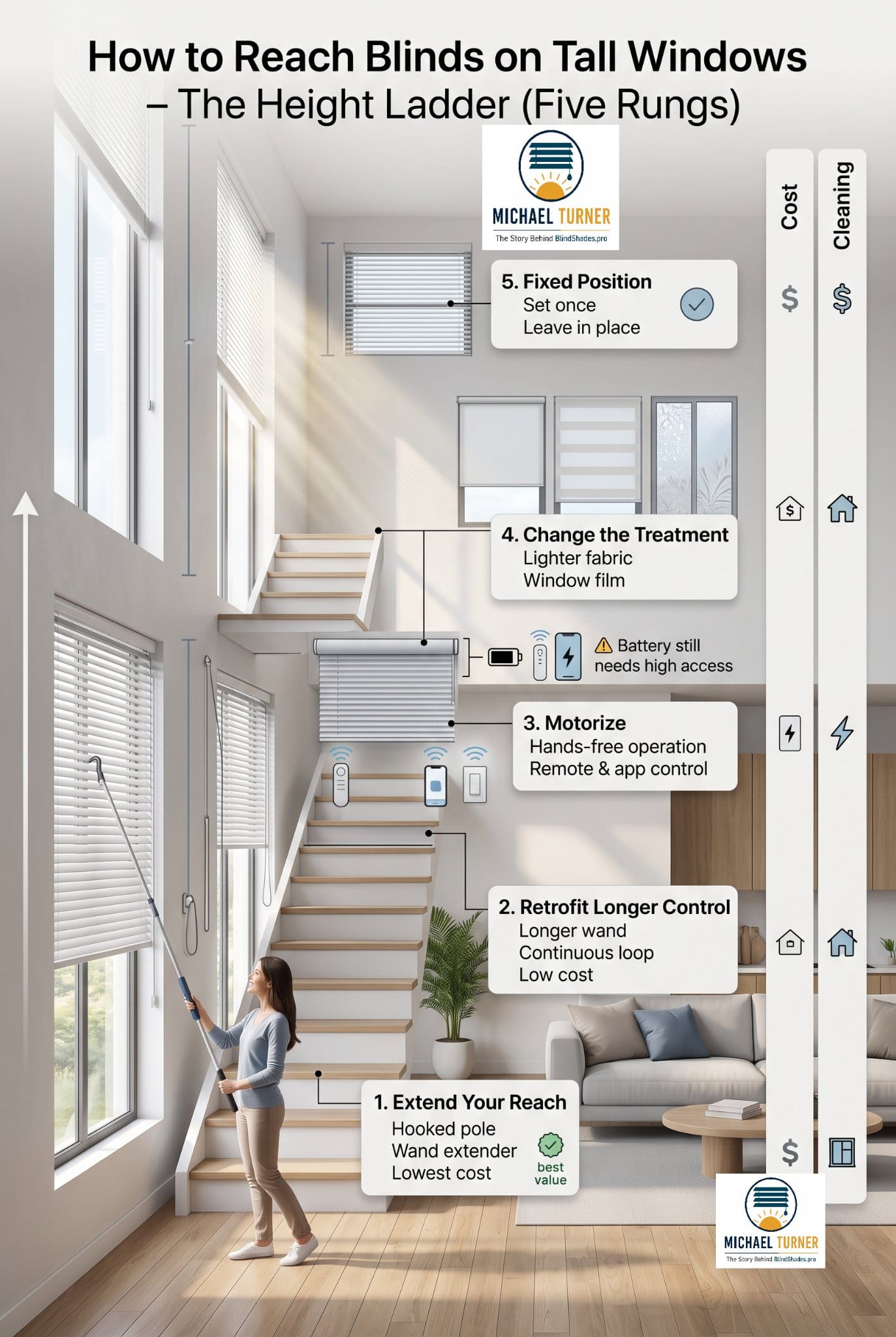
By Michael Turner — 30 years in window treatments
How to reach blinds on tall windows starts far lower down the price list than the industry suggests: before you price a motor, extend your own reach with a hooked pole or a gripping tool, because in the largest owner discussion on record the winning answer cost nothing and beat every paid one. Motorising is right for genuinely high glass and for anyone who shouldn’t be reaching at all — but it’s rung three of five, and it quietly creates a problem nobody mentions: something up there now needs charging. What follows is the ladder in cost order, plus the two problems at height every page here ignores.
Key Takeaways
- Start at the cheapest rung. A hooked pole or long gripping tool solves most tall-window frustration for the price of a takeaway.
- The free fix genuinely won. A socket taped to a broom handle to turn an unreachable wand — its owner said it changed his daily life.
- Pull evenly, even with a pole. Hooking one corner is how a tall blind jams, and it’s the one caution the industry does state.
- Motorising at height buys a new chore — the battery is out of reach too, so ask how it charges before you buy.
- Nobody plans the cleaning. A pole solves operating and nothing about dust, which is what people discover in year two.
⭐ Quick Answer — How to Reach Blinds on Tall Windows
Work up five rungs in order — extend your reach, retrofit a longer control, motorise, change the treatment, or accept a fixed position:
- Rung one costs pocket money and solves most cases: a hooked extension pole pushes and pulls a cordless bottom rail, and long silicone tongs grip a rail or wand just past your fingertips.
- The free fix genuinely won: a socket taped to a broom handle, used to turn an unreachable tilt wand from the floor — it beat every paid answer in the largest owner discussion on record.
- Keep the pull even, even at the end of a pole: Blinds Chalet puts both hands evenly on the bottom rail with a slow release, and hooking one corner from below is the fastest way to jam a tall blind.
- Motorise for genuinely high glass — second storeys, stairwells, heavy treatments, or any reach or mobility limit — but settle the battery access first, because a motor at height puts the charging job back where the problem started. The powered options are weighed in cordless vs motorized blinds.
- Choose lighter fabric, and plan the cleaning: The Shade Store flags tall windows as a situation to think twice about before choosing cordless at all — a fair warning, weighed in are cordless blinds worth it, with the picks ranked in our Cordless Blinds & Shades guide. Owner tool builds going back to 2012 are still circulating on Houzz.
How to Reach Blinds on Tall Windows
The Height Ladder (Five Rungs)
The industry answers with three options side by side — motorised automation, extension poles, continuous cord loops — motorising listed first, shopping link attached. That ordering is backwards for most homes: owner discussions are full of people who solved this for the price of a kitchen utensil, after being quoted for motors. So take it as a ladder, cheapest rung first, and stop climbing when the problem is solved.
| Rung | What it is | Cost class | What it fixes | What it doesn’t |
|---|---|---|---|---|
| 1. Extend your reach | Hooked pole, long gripper, or a wand extender | Pocket money | Daily operating on windows just out of reach | Dust; very high glass; anyone who shouldn’t be stretching |
| 2. Retrofit a longer control | A longer wand, a wall-anchored continuous loop, or a DIY coupler on the existing handle | Low | Windows a rung-one tool can’t reach cleanly | Needs the right mechanism to attach to |
| 3. Motorise | Motor in the headrail, run by remote, app, wall switch or schedule | Significant | Everything about operating, including hands-free | ⭐ Creates battery access at height; cleaning still unsolved |
| 4. Change the treatment | Lighter fabric, a different style, or film on the glass instead of a covering | Varies | The underlying mismatch between window and product | Loses the covering’s other functions |
| 5. Accept a fixed position | Set it once at a working height and leave it | Free | The struggle | Any light control you’d wanted |
Rung five sounds like defeat and is often correct for a transom nobody looks through — setting a high panel once and treating it as glazing is a decision, not a failure.
What Tools Actually Work?
This is where the field goes quiet and owners go specific. The industry line is a long pole with a hooked tip that pushes or pulls the bottom rail — accurate, and the entire treatment given to the cheapest rung on the ladder. Owners have gone much further, in public, where anyone could read it.
| Tool | How it’s used | Where it comes from | Best for |
|---|---|---|---|
| Hooked extension pole | Hook under or over the bottom rail; push up, pull down, keeping the hook near the centre | The standard industry recommendation | Cordless rails a foot or two out of reach |
| ⭐ Long silicone tongs | Grip the rail or wand and pull; the twelve-inch kitchen tongs sold for retrieving laundry | The winning answer in an eighty-comment owner discussion on a five-foot-eight household | Rails and wands just beyond fingertips |
| ⭐ Socket taped to a broom handle | The socket slips over the wand tip and turns it from the floor | The accepted answer in the largest reach discussion on record; the owner reported it changed his daily life | Tilt-only problems on venetian and faux-wood blinds |
| Elbow and coupler on a pole | A right-angle fitting with a slotted coupler that grips the handle tab | A homeowner’s build documented on a design forum back in 2012, still circulating | Blinds with a moulded handle tab on the rail |
| Wand extender | A purpose-made extension that lengthens the existing tilt wand | Manufacturer accessory | A permanent tidy fix where a wand already exists |
Two patterns matter. Every winning tool is a gripper or a turner, not a hook — what most people can’t do isn’t lifting the rail, it’s getting purchase on the control. And every successful build attaches to something specific: a wand tip, a handle tab, a rail lip. Check what your blind gives you to grab, which comes down to how cordless blinds work — the rail lifts, the wand tilts, so a tool that solves one won’t touch the other.
The caution the industry does get right: don’t hook one side and pull. Blinds Chalet’s July 2026 guidance states the form plainly — both hands evenly on the bottom rail, a gentle push, a slow release to let the brake catch — and it survives at the end of a pole. Pull one corner from six feet below and the internal cords wind unevenly, the most reliable way to jam a tall blind. If yours already won’t cooperate, the diagnosis is in why cordless blinds won’t go up or down.
The Three Problems at Height
Every page about tall windows answers one problem and leaves two standing. Operating is the one everybody writes about. The other two are what people actually complain about in year two.
| Problem at height | Who forgets it | The honest fix |
|---|---|---|
| Operating | Nobody — this is the whole field | The ladder above |
| ⭐ Cleaning | Everybody, including the motorised buyers | Long-handled duster or a vacuum wand attachment on a schedule; avoid fabrics that trap grime up there |
| ⭐ Maintenance access | The motorised buyers specifically | Ask how does the battery get charged before ordering; prefer hardwired, solar-assisted, or a removable pack you can reach |
The cleaning gap is real and expensive. A pole gets the shade up and down; it does nothing about dust on a treatment you can’t reach with a cloth. Owners describe hauling out fully-extended ladders, and cellular shades collect debris inside the cells that only a vacuum attachment retrieves — the method is in how to clean cordless blinds. Choose fabric with the cleaning in mind; at height it’s the harder chore.
The maintenance trap deserves its own warning, because it’s the most predictable failure in this subject. A homeowner asks how to reach a blind; the group says motorise; someone asks the obvious follow-up — how do you reach the battery. A motor on a sixteen-foot window puts that job right back where the problem started. Not an argument against motorising: an argument for settling the power route in the same decision, which is set out in cordless vs motorized blinds.
Should You Motorise, or Change the Treatment?
Two retailers here are honest enough to name the problem and then stop. The Shade Store (April 2026) lists very wide or tall windows among the situations to think twice about before choosing cordless at all, and Suncoast Blinds concedes its own Lift-n-Lock design hits the same reach limitation. Both true; neither tells you what to do. The wider question of whether the category suits your windows is settled in are cordless blinds worth it — here is the matrix.
| Your window | Mechanism now | The recommendation |
|---|---|---|
| Just out of comfortable reach | Cordless | Rung one — a gripper or hooked pole, and stop there |
| Tall but reachable with a pole, used daily | Cordless | Rung one or two; lighter fabric if the push feels heavy |
| Very high, second storey, or above a stairwell | Anything | ⭐ Motorise, and settle the power route first |
| Tall and wide, heavy treatment | Cordless | Motorise — a heavy blind at height is two problems compounding; see large windows |
| Transom or clerestory nobody looks through | Anything | Rung five, or film on the glass and no covering at all |
| Any height, with reach or mobility limits | Anything | Motorise the windows you use; don’t accept a daily struggle |
| Tall window, privacy is the real need | Cordless venetian | Tilt rather than lift — the wand solves it without moving the rail |
The other lever is worth taking seriously: choose lighter fabric. Guidance across this field converges on it, and Blinds Chalet’s hard-to-reach page says the same — lighter materials such as certain fabric shades are easier to operate cordless. A light cellular or roller takes far less force than a heavy faux-wood venetian, which matters enormously at the end of a pole. Those trade-offs are drawn in cellular vs roller cordless shades.
One regulatory note on continuous loops. They appear in standard advice as a fixed chain kept at a reachable level, and remain legitimate — but under the current window covering safety standard, continuous-loop products must ship with a permanently attached tension device that anchors and immobilises the loop. It isn’t optional or decorative; it must be fixed to the wall for the product to work as intended. In a home with children, read are cordless blinds child-safe first — a reachable chain reintroduces the hazard the cordless redesign removed.
And the option nobody selling blinds will print: in the largest owner discussion on this problem, the highest-voted answer was to take the covering down and tint or film the glass instead. For a window fifteen feet up that exists for daylight rather than privacy, that’s frequently the correct engineering answer and costs less than motorising. Rung four, real, and you won’t hear it from a retailer.
Avoid These Mistakes
- Pricing a motor first. Try the pocket-money rung before the expensive one; most tall-window complaints stop there.
- Hooking one corner. Keep the pull near the centre of the rail even at the end of a pole, or you’ll jam the blind and eventually bend the rail.
- Buying a motor without settling the power route. A battery at height is the original problem wearing a disguise.
- Ignoring the cleaning. Choose the fabric for how it will be dusted, not just for how it will be lifted.
- Reaching from a chair. If it needs a ladder, it needs a proper ladder — or it needs rung three.
- Assuming a heavy blind is the only option. Lighter fabric is the cheapest force reduction there is; if the treatment is oversized, check the width and bracket rules before blaming height.
Who Should Buy Which Solution?
✔ Rung one or two suits you if: the rail or wand is within a foot or two of your reach · you use the window daily and want it usable now · you rent, or don’t want to modify anything · the blind gives you a wand tip, handle tab or rail lip to grab · the treatment is light enough to move with modest force.
✖ Go straight to motorising if: the window is on a second storey, above a stairwell, or genuinely high · the treatment is heavy, wide, or both · reach, grip or mobility make a pole a poor answer — this is the strongest reason on the list and worth paying for without hesitation · you want scheduling or hands-free operation · you’re building or renovating with the walls open, which is the cheapest moment to run power.
The Bottom Line
How to reach blinds on tall windows is a ladder, not a purchase. Rung one — a hooked pole, a long silicone gripper, a socket on a broom handle — solves more of these situations than the field admits, and it beat every paid answer in the biggest discussion owners have had about it. Motorise when the height, the weight, or your own reach makes that the honest answer, and settle the battery question in the same conversation. Keep the pull even, choose the lighter fabric, and decide how the thing will be cleaned before you decide how it will be lifted.
If you’re still choosing the treatment itself, the picks are ranked in our complete Cordless Blinds & Shades buying guide — and if the reach problem has you questioning the whole category, that verdict is delivered in are cordless blinds worth it.
FAQ
How to reach high window blinds? Extend your reach before you spend: a hooked pole pushes and pulls a cordless bottom rail, and a long silicone gripper handles a rail or wand just past your fingertips. For genuinely high glass, second storeys or heavy treatments, motorise — and decide how the battery gets charged before ordering.
How do you operate window blinds? Cordless blinds lift by hand: both hands evenly on the bottom rail, a gentle push or pull, then a slow release so the brake catches. Slat tilt is separate, handled by a wand. Corded blinds lift by cord and tilt by wand or second cord.
How to do blinds on large windows? Large windows compound width and weight, and both make the spring work harder. Order enough bracket support across the span, favour lighter fabrics, pull from the centre. Very wide or tall openings are often better split into panels or motorised outright.
How to open tall blinds? Tilt the slats flat first on a venetian, then raise from the centre of the bottom rail with a pole hook or gripper, keeping the pull even. If the blind is only there for daylight, tilting rather than lifting usually gives you what you wanted.
How do you raise and lower vertical blinds without a cord? Cordless verticals don’t lift at all — they traverse. A wand walks the vanes along the headrail track and rotates them for light control, so height is far less of an obstacle than with a lifting blind. That makes verticals a genuinely underrated answer for tall, narrow windows and patio doors.
How do you clean blinds you can’t reach? With a long-handled duster or a vacuum wand attachment on a schedule, rather than a cloth and a ladder. Cellular shades trap debris inside the cells and need the vacuum attachment specifically. Fabric choice matters more at height than anywhere else.
Related Guides
- Best Cordless Blinds & Shades — the complete buying guide
- Are Cordless Blinds Worth It? — the conditioned verdict, including reach
- Cordless vs Motorized Blinds — when the spring should become a motor
- Best Motorized & Smart Blinds — the powered field, ranked
- Do Cordless Blinds Work on Large Windows? — width, weight and brackets
- Are Cordless Top-Down Bottom-Up Shades Worth It? — the top rail is the least reachable part of any window
- How to Clean Cordless Blinds — including the ones you can’t reach
- How Long Do Cordless Blinds Last? — why forced operation shortens the clock
- How Do Cordless Blinds Work? — the rail lifts, the wand tilts
- Can You Cut Cordless Blinds to Size? — measuring and the length rule
