Best Cordless Blinds for Bathrooms and Kitchens: The Four Wet-Room Failures

Authored By Michael Turner -30 Years Home Improvement Expertise | Updated 2026 | BlindShades.pro
Updated on July 27, 2026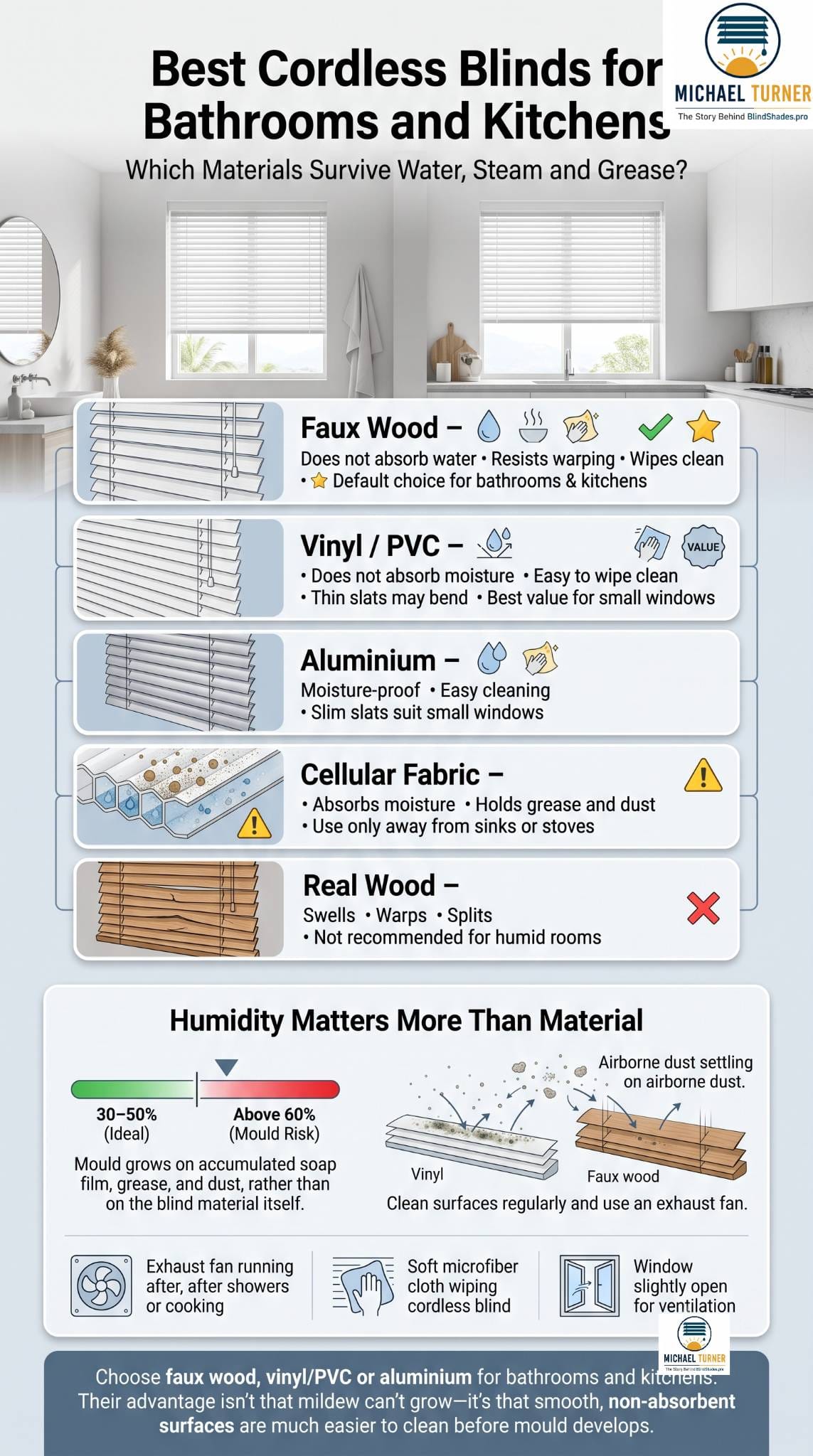
By Michael Turner — 30 years in window treatments
The best cordless blinds for bathrooms and kitchens are faux wood, vinyl or aluminium in rooms that get properly wet, and cellular fabric only where the window is well away from the shower or the hob — but the advice everyone gives is about the slats, and the slats are not what fails. A cordless blind hides a spring, spool and brake inside its headrail — an assembly sitting in a room that saturates twice a day, and no material chart mentions it. The trade is so confident about materials that one seller says a faux wood blind could be submerged and be fine, while another warns never to submerge one — and on a cordless blind only one of those is safe advice.

Key Takeaways
- Buy for the mechanism, not the slats. Vinyl, PVC, aluminium and faux wood all resist water. The headrail is what water ruins, and it is the same on all.
- “Waterproof” is a marketing word here. Nothing sold for a bathroom window is waterproof in the sense buyers mean. Non-absorbent is the honest term.
- Mildew grows on the dirt, not the material. The Environmental Protection Agency’s guidance is that mould needs a surface carrying dust or debris — so a non-absorbent slat with soap film still grows mildew.
- Bathrooms and kitchens fail differently. Steam attacks one; airborne grease attacks the other, and grease is harder because it holds dust.
- Fit decides more than material. A blind ordered to sit flat on the sill dries and cleans properly; one hanging short traps moisture.
⭐ Quick Answer — Best Cordless Blinds for Bathrooms and Kitchens
The best cordless blinds for bathrooms and kitchens are the non-absorbent ones — but the slats are the easy half of the decision:
- Choose faux wood, vinyl or aluminium for any window taking direct steam, spray or cooking grease. Blindster puts the reason plainly: these materials do not absorb water. Keep cellular fabric for windows across the room from the source.
- ⭐ The headrail is what actually fails. A cordless blind keeps its spring, spool and brake in a sealed housing you cannot open or dry — which is why Blindsgalore says never submerge a blind, and why the advice that a faux wood blind could be submerged is wrong on this product.
- Mildew grows on the dirt, not the material. The Environmental Protection Agency puts mould on surfaces carrying dust or debris above 60 per cent humidity, so a non-absorbent slat with soap film still spots. Hold the room between 30 and 50 per cent and run the extractor.
- Wipe, never soak. A damp cloth and a dry pass — the full routine for cells and slats is in cleaning cordless blinds. Order the drop to sit flat on the sill so nothing traps damp behind it.
- ⚠️ Check it is still private after dark. A light-filtering shade that looks opaque by day can turn into a lit screen at night — specify room-darkening for overlooked bathrooms. Room-by-room options are in bathroom window blinds, and the picks in our Cordless Blinds & Shades guide.
Cordless Blinds for Bathrooms and Kitchens: What Actually Fails?
The Four Wet-Room Failures (Mechanism · Warp · Mildew · Mount)
Pick the material second — after you know what kills window coverings in these rooms, because the standard advice (vinyl and aluminium do not absorb water, so buy those) answers only one of four failures.
| The failure | What it looks like | What actually prevents it |
|---|---|---|
| ⭐ Mechanism | Spring loses tension, brake slips, the blind will not hold | Keeping water out of the headrail — wipe only, never soak |
| Warp | Slats bow or discolour above a shower or hob | Non-absorbent material — faux wood, vinyl, PVC, aluminium |
| Mildew | Spotting along slats, in cell folds, at the bottom rail | Removing the soil it feeds on, plus ventilation and humidity control |
| Mount | Brackets loosen in tile or plaster; the blind hangs short | The right mount for the surface, and a drop that reaches the sill |
Only the second row is a material question. The trade answers that one thoroughly — which is why the advice is uniform, and the gaps are too.
What Actually Fails in a Bathroom — and It Isn’t the Slats
Here the trade contradicts itself, and one side of it will destroy your blind.
One retailer states faux wood is so impervious you could submerge it and it would be fine. Blindsgalore says the opposite — never submerge a blind, because water seeps into the headrail and damages the lift mechanism. Same product, and both cannot be right.
They reconcile once you separate the halves. The slats survive submersion — that is true, and it is why these materials are recommended. The headrail does not. On a corded blind it holds little more than a cord lock; on a cordless blind it holds the spring, spool and brake, in a sealed housing you cannot open, dry or service, so water that gets in stays in. The mechanism is unpacked in how cordless blinds work, and the failure it causes in why cordless blinds won’t go up or down.
So on a cordless blind the submersion advice is not merely wrong: it describes the exact procedure that ruins the expensive half of the product — the same failure owners report after washing a cellular shade and finding the internal cord knotted, covered in cleaning cordless blinds.
Two facts make this concrete. The Environmental Protection Agency’s rule for damp materials is that drying within 24 to 48 hours generally prevents mould — a schedule a sealed headrail cannot meet. And warranties concede the point in advance: faux wood is commonly covered around three years, sometimes five, with fading excluded, while real wood warranties frequently exclude humidity damage outright. Manufacturers know which rooms cost them money — see how long cordless blinds last.
The rule: in a wet room, clean with a damp cloth and a dry pass. Never immerse, hose, or take a blind into the shower to rinse — a habit that ends the blind quietly, months later.
Which Materials Survive Water, Steam and Grease?
| Material | Water and steam | Grease | Verdict |
|---|---|---|---|
| Faux wood | Does not absorb; resists warping from hot showers | Wipes clean | ⭐ The default for both rooms |
| Vinyl and PVC | Does not absorb; the cheapest route | Wipes clean, though thin slats bend | Best value on small windows |
| Aluminium | Does not absorb | Wipes clean | Narrow slats suit small frames |
| Cellular fabric | Absorbs; holds moisture in the cells | Holds grease and then dust | ⚠️ Only away from the source |
| Real wood | Swells, warps, splits | Finish degrades | ✖ Not for these rooms |
Blindster states the mainstream position clearest: for humid rooms choose vinyl, PVC or aluminium because these materials do not absorb water. Bali recommends the same for bathrooms, kitchens and laundry rooms. That is correct as far as it goes.
What it misses is that mould does not need an absorbent surface. The Environmental Protection Agency’s wording is that above 60 per cent relative humidity, mould grows on surfaces carrying dust or debris — the substrate is not the food, the soil on it is. A vinyl slat with soap film or cooking residue grows mildew as readily as anything else. Non-absorbent materials do not resist mildew; they make it easier to wipe off. Keep the room in the agency’s 30 to 50 per cent band, run the extractor, and clean before the film builds — the routine differs for cells and slats, in how to clean cordless blinds.
Is Any Blind Actually Waterproof?
Not in the way the word is used. Three terms circulate and only one is honest.
Waterproof implies sustained direct wetting without harm — no cordless blind qualifies, because of the headrail. Water-resistant means it tolerates humidity and splashes, accurate for most of these. Non-absorbent describes the material, and is what you are actually buying.
The distinction matters most for a shower window, a harsher case that deserves its own answer: blinds for a shower window. Inside an enclosure the honest options narrow to fixed treatments, films, or an aluminium blind you accept as consumable.
⚠️ And with single glazing, expect condensation on the glass whatever you hang, with mould on the sill and bottom rail behind it — a window problem wearing a blind problem’s clothes. Options that do not trap moisture against the glass are in bathroom privacy without losing light, the wider comparison in best bathroom window blinds.
Bathroom or Kitchen? They Fail Differently
The two rooms get bundled together in every roundup because the materials overlap. The failures do not.
| Bathroom | Kitchen | |
|---|---|---|
| The enemy | Steam, condensation, splash | Airborne grease, then dust sticking to it |
| Worst position | Beside or above the bath or shower | Above the hob, then above the sink |
| The material call | Non-absorbent, and nothing fabric near the spray | Non-absorbent and smooth — texture holds grease |
| The daily problem | Humidity and drying time | Cleaning frequency, and reach over a worktop |
| Also consider | Privacy after dark, below | ⚠️ Never site a fabric shade near the hob |
Grease is the harder failure because it works in two stages: the film lands, dust binds to it, and by the time it shows it needs solvent rather than a wipe. The best kitchen advice is placement — keep fabric away from the hob and prefer smooth slats to textured or woven finishes. Method in removing grease from kitchen blinds, the room in best kitchen window blinds, and a window beside the cooker in kitchen window treatments near the stove.
⭐ In the kitchen the cordless mechanism earns its place for a separate reason: the window over the sink is the one people struggle to reach, and a wet cord above a worktop was never a good arrangement — reaching awkward windows applies directly.
The Shade That Was Private All Day and See-Through at Night
Top-down bottom-up shades are widely recommended for bathrooms, on the reasonable logic that you can drop the top for daylight and keep the lower half closed. It is good advice with one omission that turns it into a problem.
A light-filtering fabric that reads as opaque in daylight reverses after dark: with the room lit and the outside black, the shade becomes a lit screen. One owner found out the way people usually do — a neighbour told them. The reversal had not been disclosed, and they were charged for the replacement fabric.
This is the most useful thing to know before buying a bathroom shade, and almost nobody states it. The fix is simple: for any bathroom window overlooked at night, specify room-darkening or blackout fabric rather than light-filtering, or use slats you can close fully. If you still want the top-down configuration, read its other caveat — cords become exposed as the top rail drops, in cordless top-down bottom-up shades, alongside cellular vs roller cordless shades.
What to Buy
Published prices and review bases captured July 2026 — treat both as dated; promotional pricing here moves constantly.
| Product | Where | What it is for |
|---|---|---|
| Cordless 2-inch faux wood (Blinds.com custom) | About twenty-eight dollars; 4.5 stars across roughly 5,500 reviews | ⭐ The all-round pick for either room |
| allen + roth 2-inch cordless faux wood | Lowe’s; about thirty-five dollars; 4.2 across 219 reviews | ⚠️ Thin review base — a stock alternative |
| Cordless vinyl mini blind | About thirteen dollars | Small or narrow windows, and rentals |
| No-drill waterproof cellular (Hestia) | About a hundred dollars | ⚠️ Tension-mounted for tile; fabric, so keep it off the spray |
| Cordless light-filtering top-down bottom-up (Blindster) | About twenty-seven dollars; 4.7 across ~5,300 reviews | Overlooked windows — ⚠️ read the night reversal above |
⚠️ No-drill tension mounts are useful on tile, glass and in rentals, and are the practical route for tenants — no-drill, tension and magnetic blinds. They are not free of trade-offs: tension fittings hold less weight and need a square, true reveal. Costs across the house are in what cordless blinds cost.
Avoid These Mistakes
- Submerging or hosing a cordless blind. The slats survive it; the headrail does not, and you cannot dry what you cannot open.
- Buying fabric for the window beside the shower or hob. Cells hold moisture and grease. Put fabric across the room or not at all.
- Trusting “mould-resistant” material. Mould grows on the soil, not the substrate. Ventilation and cleaning are the controls.
- Ordering the drop short. A blind hanging above the sill traps damp air behind it. Measure to the sill.
- Assuming a light-filtering shade is private at night. It often is not, and in a bathroom that matters more than anywhere.
Who Should Choose What
✔ Faux wood, vinyl or aluminium if: the window is near the shower, bath, sink or hob · the room is small and steams fast · you want the cheapest reliable answer · you would rather wipe a slat than launder fabric · you need something a tenant can fit.
✖ Cellular fabric only if: the window sits well away from the source · the room ventilates properly · you accept the cleaning burden for insulation or a softer look — trade-offs in cellular vs roller cordless shades · ⚠️ never in a shower reveal, where purpose-built options apply · ✖ real wood belongs in neither room.
The Bottom Line
The best cordless blinds for bathrooms and kitchens are the non-absorbent ones — faux wood, vinyl or aluminium — but material is the easy half of the decision and the only half the trade discusses. The blind will most likely fail at its headrail, the one part you cannot dry out. So buy the right slats, then protect the mechanism: wipe, never soak; ventilate and hold the room in the 30 to 50 per cent band; keep fabric away from steam and grease; order the drop to the sill; and check the shade is still private after dark.
The full range is ranked in our complete Cordless Blinds & Shades buying guide — and if mildew is already showing, start with preventing mould on bathroom blinds.
FAQ
What are the best cordless blinds for a bathroom? Faux wood, vinyl or aluminium, because they do not absorb water and wipe clean. Reserve cellular fabric for windows away from the shower. Whatever the material, protect the headrail — it holds the spring and brake, and water that gets inside cannot be dried out.
Are any window blinds actually waterproof? Not meaningfully. Slats made of vinyl, PVC, aluminium or faux wood are non-absorbent and water-resistant, which is what retailers mean by the word. No cordless blind is waterproof as a whole product, because the headrail mechanism cannot tolerate sustained wetting.
Can you put cordless blinds in a shower window? Inside a shower enclosure, treat any blind as consumable. Aluminium survives longest, but constant direct spray reaches the headrail. Fixed treatments, frosted film or a purpose-built shower-window option are more realistic than a shade you expect to last years. Ventilation matters more here than the product choice.
What blinds are best for a kitchen window over the sink? A smooth, non-absorbent slat — faux wood, vinyl or aluminium — because textured and woven finishes hold airborne grease that dust then sticks to. Cordless helps here specifically, since reaching over a worktop for a cord was never convenient. Wipe down before the film builds up.
Do cellular shades get mouldy in bathrooms? They can. The fabric holds moisture inside the cells, and mould grows on the dust and soap film that settles on any surface rather than on the material itself. Keep humidity between 30 and 50 per cent, ventilate, and site cells away from direct steam.
Can you get bathroom window blinds with no drilling? Yes. Tension-mounted and adhesive no-drill options exist in both slat and cellular formats, and they suit tile, glass and rented homes where drilling is not an option. They carry less weight than screwed brackets and need a square, true window reveal.
Related Guides
- Best Cordless Blinds & Shades — the complete buying guide
- Cellular vs Roller Cordless Shades — the fabric decision
- Best Bathroom Window Blinds · Best Kitchen Window Blinds — the full room guides
- Faux Wood vs Aluminium Blinds for Bathrooms · Best Faux Wood Blinds — the material picks
