Cordless vs Corded Blinds: The Five Swaps

Authored By Michael Turner -30 Years Home Improvement Expertise | Updated 2026 | BlindShades.pro
Updated on July 27, 2026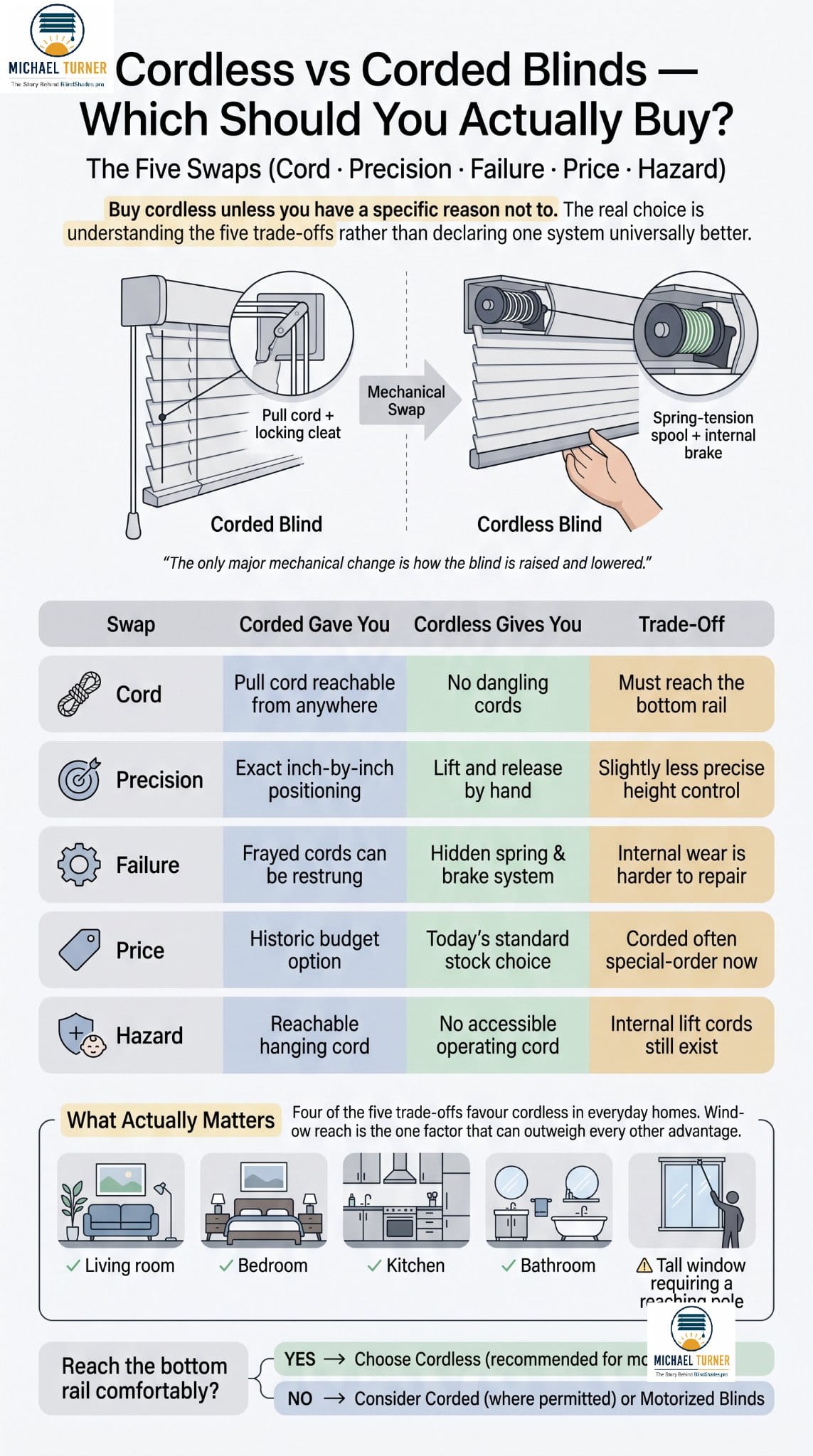
By Michael Turner — 30 years in window treatments
Cordless vs corded blinds is no longer a clean comparison, because on most stock shelves the choice has already been made for you — and the reason is that the Consumer Product Safety Commission attributes about nine deaths of children under five every year to strangulation in corded window coverings. Removing the cord also changed precision, failure mode, price position and who can operate the blind. Corded blinds are not illegal, and the gap between “banned” and “no longer built that way” is the entire answer to why you cannot find them. The surprise underneath: cordless blinds still contain cords, and the standard that reshaped the industry says so in its own text.

Key Takeaways
- Corded blinds are not banned. What changed is what manufacturers may build and sell — an availability constraint from an industry standard and a federal rule, not a prohibition.
- Cordless didn’t remove the cord, it moved the interface. The operating point went from a cord at hand height to a rail at window height, which is why nearly every complaint is really about reach.
- The cheap option flipped. Cordless is now the stock default carrying stock pricing; corded has moved into the special-order lane, where the money is.
- Cordless is not cord-free. Internal lift cords remain; the safety claim covers accessible cords, defined in inches.
- Both fail, and both are fixable. Corded fails at the cord and is restrung; cordless fails at the spring and is retensioned — one repair is far better documented.
⭐ Quick Answer — Cordless vs Corded Blinds
Cordless vs corded blinds is not a contest with a winner but five trades, and for a household with reachable windows cordless takes four of them:
- Corded blinds are not banned. The industry standard ANSI/WCMA A100.1-2022 eliminated free-hanging operating cords on made-to-order products and required stock products to be cordless or built with inaccessible cords — an availability constraint, not a prohibition.
- The hazard is a measurement, not a category. Any accessible cord longer than eight inches counts, which is how a compliant product can still contain cords. The Consumer Product Safety Commission attributes about nine deaths of children under five each year to corded coverings.
- Cordless is not cord-free. Internal lift cords still thread through the slats or fabric, so the safety claim covers what a child can reach rather than what is inside — the distinction is drawn in are cordless blinds child-safe.
- The cheap option flipped. Cordless is now the stock default at stock pricing while corded has moved to special order, which is why Blindsgalore and most national retailers treat cordless as the standard configuration.
- Reach is what actually decides it. The cord did not disappear so much as move to the bottom rail, so if the window is out of comfortable reach see reaching blinds on tall windows before you buy — and the picks themselves are ranked in our Cordless Blinds & Shades guide.
Cordless vs Corded Blinds — Which Should You Actually Buy?
The Five Swaps (Cord · Precision · Failure · Price · Hazard)
Buy cordless unless you have a specific reason not to. The honest version is not that cordless won on every axis but that it traded on five of them — reading it as trades rather than a scorecard predicts which household ends up happy.
The mechanical difference is small. As the custom retailer Stoneside puts it, it is simply the system that raises and lowers the blind: a corded blind runs a pull cord over a locking cleat, while a cordless blind hides a spring-tension spool and a brake inside the headrail, unpacked in how cordless blinds work. Everything below follows from that substitution.
| The swap | Corded gave you | Cordless gives you | What it costs you |
|---|---|---|---|
| Cord | A pull cord at hand height, worked from anywhere in the room | Nothing dangling to reach or tangle | You must reach the bottom rail — see tall windows |
| Precision | A cleat holds any height, to the inch | Set-and-release positioning by hand | Coarser height control — a trade the retailer AIM Your Home concedes to corded |
| Failure | Frayed cords: visible, restringable | Spring fatigue and brake slip in the headrail | Hidden, and less documented |
| Price | The historic budget option | Today’s stock default, at stock pricing | Corded moved to special order, raising cost |
| Hazard | A reachable cord — the documented risk | No accessible cord; inner cords remain | Precise, not absolute: see child safety |
Read down the fourth column: four of the five swaps favour a household with reachable windows, while reach matters enormously to anyone who cannot manage it.
Are Corded Blinds Illegal — or Just Gone?
They are not illegal. Nothing prohibits owning or using a corded blind, and in specific configurations they can still be made and sold. What changed is narrower than a ban, and came through two instruments.
The first is the industry’s own standard, ANSI/WCMA A100.1-2022, published by the Window Covering Manufacturers Association: it eliminates free-hanging operating and tilt cords on made-to-order products and requires stock products to be cordless or built so any cord is inaccessible. The second is federal — on 2 November 2022 the Consumer Product Safety Commission voted four to nil to approve a mandatory standard for custom window coverings, and added non-compliant corded products to its substantial product hazard list.
Both turn on a measurement rather than a category. The hazard is defined as any accessible cord longer than eight inches — pull cord, continuous loop or inner cord alike. That number explains how a product can carry cords and still comply.
| Lane | Can it still be sold new? | What governs it |
|---|---|---|
| Stock retail blinds | Cordless, or built with inaccessible cords | ANSI/WCMA A100.1-2022 |
| Made-to-order and custom | No free-hanging operating or tilt cords | The standard, plus the November 2022 federal rule |
| Continuous-loop products | Yes — with a permanently attached tension device | The standard; the device must be fitted to comply |
| The blind already on your window | Nothing requires its removal | ⚠️ But see the replacement advice below |
That last row carries the most urgent line here. The Commission has long advised replacing window coverings bought before 2001, because the inner-cord hazard in older horizontal blinds predates the design changes that addressed it: its historical record counts roughly two hundred strangulation deaths between 1991 and 2004, at least twenty caused by inner cords rather than pull cords, those victims typically nine to twenty months old and in cribs near windows.
Its position on the choice is unusually direct: cordless window coverings are, in its words, the only option that eliminates the strangulation hazard, while retrofitting a corded blind will not eliminate it — only reduce it. Conceding the limit of the alternative is what makes that the stronger claim.
What Are the Disadvantages of Cordless Blinds?
Three, and only one is a defect. The rest follow from where the operating point moved.
You have to reach it. A cord could be worked from the floor by anyone; a bottom rail sits wherever the window puts it. Over a sink, behind a sofa or up a stairwell, that is a daily annoyance rather than a one-time inconvenience.
Technique is not optional, and nobody teaches it. Owner accounts converge on one rule: two hands, either side of centre, steady pressure. One-corner pulls wind the internal cords unevenly, and the blind curves inward, jams and gouges the wall corner. More than one owner reports breaking set after set before being told this, and one installer says he demonstrates operation to every customer. That is a documentation failure, not a user failure — and why so many “broken” cordless blinds are working blinds operated wrongly.
The mechanism is the wear item, and makers know it. Warranty terms are the tell: hotBlinds covers cords and operation for three years against five for the cellular fabric. The maker expects the mechanism to go first — developed in how long cordless blinds last.
One quieter pattern: the blinds that fail first are the ones nobody touches — AwardBlinds instructs owners to run cordless shades through their full range daily where possible.
Do Cordless Blinds Last as Long as Corded Blinds?
Broadly yes, but they fail differently, and repairability is the honest core of the argument. The retailer blindkingco states the trade cleanly: corded blinds are easier to repair when cords wear out, while cordless have fewer moving parts but can be harder to fix when the mechanism fails. That is half right — both repairs exist, but one is far better publicised.
| Failure | Which system | What it looks like | Fixable? |
|---|---|---|---|
| Frayed or snapped cord | Corded | Parts at the cleat or in the headrail | Yes — restringing, as on venetian or mini blinds |
| Won’t raise or hold | Corded | The lock fails to catch | Usually — the lift mechanism is serviceable |
| Spring won’t hold position | Cordless | Drifts down, or refuses to rise | Yes — retensioning and respooling are documented repairs |
| Uneven winding, hangs crooked | Cordless | One side rises faster; the rail tilts | Yes — level two-handed operation resets it |
| Cracked headrail housing | Both | Damage around the spool or drum | Rarely — the headrail assembly is a replacement item |
Owner reports separate on tier, fit and use frequency rather than luck: cheap units ordered short, worked from one corner and left dormant fail, while the same units ordered half an inch to an inch longer than the sill and exercised regularly last for years. The full case sits in are cordless blinds worth it.
Which One Actually Costs More?
The received wisdom is out of date. Corded-as-budget describes the market of a decade ago; cordless is now the stock default at stock pricing, while corded has migrated into the special-order lane.
| Channel | What it stocks now | Owner-reported outcomes |
|---|---|---|
| Big-box, cut-to-size | Cordless stock lines | One household replaced four blinds for under a hundred dollars; another fitted twenty-three windows for under a thousand |
| Online custom | Cordless standard, corded by exception | Around a hundred dollars per faux wood blind; about a hundred and seventy-five for double-cell top-down units |
| In-home consultation | Cordless standard | About thirty-six hundred dollars for eighteen cellular blinds, some oversized |
| Special-order corded | Rare, configuration-limited | No cheap lane reported |
⚠️ Every figure above is an owner account one to five years old, not a current listing — what cordless blinds cost carries the current picture. And returns matter more than the sticker: custom and cut-to-size orders are generally not returnable, a real cost when a measurement is wrong, as cutting cordless blinds to size sets out.
Who Lost When the Cord Left?
Almost nobody writing about this admits the change created losers. It did.
A consistent group describes the switch as a downgrade: an owner with chronic pain, five feet tall, using a step ladder daily; a household of arthritic retirees with no children in it; a seventy-five-year-old with a cabinet in front of the window; a short owner who gave up a quarter of the view because the rail would go no higher. One complaint is blunt — that a design built around reaching upward discriminates against people who cannot.
These are the owners hunting for corded stock, and why many arrive at converting corded blinds to cordless wanting to run it backwards. Two things follow.
First, the safety case narrows rather than evaporates in a household with no children. The Commission’s figures — more than two hundred incidents involving children up to eight years old between January 2009 and December 2021, with a child dying in forty-eight per cent of them — describe a hazard to children specifically.
Second, the answer for a high window is usually motorisation rather than a return to cords, because it removes the reach problem instead of relocating it — the calculation runs in cordless vs motorized blinds. Where that is out of budget, reaching blinds on tall windows is the honest next stop.
Avoid These Mistakes
- Assuming corded is illegal and giving up. It is constrained, not banned, and one compliant configuration still exists.
- Assuming cordless means cord-free. Internal lift cords remain. The claim covers accessible cords over eight inches, which is precise language for a precise reason.
- Buying cordless for a window you cannot reach. The difficulty moves rather than disappears, and a daily step ladder is its own risk.
- Ordering the drop short. Order half an inch to an inch longer than the sill so the rail rests flat — short orders cause most “it never sits right” complaints.
- Retrofitting and calling it solved. The Commission is explicit that retrofit measures reduce the hazard rather than eliminate it.
Who Should Choose Which?
✔ Choose cordless if: you have young children or pets · your windows are within comfortable reach · you are buying from stock · you want the hazard eliminated rather than mitigated · you are fitting bedrooms, living rooms or a nursery, where the best cordless picks apply directly.
✖ Look elsewhere if: the window is out of reach, where motorisation answers better than a cord ever did · you need micro-adjustment to the inch for glare control · reaching upward is painful · the treatment is very wide or heavy, where the spring works against you.
The Bottom Line
Cordless vs corded blinds resolves in cordless’s favour for most households, but not for the reason usually given: four of the five trades favour a household with reachable windows, and the fifth — precision — is worth less than the hazard it replaced. Corded blinds are not banned; they are constrained to configurations most buyers will never meet on a shelf. If your windows are within reach, buy cordless and learn the two-handed pull. If they are not, the answer is a motor, not a cord.
The picks are ranked in our complete Cordless Blinds & Shades buying guide.
FAQ
What are the disadvantages of cordless blinds? You must reach the bottom rail to operate them, which is awkward on tall or blocked windows. Height control is coarser than a cord and cleat, the spring is the wear item, and two-handed level operation is required — a technique almost no manufacturer explains at the point of sale.
Do cordless blinds last as long as corded? Broadly yes, but they fail differently. Corded blinds fail at the cord and are restrung; cordless fail at the spring and are retensioned or respooled. Warranties tell the story — hotBlinds covers cords and operation for three years against five for the fabric itself.
Why are there no corded blinds anymore? Because ANSI/WCMA A100.1-2022 eliminated free-hanging operating cords on made-to-order products and required stock products to be cordless or have inaccessible cords. Manufacturers changed what they build rather than continue a product that could no longer be sold compliantly through normal retail channels.
Why are blinds now cordless? Child safety. The Consumer Product Safety Commission attributes about nine deaths of children under five each year to strangulation in corded window coverings, and states cordless is the only option that eliminates the hazard rather than reducing it. In November 2022 it approved a mandatory standard for custom coverings.
What are cordless blinds? Blinds with no dangling operating cord. A spring-loaded spool and brake sit inside the headrail, and you raise or lower the blind by moving the bottom rail by hand. Internal lift cords still run through the slats or fabric — cordless describes what a child can reach, not what is inside.
Are corded blinds illegal to own? No. Nothing requires you to remove a corded blind you already own, and continuous-loop products can still be sold new with a permanently attached tension device. The Commission does advise replacing any window covering bought before 2001, because of the inner-cord hazard in older blinds.
Related Guides
- Best Cordless Blinds & Shades — the complete buying guide
- Are Cordless Blinds Worth It? — the durability case, both sides
- Are Cordless Blinds Child-Safe? — what the safety claim actually covers
- Can You Convert Corded Blinds to Cordless? — including the reverse conversion
- Best Mini Blinds · Best Venetian Blinds · Best Faux Wood Blinds · Best Cellular & Honeycomb Shades — the families this decision applies to
