Are Cordless Top-Down Bottom-Up Shades Worth It?

Authored By Michael Turner -30 Years Home Improvement Expertise | Updated 2026 | BlindShades.pro
Updated on July 26, 2026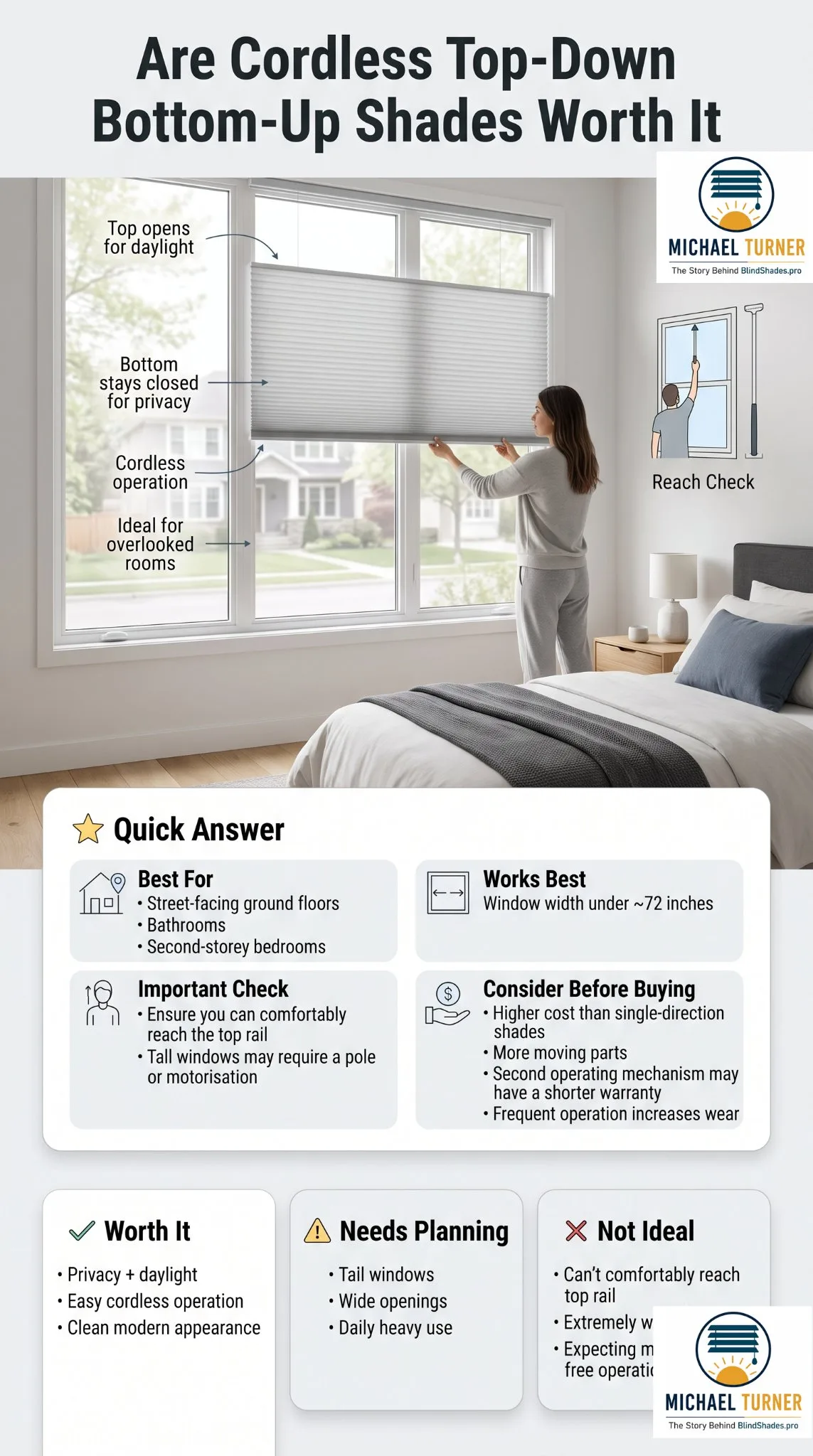
By Michael Turner — 30 years in window treatments
Yes for overlooked windows where you want daylight without being seen — and no for any window whose top you cannot comfortably reach. Every guide says yes and none dwells on the catch: cordless top-down bottom-up shades have a middle rail as well as a bottom one, so lowering the top means reaching the top of the window. AwardBlinds says it in its own specification — confirm you can reach the top before ordering. The rest of the mechanism is doubled too: two moving rails, two cord systems, four handles past 59 inches, and cords warranted three years against five for the fabric. Health Canada went further and effectively removed the category from sale.

Key Takeaways
- The privacy trick is real — bottom closed, top open gives daylight while people outside cannot see in.
- ⭐ The top rail is the catch. You reach up to pull it down, so tall windows need a pole or a motor.
- Everything doubles: two rails, two cord systems, twice the handling, four handles past 59 inches.
- The width ceiling is about 72 inches, same as standard cordless cellular.
- ⚠️ Canada banned the category over the inner cords that position the top rail. The US standard did not.
⭐ Quick Answer — Are Cordless Top-Down Bottom-Up Shades Worth It?
Yes in overlooked rooms — cordless top-down bottom-up shades are worth it if you can reach the top of the window and the opening is under about 72 inches wide:
- The privacy trick is the whole point. Bottom closed, top dropped: daylight and sky come in while passers-by cannot see through. It earns its premium on street-facing ground floors, bathrooms and overlooked bedrooms — and nothing at all where no one can see in.
- ⭐ The top rail is the catch. There is a middle rail as well as a bottom one, and you reach up to pull it down. AwardBlinds states in its own specification that buyers should confirm they can reach the top of the window before ordering — if that is a stretch, see reaching blinds on tall windows.
- Everything doubles. Two moving rails, two cord systems, twice the handling, and four handles once the shade passes 59 inches. hotBlinds warrants cords and operation for three years against five for the fabric — the maker expects the mechanism to go first.
- About 72 inches is the ceiling. Published maximum widths cluster there, the same limit as a standard cordless cellular shade. Wider openings need the split-headrail route in cordless blinds for large windows.
- ⚠️ Canada removed the category from sale. Health Canada’s cord limits cover inner cords, and Select Blinds Canada lists these shades among the products affected. US rules differ — but it shows cords still position that top rail. Compare configurations in our top-down bottom-up guide.
Are Cordless Top-Down Bottom-Up Shades Worth It?
The Four Checks (Room · Reach · Width · Wear)
Run four checks on cordless top-down bottom-up shades. If all four pass, this is one of the cleverest products in window coverings. If the reach check fails, nothing else matters.
| Check | Passes if | Fails if | Verdict on failure |
|---|---|---|---|
| Room | Overlooked — street-facing, ground floor, bathroom, second storey | Nobody can see in anyway | Buy a standard cordless shade; the premium buys nothing |
| Reach | You can comfortably touch the top of the window | The window is tall or set high | Add a pole, or motorise |
| Width | Under about 72 inches | Wider | Not made cordless — split, motorise or change product |
| Wear | You accept two mechanisms and daily exercise | You want fit-and-forget | Standard cordless, one rail, half the failure surface |
Room is the one the field gets right. The whole point is the split: bottom closed for privacy, top dropped for daylight and sky. That earns its keep on a street-facing ground floor, a bathroom, or a bedroom a neighbour overlooks — and earns nothing on a window with a field behind it, where a plain cordless shade does the same job for less. Our top-down bottom-up blinds and shades guide ranks the options once you know the room.
Wear is the one nobody mentions. AwardBlinds instructs owners to lift and lower the shade through its full range of motion, fully up and down, every day if possible. That is a maintenance instruction on a product sold as maintenance-free, and it matches what owners report — the least-used blinds seize first. The long view is in how long cordless blinds last.
Reach and width need their own sections, because both have published limits the guides skip.
What’s the Catch With the Top Rail?
You have to reach the top of the window to use the feature you paid for. That is the catch — stated plainly in product specifications, nearly absent from editorial guidance.
These shades have three rails: a fixed headrail, a middle rail carrying the top of the fabric, and a bottom rail. The bottom rail behaves like any cordless shade. The middle rail starts at the top of the window and you pull it down — gripping something at the very top of the opening, then pushing it back up there afterwards. AwardBlinds’ specification is unambiguous: the ability to fully raise or lower the shade depends on the operator’s reach, and buyers should confirm they can reach the top of the window before ordering.
⭐ This is worth stating against our own earlier advice. In cordless blackout blinds we recommended this configuration as the elegant answer to hunting for a bottom rail in a dark bedroom — and that holds, but only where you can reach the top. On a tall bedroom window it moves the problem rather than solving it.
If reach is your constraint, the escalation is the same as for any cordless shade — wand, pole, or power — laid out in how to reach blinds on tall windows. Motorised versions solve it completely: both rails move on command and nothing needs touching. Whether that premium is right is weighed in cordless versus motorised blinds, the category ranked in our motorised and smart blinds guide, and the Roman equivalent in cordless versus motorised Roman shades.
What Does the Second Rail Actually Cost You?
It doubles the mechanism, and published specifications show where that lands.
| What doubles | The consequence | What to do about it |
|---|---|---|
| Two moving rails | Two things to position every time | Use the clear snap-on handles supplied for both |
| Two cord systems | Two failure surfaces inside one headrail | Exercise both rails fully, daily where possible |
| Twice the handling | Fabric marks where fingers land | Never grip the fabric — only the handle |
| Four handles past 59 in | Wider shades need balanced movement | Both hands, centre of each rail |
| Two rails of dust ledges | More cleaning, and the middle rail is at eye level | See our cleaning guide before you wet anything |
Two deserve numbers. The handle threshold is published and specific: AwardBlinds notes shades over 59 inches wide carry two handles per rail, and Blindsgalore includes four handles above 59 inches for balanced movement. Four handles is the manufacturer telling you this is a two-handed product on both rails — the centre-pull discipline of any wide cordless blind, doubled.
⭐ And the warranty tells you what the maker expects to fail. hotBlinds warrants cords and operation on its cordless top-down bottom-up shade for three years, and the cellular material for five — the mechanism covered for less time than the fabric it moves. Not a defect, but an honest actuarial statement about a product with two cord systems.
The handling cost is real too: owners asked about regrets raise one recurring complaint — grab the fabric reaching for the bar and you will smudge it. Two rails means twice as often, and the middle rail sits where marks show. Cleaning is covered in how to clean cordless blinds.
How Wide Can They Go?
About 72 inches — the same ceiling as a standard cordless cellular shade, published consistently across independent retailers.
| Retailer | Minimum width | Maximum width | Handle rule |
|---|---|---|---|
| MOOD | 19 in | 72 in | — |
| hotBlinds (Basics II) | 18⅜ in | 72 in | — |
| Chicology | 23 in | 72 in | — |
| AwardBlinds | 18⅜ in | — | Two handles per rail over 59 in |
| Blindsgalore | — | — | Four handles over 59 in |
The ceiling is no lower than a normal cordless shade, but people hit it more often here, because this is what they want for exactly the wide living-room windows that exceed it. One owner described the trap precisely: they wanted a single shade opening from top and bottom, found the window too wide, and were advised to fit a large roller instead. The alternatives are in cordless blinds for large windows.
Two ordering details matter. These shades are built slightly longer than ordered to prevent spring-back, so do not shorten your measurement to compensate. And cellular fabric cannot be trimmed narrower afterwards, so the width must be right first time — see can you cut cordless blinds to size. Expect a premium over a single-direction shade; per-window tiers are in what cordless blinds cost.
Why Did Canada Ban Them?
⚠️ Because of the cords that position the top rail — and this is a Canadian rule, not a US one. Health Canada’s Corded Window Coverings Regulations, made under the Canada Consumer Product Safety Act and enforced from May 1, 2022, limit a reachable cord with a free end to 22 centimetres and any accessible loop to 44 centimetres. Those limits cover inner cords, not just lift cords — Select Blinds Canada lists top-down bottom-up shades explicitly among the products affected, and a Canadian retailer states flatly that their exposed cords make the category non-compliant. Another named the mechanism: the exposed ladder cords that hold the shade together.
The American position differs. The ANSI/WCMA standard restricts free-hanging operating cords and requires stock products to be cordless or have inaccessible cords, and it does not remove these shades from sale — they are widely available and legitimately marketed as cordless.
⭐ What the Canadian rule usefully exposes is a fact the US field never states: a cordless top-down bottom-up shade is still a cord-operated product internally. Cords hold and position that middle rail. That is why the same guides warning you about child safety also warn that the internal cords “lose tension or tangle” over time — one cord system, two different complaints. It does not make these shades unsafe in the US sense, where the test is whether cords are accessible. It does mean the safety claim is about reachable cords rather than the absence of cords, a distinction examined in are cordless blinds child-safe, with the regulation itself set out in converting corded blinds to cordless.
Which Rooms Are Actually Worth It?
The rooms where someone can see in and you still want the sky.
| Room | Why the split helps | Configuration |
|---|---|---|
| Bathroom | Privacy at eye level, daylight above | Light-filtering cellular; moisture-tolerant fabric |
| Street-facing ground floor | Passers-by blocked, room stays bright | Light-filtering, inside mount |
| Overlooked bedroom | Daytime privacy, darkness at night | Blackout cellular — but check the reach |
| Kitchen or dining | Sky view over a sink or table | Light-filtering; expect more cleaning |
Bathrooms are the strongest case, with their own guidance in top-down bottom-up shades for bathrooms and, for the pleated version, pleated bathroom shades. In bedrooms the blackout question comes first — sealing the edges matters more than the split, as cordless blackout blinds explains. Cellular is the usual fabric; alternatives are compared in cellular versus roller cordless shades and our cellular and honeycomb shades guide.
Avoid These Mistakes
- Buying the split for a private window. If nobody can see in, the premium buys a feature you will not use.
- ⭐ Not testing the reach first. Stand at the window and touch the top of the opening. If that is a stretch, choose a pole or a motor.
- Gripping the fabric instead of the handle. Twice the smudging, and the middle rail is at eye level.
- Assuming it fits a wide window. About 72 inches is the ceiling, and wide living-room windows are where people get caught.
- Shortening your height measurement. These are built longer than ordered on purpose, to stop spring-back.
- Leaving one rail parked for months. Exercise both fully; the unused mechanism seizes first.
Who Should Buy Top-Down Bottom-Up?
Worth it if: ✔ The window is overlooked, you can reach the top of the opening, and it is under about 72 inches wide ✖ Not if a plain cordless shade would solve the same privacy problem
Motorise instead if: ✔ The window is tall, set high or above a stairwell, or you want both rails positioned without touching anything ✖ Not on a reachable window, where the premium buys convenience only
Choose a standard cordless shade if: ✔ Privacy and light do not conflict in that room, and you want one mechanism and half the handling ✖ Not if daytime privacy is the reason you are shopping
The Bottom Line
Cordless top-down bottom-up shades are worth it in overlooked rooms, on windows whose top you can reach, under about 72 inches wide, if you accept a second mechanism that needs exercising and a fabric that marks when grabbed. The privacy trick is genuinely good and nothing else does it as neatly. But run the reach check first — the middle rail lives at the top of the window, the specifications tell you to confirm you can get to it, and no engineering fixes a shade you cannot operate. And know what you are buying: cords still position that top rail, which is why the maker warrants them for less time than the fabric, and why Canada took a stricter view than the United States.
Ready to choose one? Compare configurations in our top-down bottom-up blinds and shades guide, or start with the complete cordless blinds and shades guide.
FAQ
How wide can cordless top-down bottom-up shades be? About 72 inches. MOOD, hotBlinds and Chicology all publish a 72-inch maximum on their cordless top-down bottom-up cellular shades, with minimums between roughly 18⅜ and 23 inches. Past that ceiling you need a split-headrail arrangement, a motorised shade, or a different product entirely.
Can you get motorized top-down bottom-up shades? Yes, and they solve the reach problem completely because neither rail needs touching. Both the middle and bottom rails position on command from a remote or app. The trade-off is cost and a battery or power supply to maintain, which is the same calculation as motorising any shade.
Does IKEA or Costco sell top-down bottom-up blinds? Both are commonly searched for this product, but stock ranges change and neither publishes the detailed width and handle specifications the specialist retailers do. For a configuration this dependent on exact width and reach, buy where the maximum width, minimum width and handle count are stated on the product page.
Can you get top-down bottom-up Roman shades? Yes, though the choice is far narrower than in cellular, and cordless versions are less common still because a Roman’s fabric stack is heavier to hold at two positions. Cellular remains the mainstream option for this mechanism; Roman versions are usually specified as motorised.
Why are top-down bottom-up blinds banned in Canada? Health Canada’s Corded Window Coverings Regulations, enforced from May 2022, limit reachable cords to 22 centimetres and accessible loops to 44 centimetres, and those limits cover inner cords as well as lift cords. Canadian retailers report that the exposed cords positioning the top rail make the whole category non-compliant.
Do top-down bottom-up shades get dirty faster? Yes, for two reasons. You handle them twice as often because there are two rails to position, and the middle rail sits at eye level where marks show. Using the supplied clear handles rather than gripping the fabric prevents almost all of it.

Related Guides
- Best Top-Down Bottom-Up Blinds & Shades — the complete guide
- Best Cordless Blinds & Shades — the cordless category
- How to Reach Blinds on Tall Windows — if the reach check fails
- Cordless Blinds for Large Windows — if the width check fails
- Top-Down Bottom-Up Shades for Bathrooms — the strongest use case
- Cordless Blackout Blinds — bedrooms, sealed properly
- Best Cellular & Honeycomb Shades — the usual fabric
- How to Clean Cordless Blinds — two rails, twice the marks
- Best Roman Shades — the Roman alternative
