Should All the Blinds in Your House Match? Three Matches

Authored By Michael Turner -30 Years Home Improvement Expertise | Updated 2026 | BlindShades.pro
Updated on July 29, 2026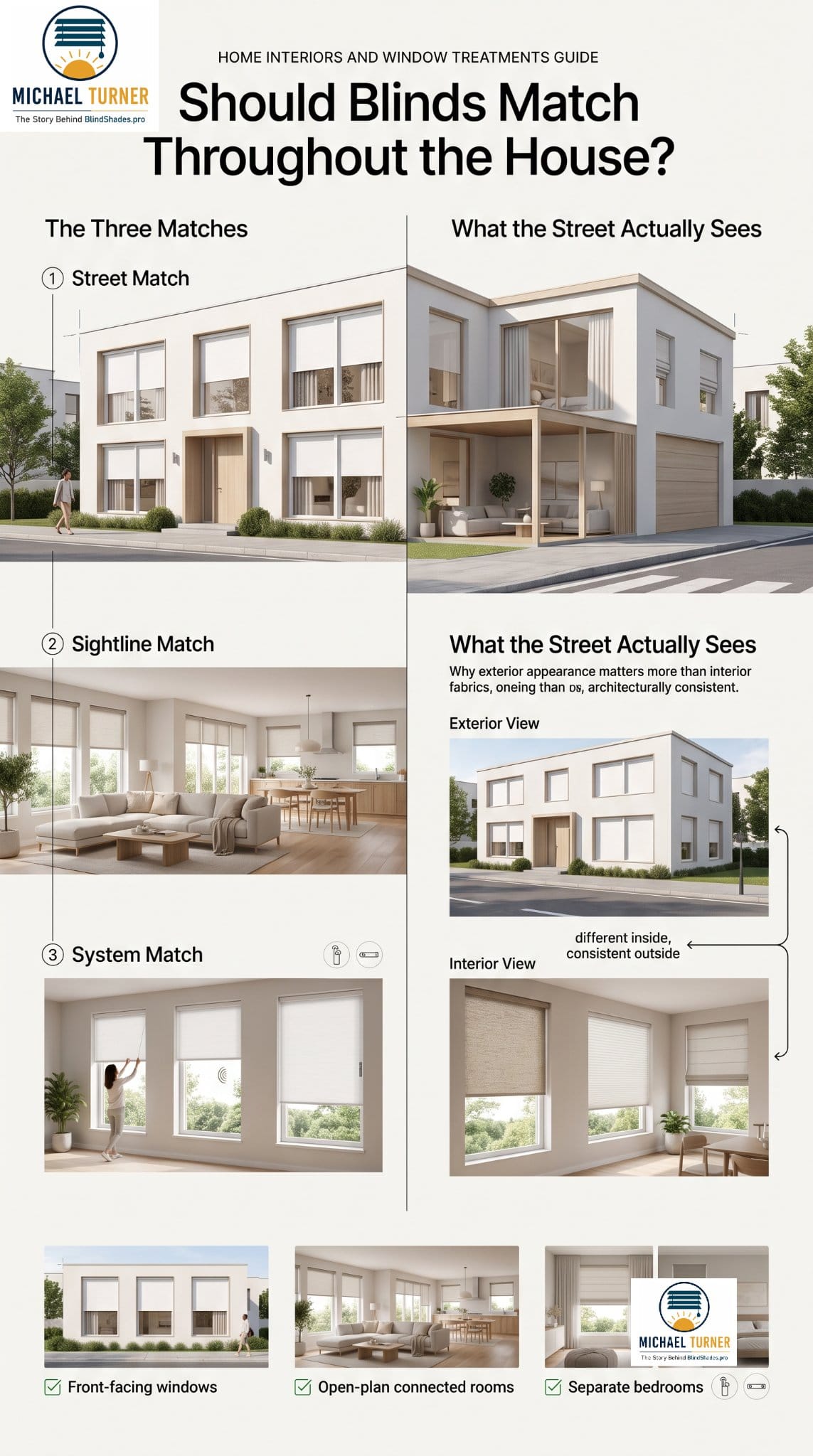
By Michael Turner — 30 years in window treatments
Should all the blinds in your house match? No — but three things should agree, and colour is not reliably one of them: the street-facing elevation, any rooms you can see into from one standing position, and the operating mechanism. Everything else is free to change room by room. The advice in circulation stops at colour and style, and never mentions the part homeowners collide with daily. There is a harder fact underneath the debate: in an ordinary house, several windows physically cannot take the same product, whatever you would prefer.
Key Takeaways
- The honest answer is no — with three exceptions. Match the street-facing elevation, rooms sharing a sightline, and how the blinds are operated.
- The front of the house is the only rule with a reason behind it. From the pavement people see the back of your coverings, not the fabric you chose — which makes it the cheapest rule to satisfy.
- Some rooms cannot match, and it is not a taste decision. Width ceilings, sealed headrails, blackout weight and reach each rule the same product out.
- Nobody matches the mechanism, and it is the one people notice. Two shades can look identical and hide two different machines that fail differently.
- Colour is the weakest rule being sold to you. The trade openly contradicts itself on it, and the contradiction is worth understanding.
⭐ Quick Answer — Should All the Blinds in Your House Match?
No. Should all the blinds in your house match — there are three exceptions and no fourth — match the street, the sightline and the system, then let everything else change room by room:
- Match the street. Windows visible from the road read as one line to everyone but you, and from the pavement people see the back of the covering rather than the fabric — which makes this the cheapest of the three rules to satisfy.
- Match the sightline. Rooms you take in from one standing position get compared directly, so keep them in one colour family. NY City Blinds puts it well: treatments need not match on style, but should complement on colour and texture.
- Match the system. Two shades can look identical and hide two different machines — a roller’s spring sits in the top tube, a cellular’s in a sealed headrail — which is why they fail and get repaired differently, as cellular vs roller cordless shades sets out.
- ⚠ Some rooms cannot match at all. Wide openings hit a published ceiling near 72 inches, and a sealed headrail cannot meet the US EPA 24-to-48-hour drying window that keeps a wet room safe — the detail sits in cordless blinds for bathrooms and kitchens.
- Colour is the weakest rule being sold to you. Stoneside calls whole-house matching absolutely not required and entirely dependent on the rooms involved — and if you are specifying a house at once, the picks that survive it are ranked in our Cordless Blinds & Shades guide.
Should All the Blinds in Your House Match?
The Three Matches (Street · Sightline · System)
No — and almost everyone writing on this agrees. Stoneside calls matching absolutely not required and entirely dependent on the rooms involved. Blended Blinds says it is not necessary and that matching the individual room matters more. NY City Blinds narrows it: treatments need not match on style, but should complement one another on colour and texture.
The problem is what comes next. Having answered no, the field hands you a colour rule — keep the family close, stay neutral, pick a common element — and stops. Should blinds match throughout the house? The answer turns on three constraints it never states, not on colour.
| The match | What it means | Why it is not just taste |
|---|---|---|
| Street | Windows visible from the road read as one line | The one view you cannot rearrange, and the one you personally see least |
| Sightline | Rooms visible from one standing position agree | Co-visible rooms are read together, so a mismatch reads as an error |
| System | Blinds used daily are operated the same way | Three lift systems means every guest has to be taught each window |
Outside those three you are free — and in the rooms below, forced.
What Does Anyone Actually See From the Street?
Not what you think, and that is why this rule is cheap.
The strongest real-world evidence is consistent: asked whether they keep the same blinds throughout the home, the most upvoted homeowner answer in one large discussion was no — with the immediate qualification that it matters if it is the front of the house. Older forums land in the same place, and industry guidance agrees, usually phrased as one neutral on front-facing windows.
Here is the part nobody develops. From the pavement, a passer-by is not looking at your fabric. They are looking at the back of your window covering, and on many shades that back is deliberately different. Dual-sided fabrics exist precisely so the outward face reads as a consistent neutral while the room-facing side does whatever the room needs — which is why homeowners describing the view from outside so often say it is simply white.
That changes the economics completely. You are not committing to one colour throughout the front of the house, only to one outward-facing colour, which several products give you without constraining the interior. Ask for it by name; it is rarely a headline specification. Two windows read as part of the elevation rather than as rooms: the glazing beside your front door, covered in our front door and sidelight guide, and any large glazed run neighbours overlook, in the sliding glass door guide.
Which Rooms Have to Agree Inside?
Only the ones the eye takes in together.
The interior test is not the floor plan, it is where you stand. If two rooms are visible from a single position — an open-plan kitchen and living space, a dining room through a wide opening, a landing with doors off it — their treatments are read as one composition, and a mismatch there looks like a mistake. Rooms you walk between are separate compositions and can differ entirely.
So the advice about adjoining rooms, and about matching curtains between dining and living spaces, holds only where they are co-visible. A bedroom down a corridor is under no obligation. Within a room the rule tightens: two windows on one wall in different products is the mismatch that always looks accidental.
Why the Mechanism Matters More Than the Fabric
Two shades can look identical and hide two entirely different machines.
This is the match nobody writing on the subject mentions, and the one that affects daily life. A cordless roller stores its spring in the top tube with no lift cords at all; a cordless cellular shade winds internal cords onto a spring-loaded spool inside a sealed headrail, threaded through the cells. They can hang side by side in the same colour and behave like different appliances. The full comparison is in cellular vs roller cordless shades.
| Product | Where the spring lives | How it typically fails | What repair looks like |
|---|---|---|---|
| Cordless roller | Top tube, no lift cords | Loses tension, will not hold height | Mechanical — retensioning is an owner-level fix |
| Cordless cellular | Sealed spool, cords through the cells | Spool fatigue, uneven winding, knotting | Surgical — see why cordless blinds won’t go up or down |
| Corded | No spring; the cord does the work | Cord wear, tension device failure | Restringing — operation is obvious to any user |
| Mixed house | All of the above | Confusion, not breakage | Nothing to repair; people cannot work the windows |
That last row is not a joke. The commonest report from a mixed house is someone hunting at a window for a cord that does not exist, or deciding a healthy cordless blind is a corded one with the cord snapped off. If you take one rule from this guide, take this one — start with how cordless blinds work if any of yours are still a mystery.
There is a second reason. Cordless mechanisms are worn by use but also damaged by disuse — the blinds operated least fail first, which is why AwardBlinds instructs owners to run each shade through its full range daily. A house matched on appearance but split across mechanisms therefore ages unevenly, and nothing bought later will match. How long cordless blinds last covers which builds survive it.
Which Rooms Cannot Match — and Why?
In an ordinary house, four or five windows rule themselves out before taste is consulted.
Room-by-room product advice is common enough. What is missing is the ceiling underneath it: these are not preferences a decorating decision can override. Each is a published limit or a physical property, and each forces a different product into that room whatever you chose elsewhere.
| The room | What rules matching out | The published constraint | Where it is resolved |
|---|---|---|---|
| Wide openings | Cellular tops out below patio-door width | hotBlinds publishes a 72-inch maximum from 18⅜; MOOD lists 19 to 72, Chicology 23 to 72 — three retailers, one ceiling | Large windows |
| Bathrooms, kitchens | The headrail is sealed and cannot be dried or serviced | The US EPA advises humidity below 60 percent, ideally 30 to 50, and says damp materials avoid mould only if dried within 24 to 48 hours | Wet rooms · bathroom · kitchen |
| Dark bedrooms | Blackout is the heaviest fabric on a spring sized for it | Owners report heavy blackout straining mechanisms that handle light-filtering fabric without complaint | Blackout · guide |
| High windows | Operation requires reaching the rail | Blindsgalore includes four handles rather than two above 59 inches; AwardBlinds tells buyers to confirm they can reach the top before ordering | Tall windows |
| Light without exposure | A middle rail sits at the top of the window | The same roughly 72-inch ceiling applies, and the rail still has to be reached | Top-down bottom-up |
Read that as a floor plan and the question changes shape: a house with a wide opening, a bathroom, a dark bedroom and a high landing window has already been handed four products, so insisting they match is a request to fit the wrong shade in three rooms — the premise the bedroom guide starts from. Renters have a further constraint, since the mounting method chooses the product where drilling is barred: no-drill and tension blinds.
What Should I Match My Blinds To?
Not each other — to the fixed surfaces that will outlast them.
If matching between rooms is largely off, what should each blind relate to? The answers in circulation are scattered, and one is contested.
| The anchor | What is said about it | Our position |
|---|---|---|
| Wall and trim | The dominant trade recommendation — hold the blind close to trim colour so the frame reads clean | Sound, and it is what makes room-by-room variety work; trim stays consistent when nothing else does |
| One colour throughout | velablinds states it is best practice to use the same colour blinds throughout the house for a cohesive look inside and out | ⚠️ Directly contradicted by Blended Blinds, Stoneside and NY City Blinds. The disagreement is real and resolves below |
| The specification sheet | Occasionally proposed, usually via insulation figures | Do not. Published cellular R-values run from roughly 0.42 to 5.0, retailer-published and not measured to a common standard — no basis for matching anything |
The contradiction in row three is worth understanding rather than picking a side on, because nobody is lying. The one-colour camp is answering the exterior question, where a single neutral genuinely is best practice; the it-depends camp is answering the interior question, where it genuinely does depend. Separate the two and the disagreement disappears — which is what the Three Matches does. Bloomin’ Blinds gets closest, recommending a common element in colour, fabric or style rather than wholesale matching.
Avoid These Mistakes
- Matching the whole house to satisfy the front of it. The elevation rule only ever applied to the outward-facing side.
- Buying one product for every window in one order. It feels efficient and puts the wrong shade in the wet room, the wide opening and the high window. Buy by room, order together for the discount — see where to buy.
- Mixing operating systems in daily-use rooms. The cost lands on whoever was never shown how each window works.
- Matching on published performance figures. They are not comparable across brands. Match on how a room is used.
- Assuming a mismatch must be fixed. Mini blinds against cellular shades is a real functional comparison; a house running both is not a fault.
Who Should Match — and Who Shouldn’t?
✔ Match if: your windows are visible together from the road · you have an open-plan or knocked-through space · more than one window sits on the same wall · your household includes children or guests who will not be taught each mechanism · you are selling within a year.
✖ Don’t force a match if: one opening is materially wider than the rest · a bathroom or kitchen window is in scope · one bedroom needs real darkness · a window sits above comfortable reach · you rent and cannot drill · the rooms cannot be seen from one another · matching would mean replacing shades that work perfectly well.
The Bottom Line
Should all the blinds in your house match? No — and the version worth acting on is more specific than the one usually given. Match the street-facing elevation, where a single outward colour buys the whole benefit and costs nothing inside. Match rooms you can see into from one position, and windows within a room. Match how they are operated, because that is what your household touches daily. Then let colour, fabric and product type change freely — and accept that in the wet rooms, wide openings, dark bedrooms and high windows they were always going to have to.
Specifying a whole house at once? The picks that survive it are ranked in our complete Cordless Blinds & Shades buying guide — and are cordless blinds worth it weighs the system itself.
FAQ
Do all your blinds have to match? No. Three things need to agree: windows visible from the street, rooms you can see into from one standing position, and the way the blinds are operated. Colour, fabric and product type can change room by room — and in wet rooms, wide openings and high windows they usually have to.
Should blinds be the same colour throughout the house? On the outward-facing side, yes — a single neutral on front-facing windows makes an elevation read cleanly, and many shades offer a different exterior face for exactly this reason. Inside, no. The trade openly disagrees here, and the disagreement dissolves once exterior and interior are separated.
Do all windows in a house need to match? No, and several cannot. A window wider than about 72 inches, a bathroom window, a bedroom needing full darkness and a window above easy reach each rule out the product that suits the rest of the house. Match within a room and within a sightline; treat separate rooms separately.
What should I match my blinds to? Trim and wall colour in most cases — trim tends to stay consistent when nothing else does, and it keeps the window frame reading cleanly. In main living areas, matching floor and furniture tones works well. Avoid matching on published performance figures, which are not comparable between brands.
Are blinds out of style? No, though certain products date faster than the category does. Narrow aluminium slats read as older than fabric shades to most eyes, which is the real question behind the phrasing — are mini blinds outdated answers it, and alternatives to mini blinds covers what replaces them.
Do all window treatments need to be the same? No. Blinds, shades and curtains routinely coexist in one house and often in one room, layered for light control. What should stay consistent is the outward-facing view and the operating method, not the treatment type — roman shades beside roller shades is a normal, competent house.
Best Sources on Matching Blinds Throughout the House
- Stoneside (2025), NY City Blinds and Blended Blinds: three independent retailers on the record that matching is not required, and the source of the colour-and-texture framing.
- US Environmental Protection Agency, indoor moisture and mould guidance: the humidity thresholds and the 24-to-48-hour drying window that decide what a wet-room window can take.
- Manufacturer specifications (hotBlinds, MOOD, Chicology, Blindsgalore, AwardBlinds): the width ceilings, handle counts and reach instruction cited above.
- Community record (homeowner and home-design forums): several hundred posts across three platforms, and the origin of the most repeated real-world rule — no, except the front of the house.
Related Guides
- Best Cordless Blinds & Shades — the complete buying guide
- Cellular vs Roller Cordless Shades — two mechanisms, two failure modes
- Cordless Blinds for Bathrooms and Kitchens — the wet-room exception
- How to Reach Blinds on Tall Windows — when height decides the product
- Best Cellular & Honeycomb Shades — the product most houses standardise on
