Do You Need Blackout Blinds in a Living Room?

Authored By Michael Turner -30 Years Home Improvement Expertise | Updated 2026 | BlindShades.pro
Updated on July 30, 2026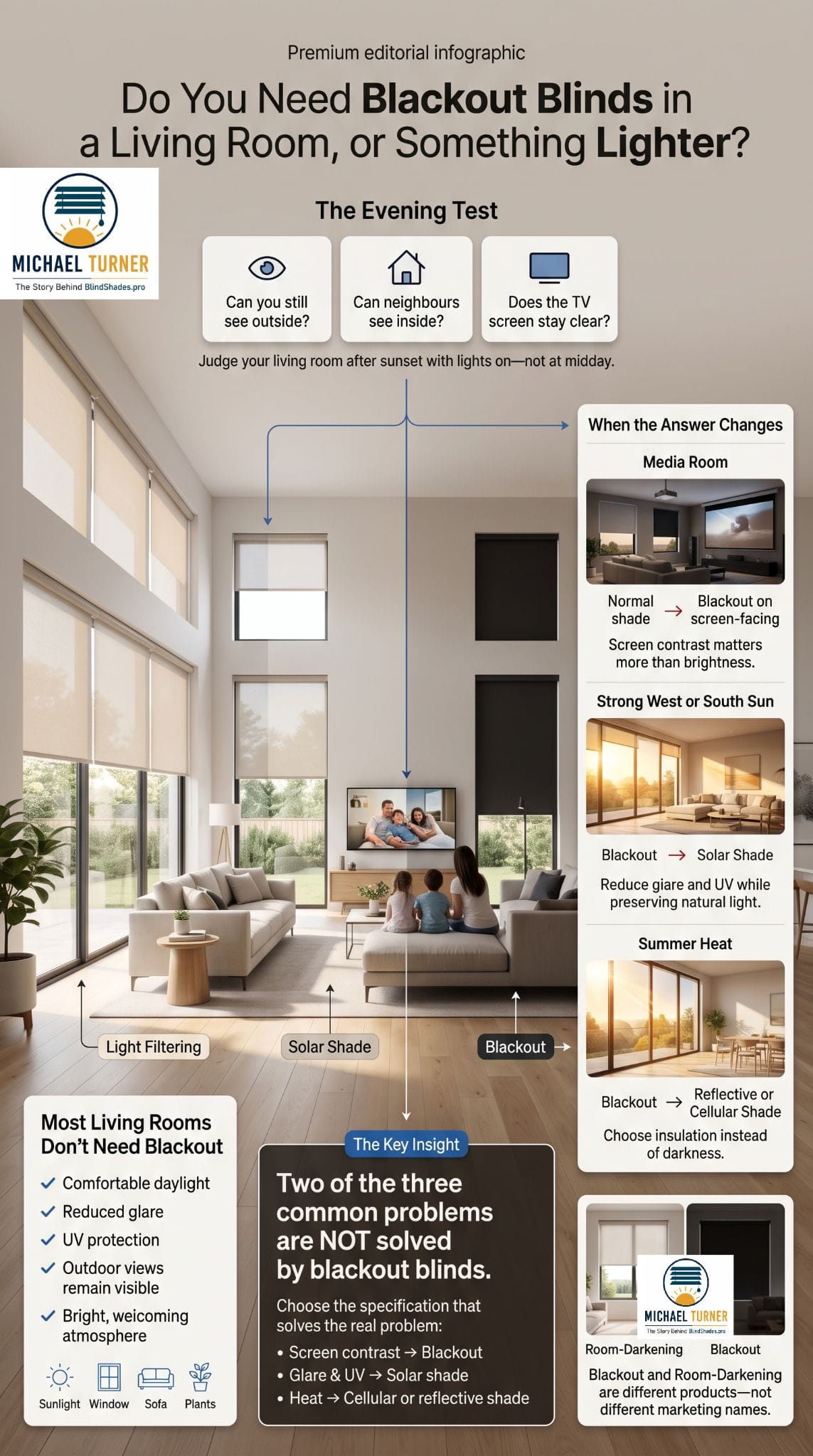
By Michael Turner — 30 years in window treatments
Usually no — and the two questions that decide it are which way the windows face and whether a screen is in the room. South and west windows with a television opposite them make a case; north-facing windows with no screen almost never do. But the standard advice you will be given, that living rooms want light-filtering shades, is built entirely on how the room behaves at midday. The living room is the room you sit in after dark with the lamps on, and that is exactly when a light-filtering shade stops working — a point the industry mentions in passing and never builds its recommendation around.

Key Takeaways
- Blackout is the wrong default for a living room. Full darkness in a room you use by day removes the reason the windows are there.
- Three things change the answer: a screen you watch in daylight, harsh west sun that fades furniture, and a room that overheats in summer.
- Light-filtering fails after dark. With lamps on and darkness outside, people see silhouettes and movement through it — in the one room used most in the evening.
- The living room needs two settings, not one opacity, which is why dual and layered systems suit it better than any single fabric.
- Test it from the pavement. Turn the lamps on after dark, go outside, and look back at your own window.
⭐ Quick Answer — Do You Need Blackout Blinds in a Living Room?
Usually no — blackout blinds in a living room spend the daylight you bought the window for, and only three conditions change that:
- A screen facing a bright window. Contrast, not brightness, is what daylight destroys. Treat that one window and leave the rest light.
- Direct west or south sun. The job here is glare and fading, not darkness — a solar shade at the right openness beats blackout.
- A room that overheats. Blinds.com puts room-darkening fabric near 95 percent of light blocked, but reflectivity does the thermal work, not opacity.
- ⚠ Light filtering fails after dark. Blindsgalore concedes that with interior lights on and darkness outside, silhouettes and movement are readable from the street — in the room you use most in the evening.
- The honest answer is two settings, not one fabric. Budget Blinds reframes it well: do you want any light at all? If yes, choose room darkening over blackout, or a dual-state banded shade that gives you both.
✉ Ask Michael a Question — installation, buying advice or repair
Straight to Michael Turner — 30 years in window treatments.
Do You Need Blackout Blinds in a Living Room, or Something Lighter?
THE EVENING TEST — judge a living-room covering after dark with the lamps on, not at midday. Three checks: what you can see out, what they can see in, and what is on the screen.
The industry answer is consistent and mostly right. Blindsgalore says living rooms are perfect for light-filtering shades. Go Smart Blinds puts light filtering in kitchens, living rooms and offices, and blackout in bedrooms, nurseries and home theatres. Budget Blinds reframes the whole question usefully: do you want any light in the room? If the answer is yes and you only need glare and ultraviolet cut, there are better options than a blackout shade.
Where that advice thins out is that it describes a room at two in the afternoon. Three specific conditions flip it.
| What changes the answer | Why it flips | What to fit instead of a plain shade | Covered in depth |
|---|---|---|---|
| The room doubles as a media room | Screen contrast collapses under any daylight; contrast, not brightness, is what fails | Blackout on the screen-facing window only, light filtering elsewhere | Home-theatre and basement blinds |
| Direct west or south sun | Afternoon sun fades upholstery, wood and artwork, and washes out a screen | A solar shade sized to the openness you need, not blackout | Living-room solar openness |
| The room overheats in summer | Glass is the weak point in the wall; the covering is doing thermal work, not light work | Reflective or cellular, chosen for heat rather than darkness | Blackout versus thermal blinds |
Notice that in two of the three cases the answer is not blackout at all — it is a different specification that happens to be darker. That distinction matters because blackout and room-darkening are sold at similar prices and confused constantly; the difference is set out properly in blackout shades versus room-darkening shades, and this page defers to it rather than repeating it.
What Do the Four Opacity Levels Actually Do After Dark?
Every level is described by how it behaves in daylight, and three of the four behave completely differently once the lamps are on.
This is the table the category does not print. The daytime column is what you are sold on. The evening column is the room you actually live in.
| Level | At midday | After dark, lamps on | Living-room verdict |
|---|---|---|---|
| Sheer | Soft daylight, view retained, no real privacy | Effectively transparent — full silhouettes visible from outside | Layer only, never alone |
| Light filtering | Diffused glow, no direct sightlines in | ⚠️ Silhouettes and movement readable from the street | Good by day, weakest at night |
| Room darkening | Glare and brightness cut, room still usable | Solid privacy, some light escape at the edges | The best single-fabric compromise |
| Blackout | Room goes dark; daylight wasted if left down | Complete privacy, complete darkness | Right only for the three triggers above |
Two figures worth holding while you read that. Blinds.com puts room-darkening fabric at roughly ninety-five percent of light blocked, and Blindsgalore puts blackout at up to ninety-nine percent while conceding true total darkness is close to impossible without extra measures. ⚠️ Those published percentages disagree across the industry and nobody certifies them — the full ledger of competing claims sits in blackout blinds versus blackout curtains, and the short version is that the number on the label is a sales claim.
Blindsgalore adds one genuinely useful mechanical point that almost nobody repeats: with light-filtering fabric, weave density matters more than buyers think. A tighter weave blocks more light while keeping the filtered effect, which is the lever to pull before jumping a whole opacity level.
Can People See You Through Light-Filtering Shades at Night?
Yes — and this is the flaw in the standard living-room recommendation, because the living room is the room you occupy after dark with the lights on.
Blindsgalore states it plainly, though as an aside rather than a headline: when your interior lights are on and it is dark outside, people can see silhouettes and movement through light-filtering shades. They will not see detail, but they will know someone is home, where you are sitting, and when you get up.
Now put that beside the recommendation the whole field makes. Light filtering is advised for living rooms because they are daytime social spaces. But a living room is used hardest in the evening, in winter especially, when it is dark by five and every lamp is on. The advice is sound at midday and quietly wrong at nine at night.
The physics is simple. A fabric’s privacy depends on which side is brighter. By day, outside is brighter, so the fabric reads as opaque from the street. After dark that reverses exactly: your lamps make the inside the bright side, and the fabric that hid you at noon now backlights you.
Here is the test, and it takes two minutes. Wait until dark, turn on the lamps you normally use, walk outside, and stand where a passer-by would stand. Look back at your own window. Whatever you can see is what the street can see every evening. Do it before you buy anything, and do it again after fitting.
| Your situation | With light filtering | With room darkening | What actually fixes it |
|---|---|---|---|
| Ground floor, pavement close | Silhouettes readable from a few feet away | Solid, minor edge glow | Room darkening, or filtering plus lined curtains |
| Set back behind a garden or drive | Movement visible, detail not | Effectively private | Light filtering is fine here |
| Facing another building’s windows | Readable at any distance with lamps on | Private, but check edge gaps | Dual shade, or top-down-bottom-up raised at the bottom |
| Upper floor, no facing windows | No practical exposure | Overkill for privacy alone | Choose on glare and heat instead |
Why a Living Room Needs Two Settings, Not One Opacity
It is the only room in the house with two jobs that contradict each other, which is why no single fabric suits it.
A bedroom has one job: be dark when you sleep. A bathroom has one: be private. A living room has to be bright, open and outward-looking from morning until dusk, then private, glare-free and screen-friendly for the rest of the evening. Asked to pick one opacity for that, you are choosing which half of the day to get wrong.
This is why the industry’s own fallback, when pressed, is layering — sheer or filtering fabric for the day with something heavier behind it at night. It is also why the products that sell best in living rooms are the ones that change state: banded shades, where opaque and sheer stripes slide past each other, and top-down-bottom-up shades, which keep the lower half closed while daylight comes over the top. Neither is a compromise. Each gives you both.
If you would rather not buy a dual system, the honest single-fabric answer is room darkening — not blackout, not light filtering. It cuts daytime glare enough for a screen, keeps the room usable, and holds after dark. Blackout earns the window only on the three triggers.
Avoid These Mistakes
- Buying on the daytime showroom impression. Fabric is demonstrated against bright glass. Judge it against a dark window with lamps on instead.
- Fitting blackout across a whole living room. If the trigger is one screen or one west window, treat that window and leave the others light.
- Assuming a lined curtain solves the evening problem. It does, but only when drawn — and living-room curtains usually are not.
- Ignoring the edges. A darker fabric with a bright halo around it reads as a bright window from outside. See why light comes through the sides.
- Choosing on darkness when the real problem is heat or glare. Those are different specifications, and a solar shade or a thermal fabric will serve better than blackout.
- Leaving a blackout blind down all day. The U.S. Department of Energy notes roughly three-quarters of household window coverings never change position — which in a living room means paying for a window and then closing it permanently.
Who Should Choose Which?
| Your living room | Choose | Why |
|---|---|---|
| Television opposite a bright window | Blackout on that window only | Screen contrast is the one thing daylight destroys |
| Doubles as a media or cinema room | Blackout throughout | The whole room is the screen environment |
| Direct west sun, fading furniture | Solar shade, low openness | Cuts glare and ultraviolet without darkening |
| Overheats every summer | Reflective or cellular | The job is thermal, not visual |
| Ground floor on a street | Room darkening, or dual | Evening privacy is the binding constraint |
| Bright, set back, no screen | Light filtering | Nothing here justifies going darker |
| Bay window, overlooked | Room darkening on the flanks | Angled returns leak sightlines the front does not |
| Large glazing or patio doors | Banded or panel track | Weight and span decide before opacity does |
✔ Fit blackout in a living room if the room is a media room, a screen faces a bright window, or west sun is measurably damaging furnishings.
✔ Fit a dual or layered system if the room is used hard both by day and after dark — see banded and zebra shades, day and night blinds and top-down-bottom-up shades.
✖ Do not fit blackout if the only motive is privacy. Room darkening delivers evening privacy without spending the daylight.
✖ Do not rely on light filtering alone if the room is at ground level on a street, or faces another building’s windows.
The Bottom Line
You do not need blackout blinds in a living room, and fitting them by default costs the daylight you bought the window for. Fit them for a screen, for west sun, or for a room that overheats. Otherwise choose between room darkening as a single fabric and a dual system giving you a bright day and a private evening — the evening half being what the standard advice skips. Run the walk-outside test first.
Compare every option across the category in our blackout blinds and shades guide, and check prices on the style you settle on before ordering — living-room windows are usually the largest in the house, so specification changes cost more here than anywhere else.
FAQ
Do you need blackout blinds in a living room?
Usually not. A living room needs daylight, and a blackout blind left down removes the reason the window is there. Fit blackout only where a screen faces a bright window, where west sun is damaging furnishings, or where the room overheats every summer.
Can you see through room darkening curtains at night?
Barely, and much less than through light filtering. Room-darkening fabric blocks around ninety-five percent of light, so with lamps on you get solid privacy with some glow at the edges. Light filtering, by contrast, shows readable silhouettes once it is dark outside.
What is better for a living room, blackout or light filtering?
Neither, for most rooms — room darkening sits between the two and suits a living room better than either. It cuts daytime glare enough to watch a screen, keeps the room usable in daylight, and holds privacy after dark, which light filtering does not.
Do blackout blinds make a living room too dark?
Left down, yes — that is the main objection to blackout in a daytime room. Raised, it is simply an opaque blind, so the real question is whether you will operate it every day or leave it permanently closed and lose the window.
Are blackout blinds good for watching TV?
They are the best option for a screen facing daylight, because contrast rather than brightness is what daylight destroys. Treat only the offending window rather than darkening the whole room. For screens in a working space, home-office and video-call lighting covers the same problem.
Do blackout blinds help with heat in a living room?
Some. Reflective blinds fully closed cut heat gain by about forty-five percent according to the Department of Energy, but the property doing the work is reflectivity, not darkness, so a fabric chosen for thermal performance beats one chosen for opacity.
Related Guides
- Best Blackout Blinds & Shades — the buying guide
- Blackout vs Room-Darkening Shades — the specification that suits most living rooms
- Blackout Blinds vs Blackout Curtains — the percentage claims, examined
- What Percentage Solar Shade for a Living Room? — glare and sun without darkness
- Roller Shades Layered With Curtains — the layering route
- Best Window Treatment for an East-Facing Room — choosing by orientation
- Best Roller Blinds for Large Windows — living-room spans
- Are Cellular Shades Worth It for Energy? — the overheating case
- Blackout vs Light-Filtering Roman Shades — the same choice in folded fabric
